

In This Article
Let’s be honest: nobody warns you about the July afternoon when your home office turns into a proof-of-concept for how hot a room can get before your laptop starts throttling. That’s usually the moment someone Googles USB mini air conditioner at 2 p.m. on a workday, fan blades whirring uselessly in the background like they’re mocking you. A USB mini air conditioner is a compact, low-wattage personal cooling device — usually an evaporative cooler or a small fan — that plugs into a USB port on a laptop, power bank, or wall adapter to blow cooled or misted air directly at one person, rather than conditioning an entire room. It won’t replace a real air conditioner, and it shouldn’t try to; it’s a targeted comfort tool for a desk, a dorm bed, or a car cupholder.

Canadian summers have gotten stickier and less predictable, and Health Canada’s guidance on extreme heat notes that a fan can help you feel cooler, though fans alone stop being effective once temperatures climb high enough — which is exactly why these little devices sit in a useful middle ground between “just a fan” and “installing a window unit in a rental you don’t own.” This guide walks through seven real products sold on Amazon.ca, what their specs actually mean for your desk or bedside table, and where each one falls short — because every product on this list has trade-offs, and pretending otherwise would just waste your afternoon.
We’ll compare budget, mid-range, and premium options, dig into real aggregated review sentiment (clearly labelled as such, never invented), and give you a decision framework so you’re not stuck guessing between six nearly identical Amazon listings with different coloured plastic.
Quick Comparison Table: USB Mini Air Conditioners at a Glance
| Product | Type | Price Range (CAD) | Best For |
|---|---|---|---|
| OPOLAR USB Powered Desk Fan | Airflow fan | Under C$35 | Pure budget desk airflow |
| Arctic Air Pure Chill 2.0 | Evaporative | C$50-C$65 | Best-known name brand |
| HattyRoom Portable Air Conditioner | Evaporative + LED | C$40-C$55 | Mood lighting + humidifying mist |
| Honeywell TurboForce HT-904 | Airflow fan | C$35-C$50 | Trusted brand, no water fuss |
| Arctic Air Grip Go | Evaporative, clamp | C$45-C$60 | Small desks, bunk beds, RVs |
| SereneLife Personal Air Cooler | Evaporative | C$50-C$70 | Quiet overnight cooling |
| Costway 3-in-1 Evaporative Air Cooler | Evaporative + humidifier | C$70-C$100 | Largest tank, longest runtime |
Looking at this lineup, the split really comes down to water or no water. The OPOLAR USB Powered Desk Fan and Honeywell TurboForce HT-904 move air but don’t actually cool it below room temperature — they’re airflow-only, which means near-zero maintenance but a lower ceiling on relief during a real heat wave. The evaporative models, from the Arctic Air Pure Chill 2.0 up through the Costway 3-in-1 Evaporative Air Cooler, add a water reservoir that drops output temperature several degrees through evaporation, at the cost of needing regular refills and occasional cleaning. Budget-conscious shoppers gravitate toward the fans; anyone who’s sat through a Toronto or Winnipeg humidity spike usually upgrades to evaporative within a season.
💬 Just one click — help others make better buying decisions too!😊
Top 7 USB Mini Air Conditioners: Expert Analysis
1. OPOLAR USB Powered Desk Fan — biggest airflow a USB port can drive
The OPOLAR USB Powered Desk Fan is a straightforward 9-inch desk fan built to squeeze the maximum airflow out of a standard 5V USB connection, and it doesn’t pretend to be anything fancier than that. It draws roughly 4 watts on its highest of two speeds, which on paper sounds trivial, but in practice it means you can run it off a laptop USB port for an entire workday without denting your battery or needing a wall outlet nearby. The metal frame tilts 360 degrees, so aiming it at your face instead of your monitor takes about two seconds.
Based on the spec comparison against similar plug-in USB cooling fan models, what stands out here is the industrial-grade metal housing at this price point — most competitors in the sub-C$35 bracket use flimsier plastic that rattles at higher RPM. This is squarely a beginner-budget pick: students, remote workers, or anyone who just needs directed airflow without commitment to cleaning a water tank. Reviewers consistently note the fan is compatible with laptops, power banks, and standard adapters, and that noise stays low enough for video calls, though a recurring theme in feedback is that airflow at 12+ inches away feels noticeably weaker than up close.
Pros:
- ✅ Draws only 4 watts, sips power from any USB source
- ✅ Durable metal frame with 360-degree tilt adjustment
- ✅ Quiet enough for video calls and shared offices
Cons:
- ❌ No cooling below ambient room temperature
- ❌ Effective range drops off past arm’s length
At around C$25-C$35, this is the entry point of the category — a fair value verdict for anyone who wants a plug-in USB cooling fan rather than a full evaporative unit.

2. Arctic Air Pure Chill 2.0 — the category’s most recognizable name
The Arctic Air Pure Chill 2.0 is arguably the product that popularized personal evaporative coolers on this continent, and its second-generation refresh keeps the same core formula: a small water reservoir, a fan, and a moistened cooling pad that pulls heat out of the air as water evaporates through it. Filling the tank and running it on high produces a noticeably cooler stream of air than a plain fan within about 90 seconds to 2 minutes of standing distance, which is the whole point of evaporative technology over simple airflow.
What most buyers overlook about this model is that its cooling effect is highly dependent on ambient humidity — evaporative cooling works far better in dry heat than in the muggy conditions common in Ontario or Quebec summers, since the air needs room to absorb more moisture. It’s best suited to dry-climate regions or air-conditioned offices that still feel a bit warm, rather than a Maritimes heat wave with 80% humidity. Aggregated review sentiment across retail platforms frequently praises the brand recognition and simple fill-and-go operation, while a common complaint is that the water tank needs topping up every few hours on the highest fan setting.
Pros:
- ✅ Genuine evaporative cooling, not just moving air
- ✅ Simple one-button operation, no learning curve
- ✅ Well-established brand with wide retail support
Cons:
- ❌ Less effective in high-humidity Canadian summers
- ❌ Small tank needs frequent refilling on high speed
Priced in the C$50-C$65 range, it’s a fair mid-tier entry if you live somewhere dry or mostly use it indoors with a dehumidifier already running.
3. HattyRoom Portable Air Conditioner — 4-speed evaporative cooling with mood lighting
The HattyRoom Portable Air Conditioner takes the same evaporative concept and adds two things: a genuine 4-speed fan control instead of the usual 2-3 settings, and a 7-colour LED light ring that doubles as a soft night light. It runs entirely off USB power, so it’s compatible with laptops, power banks, or a wall adapter, and it functions as a light humidifier alongside its cooling duty — useful in dry winter air as much as summer heat.
The extra speed granularity actually matters more than it sounds: the difference between “barely moving air” and “too loud to sleep through” is often just one intermediate step, and having 4 speeds instead of 2 or 3 means you’re more likely to land on a setting that’s both cool and quiet enough for a bedroom. This is a genuinely dual-purpose desktop personal cooler — usable for late-night reading with the light on low, or full-blast desk cooling during the day. Reviewers commonly mention the LED feature as a pleasant surprise rather than the main selling point, and a recurring critique is that the light can’t be fully disabled independent of the fan on some units, which matters if you want cooling without any glow at bedtime.
Pros:
- ✅ Four distinct speed settings for finer control
- ✅ Doubles as a humidifier and soft night light
- ✅ Fully USB-powered, no proprietary charger needed
Cons:
- ❌ LED light can’t always run independent of the fan
- ❌ Plastic housing feels less premium than metal-frame rivals
Expect a price range around C$40-C$55, making it a strong value pick among small USB air cooler office Amazon listings for anyone who wants a bit of ambiance with their cooling.
4. Honeywell TurboForce HT-904 — trusted brand, dual power airflow
The Honeywell TurboForce HT-904 swaps evaporative cooling for something the brand is genuinely known for: aerodynamic turbo airflow design. Honeywell’s internal testing claims you can feel meaningful air movement from several feet away, which for a compact tabletop fan is a real differentiator — most desk fans in this size class lose noticeable force past arm’s length. It runs on three speeds with a 90-degree pivoting head for aiming.
Here’s what the spec sheet won’t spell out clearly: turbo-style blade design trades a bit of quietness for raw throw distance, so if your priority is total silence over distance, this isn’t the quietest option on this list — but if you’re cooling a whole desk setup rather than just your face, the extra reach is genuinely useful. Honeywell’s reputation for durability in the small-appliance space is well earned; this isn’t a brand that disappears after one bad batch of units, and that matters when you’re trusting an appliance to run for 8 hours a day. Aggregated customer feedback for Honeywell’s personal fan lineup consistently highlights DC-motor efficiency (the company states up to 50% power savings versus AC-motor equivalents) and long-term reliability, with occasional notes that the single-speed and lower-speed variants feel underpowered for larger rooms.
Pros:
- ✅ Genuine turbo airflow reaches farther than most rivals
- ✅ Reputable brand with strong long-term reliability record
- ✅ Energy-efficient DC motor design
Cons:
- ❌ No evaporative cooling, airflow only
- ❌ Turbo design runs slightly louder on top speed
At roughly C$35-C$50, it’s the brand-name safety net of this list — the pick for buyers who value a known name over a novelty feature set.
5. Arctic Air Grip Go — clamp-anywhere cordless design
The Arctic Air Grip Go solves a problem the rest of this list doesn’t really address: what do you do when there’s no flat desk space to put a cooler on? Its universal clamp mounts to a headboard, a bike handlebar, a patio chair, or a car seat, and the head swivels a full 360 degrees once attached. It runs on USB charging with roughly a 5-hour battery per charge, plus three speed settings.
What most buyers overlook about clamp-style coolers is how much the mounting flexibility changes the actual use case — this isn’t really competing with desk fans so much as with camping fans and car vent clips, since its main advantage is going where a standalone unit can’t sit upright. Reviewers commonly point to the clamp’s grip strength holding steady even on uneven surfaces like tent poles or bike frames, while a fairly consistent complaint is that battery life on the highest speed drops noticeably below the advertised 5 hours, closer to 3-3.5 hours in real-world testing conditions described in user feedback.
Pros:
- ✅ Universal clamp mounts almost anywhere
- ✅ Fully cordless with 360-degree swivel head
- ✅ Genuinely portable for camping, cars, and bunk beds
Cons:
- ❌ Real-world battery life shorter than advertised on high
- ❌ Clamp mechanism adds bulk versus a standalone fan
Priced around C$45-C$60, this is the pick for anyone whose “desk” is actually a tent, a bunk bed, or the passenger seat of a car.

6. SereneLife Personal Air Cooler — compact evaporative cooler with humidifying mist
The SereneLife Personal Air Cooler leans into a quieter, bedroom-first design philosophy. It’s an evaporative unit with a misting function layered on top of straight airflow, aimed at people who want a bit of humidity added back into dry, air-conditioned rooms while still getting a cooling breeze. The compact footprint is genuinely desk-friendly — it won’t dominate a nightstand the way some bulkier units do.
Based on the spec comparison with other evaporative units on this list, SereneLife’s engineering choice to prioritize low decibel output over maximum airflow is the right call for its target buyer: someone who wants ambient cooling while sleeping or working, not a wind tunnel. What most people overlook is that misting mode uses water faster than plain evaporative mode, so if you enable both mist and high fan speed simultaneously, expect tank refills roughly twice as often. Reviewers frequently describe the noise level as one of the standout traits — quiet enough to run through a full night — while a repeated critique in aggregated feedback is that the cooling effect is more “gentle breeze” than “noticeable temperature drop” compared to larger evaporative units.
Pros:
- ✅ Notably quiet operation suited to overnight use
- ✅ Adds humidity via misting mode in dry rooms
- ✅ Compact size fits small desks and nightstands
Cons:
- ❌ Mist mode drains the water tank quickly
- ❌ Cooling effect is milder than bulkier evaporative rivals
Sitting in the C$50-C$70 range, it’s a solid value verdict for light sleepers who prioritize quiet over raw cooling power.
7. Costway 3-in-1 Evaporative Air Cooler — largest tank for all-day cooling
The Costway 3-in-1 Evaporative Air Cooler is the premium pick here, and the “3-in-1” branding refers to its combined fan, evaporative cooler, and humidifier functions in a single larger-capacity unit. Its bigger water reservoir is the headline spec, and it matters in a very practical way: instead of refilling every 2-3 hours like the compact evaporative units on this list, you’re looking at closer to a half-day of runtime before the tank needs attention, depending on fan speed and ambient humidity.
Here’s what the spec sheet doesn’t tell you directly: bigger tanks mean bigger physical footprint and more weight, so this isn’t really a “grab it and clamp it to a bike” product — it’s a stationary desktop or bedside unit that trades portability for endurance. That’s a fair trade for a home office where the device lives in one spot all day. Aggregated review sentiment on similar Costway evaporative units tends to highlight the noticeably longer runtime between refills as the standout benefit, alongside decent build quality for the price bracket, while a recurring theme in feedback is that the larger housing takes up meaningfully more desk real estate than the compact competitors on this list.
Pros:
- ✅ Largest water tank means longest runtime between refills
- ✅ Combines fan, evaporative cooling, and humidifying functions
- ✅ Solid build quality reported across similar Costway units
Cons:
- ❌ Bulkier footprint than every other product on this list
- ❌ Less suited to travel or clamp-mount portability
At approximately C$70-C$100, it sits at the top of this list’s price ladder, justified mainly for buyers who want a stationary desktop personal cooler rather than a grab-and-go option.
Practical Usage Guide: Getting the Most From Your USB Mini Air Conditioner
Setup on nearly every model here follows the same three steps: connect the USB cable to a laptop, wall adapter, or power bank rated for at least 5V/1A output; if it’s an evaporative model, fill the reservoir to the marked line with clean water (distilled water reduces mineral buildup over time); then select your speed. A common first-30-days mistake is running evaporative units completely dry — most pads degrade faster when the fan runs without moisture, so an empty tank isn’t just ineffective, it can shorten the unit’s lifespan.
Maintenance-wise, rinse the cooling pad or tank every 3-5 days if you’re using tap water, since mineral deposits and mild mold can build up in a humid environment faster than you’d expect. For plug-in USB cooling fan models with no water at all, wiping down the blades monthly keeps airflow consistent, since dust accumulation on the intake side quietly saps performance over weeks without you noticing. One optimization trick worth knowing: positioning any of these units so airflow crosses an ice pack or a bowl of ice water first can genuinely amplify the cooling effect for an hour or two — a low-tech trick that predates every product on this list.
✨ Don’t Miss These Exclusive Deals!
🔍 Take your desk cooling setup to the next level with these carefully selected picks. Click on any highlighted item to check current pricing and availability. These compact coolers will help you get through summer meetings without melting into your keyboard!
Real-World Scenarios: Who Should Buy What
Picture a university student in a dorm with no air conditioning and a strict no-modification lease — the Arctic Air Grip Go clamps to a bunk bed frame, runs cordless for study sessions, and travels home for the summer without needing to be uninstalled from anything. Picture instead a remote worker with a home office that gets brutal afternoon sun through a west-facing window — the Costway 3-in-1 Evaporative Air Cooler‘s larger tank means it can run through an entire workday without a refill interruption mid-meeting.
Then there’s the budget-conscious buyer furnishing a first apartment who just needs something to blow air across a desk without complication — the OPOLAR USB Powered Desk Fan or Honeywell TurboForce HT-904 covers that need for under C$50 with zero maintenance. And for the light sleeper who wants gentle humidity and quiet cooling overnight rather than a gust of wind, the SereneLife Personal Air Cooler‘s low-noise design fits a bedroom far better than a turbo-airflow fan ever would. Matching the product to the actual environment — dorm, home office, apartment, bedroom — matters more here than chasing the highest spec number on a listing.
How to Choose a USB Mini Air Conditioner
- Decide between airflow-only and evaporative cooling first. If you just need moving air, a plug-in USB cooling fan like the OPOLAR or Honeywell models needs zero maintenance. If you want an actual temperature drop, you need a water reservoir.
- Check your local humidity. Evaporative cooling loses effectiveness in muggy conditions, so buyers in humid regions should temper expectations versus buyers in drier climates.
- Match tank size to your routine. A small tank means frequent refills; if you can’t babysit a desk cooler, prioritize larger reservoirs like the Costway unit.
- Confirm real USB power draw. Some units need more than a basic 5V/1A USB port to run at full speed — check whether it’s laptop-compatible or requires a dedicated wall adapter.
- Weigh noise tolerance against airflow strength. Turbo-style fans throw air farther but run louder; evaporative misting units are typically quieter but have a shorter effective range.
- Consider portability needs. Clamp-mount and cordless designs suit dorms, cars, and camping; stationary larger units suit a fixed desk.
- Look for CSA, cULus, or cETL safety marks on the box or adapter — Canadian consumer safety guidance consistently recommends checking for a recognized certification mark before buying any plug-in electrical appliance sold in Canada.
Common Mistakes When Buying a USB Mini Air Conditioner
The most frequent mistake is expecting an evaporative unit to perform like a real compressor-based air conditioner — it won’t drop room temperature the way a window unit does, and marketing photos showing frost or ice can create unrealistic expectations. A second common misstep is buying based purely on wattage or fan-speed count without checking tank size, then being annoyed at refilling every 90 minutes on a hot day. As CBC’s guide to staying cool in a heat wave points out, finding a genuinely air-conditioned space is one of the most reliable ways to beat serious heat, which is a useful reminder that these personal coolers supplement, rather than replace, a truly cool room during an actual heat warning.
Buyers also frequently overlook USB power source compatibility — plugging a higher-draw evaporative motor into a low-output USB port (like an older laptop port) can result in sluggish fan speeds that make the whole unit feel underpowered even though the design itself is fine. Finally, skipping regular cleaning is a mistake that compounds over a season: a neglected water tank isn’t just a performance issue, it’s a genuine hygiene one, since standing water in a warm room is exactly the environment mold and bacteria prefer.
USB Mini Air Conditioner vs Traditional Portable AC
| Factor | USB Mini Air Conditioner | Traditional Portable AC |
|---|---|---|
| Price (CAD) | C$25-C$100 | C$300-C$800+ |
| Power source | USB (laptop, power bank, adapter) | Wall outlet, higher wattage |
| Cooling method | Airflow or evaporative | Compressor-based refrigerant |
| Best For | desktop personal cooler, single-person use | Whole-room cooling |
| Installation | None, plug and go | Window kit or venting hose |
A traditional compressor-based portable AC genuinely lowers room temperature through refrigerant cycles, which a USB mini air conditioner simply cannot replicate — there’s no comparison in raw cooling capacity. But the trade-offs cut both ways: a full portable AC needs a window vent, meaningfully more electricity, and a much bigger upfront cost, while a compact USB unit needs none of that and travels in a backpack. For renters, students, or anyone cooling a single desk rather than an entire room, the USB category wins on convenience even though it loses decisively on raw output. CSA Group’s testing standards for small household appliances (as opposed to major climate-control equipment) reflect this same category split, since these are treated as low-risk personal electronics rather than fixed HVAC installations, according to the CSA Group small appliances certification page.

What to Expect: Real-World Performance
On paper, “cooling” sounds like a fixed number, but in practice the temperature drop from any evaporative unit on this list depends heavily on humidity, water quality, and how close you sit. Expect noticeable relief — several degrees cooler air directly at your face — from a distance of 12-24 inches, but almost no measurable room-wide cooling effect beyond a few feet, since these units simply don’t move enough air volume to condition a whole space. Airflow-only fans like the OPOLAR and Honeywell models won’t lower air temperature at all; their comfort effect comes purely from increased evaporative cooling of your own skin, the same principle behind why a breeze feels cooler than still air at identical temperatures.
Noise levels across this category generally range from near-silent on low settings to a mild hum on maximum speed — nothing that should interfere with a video call, though turbo-style fans run audibly louder than evaporative misting units at comparable airflow. Battery-powered clamp models like the Arctic Air Grip Go typically underperform their advertised runtime by 20-30% under real usage, a pattern common across small rechargeable appliances rather than a flaw unique to one brand.
Long-Term Cost & Maintenance
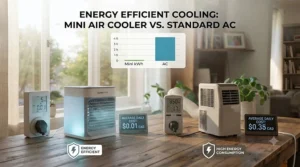
Total cost of ownership for this entire category is refreshingly low compared to full HVAC equipment: even the priciest option here, the Costway 3-in-1 unit, sits under C$100 upfront with essentially no ongoing electricity cost worth mentioning, since USB-powered devices draw a handful of watts rather than the 1,000+ watts a window AC unit demands. The main recurring cost is replacement parts — evaporative cooling pads typically last 6-12 months of regular seasonal use before losing efficiency and needing replacement, usually priced in the C$5-C$15 range depending on the model.
Battery degradation is the other long-term factor for cordless models like the Arctic Air Grip Go: rechargeable lithium batteries in small appliances typically lose noticeable capacity after 300-500 charge cycles, which for seasonal use (say, 3-4 months a year) could mean 3-5 years before a real performance drop-off. Compare that to a traditional portable AC, where the compressor itself is the expensive failure point and repairs often cost more than the unit’s resale value — the USB mini air conditioner category is simply cheaper to maintain and cheaper to eventually replace outright.
Safety, Certification & Regulations in Canada
Every electrical product sold in Canada, regardless of how small or low-powered, falls under provincial electrical safety requirements that generally call for recognized certification marks like CSA, cULus, or cETL on the device or its power adapter. Before buying any of these units — or any small electrical appliance, really — checking the packaging or listing for one of these marks is a genuinely useful five-second habit, since uncertified imported electronics occasionally bypass proper safety testing.
Beyond electrical certification, there’s a practical safety point specific to hot weather: Health Canada’s fact sheet on staying healthy in the heat outlines symptoms of heat exhaustion, including elevated body temperature, dizziness, and heavy sweating, and it’s worth repeating that a personal USB cooler is not a substitute for recognizing and responding to real heat illness symptoms during a genuine heat warning. If you or someone nearby shows signs of confusion, no sweating despite very hot skin, or fainting during extreme heat, that’s a medical emergency requiring immediate attention — no desk fan changes that equation. For full guidance, see Health Canada’s fact sheet on staying healthy in the heat.
Frequently Asked Questions
❓ Does a USB mini air conditioner actually cool the air, or is it just a fan?
❓ Can I run a USB mini air conditioner off a power bank all day?
❓ Why is my USB mini air conditioner not cooling well in humid weather?
❓ How often should I clean the water tank on a personal air cooler?
❓ Are USB mini air conditioners safe to leave running overnight?
Conclusion
None of the seven products on this list will replace a real air conditioner during a genuine heat emergency, and that’s fine — that was never really the assignment. What they’re actually good at is targeted, low-cost, zero-installation relief for one person at one desk, bed, or car seat, which is a problem worth solving on its own terms. Budget shoppers land well with the OPOLAR USB Powered Desk Fan or Honeywell TurboForce HT-904; anyone chasing genuine temperature drop should look at the evaporative lineup from the Arctic Air Pure Chill 2.0 through the Costway 3-in-1 Evaporative Air Cooler; and portability-first buyers should start with the Arctic Air Grip Go.
Whichever one you land on, check current pricing before buying, since ranges shift with retailer promotions, and keep the maintenance habits above in mind — a little cleaning goes a long way toward getting a full season of use out of any of these. Stay cool out there, and if the mercury climbs past what any desk gadget can handle, a real cool space still beats every product on this list combined.
✨ Ready to beat the heat? Compare current prices on today’s top USB mini air conditioners and pick the one that fits your desk! 🌬️
Recommended for You
- Does Evaporative Cooling Work in Humid Climate? 7 Honest Picks (2026)
- Battery Evaporative Cooler vs Misting Fan: 7 Real Picks for 2026
- Battery Evaporative Cooler for Camping: 7 Picks That Actually Work (2026)
Disclaimer: This article contains affiliate links. As an Amazon Associate, I earn from qualifying purchases. If you purchase products through these links, we may earn a small commission at no additional cost to you.
✨ Found this helpful? Share it with your friends! 💬🤗
