
In This Article
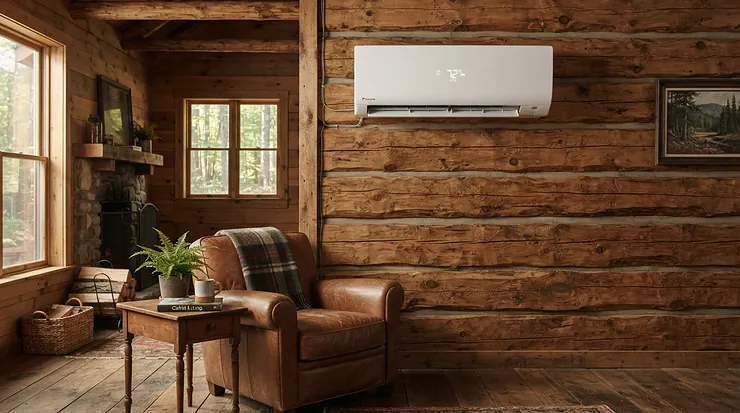
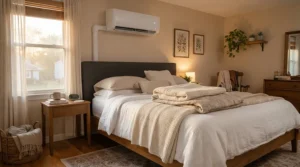
A 12000 BTU ductless AC for cottage use is a one-tonne, inverter-driven split system: one wall-mounted indoor head, one outdoor compressor, and a refrigerant line set joining them. Most models are also heat pumps, so the same box cools you through a July heat wave and takes the chill off a September morning, with no ductwork anywhere.
It’s October as I write this, which means half of Canada is draining water lines and draping the dock in tarps. It’s also the best time to plan next summer’s comfort. Anyone who has slept in a closed-up cottage during a humid August night knows a box fan isn’t the answer. A 12000 BTU ductless AC for cottage use is the grown-up version of the window unit: quiet, efficient, and free of the “cottage cough” that comes from stale, damp air.
Natural Resources Canada notes that air-source heat pumps pull heat from outdoor air to warm a space in winter and expel indoor heat in summer. Canada’s climate and a cottage’s quirks make the buying decision trickier than the box suggests.
So here is what follows: seven real 12,000 BTU systems, honest analysis of each, and deep dives on BTU sizing, line set length and your seasonal electrical panel. One transparency note: I’m synthesizing published specs and third-party review sentiment, not claiming hands-on testing. Prices are ranges, and Amazon.ca stock changes constantly, so verify before you buy.
Quick Comparison: 12000 BTU Ductless AC for Cottage Shortlist
| Model | Voltage | SEER2 | Heating Rating | Standard Line Set | Price Range (CAD) | Best For |
|---|---|---|---|---|---|---|
| Senville LETO 12,000 BTU | 115V (230V also sold) | ~21 | -15°C (listed) | 16 ft (4.9 m) | C$1,100–C$1,600 | Three-season cottages on a budget |
| Senville AURA 12,000 BTU | 230V | 25.4 (R454B version) | -30°C | 16/25/50 ft (4.9/7.6/15 m) | C$1,600–C$2,300 | Cold shoulder seasons |
| Senville ELITE 12,000 BTU | Check variant | 29.4 | -30°C | 16/25/50 ft | C$1,900–C$2,800 | Frequent or year-round use |
| MRCOOL DIY Easy Pro 12K | 115V | 19.5 | Supplemental | 11.5 ft (3.5 m) pre-charged | C$1,300–C$1,900 | First-time DIY installers |
| MRCOOL DIY Hyper Heat 12K | 208/230V | 23.5 | -30°C | 25 ft (7.6 m) | C$2,000–C$2,800 | DIY plus real cold tolerance |
| Pioneer Diamante Pro 12,000 BTU | 115V or 230V | 19–20 | -25°C | 16 ft (4.9 m) | C$1,100–C$1,700 | Value with a pro installer |
| GARVEE 12,000 BTU | 208–230V | ~21 (listed) | Not stated | Kit included | C$900–C$1,300 | Budget wildcard, summer only |
Looking at the comparison, the Senville LETO wins on electrical flexibility, while the Senville AURA and MRCOOL DIY Hyper Heat are the picks if cold-weather heat matters. The MRCOOL DIY Easy Pro trades efficiency for installation simplicity. Budget buyers should note that the GARVEE 12,000 BTU has the lowest entry price but the thinnest verifiable track record. All price ranges are planning estimates, so check current prices on Amazon.ca.
💬 Just one click — help others make better buying decisions too!😊
Top 7 Picks: 12000 BTU Ductless AC for Cottage Expert Analysis
1. Senville LETO 12,000 BTU — budget workhorse with a 115V option
The LETO earns the top slot because a 115V version exists, which means many cottages can skip a new 240V circuit.
It’s a 12,000 BTU inverter system with a published cooling modulation range of roughly 2,200 to 12,300 BTU/h, plus cool, heat, dehumidify and fan modes and Alexa or app control. Retail listings rate it for about 450–750 sq ft (42–70 m²), and the base kit includes a 16 ft (4.9 m) line set. That low modulation floor matters: on a mild night the unit idles instead of cycling, which is quieter and easier on a sleeping loft.
Based on the spec comparison, this is the sensible choice for a cottage used May to October. A Montreal installer’s published figures put output near 9,000 BTU at -8°C and about 6,600 BTU at -15°C, so treat winter heat as a bonus, not a plan.
I couldn’t verify a large Amazon.ca review sample to quote a rating. Independent Canadian roundups and a cabin-focused buyer’s guide both rank it a top plug-and-play pick. Check the live review count before ordering.
Pros:
- ✅ 115V option avoids a new 240V circuit
- ✅ Wide modulation range keeps nights quiet
- ✅ Wi-Fi and Alexa control included
Cons:
- ❌ Heating output drops sharply below -8°C
- ❌ 16 ft standard line set limits placement
Expect around C$1,100–C$1,600; check current price. Verdict: best value for three-season cottages.
2. Senville AURA 12,000 BTU — genuine cold-weather heating to -30°C
If your cottage season stretches into frosty October weekends, the AURA’s cold-climate design is the reason to look.
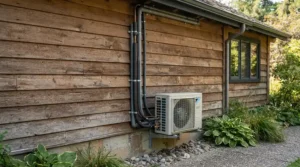
The current R454B generation lists a 25.4 SEER2 rating, ENERGY STAR cold-climate certification and a minimum heating operating temperature of -30°C. Its refrigerant piping is 1/4 in liquid and 3/8 in suction. Line sets come in 16, 25 or 50 ft (4.9, 7.6 or 15 m), with 50 ft the stated maximum.
Here’s the nuance most listings skip. “Operates at -30°C” is not “delivers 12,000 BTU at -30°C.” One Quebec installer’s data shows maximum output near 5,900 BTU at that temperature. That is still meaningful heat for a small, well-sealed cottage kept above freezing, but it won’t carry a draughty uninsulated one through a polar vortex.
Watch the refrigerant too. Older AURA units used R410A, and some web pages still describe them, so confirm which version the Amazon.ca listing actually ships.
Reviewer sentiment on Amazon.ca wasn’t verifiable in sufficient volume for me to summarize honestly. Retailer notes on the older AURA lean positive on efficiency and quiet, and the line is described as professionally installed.
Pros:
- ✅ Rated heating down to -30°C
- ✅ Three line set lengths up to 50 ft
- ✅ Very high SEER2 for a one-tonne unit
Cons:
- ❌ Needs a 230V circuit
- ❌ Refrigerant version varies between listings
Expect around C$1,600–C$2,300; check current price. Verdict: the right pick if shoulder-season heat matters.
3. Senville ELITE 12,000 BTU — highest efficiency in this lineup
The ELITE is the efficiency flagship: a listed 29.4 SEER2 and heating operation down to -30°C.
Its published heating range runs from roughly 4,100 to 17,200 BTU/h. That upper figure suggests the compressor can briefly exceed its nameplate rating when the cottage needs a push. The line set can be ordered at 16, 25 or 50 ft (4.9, 7.6 or 15 m), and the maker states it needs professional installation.
An efficiency number that high looks seductive, but run hours decide the payoff. A cottage occupied twelve weekends a year won’t recoup a premium the way a year-round home does. Where this model shines is a four-season retreat or a cottage you’re gradually converting to full-time living. There, the combination of deep modulation and cold-climate capability earns its keep, and the quiet operation helps in small buildings where the indoor head sits close to the bed.
On reviews, I couldn’t confirm a meaningful Amazon.ca sample, and the model is new enough that long-term reliability data is thin. That’s a point to weigh before paying a premium. Check warranty terms in writing.
Pros:
- ✅ Listed 29.4 SEER2 cuts running costs
- ✅ Heats to -30°C with wide modulation
- ✅ Multiple line set lengths available
Cons:
- ❌ Premium price for seasonal-use cottages
- ❌ Professional installation required
Expect around C$1,900–C$2,800; check current price. Verdict: worth it only for heavy-use cottages.
4. MRCOOL DIY Easy Pro 12K — the lowest-friction install
The Easy Pro’s selling point is that a handy owner can install it without vacuuming or charging refrigerant.
Quick Connect fittings join a factory-sealed, pre-charged line set, and no vacuum pump is required. The R454B-era 115V version lists 19.5 SEER2 and a 11.5 ft (3.5 m) pre-charged 1/4 x 3/8 in line set, while earlier kits shipped 16 ft. It’s marketed for up to roughly 500 sq ft (46 m²) and supports a SmartHVAC app plus Alexa and Google Assistant.
For a remote cottage where hiring a refrigeration tech means a two-week wait and a long drive, that DIY pathway is its real value. A short line set is the trade-off: your outdoor unit must sit within about 3.5 m of the indoor head unless you buy a longer set. An optional 14 in snow riser kit also helps keep the condenser clear of ice and drifts.
You still need a licensed electrician for the circuit. One US retailer lists a 1-year compressor and 2-year parts warranty, so confirm the Canadian terms. It has also been shown as backordered at some stores, so check Amazon.ca availability.
Pros:
- ✅ Tool-free Quick Connect, no vacuum needed
- ✅ 115V operation on a dedicated circuit
- ✅ Optional snow riser kit for winter
Cons:
- ❌ Short pre-charged line set limits placement
- ❌ Lower SEER2 than Senville cold-climate models
Expect around C$1,300–C$1,900; check current price. Verdict: best for first-time DIY installers.
5. MRCOOL DIY Hyper Heat 12K — DIY install with real cold tolerance
This is the DIY system for owners who also want serious cold-weather capability.
The 5th Gen Hyper Heat is specified to operate from -22°F to 122°F (-30°C to 50°C) ambient, uses R-454B refrigerant, and ships with a 25 ft (7.6 m) DIY No-Vac Quick Connect line set. It runs on 208/230V, lists 23.5 SEER2, and includes the remote plus app and voice control. The maker’s optional extended replacement warranty is worth reading closely.
That 25 ft default is much more practical than the Easy Pro’s short run. You can put the condenser around the corner from the head unit, away from the lake-facing wall where wind and ice hit hardest. Pair that with cold-climate heating and you get a cottage system that could take a nasty October morning in stride.
Remember the same caution as with every cold-climate unit: capacity falls as the mercury does, so size the heat load rather than trusting the nameplate. I couldn’t verify enough Amazon.ca reviews to summarize them honestly, so read recent ones for installation snags.
Pros:
- ✅ DIY install with cold-climate heating
- ✅ 25 ft pre-charged line set included
- ✅ Newer R-454B refrigerant
Cons:
- ❌ Requires a 208/230V circuit
- ❌ Higher price than the Easy Pro
Expect around C$2,000–C$2,800; check current price. Verdict: the best DIY pick for four-season cottages.
6. Pioneer Diamante Pro 12,000 BTU — dependable value with a pro installer
Pioneer is a budget-tier brand, and the Diamante Pro is where it makes the most sense.
The 230V version lists 19 SEER2, 8.5 HSPF2 and a heating rating down to -13°F (-25°C). Its published heating range tops out around 13,500 BTU/h. A 115V version lists 20 SEER2 and a heating capacity range of about 3,400–13,900 BTU/h. Both ship with a fixed 16 ft (4.9 m) line set the manufacturer says can’t be changed at checkout.
Pioneer’s own store notes that some R410A-era Diamante units were discontinued during the refrigerant phase-out, so double-check which refrigerant generation the listing carries. A cold-climate rating of -25°C is decent, but the maker points shoppers who need tougher winter performance to its higher-end lines.
For a cottage where a local HVAC contractor is handling the install, this is a practical buy, and you won’t overpay for features a weekend place rarely uses. It also needs professional installation, so factor that cost in.
I found no robust Amazon.ca review sample to summarize, so I’m leaving sentiment to the live listing.
Pros:
- ✅ Heating rated to -25°C
- ✅ Both 115V and 230V options exist
- ✅ Low entry price for an inverter heat pump
Cons:
- ❌ Fixed 16 ft line set
- ❌ Refrigerant generation varies by listing
Expect around C$1,100–C$1,700; check current price. Verdict: a solid value pick.
7. GARVEE 12,000 BTU — cheapest way in, with caveats
The GARVEE is the budget wildcard: low cost, modern R32 refrigerant, and lots of features on paper.
Listings on Best Buy Canada’s marketplace show a 21 SEER2 model on 208–230V with Wi-Fi, an installation kit, and a claim of cooling rooms up to 750 sq ft (70 m²). A separate listing shows an 18.5 SEER 230V version claiming noise as low as 32 dB. R32 carries a lower global-warming potential than older R410A, which is a real point in its favour.
Now the honest part. The seller rating appears across very few reviews, the warranty line says only to check with the manufacturer, and I didn’t see a stated cold-weather heating rating. The 750 sq ft claim also reads optimistic for a leaky cottage, where 400–600 sq ft is the more realistic range.
My analysis: treat this as a summer-cooling unit for a cottage you open late May and close by Thanksgiving. Read warranty and return terms carefully before buying.
Pros:
- ✅ Lowest price of the seven
- ✅ Modern R32 refrigerant
- ✅ Wi-Fi control included
Cons:
- ❌ Thin review history, unclear warranty
- ❌ Cold-weather heating not specified
Expect around C$900–C$1,300; check current price. Verdict: acceptable only as a summer-only budget buy.
BTU Sizing by Cottage Square Footage: Is 12,000 Really Right?
A common starting point is about 20 BTU per square foot of floor area for average insulation. Many 12,000 BTU listings claim coverage of 500–750 sq ft, but those numbers assume tight, insulated construction. A typical cottage has single-glazed windows, wood walls with few vapour barriers, and a sunny deck. For those buildings, the realistic range is lower.
| Floor Area | Square Metres | Typical Cooling BTU | Notes |
|---|---|---|---|
| 150–250 sq ft | 14–23 m² | 6,000 | Sleeping cabin |
| 250–400 sq ft | 23–37 m² | 7,000–9,000 | Studio cottage |
| 400–550 sq ft | 37–51 m² | 10,000–12,000 | 12,000 BTU sweet spot |
| 550–700 sq ft | 51–65 m² | 14,000 | Open-plan, sun exposure |
| 700–1,000 sq ft | 65–93 m² | 18,000 | Larger cottage or two zones |
Adjust upward for poor insulation, a western sun exposure or a heavy-use kitchen. Adjust downward for heavy shade. Consider also that an open-plan cottage lets one head heat or cool the whole space, whereas a cottage with closed bedrooms leaves distant rooms stranded.
Looking at the table, a 12,000 BTU unit suits roughly 400–550 sq ft of real cottage space, even though manufacturers claim more. If you’re near the top of that range, or you want serious winter heat, size up or plan a second head. For a rigorous method, Natural Resources Canada’s sizing and selection toolkit walks contractors through heat-load calculations for Canadian climates. Don’t oversize wildly, though. An inverter forgives some excess capacity, but a hugely oversized unit cools quickly, shuts off and leaves a clammy cottage because it never runs long enough to dehumidify.
Refrigerant Line Set Length: How Far Can the Outdoor Unit Sit?
Refrigerant line set length is the quiet constraint that shapes your whole installation. A 12,000 BTU system typically uses 1/4 in liquid and 3/8 in suction tubing, although some models specify a 1/2 in suction line, so verify against your manual. Pre-charged kits commonly arrive in 16, 25, 35 or 50 ft lengths (4.9 to 15 m).
Here are the rules that matter:
- Maximum length is brand-specific. Many single-zone units cap at about 50 ft (15 m), and some specify more.
- Factory charge covers a standard run, often 25 ft (7.6 m). Longer runs usually need extra refrigerant, with figures often cited between 0.2 and 0.5 oz per foot, depending on the brand.
- Vertical rise has its own cap and counts separately from total length.
- Pre-charged quick-connect sets shouldn’t be cut or re-brazed. Buy the right length instead.
For a cottage, keep it short. The shortest sensible run loses less efficiency and has fewer places for rodents, ice and kinks to cause trouble. Avoid sharp bends, protect exposed copper from UV with a line set cover, and mount the condenser on a stand above snow level. Mounting on the lake side may look neat, but wind-driven snow and shoreline ice make a sheltered wall the better call.
That’s why the MRCOOL DIY Easy Pro with its 11.5 ft kit needs planning, while the Senville AURA with its 50 ft option offers real flexibility.
Seasonal Cottage Electrical Panel Capacity: Will Your Panel Handle It?
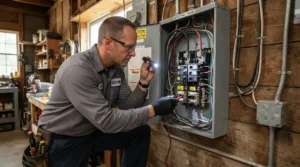
Before you fall for any unit, check your panel. A mini split needs its own dedicated circuit, and the nameplate’s MCA (minimum circuit ampacity) sizes the wire while the MOP or MOCP caps the breaker. Never pick a breaker by BTU alone.
| Unit Type | Typical MCA | Typical Breaker | Notes |
|---|---|---|---|
| 12,000 BTU, 115V | ~10–18A | 20A single-pole | Draws more than twice the amps of 230V |
| 12,000 BTU, 230V | ~8–15A | 15–20A double-pole | Uses two panel slots |
Published figures vary by model, so the nameplate always overrides this table. One manufacturer lists certain 115V DIY models at 18A MCA with a 20A maximum breaker.
That’s the unit’s side of the story. The cottage’s side matters more. Many seasonal cottages run 60A or 100A service, and an electric range, water heater, well pump and baseboard heaters can already consume most of it. A 230V 12,000 BTU unit typically runs around 5–7 amps in normal operation, which is modest, but the wire and breaker must still be correct. You also need open breaker spaces, an outdoor disconnect near the condenser, and surge protection if your area has flaky seasonal power.
Looking at the table, 115V units simplify wiring but demand a bigger breaker, so the “easier” electrical path isn’t always cheaper. If you run a generator, check the manual for power-quality requirements, since inverter electronics can be sensitive. Hire a licensed electrician, since they’ll know your province’s code and permit rules. A load calculation is cheap insurance.
Ductless AC Review Canada: What Owners and Brands Actually Tell You
Any ductless AC review Canada shoppers read should separate three things: brand support, efficiency claims, and cold-weather reality.
On brand support, Canadian-focused retail analysis credits Senville AURA with bilingual documentation and Canadian customer support, plus a -30°C rating that goes beyond the common -25°C cold-climate standard. Pioneer is positioned as a low-cost option, with the same analysis suggesting that buyers who need cold-climate primary heating or premium features may want to look elsewhere. Premium Japanese brands such as Mitsubishi and Daikin sit well above this price tier.
On efficiency, SEER2 is a seasonal cooling metric, which you can read more about in this explainer on the seasonal energy efficiency ratio. A bigger number helps, but for a cottage open 20 weekends a year, the difference between 20 and 29 SEER2 is a few dollars a month, not a revolution.
Cold-weather reality is where listings contradict each other. The Senville LETO appears with a -15°C heating rating on one Canadian big-box listing and as a -25°C cold-climate product in some brand roundups. When specs disagree, trust the manufacturer’s capacity-at-temperature table, not the headline.
A caveat on reviews: I couldn’t verify robust Amazon.ca review volumes for these models. One marketplace seller carrying the MRCOOL DIY Easy Pro shows a 3.6 out of 5 seller rating across 76 reviews, but that’s a seller rating, not a product score. Read the one- and two-star reviews on the live listing for installation and support themes.
How to Choose a 12000 BTU Ductless AC for Cottage Use
- Measure the heat load, not the floor. Use the sizing table, then adjust for insulation, sun and windows.
- Decide on your season. Summer-only owners can save money; shoulder-season heat demands a cold-climate rating of -25°C or better.
- Check your panel first. Confirm service size, open breaker slots and whether 115V or 230V fits.
- Pick the line set you need. Map the indoor head and condenser positions, then buy the shortest set that works.
- Choose install route. DIY quick-connect saves labour. Conventional systems often need a licensed refrigeration technician.
- Verify refrigerant and warranty. R32 and R454B are newer options; read the compressor and parts terms for Canada.
- Check live Amazon.ca availability and reviews. Several of these models show backorders at some retailers.
This order matters because each step narrows the next. A cottage with a 60A panel and no spare slots can rule out half the options before you ever compare SEER2.
12000 BTU Ductless AC for Cottage vs Alternatives
| Option | Cooling | Heating | Install Effort | Winter Storage | Best For |
|---|---|---|---|---|---|
| Ductless mini split | Excellent, quiet | Yes (heat pump) | Moderate to high | Stays mounted | Senville LETO 12,000 BTU for three-season use |
| Window AC | Good, noisy | No | Low | Remove and store | Occasional use |
| Portable AC | Fair | No | Low | Easy | Renters, tiny cabins |
| Electric baseboard | None | Yes, costly to run | Moderate | Stays mounted | Backup freeze protection |
The table shows why a ductless system is the better fit for a cottage you care about. Window units block the glass, shake with vibration and leave a seal gap for mice. Portable units drag a hot exhaust hose through a window and struggle in damp rooms. A ductless system quietly handles cooling, dehumidifying and mild heating from one unit, although the upfront cost and electrical work are real. For anyone planning more than a few summers at the cottage, the long-term comfort tends to outweigh the initial hurdle.

What to Expect: Real-World Performance at the Cottage
On paper a 12,000 BTU system sounds simple. In a real cottage, expect these behaviours.
In cooling mode, the unit runs steadily at low speed, which keeps humidity under control and noise low. In heating mode, expect the compressor to run defrost cycles in cold, damp weather, which briefly pause heat and are normal. Capacity falls as outdoor temperature drops, and a heat pump that “operates at -30°C” is delivering a fraction of its rated output there.
Heat pumps work by moving heat rather than generating it. If you want the physics, the overview of a heat pump explains why efficiency stays high even in cool weather. Practically, that means the 3-season cottage gets a free spring and fall bonus.
Features That Actually Matter (And Those That Don’t)
Matter: cold-climate rating, a wide modulation range, a condensate drain you can route outdoors, a decent warranty, and a line set length that matches your layout.
Don’t matter much: voice control, a flashy app and a “turbo” button. Wi-Fi does earn its keep if you want to pre-cool the cottage before arriving, but only if you have reliable internet there.
One feature worth hunting for is a low-temperature “frost protection” or heat-hold mode, which some models offer to keep a closed cottage above freezing. Check the manual for the exact behaviour. Skip anything that promises “up to 30% savings” without a test standard behind it.
Practical Usage Guide: Install, First Season and Cottage Open-and-Close
Setup. Mount the indoor head high on an interior wall with clear airflow, away from bed foot-ends. Keep the condenser level, off the ground and clear of snow loads. Route the condensate drain so it can’t freeze against a deck or foundation.
First-use tips. Run the system in cool mode first and check for steady airflow and a clean condensate drip. Set the thermostat a few degrees above your target on day one, then lower it gradually.
Maintenance schedule.
- Monthly during use: rinse the washable filter.
- Spring: clear leaves and debris from the condenser, check line set insulation.
- Fall: inspect for rodent damage, tidy the outdoor unit and decide whether to leave power on or switch it off at the disconnect.
Common mistakes in the first 30 days: placing the head above a bed, leaving the condensate drain unsupported, ignoring the filter and forgetting that the first cold night will test your heat-mode setup.
Real-World Scenarios: Which Pick Fits Which Cottage?
Scenario 1: The weekend lake cottage. A 480 sq ft (45 m²) cottage, used May to September, with a 100A panel and a handy owner. The MRCOOL DIY Easy Pro or Senville LETO 12,000 BTU fits: low upfront cost, 115V, summer-first. Budget for the electrician even if you install the unit yourself.
Scenario 2: The shoulder-season retreat. A 520 sq ft (48 m²) insulated cabin used through October and again in April. The Senville AURA or MRCOOL DIY Hyper Heat make sense. Their cold-climate ratings and longer line sets give you heat and placement flexibility, provided the panel has a spare 230V slot.
Scenario 3: The retirement conversion. A year-round-in-progress cottage with a pro installer already on site. The Senville ELITE 12,000 BTU or Pioneer Diamante Pro both work. Here the high efficiency of the ELITE starts to pay back, while the Pioneer keeps the budget in check.
If you’re short on cash and only need summer cooling, the GARVEE 12,000 BTU may tempt you, but read the warranty carefully before committing.
FAQ
❓ How much does a professional install cost for a 12000 BTU ductless AC for cottage use?
❓ Is a DIY quick-connect mini split a good idea for a seasonal cottage?
❓ Will a 12000 BTU mini split heat my cottage in winter?
❓ Can I leave a ductless AC running while I'm away from the cottage?
❓ Does a 12000 BTU ductless AC for cottage use work with a generator?
Conclusion
The right 12000 BTU ductless AC for cottage use depends less on SEER2 bragging rights and more on three things: honest sizing, a line set that fits your layout, and a panel that can take the load. For three-season cottages on a budget, the Senville LETO 12,000 BTU and MRCOOL DIY Easy Pro are the practical starting points. For cold shoulder seasons, the Senville AURA and MRCOOL DIY Hyper Heat earn their premium. For year-round conversion, the Senville ELITE is worth a close look, with the Pioneer Diamante Pro as the value alternative and the GARVEE 12,000 BTU as a summer-only gamble.
Measure your space, check your panel, and read live Amazon.ca reviews and warranty terms before you click. Do that, and next July you’ll be reading on the deck with a cool, quiet cottage behind you.
✨ Ready to upgrade your cottage comfort?
🔍 Click any highlighted product above to check current pricing and availability on Amazon.ca, and pick the system that fits your cottage, not just your budget!
Recommended for You
- Portable Generator And Cooler Combo For Camping: 7 Proven Picks 2026
- Generator For RV Air Conditioner: 7 Best Picks For 2026
- 7 Best Generator-Compatible Cooler Picks For 2026
Disclaimer: This article contains affiliate links. As an Amazon Associate, I earn from qualifying purchases. If you purchase products through these links, we may earn a small commission at no additional cost to you.
✨ Found this helpful? Share it with your friends! 💬🤗
