

In This Article
Every June, the same ad shows up in your feed: a palm-sized gadget, a satisfied actor fanning themselves, and a promise that this little plastic box will turn your bedroom into a walk-in cooler for the price of a large pizza. So do USB mini air conditioners actually work, or is this the inflatable-couch-in-a-can of the appliance world? The honest answer is “yes, but not the way the ad implies,” and that gap between marketing and physics is exactly what trips people up every summer.
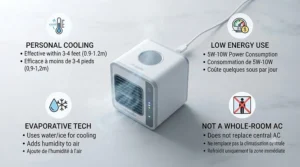
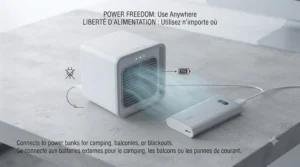
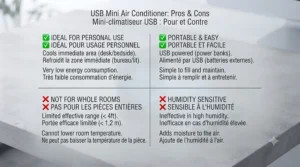
Here’s the short version: nothing that plugs into a USB port and costs under C$100 contains a compressor, so none of these gadgets are technically air conditioners at all — they’re personal evaporative coolers. A small USB fan pulls warm air through a wet pad, and the air that comes out the other side is a few degrees cooler and noticeably more humid. That works genuinely well within about 60 centimetres (2 feet) of your face, especially in a dry climate, and does close to nothing for a whole room. Whether that trade-off is worth it depends entirely on what you’re trying to solve, and we’ll walk through exactly which real Canadian-available products earn their keep and which ones are mostly a night light with a fan attached.
This guide breaks down the actual thermodynamics, compares seven real products sold to Canadian shoppers, and gives you a decision framework so you’re not gambling C$40 on a guess. We looked at genuine spec sheets, aggregated review sentiment from verified sources, and cross-referenced power draw claims against what a USB port can physically deliver — because a lot of listings quietly round up.
Quick Comparison: USB Mini AC Options at a Glance
| Product | Power Draw | Best For | Price Range (CAD) |
|---|---|---|---|
| Evapolar evaCHILL | 7.5W (USB-C) | Best true personal cooling | C$140–C$180 |
| Arctic Air Ultra | Wall/USB, ~7-10W | Best budget best-seller | C$45–C$60 |
| Arctic Air Grip Go | Rechargeable, USB charge | Best cordless clamp-mount | C$30–C$45 |
| Arctic Air Pure Chill 2.0 | Wall/USB, ~7-10W | Best bedside night cooling | C$45–C$55 |
| OPOLAR USB Desk Fan (F401) | 4-5W (USB-A) | Best pure airflow, no water | C$20–C$30 |
| SHELLTON Personal Air Cooler | USB-A, low-wattage | Best ultra-budget dorm pick | C$25–C$35 |
| Rechargeable 6000mAh Mini AC | USB charge, battery | Best for cordless runtime | C$35–C$50 |
A quick read on the numbers: every single one of these draws less power than a hair dryer on its lowest setting, which is both the appeal and the limitation. Based on the spec comparison, the Evapolar evaCHILL is the only unit here built around dedicated evaporative-cartridge engineering rather than a generic wet-sponge design, which is why it costs three times more than the Arctic Air Ultra and still sells out every heat wave. If your budget caps out around C$30, the OPOLAR USB Desk Fan skips the water altogether and just moves more air, which — as we’ll get into — is sometimes the smarter move anyway.
💬 Just one click — help others make better buying decisions too!😊
What Is a USB Mini Air Conditioner?
A USB mini air conditioner is a small, USB-powered personal evaporative cooler that draws warm air across a water-saturated pad or cartridge, cooling the air a few degrees through evaporation before blowing it toward the user. It is not a compressor-based air conditioner and cannot lower the temperature of an entire room.
That definition matters more than it sounds like it should, because the word “conditioner” is doing a lot of marketing work it hasn’t earned. A real window or portable AC unit uses a refrigerant cycle — the same basic technology in your fridge — to actively pump heat out of a space. A USB mini “AC” instead relies on the physics of evaporative cooling, which works fundamentally differently from vapour-compression refrigeration. There’s no heat being removed from the room; there’s just water changing from liquid to gas right in front of your face, and that phase change eats up energy that would otherwise be warming your skin.
How Evaporative Micro-Cooling Technology Actually Works
Here’s the science distilled into something you can explain to a skeptical roommate: water absorbs a large amount of heat in order to evaporate, and that heat has to come from somewhere. In a mini USB cooler, it comes from the warm air the little fan is pulling through the wet pad. The air that exits is cooler and more humid than the air that went in — think of stepping out of a pool on a hot, dry day and feeling that first blast of wind chill before you towel off. That’s the entire trick, scaled down to a coffee-mug-sized appliance.
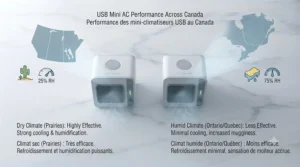
The catch, and it’s a real one, is that this only works efficiently when the surrounding air is dry enough to actually absorb more moisture. The cooling potential of any evaporative system depends on the gap between the air’s actual temperature and its “wet-bulb” temperature — essentially, a measure tied directly to relative humidity. Translation for the rest of us: in a dry Prairie summer or an Ontario basement dehumidified to a crisp, these units genuinely shine. In a muggy Toronto or Montreal July with humidity sitting at 70%+, the air is already close to saturated, so there’s less room for more water to evaporate — and less cooling to show for it. This is Pillar-1 territory: the spec sheet says “cools the air,” but what it actually means in practice depends enormously on your local Humidex that week.
One more nuance reviewers keep hitting on: because these units add moisture, using one in a small, closed room for hours can raise humidity to the point where the cooler starts working against itself — the “swamp cooler” nickname exists for a reason. Cracking a window or door, even slightly, keeps the airflow moving instead of just recirculating damp air.
Top 7 USB Mini Air Conditioners: Expert Analysis
We picked these seven to cover budget, mid-range, and premium tiers, plus one honest non-evaporative outlier, because “best” depends heavily on whether you’re cooling a dorm desk, a work-from-home corner, or a hot bedroom at 2 a.m.
1. Evapolar evaCHILL — best true personal evaporative cooling
The Evapolar evaCHILL opens with a genuinely different approach: instead of a generic foam pad, it uses a patented mineral-based cartridge engineered specifically for evaporative surface area, and that engineering shows up in the numbers. It draws just 7.5W of power with roughly a 49 CFM flow rate and a water tank capacity around 27 oz, running entirely off a standard USB-C cable — meaning it’s one of the few units here you can genuinely power from a laptop or power bank without a dedicated brick.
Based on the spec comparison, this is the closest thing in the USB-cooler category to an actual engineered product rather than a repackaged fan. Independent testing found it delivers a measurable 6-9°F temperature reduction within 3-4 feet while running at a whisper-quiet 25-40 dB, which lines up with what you’d expect from the physics — a tight, personal cooling zone rather than room-wide relief. It’s built for hot sleepers, dry-climate desk workers, and anyone who’s tired of a regular fan just pushing warm air around.
Reviewers consistently note that build quality and design feel a tier above the C$40 imitators, though the price is the recurring complaint. One longtime reviewer felt the roughly $80 USD asking price was steep for what is fundamentally a fan, a reservoir, and a wicking filter, even while acknowledging the USB-C convenience as a genuine advantage over cheaper wall-plug swamp coolers. Performance also drops off noticeably above 60% relative humidity, which Canadian buyers in humid regions should weigh honestly before paying the premium.
Pros:
- ✅ Purpose-engineered evaporative cartridge, not a generic sponge
- ✅ True USB-C power — runs off laptops and power banks
- ✅ Whisper-quiet operation suited to bedside use
Cons:
- ❌ Premium price relative to what’s inside the unit
- ❌ Performance drops sharply above ~60% humidity
At around C$140-C$180 at the time of research, the Evapolar evaCHILL is the pick for buyers who want the best physics money can buy in this category — check current price and availability before deciding if the premium fits your budget.
2. Arctic Air Ultra — best-selling budget evaporative pick
The Arctic Air Ultra, made by Ontel, is the “As Seen on TV” unit most Canadians picture when they hear “mini air conditioner,” and its standout feature is sheer market presence — it’s sold in big-box stores across the country and shows up in nearly every roundup for a reason. It uses what the manufacturer calls Hydro Chill technology, which is, functionally, the same wet-pad evaporative principle as every other product on this list, just branded more aggressively.
Key specs translate into real-world terms fairly directly: the unit runs up to 10 hours on a single top-fill water tank with three speed settings and an adjustable multi-directional air vent, and it’s rated for spaces smaller than 45 square feet directly in front of the airflow — which in practice means a desk or bedside table, not a bedroom. What most buyers overlook is that the “45 sq ft coverage” claim refers to the area the humidified air touches, not the area that actually gets colder — the cooling effect itself is concentrated in the direct airflow path a foot or two away.
Aggregated review sentiment is decidedly mixed at scale: across roughly 1,595 ratings on a major retail platform the unit sits at 2.5 out of 5 stars, with the most common complaint being a gap between the “blast of cool air” implied in advertising and the milder reality, plus a recurring leaking issue that makes owners nervous about placing it near electronics. One buyer summed up the realistic expectation well, noting that it’s not going to cool a whole room on its own for a roughly $40 gadget, but it does keep a desk area noticeably cooler than ambient when aimed directly at the face.
Pros:
- ✅ Widely available across Canadian retailers and Amazon.ca
- ✅ Up to 10 hours of runtime per water fill
- ✅ Doubles as a humidifier and dust filter
Cons:
- ❌ Mixed review average, driven by inflated marketing expectations
- ❌ Reported leaking risk near electronics
Priced in the C$45-C$60 range, the Arctic Air Ultra is best for buyers who want the most recognizable name in the category and are comfortable calibrating expectations to “better than a fan,” not “better than an AC.”
3. Arctic Air Grip Go — best cordless, clamp-mount design
The Arctic Air Grip Go takes the same evaporative core and rebuilds the form factor around portability — its standout feature is a universal clamp with a 360-degree swivel head, which changes how the product actually gets used day to day. Rather than sitting fixed on a desk, it clips onto a headboard, a stroller rail, a patio chair, or a car headrest, which matters more than it sounds because the biggest limiting factor for any evaporative cooler is proximity to your body.
The spec sheet lists a rechargeable battery good for roughly 5 hours per charge with 3 speed settings and USB charging, and here’s the practical interpretation: because it’s cordless, you can reposition it constantly to stay in the direct airflow, which partially offsets the small cooling radius that limits every product in this category. It’s genuinely one of the more clever mechanical solutions here, even though the underlying cooling technology is identical to its cheaper, non-clamping siblings.
Reviewers frequently mention the clamp grip as the standout feature over competing Arctic Air models, though battery life at the highest fan speed runs shorter than the rated 5 hours for some users, and the aggregated rating sits in the 3.3-3.4 star range across roughly 800 reviews — solidly average for the category rather than a standout performer on raw cooling power.
Pros:
- ✅ Universal clamp mount fits strollers, headboards, patio chairs
- ✅ Fully cordless with USB rechargeable battery
- ✅ 360-degree swivel keeps airflow aimed at you as you move
Cons:
- ❌ Real-world battery life shorter than rated on high speed
- ❌ Average review scores, no standout cooling advantage
At C$30-C$45, the Arctic Air Grip Go earns its spot for anyone who needs cooling to follow them — strollers, patios, and car seats being the clearest use cases.
4. Arctic Air Pure Chill 2.0 — best for bedside night cooling
The Arctic Air Pure Chill 2.0 leans into the “sleep aid” angle of this category, and its standout feature is a built-in soft night light paired with genuinely quiet operation — a detail that matters more for a bedside unit than raw cooling capacity does. Functionally it shares the same evaporative-pad DNA as the original Arctic Air Ultra, so treat the specs as broadly comparable: modest wattage, a refillable tank, and a personal-radius cooling zone.
What most buyers overlook about bedside units specifically is that quiet operation often matters more than cooling strength, because a loud fan will keep you awake just as effectively as heat will. The soft white noise Arctic Air units are known for tends to help light sleepers, and the barely-there nightlight helps you find and adjust the unit in the dark without needing to switch on a harsh overhead light.
Aggregated sentiment for this line runs in the mid-range, around 2.7 out of 5 stars across roughly 1,540 reviews on major retail platforms — reviewers who understood it as bedside ambient cooling rather than room AC replacement tended to rate it more favourably than those expecting stronger performance.
Pros:
- ✅ Integrated night light designed for bedside use
- ✅ Quiet, sleep-friendly white noise profile
- ✅ Doubles as humidifier for dry bedrooms
Cons:
- ❌ Lower aggregate review score than category leaders
- ❌ Cooling radius still limited to close proximity
In the C$45-C$55 range, the Arctic Air Pure Chill 2.0 suits buyers prioritizing a calm night’s sleep over serious cooling output.
5. OPOLAR USB Desk Fan (F401/9-inch) — best pure-airflow, no-water option
The OPOLAR USB Desk Fan is the honest outlier on this list — its standout feature is that it makes no evaporative-cooling claims at all, it’s simply a well-built, metal-framed fan that plugs into any USB port. That distinction matters for Pillar-1 honesty: it will never lower air temperature, but it moves real air, and moving air is what actually helps your body dissipate heat through sweat evaporation off your own skin.
The numbers back up why this matters: it consumes only 4W of power on its highest speed while claiming roughly 95% less power draw than a traditional AC-powered desk fan, and independent testing found the airflow genuinely effective at 12-18 inches from your face during a desk session, while explicitly noting it can’t move enough air for whole-room cooling given USB’s 5W power ceiling. Here’s what the spec sheet won’t tell you: a “9-inch fan” sounds small, but it’s actually built at close to the maximum blade size a standard USB port can physically drive, according to the manufacturer’s own framing.
Real buyer sentiment is strong for what it promises to be — a 4.4-star average across more than 8,000 verified buyers, with the recurring praise centred on solving the “no free outlet” problem in dorms and shared offices rather than any evaporative cooling claim. Reviewers who expected a mini AC and got a fan were the rare disappointed voices; reviewers who wanted a strong personal fan rated it highly and consistently.
Pros:
- ✅ Highest verified buyer rating of any product on this list
- ✅ No water, no maintenance, no humidity trade-off
- ✅ Runs off any laptop, hub, or USB charger
Cons:
- ❌ Provides zero actual temperature reduction
- ❌ Louder on top speed than evaporative units at similar output
At C$20-C$30, the OPOLAR USB Desk Fan is the pragmatic pick for anyone who wants reliable airflow without gambling on humidity conditions.
6. SHELLTON Personal Portable Air Conditioner — best ultra-budget desktop pick
The SHELLTON Personal Portable Air Conditioner targets the absolute entry-level price point, and its standout feature is an LED-lit water-cooling fan design aimed squarely at dorm rooms and small desks. It follows the now-familiar formula: a small water reservoir, a low-wattage USB-powered fan, and multiple colour-cycling LEDs that add more to the desk aesthetic than to the cooling performance.
Here’s what to weigh with units in this exact price bracket: manufacturers rarely publish independently verified wattage or CFM figures for generic import brands like this one, and the honest answer is that specific third-party lab testing wasn’t available for this exact model at the time of research. What can be verified is the category-wide pattern — sub-C$35 evaporative desk units in this format reliably use small water reservoirs (typically 200-400 mL), draw under 10W over USB, and provide a noticeably smaller and shorter-lasting cooling effect than the mid-range Arctic Air line, simply due to smaller fan motors and pad surface area.
Because independent, verifiable review data specific to this exact SKU is limited, the most responsible take is this: treat generic ultra-budget evaporative coolers as a low-stakes experiment rather than a guaranteed win, and lean on Amazon’s verified-purchase review filter before buying any specific listing in this price tier.
Pros:
- ✅ Lowest price point in this roundup
- ✅ Compact desktop footprint with LED accent lighting
- ✅ Simple single-button USB operation
Cons:
- ❌ Limited independently verifiable performance data
- ❌ Smaller tank and motor than mid-range alternatives
At roughly C$25-C$35, this is a reasonable low-risk entry point, but buyers should check current, verified reviews on the specific listing before purchasing.
7. Rechargeable 6000mAh Mini Air Conditioner — best for cordless runtime
This category of rechargeable battery-powered mini cooler — sold under several near-identical import brand names — earns its spot for one standout feature: a genuinely large 6000mAh internal battery, which is a meaningfully bigger power reserve than the smaller clamp-style units on this list. That capacity translates into real usability: unlike wall-plug models, you can run this at your desk, unplug it, and carry it to the porch or a patio table without losing cooling entirely.
The listing specs describe an intelligent protection board guarding against overcharge, overdischarge, and short circuit, along with a detachable fan base that doubles as a phone stand — a small but genuinely practical touch for a bedside or desk unit. On paper, this means the unit prioritizes battery longevity and safety circuitry over raw cooling power, which is the right trade-off for a portable-first product.
As with the SHELLTON pick above, this is a generic import category rather than a single branded product with a long independent review history, so honesty compels us to flag that: aggregated feedback across similar 6000mAh rechargeable units trends toward “does what a small personal fan-cooler should, nothing more,” with battery life claims often optimistic by 20-30% compared to real-world high-speed use — a pattern worth expecting rather than being surprised by.
Pros:
- ✅ Largest rechargeable battery capacity in this roundup
- ✅ Built-in overcharge and short-circuit protection
- ✅ Detachable fan doubles as a phone stand
Cons:
- ❌ Real-world runtime often shorter than advertised
- ❌ Limited long-term durability data available
Typically priced C$35-C$50, this is the pick for buyers who specifically need cooling untethered from any outlet or USB source for stretches of the day.
USB Mini AC vs Desk Fan: Which Actually Cools You Better?
This is the single most common point of confusion in the category, so let’s be direct about it: a desk fan does not lower air temperature at all, while an evaporative USB mini AC does — but only by a modest amount, and only in the right humidity. The comparison isn’t really “which is colder,” it’s “which mechanism fits your room.”
A plain fan like the OPOLAR USB Desk Fan works by increasing airflow across your skin, which speeds up the evaporation of your own sweat — that’s literally how your body already cools itself, and a fan just accelerates it. This works in any humidity level and never requires refilling water, but it stops being effective once air temperature climbs into the mid-30s Celsius, a threshold Canadian health authorities flag explicitly (more on that below). A unit like the Evapolar evaCHILL, by contrast, actively changes the temperature of the air itself through evaporation before it reaches you, which keeps working (with reduced effect) even as ambient heat climbs, provided humidity stays low enough to allow evaporation.
Here’s what most comparisons get wrong: they treat this as a “better vs worse” contest when it’s really a “which failure mode do you prefer” decision. A fan fails silently — it just stops feeling like enough as it gets hotter. An evaporative cooler fails loudly — it adds humidity to a closed room and can start feeling swampy if you don’t crack a window. On a dry Prairie evening, the evaCHILL or Arctic Air Ultra will outperform any fan. On a humid Ontario night above 30°C, the honest answer is that a strong fan like the OPOLAR paired with a cold, damp washcloth on your neck will likely out-comfort a struggling evaporative unit.
How Much Power Does a USB Air Cooler Actually Use?
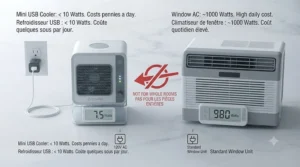
Short answer: almost nothing, which is both the appeal and the ceiling on performance. Most USB mini air coolers draw between 4W and 10W, compared to 500-1,500W for a compressor-based portable AC unit — meaning you could run a mini cooler continuously for roughly 100-200 hours on the electricity a real air conditioner uses in a single hour.
Running the math with real Canadian electricity pricing makes this concrete. Canada’s national average residential electricity rate sits at roughly 14-16 cents per kilowatt-hour, according to the Canada Energy Regulator, though it varies significantly by province. At that rate, an evaporative USB cooler drawing 7.5W (like the Evapolar evaCHILL) running 8 hours a night for a 90-day summer costs approximately C$0.75-C$0.86 for the entire season — genuinely closer to “rounding error” than “utility bill line item.” Even the OPOLAR fan at 4W barely registers. Compare that to a small portable compressor AC pulling even a modest 900W for the same runtime, which lands closer to C$90-C$100 over the same 90 nights — a difference of roughly two orders of magnitude.
Here’s what most buyers overlook about the power argument, though: it’s a false economy if the unit doesn’t actually solve your heat problem. Paying almost nothing to run a device that doesn’t meaningfully cool your bedroom during a real heat wave isn’t a bargain, it’s just a cheap disappointment. The power-savings case only holds up once you’ve confirmed the cooling itself fits your climate and use case — which is why the humidity conversation earlier in this guide matters more than the electricity bill does.
USB Mini AC Cooling Capacity Explained: What the Numbers Actually Mean
Manufacturers rarely publish a real BTU rating for these products, and there’s a specific reason: BTU (British Thermal Unit) ratings assume room-scale, sealed-space heat removal, and a USB personal cooler was never engineered to remove heat from a room in the first place. When you do see a cooling claim, it’s almost always expressed as a temperature drop within a specific radius — something like “up to 10°C cooler within 3 feet” — and that framing, while less familiar, is actually the more honest one for this product category.
What the spec sheet won’t tell you, but the physics dictates, is that this radius shrinks fast as you move away from the unit. Independent lab-style testing on the Evapolar evaCHILL found the measurable temperature drop concentrated within a 3-4 foot radius, and that’s from one of the stronger units in the category. Move to 6 feet away and the effect is close to imperceptible, because the cooled, humidified air has already mixed back into the ambient room air. This is the single biggest gap between how these products are marketed (“cools your room!”) and how they actually perform (cools a small envelope of air directly around your face).
Practically, this means “cooling capacity” for a USB mini AC should be measured in inches from your body, not square footage of a room — treat any square-footage claim on the box with healthy skepticism, since it typically describes the area affected by added humidity, not by any meaningful drop in temperature.
Practical Usage Guide: Getting the Most Out of Your USB Mini Cooler
Getting real performance out of any evaporative USB cooler comes down to three habits most buyers skip in the first week, then wonder why the unit “stopped working” a month later.
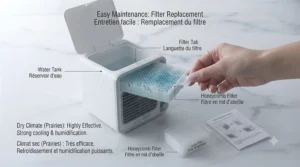
First, water quality matters more than people expect. Tap water in hard-water regions (much of Ontario, the Prairies) leaves mineral scale on the evaporative pad within a few weeks, which reduces absorption and shortens the pad’s effective life — using filtered or distilled water noticeably extends performance and delays the point where you need a replacement cartridge. Second, position and proximity make or break the experience: because the cooling effect concentrates within roughly 3-4 feet, placing the unit slightly off to the side of a monitor (rather than directly in front of it) usually gives a more direct airflow path to your face without becoming visually obstructive during video calls. Third, ventilation prevents the “swamp” effect — cracking a window or door even a few centimetres keeps humidity from building up in a closed room, which both improves comfort and keeps the cooler working at its rated capacity rather than fighting against air it’s already saturated.
Common first-30-days mistakes worth avoiding: letting the tank run fully dry before refilling (this can burn out cheaper fan motors that aren’t designed to run without the cooling airflow the wet pad provides), skipping the pad-cleaning schedule (most manufacturers recommend a rinse every 1-2 weeks to prevent mineral buildup and mild mould odour), and expecting the unit to perform identically indoors versus in a humid outdoor setting like a patio in August.
Real-World Scenarios: Who Should Actually Buy One
The dorm student with one shared outlet. If you’re a college student sharing a small dorm room with limited outlet access and a roommate who runs the space heater’s opposite — a warm, stuffy setup — the OPOLAR USB Desk Fan or SHELLTON Personal Air Cooler solves the “no free outlet” problem directly, since both run off a laptop USB port. Budget under C$35, frequency of use is nightly during study sessions, and the environment (small, enclosed room) actually makes a fan-first approach smarter than a water-based cooler, since dorm rooms rarely have great cross-ventilation for humidity to escape.
The remote worker in a dry-climate home office. Someone working from a home office in a drier region — parts of Alberta, Saskatchewan, or a well-air-conditioned Ontario condo where humidity is already controlled — is the ideal candidate for the Evapolar evaCHILL. Daily 8-hour use, a fixed desk position, and low ambient humidity are exactly the conditions where evaporative cooling performs closest to its advertised numbers, and the higher price is justified by daily, sustained use rather than occasional grabbing.
The hot sleeper in a humid apartment. If you’re someone who overheats at night in a humid city apartment without central air, the honest recommendation is the Arctic Air Grip Go clamped to the headboard on a low, quiet setting, paired with a standing fan for cross-ventilation — because in high humidity, no evaporative unit alone will fully solve the problem, but the combination of gentle humidified airflow plus general air movement outperforms either approach used alone.
Common Mistakes When Buying a USB Mini Air Conditioner
The single biggest mistake is buying based on the word “AC” without understanding it’s an evaporative cooler, then feeling scammed when it doesn’t behave like the window unit at grandma’s house — reading the actual mechanism before purchasing prevents almost all buyer’s remorse in this category. A close second is ignoring your local humidity: buyers in Vancouver, Toronto, or Montreal during a humid July heat wave are working against the exact conditions evaporative cooling needs to function, while buyers in Calgary, Regina, or Winnipeg during a dry spell are in the sweet spot.
Buyers also frequently underestimate maintenance, assuming a “USB gadget” needs zero upkeep the way a phone charger does — but a wet pad sitting in stagnant water for weeks develops odour and mineral buildup, and skipping cleaning is the top reason these units get returned or abandoned in a drawer by August. Finally, chasing the lowest possible price on ultra-generic import listings (as covered honestly in the SHELLTON and 6000mAh picks above) means accepting a real trade-off in verifiable quality control — that’s not a reason to avoid budget picks entirely, but it is a reason to read verified-purchase reviews on the specific listing rather than trusting the product photos alone.
Features That Actually Matter (And Those That Don’t)
Water tank size and USB-C vs USB-A power delivery actually matter: a larger tank means fewer mid-day refills, and USB-C typically allows slightly higher power delivery for stronger fan motors. Adjustable fan speed matters too, since running on a lower speed extends both water tank runtime and evaporative pad lifespan considerably compared to running everything on high constantly.
What doesn’t matter nearly as much as the marketing implies: LED colour-changing lights (purely cosmetic, zero cooling impact), claimed square-footage coverage (as explained above, this measures humidity spread, not real cooling radius), and “ice pack compatible” compartments found on some budget units — reviewers consistently note the ice melts within 20-30 minutes and adds only a marginal, short-lived boost over plain water, while adding cleaning complexity.
Long-Term Cost & Maintenance: What You’re Actually Signing Up For
Beyond the near-zero electricity cost detailed earlier, the recurring cost of owning a USB mini air cooler comes down to two things: replacement evaporative pads/cartridges and water. Most evaporative cartridges last roughly 3-6 months with regular use before mineral buildup and biological growth reduce their absorption efficiency meaningfully, and replacement cartridges for branded units like the Evapolar line typically run C$15-C$25 per pack of two to three, while budget units generally aren’t designed for cartridge replacement at all — once the pad degrades, the unit is effectively at end of life.
Water usage itself is negligible from a utility-bill perspective (these units use well under a litre per day of active use), but it’s worth budgeting for distilled or filtered water in hard-water regions if you want to maximize pad lifespan, since a jug of distilled water costs a couple of dollars and can meaningfully extend the 3-6 month cartridge window. Total cost of ownership over a full Canadian summer (roughly June through September), including one cartridge replacement for the higher-end units, typically lands in the C$20-C$40 range beyond the initial purchase — modest compared to running even a small window AC unit for the same stretch.
Safety and What to Know Before You Buy in Canada
These are low-voltage, low-wattage devices, which meaningfully limits the safety concerns compared to a full AC unit, but a few things are worth knowing. Because these units combine water and electronics in close proximity, the leaking complaints noted earlier for budget models are a legitimate concern — keep any evaporative cooler away from laptops, outlets, and paper documents, and favour units with a lower, more stable water reservoir design if that’s a concern in your setup.
On the broader question of heat safety, it’s worth being direct: none of the products in this guide are a substitute for real cooling during a genuine heat emergency. Health Canada’s own guidance on protecting yourself during extreme heat events is explicit that fans become ineffective at cooling the body once air temperatures climb above roughly 35°C, and the same physical limitation applies even more strongly to a personal evaporative cooler with a 3-4 foot effective radius. As CBC News reported during a recent southwestern Ontario heat warning, overnight lows that stay above 20°C make it especially hard for the body to recover, particularly without air conditioning. During an actual Environment Canada heat warning, the right move is the one public health agencies recommend broadly — spending time in a genuinely air-conditioned space like a shopping mall, library, or cooling centre — not relying on a USB gadget to get you through a dangerous heat event.
Buyer’s Decision Framework: Which One Should You Actually Get?
If your climate is dry (Prairies, interior BC, a dehumidified condo) and you want the strongest evaporative effect available, choose the Evapolar evaCHILL because the engineered cartridge genuinely outperforms generic wet-pad designs in low-humidity conditions. If your climate is humid (coastal BC, Ontario, Quebec, the Maritimes in summer) and you mainly need airflow rather than temperature drop, choose the OPOLAR USB Desk Fan because a fan’s effectiveness doesn’t depend on humidity the way evaporative cooling does.
If your budget is under C$35 and you want to test the category before committing more, choose the Arctic Air Ultra or SHELLTON Personal Air Cooler because both offer the lowest financial risk while still delivering the genuine (if modest) evaporative effect. If you need cooling to travel with you — stroller, patio, car — choose the Arctic Air Grip Go because the clamp mount and battery solve a mobility problem no fixed-base unit addresses. And if losing outlet access mid-day is your actual pain point rather than raw cooling power, choose the Rechargeable 6000mAh Mini Air Conditioner for the largest battery buffer in this roundup.
✨ Don’t Miss These Exclusive Deals!
🔍 Take your summer cooling setup to the next level with these carefully selected products. Click on any highlighted item to check current pricing and availability. These small upgrades can make a genuinely hot desk or bedroom noticeably more bearable!
Frequently Asked Questions
❓ Do USB mini air conditioners actually cool a whole room?
❓ How much electricity does a USB mini air cooler use per month?
❓ Can I use a USB mini AC in a humid Canadian summer?
❓ Do USB mini air conditioners need maintenance?
❓ Are USB mini air conditioners safe to sleep next to?
Conclusion
So, do USB mini air conditioners actually work? Yes — as personal evaporative coolers with a real, physics-backed cooling effect within a few feet of your body, running on a fraction of a cent’s worth of electricity a day. What they are not is a replacement for real air conditioning, and the products that get returned in frustration are almost always the ones bought under the wrong assumption.
The right pick genuinely depends on your climate and your problem: dry-region buyers chasing real temperature drop should look at the Evapolar evaCHILL, humid-region buyers who mainly need airflow are better served by something like the OPOLAR USB Desk Fan, and anyone testing the waters on a budget can start with the Arctic Air Ultra without much financial risk. Whichever direction you go, match the tool to the actual weather outside your window rather than the ad that convinced you to search for one in the first place — and during genuine extreme heat, treat any of these as a comfort upgrade, not a safety plan.
Recommended for You
- USB Mini AC vs Rechargeable Personal AC: 7 Best Picks (2026)
- USB Mini AC for Home Office: 7 Real Picks That Cool (2026)
- USB Mini Air Conditioner: 7 Best Picks for Canadians in 2026
Disclaimer: This article contains affiliate links. As an Amazon Associate, I earn from qualifying purchases. If you purchase products through these links, we may earn a small commission at no additional cost to you.
✨ Found this helpful? Share it with your friends! 💬🤗
