
In This Article
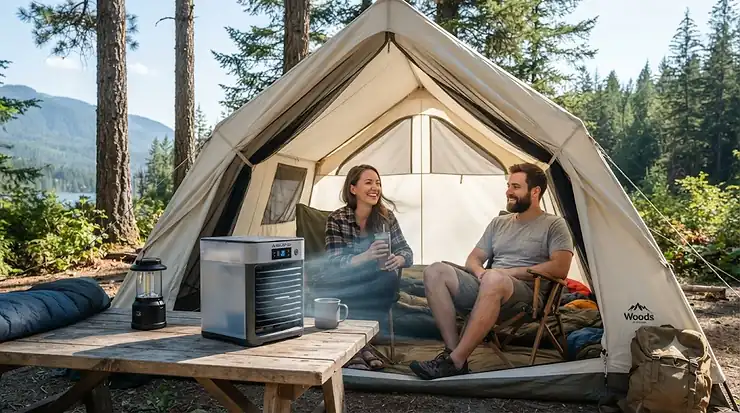
There’s a particular kind of misery that only shows up around 2 p.m. on a Saskatchewan campground in July — the kind where your tent turns into a convection oven and the dog won’t stop looking at you like you personally invited the heat wave. A battery evaporative cooler for camping is a small, water-based fan system that pulls warm air through a wet cooling pad or cartridge and pushes out air that feels several degrees cooler, all without needing a wall outlet. It runs on USB power banks, car outlets, or dedicated batteries, which is exactly why it has become the go-to fix for tenters, cottage-country weekenders, and anyone parked somewhere Hydro doesn’t reach.
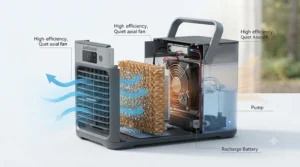
This guide breaks down seven real, currently available units, from pocket-sized desk coolers you can toss in a backpack to gallon-tank units built for a full weekend off-grid. We’ll dig into what the specs actually mean once you’re standing in a dry Prairie wind or a humid Ontario bush camp, because — and this matters more than any marketing page will admit — evaporative cooling behaves completely differently depending on where you pitch your tent. We’ll also walk through setup, maintenance, common buying mistakes, and how these units stack up against a plain box fan or a generator-powered air conditioner. If you’ve been squinting at Amazon listings trying to figure out which battery evaporative cooler for camping actually deserves a spot in your gear tote, you’re in the right place.
Quick Comparison Table
| Product | Power Source | Tank/Reservoir | Best For | Price Range (CAD) |
|---|---|---|---|---|
| Evapolar evaCHILL EV-500 | USB power bank/car outlet | 800 ml | Solo tenters, desk use | Under C$150 |
| Arctic Air Pure Chill 2.0 | USB adapter | 550 ml | Budget first-timers | Under C$60 |
| Arctic Air Grip Go | Rechargeable battery | Small misting reservoir | Clip-on convenience | Under C$50 |
| Evapolar evaLIGHT Plus | USB power bank/car outlet | Larger tank than evaCHILL | Couples, small tents | C$150-C$220 range |
| Arctic Air Ice Jet X3 | USB-C rechargeable | Dual-mist reservoir | Night-time comfort | C$45-C$65 range |
| MightyKool K2 | 12V deep-cycle/vehicle battery | 1 gallon (4 L) | Off-grid cottages, dry climates | C$220-C$300 range |
| Hessaire DC18 | Battery or AC adapter | 2.8 gallons | Group campsites, extended trips | C$250-C$350 range |
Looking at the spread above, the pattern is pretty clear: smaller tanks trade runtime for portability, while the MightyKool K2 and Hessaire DC18 trade backpack-friendliness for hours of unattended cooling. If your trip is a single overnight in a small tent, the compact end of this table earns its keep; if you’re anchored at a Prairie campsite for a week with no power hookup, the gallon-tank units stop looking like overkill and start looking like common sense.
💬 Just one click — help others make better buying decisions too!😊
Top 7 Battery Evaporative Coolers for Camping: Expert Analysis
1. Evapolar evaCHILL EV-500 — best all-around pick for solo tenters
The evaCHILL’s biggest selling point is how little it asks of you: point it, plug it into a power bank, and it starts working within seconds. Running at roughly 7.5 watts and drawing air through an 800 ml tank, it’s built to cool the three to five feet directly around your face rather than an entire tent, which is exactly the job most solo campers actually need done. The basalt-fibre cartridge is hypoallergenic and needs replacing every three to six months depending on use, and Health Canada’s guidance on staying safe during extreme heat notes that personal cooling near the body matters more than most people assume when air conditioning isn’t an option, which is precisely the gap a unit like this fills. Reviewers consistently report that it runs quietly on its lower two speeds, with the top speed drawing more complaints about fan noise than praise about cooling power. It’s a strong fit for anyone sleeping solo in a small tent, working at a folding desk under an awning, or riding shotgun on long drives to the campsite. What most buyers overlook is that performance drops off sharply the moment you move more than a few feet away — this is a personal cooler, not a tent-wide solution, and treating it as one leads to disappointment.
Pros:
- ✅ Whisper-quiet on lower speed settings
- ✅ Runs off any USB power bank or car outlet
- ✅ Lightweight enough to pack in a daypack
Cons:
- ❌ Cooling effect fades quickly past arm’s length
- ❌ Cartridge replacement adds an ongoing cost
Priced under C$150, the evaCHILL delivers solid value for anyone whose main goal is personal relief rather than whole-tent cooling.
2. Arctic Air Pure Chill 2.0 — best budget entry point
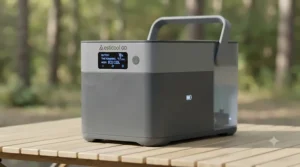
At under C$60, the Arctic Air Pure Chill 2.0 is the unit most people try first, and for good reason: it’s cheap, it’s simple, and the included Ice Boost attachment lets you freeze a small insert overnight for an extra cooling kick the next afternoon. The 550 ml tank and USB-powered fan aren’t going to compete with anything larger on raw output, but the four-speed dial and 6-colour LED light make it a genuinely pleasant bedside or picnic-table companion. Based on the spec comparison with pricier units, this is clearly designed for close-range comfort rather than area cooling, and it performs best exactly where evaporative tech shines — dry, low-humidity air. Aggregated review sentiment across major retailers points to praise for the low price and quiet low-speed operation, alongside a recurring complaint that the tank needs frequent refilling on hot days. This is the pick for a first-time camper who wants to test whether evaporative cooling suits their trips before spending more.
Pros:
- ✅ Lowest price point in this roundup
- ✅ Ice Boost attachment adds a cooling edge
- ✅ Simple one-dial operation, no learning curve
Cons:
- ❌ Small 550 ml tank needs frequent refills
- ❌ Weaker throw distance than pricier models
For under C$60, the Pure Chill 2.0 is hard to argue with as a low-risk way to try battery evaporative cooling at camp.
3. Arctic Air Grip Go — best clip-on convenience
The Arctic Air Grip Go ditches the desk-unit format entirely in favour of a universal clamp that locks onto a cooler lid, chair arm, or tent pole, with a 360-degree swivel head so you can aim the misted airflow exactly where you’re sitting. Its rechargeable battery is rated for about five hours per charge, which comfortably covers an afternoon at the picnic table or a long drive with the windows cracked. What the spec sheet won’t tell you, but user reports suggest, is that the clamp mechanism is sturdy enough for a folding chair but can feel loose on thinner tent poles, so a bit of trial placement helps on the first outing. Reviewers frequently mention appreciating the cordless freedom compared to USB-tethered units, since it means you’re not stuck sitting next to an outlet or power bank all afternoon. This one earns its spot for campers who move around a lot during the day and want a cooler that travels with them rather than staying anchored to a desk.
Pros:
- ✅ Cordless battery operation, no cable needed
- ✅ Clamps onto chairs, coolers, or tent poles
- ✅ Compact enough to toss in a cup holder
Cons:
- ❌ Roughly 5-hour runtime before recharging
- ❌ Clamp grip varies by surface thickness
Priced under C$50, the Grip Go is best suited to campers who want portable spot-cooling without babysitting a cord.
4. Evapolar evaLIGHT Plus EV-1500 — best step-up for couples
If the evaCHILL is the personal-desk option, the Evapolar evaLIGHT Plus EV-1500 is its bigger sibling, built around a noticeably larger tank that stretches runtime and widens the cooling radius enough to comfortably serve two people sitting side by side in a small tent or trailer nook. The 4-speed control and swappable basalt cartridge carry over from the evaCHILL line, so maintenance habits transfer directly if you’ve used one before. Based on the spec comparison, the jump in tank size is the whole story here — it’s the same core evaporative technology scaled up rather than a redesign, which honestly makes it easy to recommend once you know what you’re buying. Reviewers consistently note that the extra size does add a bit more desk or floor footprint, so it suits a car-camping setup better than an ultralight backpacking trip. For couples who split a two-person tent and don’t want to fight over airflow, this is the more sensible pick over doubling up on smaller units.
Pros:
- ✅ Noticeably wider cooling radius than evaCHILL
- ✅ Longer runtime per fill for overnight use
- ✅ Same reliable basalt-cartridge maintenance system
Cons:
- ❌ Bulkier footprint than pocket-sized options
- ❌ Higher price than entry-level units
In the C$150-C$220 range, the evaLIGHT Plus is a smart upgrade once one small unit isn’t cutting it for two people.
5. Arctic Air Ice Jet X3 — best for nighttime comfort
The Arctic Air Ice Jet X3 leans into dual-mist cooling modes and a soft LED mood light, aiming squarely at the bedside-table use case rather than daytime picnic cooling. USB-C charging means faster top-ups between uses, and its rated 8-hour cooling window on a single charge lines up well with a full night’s sleep in a stuffy tent. On paper this means you can fill it before bed and not think about it again until morning, which is precisely the kind of low-maintenance behaviour campers want after a long day of hiking or paddling. Aggregated customer sentiment highlights the gentle light as a genuine sleep aid rather than a gimmick, though a handful of reviewers note the mist settings use water faster than the standard fan-only mode. This is a strong option for anyone whose main complaint about camping in summer is not being able to fall asleep in the heat.
Pros:
- ✅ Roughly 8-hour runtime suits full nights
- ✅ USB-C charging is faster than micro-USB rivals
- ✅ Soft LED light doubles as a gentle night light
Cons:
- ❌ Mist modes drain the reservoir faster
- ❌ Limited daytime throw compared to larger units
Sitting in the C$45-C$65 range, the Ice Jet X3 earns its keep purely on overnight comfort value.
6. MightyKool K2 — best for off-grid dry-climate cooling
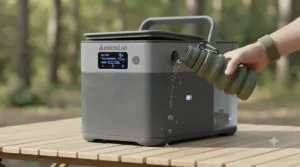
This is where the category shifts from personal comfort gadget to genuine off-grid infrastructure. The MightyKool K2 runs on a 12-volt vehicle or deep-cycle battery, drawing a modest 0.8 to 2.4 amps depending on speed — less power than a single taillight bulb — while pushing air through dual vents rated at roughly 25 mph. Its one-gallon (4-litre) tank can run four to eight hours per fill depending on conditions, and it’s specifically designed to cool people and pets inside a stationary camper, tent, or boat rather than an entire vehicle in motion. Here’s what most spec sheets skip: evaporative units like this one only really shine in low-humidity air, so the payoff is dramatically bigger on the dry Prairies than in a humid Ontario bush camp, a point echoed by long-time RV forum users who describe strong results in arid Western climates and noticeably weaker performance in muggy regions. The trade-off for that power is size and weight — at roughly five pounds and a foot-long footprint, it’s built for a base camp setup, not a hiking pack. For anyone dry-camping regularly in Alberta, Saskatchewan, or the BC Interior with no shore power, this is the unit built for exactly that job.
Pros:
- ✅ Runs directly off a 12V deep-cycle battery
- ✅ Uses less power than a single taillight bulb
- ✅ Strong 25 mph airflow through dual vents
Cons:
- ❌ Needs proper ventilation to work safely
- ❌ Heavier and bulkier than desk-style coolers
In the C$220-C$300 range, the MightyKool K2 is the clear choice for serious off-grid dry-climate campers, not casual weekenders.
7. Hessaire DC18 Mobile Evaporative Cooler — best for group campsites
Rounding out the lineup, the Hessaire DC18 is built for scale: a 2.8-gallon reservoir, a variable speed dial, and the flexibility to run on batteries or the included AC adapter when shore power happens to be available. That larger tank means it can realistically cool a communal campsite area — the space around a picnic table, an open-sided tent canopy, or a screened porch at the cottage — rather than just the zone immediately around one person. Reviewers frequently point to its longer unattended runtime as the standout feature, since a full tank can outlast an entire afternoon of gathering without a refill. What the spec sheet won’t tell you, but user reports suggest, is that the larger footprint and weight make this a “set it up once and leave it” unit rather than something you move between locations throughout the day. For a family or group trip where several people are sharing shade and airflow, this is the option that actually scales to the job.
Pros:
- ✅ Large 2.8-gallon tank for extended runtime
- ✅ Works on batteries or plug-in power
- ✅ Cools a wider group area than personal units
Cons:
- ❌ Bulkier and heavier to transport and store
- ❌ Overkill for solo or two-person trips
Priced in the C$250-C$350 range, the Hessaire DC18 is the premium pick for groups who want shared, sustained relief at a Prairie or cottage-country base camp.
Practical Usage Guide: Setting Up Your Battery Evaporative Cooler at Camp
Getting real performance out of any battery evaporative cooler for camping comes down to three habits: placement, airflow, and water quality. Set the unit so airflow moves toward open mesh windows or a tent vent rather than a sealed corner, since evaporative cooling needs somewhere for the added humidity to escape — trap it in a closed tent and you’ll just build a sauna. Use filtered or distilled water where you can, since mineral-heavy tap water speeds up scale buildup on cartridges and cooling pads, shortening their working life. On your first outing, run the unit at a lower speed setting before cranking it to maximum; several models, including the Evapolar evaCHILL and Arctic Air Pure Chill 2.0, are noticeably quieter and more battery-efficient one or two notches down from full blast.
A common first-30-days mistake is treating a personal cooler like a room air conditioner and expecting it to drop the whole tent’s temperature — it won’t, and expecting that leads to unfair one-star reviews for units that were never designed for that job. Instead, position the airflow directly at where you’ll actually be sitting or sleeping. For 12V units like the MightyKool K2, check your battery’s charge before a multi-day trip, since running an evaporative cooler alongside lights and a phone charger off the same deep-cycle battery adds up faster than people expect. A basic maintenance schedule — rinse the tank every two to three uses, empty standing water before storage, and swap cartridges on the manufacturer’s suggested timeline — keeps mildew and odour from becoming the real trip-ruiner.
Real-World Scenarios: Matching a Cooler to Your Trip
Picture a university student borrowing a hatchback for a solo weekend at a Manitoba provincial park, one small tent and a tight budget. The Arctic Air Pure Chill 2.0 or Evapolar evaCHILL fits that trip perfectly: cheap, USB-powered off a phone charger, and sized for one person’s personal space. Now picture a retired couple who tow a small trailer to the same Prairie campground every August with no power hookup — for them, the MightyKool K2 running off their trailer’s deep-cycle battery is the better long-term investment, since it’s built exactly for stationary off-grid use in dry air. Finally, picture a family reunion with a dozen relatives sharing a screened gazebo at a cottage with intermittent power; the Hessaire DC18‘s larger tank and adapter flexibility means it can run all afternoon regardless of whether the generator is on.
The throughline across all three scenarios is matching tank size and power source to how long you’ll actually be stationary, and how many people need airflow at once. A solo overnighter rarely needs a gallon tank, and a group gathering rarely gets satisfying results from a unit built for one face at a time.
Problem → Solution: Common Camp Cooling Headaches
Problem: The cooler barely makes a dent in a humid bush camp. Evaporative cooling is physics, not magic — it needs dry air to work, so in humid regions consider pairing the unit with shade and cross-ventilation rather than expecting dramatic temperature drops. Problem: The battery dies partway through the trip. For 12V units like the MightyKool K2, bring a secondary battery or a small solar panel, since a single deep-cycle battery running lights, a fridge, and a cooler simultaneously drains faster than any one spec sheet suggests. Problem: The tank runs dry overnight. Top off the reservoir before bed and, for smaller units like the Arctic Air Ice Jet X3, favour the fan-only setting over mist modes if you need it to last until morning. Problem: Musty smell after a few uses. Empty and rinse the tank after every trip rather than storing it half-full, since stagnant water inside a warm cooler is exactly the environment mildew loves. Problem: Weak airflow at the campsite compared to at home. Outdoor wind and open-air dispersal reduce the felt effect of any personal cooler, so tightening the distance between the unit and your body — rather than expecting it to fight open air — makes the biggest difference.
How to Choose a Battery Evaporative Cooler for Camping
Choosing the right unit comes down to matching a handful of practical factors to your specific trip style:
- Match tank size to trip length. A weekend solo trip rarely needs more than a small reservoir, while multi-day off-grid stays benefit from gallon-plus tanks like the MightyKool K2 or Hessaire DC18.
- Check your power source honestly. USB power bank, car outlet, or 12V deep-cycle battery all draw differently, so confirm your setup can handle the draw before buying.
- Consider your regional humidity. Dry Prairie air rewards evaporative cooling far more than humid Ontario or Maritime bush camps.
- Weigh portability against cooling area. Personal desk-style units serve one person well; larger units serve groups but cost more to carry and store.
- Factor in ongoing costs. Replacement cartridges, water, and battery charging all add up over a camping season.
- Read aggregated reviews for noise levels. Reviewers consistently flag top-speed settings as noticeably louder across nearly every model in this category.
- Plan for maintenance from day one. Units that get rinsed and stored dry last measurably longer than ones left damp in a gear tote all winter.
Evaporative Cooler Dry Climate Prairies: Why Your Region Changes the Math
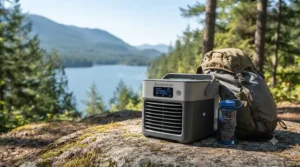
Nowhere does the phrase “your mileage may vary” apply more literally than with evaporative cooling in Canada, because the technology’s entire mechanism depends on how much moisture the surrounding air can still absorb. An evaporative cooler dry climate Prairies setup — think Saskatchewan, southern Alberta, or the BC Interior in mid-summer — routinely outperforms the same unit used in a humid Quebec or Maritime bush camp, simply because dry air lets more water evaporate off the cooling pad, pulling more heat out of the airflow in the process. Long-time RV and camper forums back this up consistently, with users in dry Western climates reporting strong, noticeable cooling from 12V units like the MightyKool K2, while camper reviews from humid regions describe a much milder effect. Environment and Climate Change Canada’s extreme heat guidance also notes that heat warnings often factor in humidity through the Humidex scale, since high humidity makes heat feel more dangerous and makes evaporative-style cooling less effective at the same time — a frustrating but predictable overlap for anyone camping east of the Prairies during a heat wave. Practically speaking, if you’re camping in a dry Prairie region, lean toward the higher end of this list’s cooling power; if you’re in a humid bush camp, treat any evaporative unit as a supplement to shade and airflow rather than a standalone fix.
Battery Cooler for Cottage No Power: Off-Grid Cooling Solutions
Plenty of Canadian cottages, especially older lakefront properties across Ontario and Quebec, either lack grid power entirely or run on a limited generator schedule, which makes a battery cooler for cottage no power situations a genuinely different shopping problem than picking a gadget for a single camping weekend. The math here favours units built around a rechargeable or deep-cycle battery rather than a small USB tank, since a cottage stay often stretches for days rather than a single overnight. This is exactly the use case the MightyKool K2 was engineered for — its 12V draw is light enough that a modest solar setup or a spare marine battery can keep it running for an entire stay without touching the main house battery bank. It also doubles as a genuine off-grid cooling solution for anyone splitting time between a cottage dock and a nearby campsite, since the same 12V battery that powers a trolling motor or a portable fridge can typically run the cooler too. The trade-off, as covered earlier, is that this only pays off fully in drier air; a humid lakefront cottage will still get some relief, just noticeably less dramatic than the same setup would deliver out on the dry Prairies.
Common Mistakes When Buying a Battery Evaporative Cooler for Camping
The single biggest mistake is buying based on wattage alone without checking tank size, since a powerful fan pulling from a tiny reservoir just means more frequent refills, not better cooling. A close second is ignoring regional humidity entirely — buyers in humid areas frequently leave disappointed one-star reviews for units performing exactly as their specs describe, simply because evaporative technology wasn’t the right tool for a wet climate to begin with. Skipping battery math is another common trap: 12V units draw real power, and pairing one with an undersized or already-strained battery bank leads to dead batteries by day two of a trip. Buyers also commonly overlook ongoing costs — replacement cartridges and filtered water add up over a season, and a cheaper unit with pricier consumables isn’t always the better long-term deal. Finally, skipping maintenance is a quiet trip-ruiner: units left damp in storage develop mildew and odour far faster than ones rinsed and dried after each use.
Battery Evaporative Cooler vs Traditional Camping Fans and ACs
A plain battery-powered box fan is cheaper and simpler than any evaporative cooler on this list, but it only moves existing air around rather than actually lowering its temperature, which matters a lot once the mercury climbs past 30°C. A generator-powered window or portable air conditioner cools more aggressively than any evaporative unit here, but it demands real power infrastructure — a generator, sustained fuel, and often a way to vent hot exhaust air outside the tent or trailer — that most tent campers simply don’t carry. Evaporative coolers sit in a practical middle ground: meaningfully more effective than a bare fan in dry conditions, while asking far less of your power setup than a true air conditioner. The trade-off is humidity sensitivity, which a box fan and a compressor-based AC don’t share, since neither actually depends on how dry the surrounding air is to do their job. For most car campers and cottage-goers without shore power, the evaporative category hits the sweet spot between cost, power draw, and genuine cooling effect — provided the regional climate cooperates.
Long-Term Cost & Maintenance of Battery Evaporative Coolers
Upfront price only tells part of the ownership story. Cartridge-based units like the Evapolar evaCHILL and evaLIGHT Plus need a replacement cartridge every three to six months of regular use, adding a modest but real recurring cost on top of the initial purchase. Larger tank units like the MightyKool K2 and Hessaire DC18 skip disposable cartridges in favour of simpler pad-and-reservoir systems, trading a lower ongoing cost for a bulkier upfront footprint. Battery wear is the other long-term factor worth budgeting for: rechargeable units like the Arctic Air Grip Go and Ice Jet X3 will gradually lose runtime capacity after repeated charge cycles, much like any consumer lithium battery, while 12V units draw from a replaceable vehicle or marine battery that most campers are already maintaining anyway. Weighed against a season of disposable ice, coolers, and gas station runs, even the pricier units in this lineup tend to pay for themselves in convenience within a summer or two of regular use — provided your regional humidity actually lets the technology do its job.
✨ Ready to gear up before the next heat wave hits?
🔥 Check current prices and availability on any of the seven picks above — a few extra degrees of comfort at camp is one click away!
Portable Cooler for Cottage Country & Outdoor Camping Gear: Building Your Kit
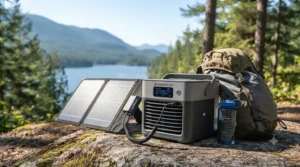
A genuinely useful portable cooler for cottage country setup rarely stands alone — it works best as one piece of a broader outdoor cooling for camping gear kit rather than a single silver-bullet purchase. Pairing an evaporative unit with basic shade infrastructure, like a tarp or canopy over the picnic table, dramatically improves the felt effect, since evaporative cooling works far better in shaded, ventilated air than in direct sun. A reusable water bottle, a wide-brim hat, and light-coloured, loose clothing round out a sensible warm-weather kit, echoing guidance from the Canadian Red Cross that staying hydrated and dressed for the heat matters just as much as mechanical cooling during a heat wave. For cottage country specifically, where trips often stretch across a long weekend or more, pack a spare battery or a small solar charger alongside whichever cooler you choose, since running out of power on day two defeats the entire point of packing one in the first place. Building the kit this way — shade, hydration, appropriate clothing, and the right cooler for your climate — consistently beats relying on any single gadget to do all the work.
Frequently Asked Questions
❓ Does a battery evaporative cooler for camping work in a closed tent?
❓ How long does a battery evaporative cooler run on one charge?
❓ Are evaporative coolers effective in humid Canadian regions?
❓ Can I use tap water in a battery evaporative cooler?
❓ What's the difference between an evaporative cooler and a portable air conditioner for camping?
Conclusion
Choosing the right battery evaporative cooler for camping really comes down to being honest about three things: how long you’ll be off-grid, how many people need airflow, and — maybe most importantly — how dry the air actually gets where you’re pitching your tent. A solo weekender in a small tent gets excellent mileage from something like the Evapolar evaCHILL or Arctic Air Pure Chill 2.0, while a family anchored at a Prairie campsite for a week without shore power is far better served by the sustained runtime of the MightyKool K2 or the group-sized capacity of the Hessaire DC18. None of these units are magic — they’re tools that work with the climate, not against it — but matched correctly to your trip and your region, any one of the seven covered here can turn a miserable, sweaty afternoon into something a lot more bearable. Whichever you choose, treat it as one part of a broader heat-comfort strategy alongside shade, hydration, and sensible clothing, and you’ll get considerably more out of your summer camping season than the thermometer might suggest is possible.
Recommended for You
- 7 Best Battery Powered Evaporative Cooler Picks for Canadian Summers (2026)
- Is a Rechargeable Personal AC Worth It in 2026? Real Answer
- Rechargeable Personal AC vs Evaporative Cooler: 7 Best Picks for Canada 2026
Disclaimer: This article contains affiliate links. As an Amazon Associate, I earn from qualifying purchases. If you purchase products through these links, we may earn a small commission at no additional cost to you.
✨ Found this helpful? Share it with your friends! 💬🤗
