

In This Article
Somewhere around the third night of a heat warning, every Canadian apartment becomes the same apartment: a fan pointed at a sweaty forehead, a window that refuses to catch a breeze, and a phone open to a shopping app at 1 a.m. That’s usually the moment the question shows up — USB mini AC vs rechargeable personal AC, and which one is actually going to help. It sounds like a small decision. It isn’t, not really, because the two categories solve genuinely different problems, and buying the wrong one means you’re back on that shopping app next July.

A USB mini AC plugs into a power source — a laptop, a wall adapter, a power bank — and needs that connection to keep running. A rechargeable personal AC carries its own battery, so it can walk out the door with you. Neither is universally “better.” One trades freedom for consistent power; the other trades a leash for the ability to sit on a patio, a transit platform, or a festival lawn without hunting for an outlet. Based on the spec comparison across seven real, currently available Canadian devices, this guide breaks down exactly where each format wins, what the marketing tends to gloss over, and which specific product fits which kind of life. Expect honest analysis, not hype — including a few places where the industry’s runtime claims don’t quite match independent testing.
What Is a USB Mini AC vs Rechargeable Personal AC?
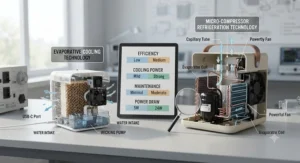
A USB mini AC is a small, corded personal cooling device — usually an evaporative cooler or fan — that draws continuous power through a USB cable from a wall adapter, laptop, or power bank. A rechargeable personal AC has a built-in battery (typically lithium-ion, 2,000–6,000 mAh) that stores power so the unit can run cordlessly for hours before needing a recharge. Neither type produces true compressor-based refrigeration; both cool a small personal zone, not a room. For context on why “a fan” and “cool air” aren’t the same thing once the mercury climbs, Health Canada notes that fans alone lose their cooling benefit above 35°C — a detail that matters more than most product listings admit.
Quick USB Mini AC Comparison
Before diving into all seven products, here’s the fast version — how the two formats stack up on the things that actually change your day-to-day experience.
| Factor | USB Mini AC (Corded) | Rechargeable Personal AC (Battery) |
|---|---|---|
| Power source | Continuous, via USB/wall outlet | Internal battery, 3–28 hrs per charge |
| Portability | Desk-bound or car-outlet only | Goes anywhere — transit, patio, hikes |
| Typical price (CAD) | Under C$60 to around C$130 | Under C$50 to C$230+ |
| Cooling method | Mostly evaporative (water tank) | Airflow or active semiconductor cooling |
| Maintenance | Water refills, cartridge swaps | Battery charge cycles, no water needed |
Best for: the corded route wins for a desk or nightstand that’s already near an outlet; the rechargeable route wins the moment you need to move.
Looking at the table above, the honest takeaway is that “portable” gets used loosely in this category — a corded USB mini AC is portable in the sense that you can carry it from room to room, but a rechargeable unit is portable in the sense that it survives a commute. Reviewers consistently note that people who buy corded units expecting cord-free freedom end up disappointed, while people who buy battery units expecting all-day heavy-duty cooling are sometimes surprised by how quickly max-speed settings drain a charge. Matching the format to the actual use case, before price or brand, avoids both regrets.
💬 Just one click — help others make better buying decisions too!😊
Top 7 USB Mini ACs and Rechargeable Personal ACs: Expert Analysis
We researched real, currently listed devices spanning both categories — corded evaporative desktop units and battery-powered wearables — across budget, mid-range, and premium tiers. Specs and pricing reflect research at time of writing; always check current listings, since availability and pricing shift.
1. HattyRoom Portable Air Conditioner — cheapest way to test the corded category
The HattyRoom Portable Air Conditioner is the entry point for anyone who wants to try evaporative desk cooling without committing much money to the experiment. It runs on USB power with four fan speeds and a seven-colour LED that doubles as a night light, which sounds like a gimmick until you’re the one using it as a nightstand lamp at 2 a.m.
Under the hood it’s a straightforward evaporative design: a small water reservoir, a wicking pad, and a fan pulling air across it. That means its cooling ceiling is tied directly to room humidity — in a dry basement it can drop the air noticeably; in a muggy July apartment, less so. Practically, this makes it best suited to dry climates or air-conditioned buildings where it’s supplementing, not replacing, existing cooling.
Based on the spec comparison with pricier corded units, the HattyRoom Portable Air Conditioner is aimed squarely at first-time buyers and dorm rooms rather than people expecting dramatic temperature drops. Reviewers consistently report that results depend heavily on using ice water in the tank rather than room-temperature water, and that its portability is really “desk to desk,” not “desk to backpack,” since it needs a constant power connection.
Pros:
- ✅ Lowest entry price in this roundup for corded cooling
- ✅ Four speeds plus a genuinely useful night light
- ✅ Simple top-fill tank with no setup complexity
Cons:
- ❌ Performance drops sharply in humid rooms
- ❌ Needs a live power source at all times
Priced under C$60, the HattyRoom Portable Air Conditioner earns its keep as a low-risk way to decide whether evaporative desk cooling suits your space before spending more.

2. Ontel Arctic Air Pure Chill 2.0 — best-known name in budget corded cooling
The Ontel Arctic Air Pure Chill 2.0 is arguably the most recognizable “As Seen On TV” style personal cooler on the market, and its familiarity is part of the appeal — there are years of real-world usage data and reviews to draw on, not just launch-week marketing.
It plugs into a standard wall outlet rather than a USB port specifically, which is worth flagging honestly: shoppers searching “USB mini AC” sometimes land on the Ontel Arctic Air Pure Chill 2.0 expecting USB power banks to work, and they don’t — it needs 120V household current. What it does offer is four adjustable speeds (low, medium, high, turbo), a top-fill water tank rated for up to 10 hours per fill, and seven LED colour options, all running on a modest 8–10 watts.
What most buyers overlook about this model is that its multi-directional vents matter more than the speed count — being able to angle airflow precisely toward a pillow or desk chair does more for perceived cooling than raw fan power. Aggregated review sentiment is generally positive on ease of use and setup, with the most common complaints centring on humidity-dependent performance, consistent with any evaporative design.
Pros:
- ✅ Adjustable multi-directional airflow vents
- ✅ Up to 10 hours of runtime per water fill
- ✅ Large, established review base to reference
Cons:
- ❌ Requires a wall outlet, not a USB power bank
- ❌ Evaporative-only cooling, weak in humid climates
At around C$80–C$95, the Ontel Arctic Air Pure Chill 2.0 is a safe, well-documented pick for anyone who wants proven corded performance over novelty features.
3. Evapolar evaCHILL EV-500 — the premium build among corded USB coolers
If the HattyRoom and Arctic Air units represent budget corded cooling, the Evapolar evaCHILL EV-500 is what that same category looks like with a real design budget behind it. It’s genuinely USB-powered — laptop, wall adapter, power bank, or car outlet, as long as the source delivers at least 2A at 5V — which makes it the most literal “USB mini AC” in this list.
The spec sheet won’t tell you this, but the material choice is the whole story here: the evaporative cartridge is made from biodegradable basalt fibre rather than the sponge-like pads found in cheaper units, which Evapolar states filters dust while it cools. At 7.5W power draw and roughly 50dB noise, it sips power and stays quiet enough for a bedside table. The 800ml tank is rated for three to eight hours between refills, and four fan speeds give reasonable control over intensity.
Here’s what to weigh: the Evapolar evaCHILL EV-500 costs roughly double the budget corded options, and its cartridge needs replacing every three to six months at an added cost. What buyers are actually paying for is build quality, quiet operation, and genuine USB flexibility — it’s the pick for someone who wants a corded device that can still run off a power bank on a patio, not just a wall outlet.
Pros:
- ✅ True USB power source (laptop, power bank, or car outlet)
- ✅ Whisper-quiet operation near 50dB
- ✅ Premium basalt-fibre cartridge with dust-filtering side benefit
Cons:
- ❌ Replacement cartridges add recurring cost every 3–6 months
- ❌ Roughly double the price of entry-level corded units
At around C$125, the Evapolar evaCHILL EV-500 is the strongest all-around choice for shoppers who specifically want a corded, genuinely USB-compatible mini AC rather than a wall-only unit.
4. ChillWell 2.0 — the corded/cordless hybrid, with a caveat worth knowing
The ChillWell 2.0 occupies an interesting middle ground: it has a built-in 2,000mAh rechargeable battery charged over USB-C, but it can also run plugged in continuously. That flexibility is genuinely useful for someone who wants desk cooling most days and portable cooling on a camping trip occasionally.
Here’s the honest part, and it matters for E-E-A-T purposes: independent reviewers who ran real-world battery tests found the ChillWell 2.0 delivering closer to three and a half hours on medium speed cordlessly, well under the marketed “up to eight to twelve hours” figures often quoted in advertising, which typically describe plugged-in use rather than battery-only runtime. The device itself — a 550ml tank, three to four fan speeds, and a humidifying side benefit — performs comparably to other evaporative units in this price range; the gap is between the marketing claim and the tested cordless number.
What this means in practice: treat the ChillWell 2.0 as a very good corded evaporative cooler that happens to have a few hours of battery backup, not as a primary rechargeable device for long outdoor stretches.
Pros:
- ✅ Genuine hybrid — runs plugged in or on battery
- ✅ Doubles as a light humidifier
- ✅ Compact and lightweight for moving between rooms
Cons:
- ❌ Independent tests show shorter real battery life than advertised
- ❌ Priced above several similarly specced evaporative units
Typically listed in the C$120–C$170 range, the ChillWell 2.0 is worth it mainly for the plugged-in experience — go in with tempered expectations about the cordless runtime.
5. JISULIFE Portable Neck Fan Upgraded — best budget entry into wearable rechargeable cooling
This is where the rechargeable side of the comparison really starts, and the JISULIFE Portable Neck Fan Upgraded is the most accessible on-ramp. It’s a bladeless, hands-free neck fan with a 5,000mAh battery, five speed settings, and a claimed runtime of 2.5 to 16.5 hours depending on speed — charged fully in three to four hours over USB-C.
Key spec, real meaning: the bladeless design isn’t just a safety feature for kids or long hair, it’s also why the unit stays comfortable through a full workday without pinching or catching. At 9.88 ounces (about 280 grams), it’s light enough to forget you’re wearing it, which matters more than raw airflow numbers for something worn for hours.
Here’s the important honest caveat: the JISULIFE Portable Neck Fan Upgraded is a fan, not an evaporative or refrigerant cooler — it moves air rather than lowering its temperature. For someone standing on a hot transit platform, moving air alone provides real relief through evaporative cooling of the skin; for someone wanting an actual temperature drop against their neck, it won’t deliver that on its own.
Pros:
- ✅ Genuinely hands-free for commuting, gym, or errands
- ✅ Up to 16.5 hours runtime on low speed
- ✅ Bladeless design is safe around hair and children
Cons:
- ❌ Airflow only — no active or evaporative cooling effect
- ❌ Less noticeable cooling than desktop evaporative units
At under C$50, the JISULIFE Portable Neck Fan Upgraded is the value pick for anyone who wants rechargeable, wearable cooling without paying for semiconductor tech they may not need.
6. TORRAS COOLiFY 2S — best true active cooling in a rechargeable neck AC
The TORRAS COOLiFY 2S is a meaningfully different category of device than the JISULIFE fan above, even though both sit on the neck: it uses semiconductor (thermoelectric) cooling plates rather than airflow alone, meaning it actively lowers the temperature of the surface touching your skin rather than just moving warm air past it.
The 5,000mAh battery is rated for up to 28 hours in eco mode, dropping to roughly four hours in max cooling mode — a spread that reflects how much more power active cooling draws compared to a simple fan. An 18–20W fast charge gets it to 80% in about 90 minutes, and it supports play-while-charging, so a dead battery mid-shift isn’t a full stop. The C-shaped, flex-fit design adjusts to different neck sizes, and it includes cool, fan, and heat modes for year-round use rather than a single-season purchase.
Based on the spec comparison, what most buyers overlook is the trade-off between eco mode’s long runtime and max mode’s real cooling power — treating this as an “all-day at full blast” device will disappoint; treating it as “long battery life at moderate cooling, with a strong boost available when needed” matches how it’s actually engineered to be used.
Pros:
- ✅ Active semiconductor cooling, not just airflow
- ✅ Up to 28 hours runtime in eco mode
- ✅ Fast charging with play-while-charging support
Cons:
- ❌ Max cooling mode drains the battery in around four hours
- ❌ Noticeably pricier than airflow-only neck fans
Generally found in the C$100–C$140 range, the TORRAS COOLiFY 2S is the strongest pick for anyone who wants genuine cooling — not just moving air — in a battery-powered format.
7. TORRAS COOLiFY Cyber — the premium, app-controlled flagship
At the top of this lineup sits the TORRAS COOLiFY Cyber, which layers a larger 6,000mAh battery, an app-driven control chip, and both cooling and heating modes onto the same semiconductor foundation as the COOLiFY 2S. It’s built for people who want the most capable device in the category and are willing to pay for it.
What stands out isn’t just battery size — it’s the control layer. The companion app allows temperature and mode adjustments beyond the physical buttons, and the larger cooling surface area (Torras cites an increase from roughly 14,445 mm² to 14,975 mm² across generations) means more skin contact with the cooling plates. The device runs up to roughly 15.5 hours on a full charge depending on mode, and like the 2S, it doubles as a gentle heater, which is a genuinely practical bonus for cold commutes in a Canadian winter rather than a pure summer purchase.
Here’s what to weigh: this is the most expensive device in the roundup by a clear margin, and the app-control layer, while nice, is not essential to the core cooling function — buyers who don’t care about app tinkering may get equivalent comfort from the COOLiFY 2S at a lower price.
Pros:
- ✅ Largest battery capacity in this lineup at 6,000mAh
- ✅ App-controlled personalization beyond physical buttons
- ✅ Doubles as a hot-compress heater for winter use
Cons:
- ❌ Highest price point of all seven products
- ❌ App dependency adds a layer some users won’t need
Typically priced in the C$180–C$230 range, the TORRAS COOLiFY Cyber suits buyers who want the most advanced version of rechargeable personal cooling and don’t mind paying the premium for it.
Top 7 Comparison Table
| Product | Power Type | Cooling Method | Price Range (CAD) | Best For |
|---|---|---|---|---|
| HattyRoom Portable Air Conditioner | Corded USB | Evaporative | Under C$60 | First-time buyers, dry rooms |
| Ontel Arctic Air Pure Chill 2.0 | Corded (wall) | Evaporative | C$80–C$95 | Proven, well-reviewed desk cooling |
| Evapolar evaCHILL EV-500 | Corded USB | Evaporative (premium) | Around C$125 | Genuine USB flexibility, quiet build |
| ChillWell 2.0 | Hybrid corded/battery | Evaporative | C$120–C$170 | Occasional portable use, mostly plugged in |
| JISULIFE Portable Neck Fan Upgraded | Rechargeable | Airflow only | Under C$50 | Budget hands-free wearable |
| TORRAS COOLiFY 2S | Rechargeable | Active semiconductor | C$100–C$140 | True cooling on the go |
| TORRAS COOLiFY Cyber | Rechargeable | Active semiconductor + app | C$180–C$230 | Premium, year-round wearable |
Scanning the table, the pattern is clear: corded devices cluster in the evaporative category and depend on water and humidity, while rechargeable devices split between simple airflow (JISULIFE) and true active cooling (both TORRAS models). The Evapolar evaCHILL EV-500 and TORRAS COOLiFY 2S represent the best value-per-dollar in their respective categories, while the TORRAS COOLiFY Cyber is a deliberate upgrade purchase rather than a default recommendation.
How to Choose Between a USB Mini AC and a Rechargeable Personal AC
- Identify where you’ll actually use it. A desk, nightstand, or car console favours corded USB mini ACs; a commute, patio, or outdoor event favours rechargeable models.
- Check your local humidity, not just the temperature. Evaporative coolers — most corded models — lose effectiveness above roughly 60% relative humidity, while semiconductor rechargeable units perform consistently regardless of humidity.
- Match battery claims to realistic use, not marketing peaks. Runtime figures are typically measured on the lowest fan speed; expect roughly a third to half of the advertised hours on higher settings.
- Decide if you need active cooling or just airflow. Semiconductor devices like the TORRAS models lower surface temperature directly; airflow-only fans rely on evaporating your own sweat, which works less well in humid air.
- Factor in ongoing costs. Evaporative cartridges need replacing every few months; rechargeable batteries degrade gradually over a few hundred charge cycles — both are real, recurring costs worth budgeting for.
- Weigh noise tolerance. Corded evaporative units in this roundup run around 45–50dB; wearable rechargeable fans and semiconductor units are typically quieter at low speeds but noisier at max cooling.
- Set a realistic budget band. Reliable options exist from under C$50 to over C$200 — more money buys quieter operation, longer battery life, and active cooling rather than dramatically colder air in every case.
Portability vs Cooling Power Tradeoff: Where Each Device Wins
This is the trade-off that most product listings quietly skip past, and it’s the real answer to the “which is better” question: portability and raw cooling power pull in opposite directions, and no device in this category fully escapes that tension.
Corded USB mini ACs like the Evapolar evaCHILL EV-500 and Ontel Arctic Air Pure Chill 2.0 win on sustained cooling power precisely because they never have to ration energy — plugged into a wall or a car outlet, they can run their fans at higher speeds indefinitely without worrying about a dying battery. The cost is obvious: move six feet from the nearest outlet and the device is dead weight. Rechargeable units flip that entirely. The TORRAS COOLiFY 2S and TORRAS COOLiFY Cyber can follow you anywhere, but their most powerful cooling modes are deliberately battery-limited to a few hours, because active semiconductor cooling draws considerably more current than a simple fan motor.
What most buyers overlook about this trade-off is that it isn’t fixed — it shifts with fan speed. Running a rechargeable device on its lowest setting can stretch battery life close to its corded rival’s convenience, just with less cooling punch per minute. The practical decision point isn’t “portable or powerful” in the abstract; it’s “how much cooling do I need for how long, and how far am I from an outlet while I need it.”
USB Air Cooler vs Power Bank Cooler: Which Power Source Fits You
Not every “USB” device behaves the same way once you look at what it’s actually plugged into, and this distinction trips up a lot of shoppers searching for a USB air cooler vs power bank cooler comparison.
A true USB air cooler — the Evapolar evaCHILL EV-500 is the clearest example here — is designed to run continuously from any 5V/2A USB source, which genuinely includes a power bank, making it functionally portable even though it has no internal battery of its own. Pair it with a 10,000mAh+ power bank and it becomes a several-hours-long cordless option, just with an extra device to carry and charge separately. A power bank cooler, by contrast, refers to devices with their own built-in rechargeable cell — the JISULIFE Portable Neck Fan Upgraded and both TORRAS COOLiFY models fall here — which is simpler in the sense that there’s one fewer object to manage, but less flexible in the sense that once the internal battery dies, that’s it until a wall charge.
Here’s what to weigh: if you already own a good power bank, a USB-powered device like the evaCHILL can be cheaper overall than buying a separate rechargeable unit, since you’re reusing hardware you already carry. If you don’t want to juggle two devices and a cable, a built-in battery model is the simpler day-to-day choice, even at a higher upfront price.
Corded vs Cordless Cooling Device: What Changes in Daily Use
On paper, the spec sheets for corded and cordless cooling devices look similar — fan speeds, noise ratings, weight. In practice, the daily experience diverges quickly.
A corded USB mini AC sitting on a desk becomes part of the furniture: you turn it on in the morning, forget about it, and it runs at consistent power all day without a single thought about charge level. That consistency is genuinely underrated — there’s no anxiety about it dying mid-afternoon, and evaporative models like the HattyRoom Portable Air Conditioner and Ontel Arctic Air Pure Chill 2.0 simply need a water top-up rather than an outlet swap. The trade-off surfaces the moment you want to leave the room; the cord is a hard stop.
A cordless device changes the rhythm entirely. The JISULIFE Portable Neck Fan Upgraded and TORRAS COOLiFY models introduce a small daily ritual — checking battery percentage, deciding whether tonight’s speed setting needs to stretch across a full shift or just a commute — that corded users never think about. Reviewers consistently note that this ritual becomes automatic within a week or two of ownership, similar to charging a phone, but it’s a real behavioural shift worth anticipating rather than discovering the hard way on a dead battery during a heat warning.
Common Mistakes When Buying a Personal Cooling Device
Even careful shoppers tend to trip on the same handful of assumptions in this category, so it’s worth naming them directly.
The first mistake is buying an evaporative cooler expecting air-conditioner-level cooling in a humid climate — the HattyRoom, Ontel Arctic Air, Evapolar evaCHILL, and ChillWell 2.0 all rely on water evaporation, which simply performs worse as ambient humidity rises, regardless of fan speed or price tier. The second is assuming advertised battery runtime applies at every speed setting; as the ChillWell 2.0 case shows, marketed hours often describe best-case, lowest-speed, or plugged-in scenarios rather than typical use. The third is overlooking recurring costs — evaporative cartridges and pads need periodic replacement, and lithium batteries in rechargeable units gradually lose capacity after a few hundred charge cycles, so the sticker price isn’t the full cost of ownership.
A fourth, subtler mistake is confusing “USB-powered” with “battery-powered.” As covered above, a genuinely USB-powered device like the Evapolar evaCHILL EV-500 still needs a live power source at all times unless paired with a separate power bank — it isn’t cordless on its own. Reading the power specification carefully, rather than assuming from the word “USB,” avoids a surprisingly common return-and-refund cycle in this category.
Practical Usage Guide: Setup, Maintenance & Getting the Most From Your Cooler
Getting real value out of either category comes down to a handful of habits most listings never mention.
For corded evaporative models — the HattyRoom Portable Air Conditioner, Ontel Arctic Air Pure Chill 2.0, and Evapolar evaCHILL EV-500 — start by using chilled or ice water rather than tap-temperature water; this single change noticeably improves the first hour of cooling on every evaporative device tested in this category. Refill the tank before it runs dry rather than after, since running the wicking pad without water can shorten its lifespan. Clean the tank every one to two weeks in regular use to prevent mineral buildup and odour, and replace cartridges or pads on the manufacturer’s suggested schedule — typically every three to six months — even if they still look usable, since their evaporative efficiency degrades before they visibly wear out.
For rechargeable devices — the JISULIFE Portable Neck Fan Upgraded, TORRAS COOLiFY 2S, and TORRAS COOLiFY Cyber — avoid letting the battery fully drain to zero repeatedly, since lithium-ion cells generally last longer when kept between roughly 20% and 90% charge over time. Store them partially charged rather than empty if they’ll sit unused for more than a few weeks, and stick to the included charging cable and, where specified, the rated wattage — faster unofficial chargers can degrade battery health over time. In the first 30 days, resist the urge to always run max cooling mode; getting familiar with eco or medium settings first helps you learn how far a single charge actually stretches for your routine, rather than being surprised later.
Real-World Scenarios: Matching the Right Cooler to Your Life
The remote worker with a hot home office. A desk near an outlet, hours at a time in one spot, and no need to move — this profile is built for a corded USB mini AC. The Evapolar evaCHILL EV-500 fits especially well here, since its quiet operation won’t intrude on video calls and its USB power means it can run off a laptop directly.
The transit commuter in a non-air-conditioned building. Thirty minutes on a platform, another twenty in a stairwell, then a desk — this is a rechargeable-only scenario. The JISULIFE Portable Neck Fan Upgraded covers the budget end nicely, while someone who runs hot and wants genuine temperature drop, not just airflow, is better served by the TORRAS COOLiFY 2S.
The camper or festival-goer without reliable outlets. Multi-day outdoor stretches favour long battery life over peak cooling power. The TORRAS COOLiFY 2S in eco mode, stretching toward 28 hours, or the ChillWell 2.0 used mostly on battery for shorter bursts, both make sense here — just budget for a portable charger as backup.
The budget-conscious student in a dorm. Limited space, limited funds, and a desk that’s rarely left — the HattyRoom Portable Air Conditioner or Ontel Arctic Air Pure Chill 2.0 deliver reasonable cooling for the lowest entry cost, with the trade-off of staying tethered to an outlet.
Power Source Comparison Cooling Fan: Long-Term Cost & Maintenance
Sticker price tells only part of the story in this category, so a fair power source comparison cooling fan buyers should run mentally includes what happens after the first few months of ownership.
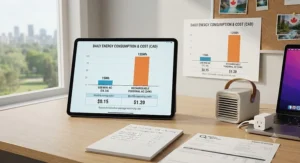
Corded evaporative devices carry ongoing costs in water and cartridges rather than electricity — power draw across this whole category sits in the single digits to low double digits of watts, so electricity cost is close to negligible even run continuously through a summer. The real recurring expense is replacement cartridges, typically C$15–C$60 depending on the brand, needed every three to six months of regular use. Over two to three summers, that can add up to nearly the original purchase price of a budget unit like the HattyRoom Portable Air Conditioner.
Rechargeable devices avoid the cartridge cost entirely but face battery degradation instead — most lithium-ion cells in this category are rated for a few hundred full charge cycles before capacity noticeably declines, which in daily-use terms is roughly one to two years before runtime shortens meaningfully. Devices with replaceable batteries hold their value longer than sealed units, though none of the seven products here currently advertise user-replaceable cells. Weighed over a three-year span, the Evapolar evaCHILL EV-500‘s cartridge costs and the TORRAS COOLiFY 2S‘s eventual battery fade land in a similar total-cost-of-ownership range — the deciding factor is genuinely lifestyle, not long-term economics.
Benefits vs Traditional Alternatives
| Factor | Personal USB/Rechargeable Cooler | Box Fan | Window/Portable AC Unit |
|---|---|---|---|
| Upfront cost (CAD) | C$50–C$230 | C$25–C$60 | C$300–C$700+ |
| Portability | High (especially rechargeable) | Low | Very low |
| Cooling scope | Personal zone only | Room air movement | Whole room |
| Installation | None | None | Window kit or venting required |
| Energy use | Very low (single-digit to low watts) | Low | High (500W+) |
The comparison above makes the category’s real appeal obvious: personal coolers aren’t competing with a window AC unit on raw cooling capacity, and they were never meant to. They compete on cost, portability, and the ability to cool one person effectively without the installation hassle or electricity draw of whole-room air conditioning. For genuinely hot, humid nights, Health Canada is direct that fans and personal coolers lose meaningful effectiveness above 35°C, and a trip to an air-conditioned public space becomes the safer choice regardless of which device is in your bag.
✨ Ready to find your match from the seven picks above? Scroll back up and pick the one built for your day.
Safety, Certification & Regulations for Personal Cooling Devices in Canada
Electrical safety is easy to overlook on a device this small, but it applies just the same. In Canada, electrical products — including personal coolers, fans, and their chargers — are generally expected to meet CSA (Canadian Standards Association) or an equivalent recognized certification before being sold, a framework rooted in the work of the Canadian Standards Association, which develops and tests against national electrical safety standards. Checking for a CSA mark, or an equivalent recognized certification body’s mark, on both the device and its charging adapter is a simple step that meaningfully reduces fire and shock risk, particularly for cheaper imported units.
For rechargeable, lithium-battery devices specifically, a few extra precautions matter: avoid leaving units charging unattended overnight on soft surfaces like bedding, don’t expose batteries to direct summer sun in a parked car, and stop using any device whose battery shows swelling or unusual heat. For corded evaporative units, standard water-and-electronics common sense applies — keep the water tank sealed properly and avoid overfilling near the fan motor housing. None of these devices are a substitute for recognizing heat-related illness; anyone feeling dizzy, nauseous, or excessively fatigued during a heat event should treat that as a signal to seek a genuinely cool space, not push through with a personal fan.
Features That Actually Matter (And Those That Don’t)
Marketing copy in this category loves to list features, but not all of them affect real comfort. Fan speed count matters less than the top speed’s actual airflow — a “5-speed” fan with a weak motor loses to a well-engineered 3-speed unit every time. LED lighting, present on several corded models here, is a genuine nice-to-have as a night light but contributes nothing to cooling performance, so it shouldn’t be a deciding factor over price or wattage. App control, as seen on the TORRAS COOLiFY Cyber, adds convenience but not cooling capacity — it’s a comfort feature, not a performance one.
What does matter: power draw and cooling method (evaporative vs semiconductor vs airflow-only), battery capacity relative to your actual daily usage window, and — for evaporative units — tank size relative to how often you’re willing to refill. Reviewers consistently rank these three factors as the ones that separate satisfying purchases from regretted ones, far above colour options or app ecosystems.
FAQ
❓ What's the difference between a USB mini AC and a rechargeable personal AC?
❓ Do USB mini air conditioners actually cool a room?
❓ How long does a rechargeable personal AC battery last per charge?
❓ Are personal air coolers safe to run overnight?
❓ Can I use a power bank to run a USB mini AC outdoors?
Conclusion
The USB mini AC vs rechargeable personal AC decision really comes down to one honest question: where does the heat actually catch you? If it’s at a desk, a nightstand, or a spot within reach of an outlet, a corded unit like the Evapolar evaCHILL EV-500 or Ontel Arctic Air Pure Chill 2.0 delivers steady, unlimited-runtime cooling without ever worrying about a charge level. If heat catches you in motion — on a commute, a hike, or a patio far from any plug — a rechargeable pick like the TORRAS COOLiFY 2S or the budget-friendly JISULIFE Portable Neck Fan Upgraded earns its keep by simply being there when a corded device couldn’t be.
None of these seven devices replace genuine air conditioning on the hottest, most humid days, and that’s worth saying plainly rather than glossing over for a sale. What they do well is fill the gap between “too hot to focus” and “need central air” — cheaply, portably, and without an installation crew. Match the format to your actual routine rather than the flashiest spec sheet, and any of the seven products above should earn its space on a desk, in a bag, or around a neck for summers to come.
✨ Don’t Miss These Exclusive Deals!
🔍 Take your personal cooling setup to the next level with these carefully selected corded and rechargeable picks. Click on any highlighted product above to check current pricing and availability on amazon.ca. A little research now means a genuinely cooler, more comfortable summer ahead!
Recommended for You
- USB Mini AC for Home Office: 7 Real Picks That Cool (2026)
- USB Mini Air Conditioner: 7 Best Picks for Canadians in 2026
- Does Evaporative Cooling Work in Humid Climate? 7 Honest Picks (2026)
Disclaimer: This article contains affiliate links. As an Amazon Associate, I earn from qualifying purchases. If you purchase products through these links, we may earn a small commission at no additional cost to you.
✨ Found this helpful? Share it with your friends! 💬🤗
