
In This Article
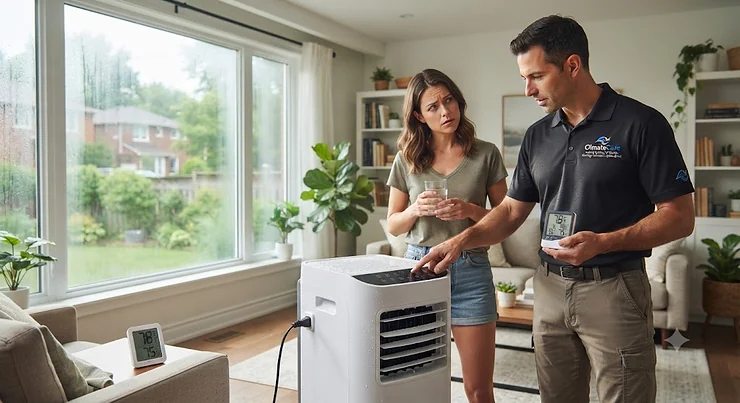
Here’s the question that trips up almost every first-time buyer standing in the fan aisle: does evaporative cooling work in humid climate weather, or is it just an expensive way to make your bedroom feel like a greenhouse? The honest answer is “it depends,” and depends on one number specifically — relative humidity. An evaporative cooler, sometimes called a swamp cooler, pulls warm air through a water-saturated pad; as the water evaporates it steals heat from the air, and you get a cooler breeze out the other side. That’s it. No compressor, no refrigerant, no complicated chemistry — just physics doing the heavy lifting. The catch is that evaporation slows down dramatically once the surrounding air is already carrying a lot of moisture, which is exactly the situation in Southern Ontario in August or coastal British Columbia in a heat dome.
That doesn’t mean these machines are useless east of the Rockies. It means they need to be matched to the right climate, the right room, and the right expectations. Some units — particularly personal-space and battery-powered models — can still pull their weight during the drier stretches of a Canadian summer, or when paired strategically with an air conditioner instead of replacing one. This guide walks through seven real products currently sold on amazon.ca, breaks down how a battery evaporative cooler actually works, explains the evaporative cooler vs air conditioner difference in plain language, and gives you a decision framework so you’re not gambling C$300 on a guess. We’ll also dig into tank capacity, cooling pad technology, and what relative humidity numbers actually mean for your comfort — because a spec sheet without context is just noise.
Quick Comparison Table
Before diving into the full breakdown, here’s a fast snapshot of how these seven units stack up on power source, coverage, and best-fit use case.
| Product | Power Source | Coverage | Tank Capacity | Best For |
|---|---|---|---|---|
| Evapolar evaCHILL | USB / power bank | ~27 sq. ft. (personal) | 800 ml | Dry-air desk cooling |
| Hessaire DC18 | Battery or AC adapter | Personal/patio | 2.8 gal | Camping & battery flexibility |
| Arctic Air Outdoor Evaporative Cooler | USB rechargeable battery | Patio/deck/beach | Small onboard reservoir | Cordless outdoor use |
| ChillWell 2.0 | USB rechargeable | Desk/nightstand | Mini reservoir | Budget personal cooling |
| Hessaire MC18V | Corded (115V) | Up to 500 sq. ft. | 4.8 gal | Garage or workshop dry heat |
| Luma Comfort EC110S | Corded (115V) | Up to 250 sq. ft. | Mid-size tank | Indoor/outdoor all-rounder |
| Honeywell CO60PM | Corded (115V) | Up to 850 sq. ft. | 15.9 gal | Large dry-climate spaces |
Looking at the spread above, the pattern is clear: the smaller, battery-friendly units like the Evapolar evaCHILL and Arctic Air Outdoor Evaporative Cooler trade coverage area for portability, while the Honeywell CO60PM goes the opposite direction with a jumbo tank built for unattended, all-day operation. If your priority is grab-and-go convenience for camping or a balcony, lean toward the battery-powered end of this table; if you’re trying to condition an entire garage or sunroom in a genuinely dry region, the corded, high-CFM units earn their larger footprint.
💬 Just one click — help others make better buying decisions too!😊
Top 7 Evaporative Coolers: Expert Analysis
Amazon’s evaporative cooler category ranges from pocket-sized personal units to garage-sized workhorses, so we picked seven real, currently listed products spanning budget, mid-range, and premium tiers — including several genuinely battery-powered options, since that’s where most of the “does this actually work” confusion starts.
1. Evapolar evaCHILL — best battery-friendly personal cooler for dry air
The standout here is simple: this is one of the only evaporative coolers on the market designed from the ground up to run off a USB power bank, not just a wall outlet. Under the hood you’re getting a 7.5W brushless fan, an 800 ml reservoir, and a basalt-fibre evaporative cartridge that also filters dust as air passes through it. In practical terms, that low draw means you can run the Evapolar evaCHILL for hours off a phone charger-sized battery pack, which no compressor-based mini AC can touch.
Who should buy this? Hot sleepers, dorm-room dwellers, and anyone whose “climate control problem” is really a two-foot radius around a desk chair — not a whole room. Based on independent performance testing, the unit delivers a real 6–9°F drop within about three to four feet, but that number collapses once relative humidity climbs past roughly 60%, which lines up with the physics every evaporative device shares. Reviewers consistently describe it as whisper-quiet at low speeds and genuinely portable, though several note the $80–120 USD price point feels steep for what is, mechanically, a fan with a wet sponge in front of it.
Pros:
- ✅ Runs on USB-C from a laptop, wall adapter, or power bank
- ✅ Whisper-quiet operation even at higher fan speeds
- ✅ Doubles as a humidifier and light air purifier
Cons:
- ❌ Effectiveness drops sharply above 60% relative humidity
- ❌ Cooling radius is limited to about 3–4 feet
Typically listed in the C$110–C$160 range on amazon.ca, the Evapolar evaCHILL is solid value if your use case is genuinely personal-space cooling in a drier room — less so if you’re hoping it’ll take the edge off a humid living room.
2. Hessaire DC18 Mobile Evaporative Cooler — best true dual-power hybrid
What sets the Hessaire DC18 apart from most personal coolers is that it genuinely runs on either batteries or an included AC adapter, with a variable-speed dial and a 2.8-gallon water tank that’s enormous compared to desktop units like the evaCHILL. In practice, that bigger reservoir means fewer refills during a camping trip or patio session, and the dual power option means you’re not stranded if there’s no outlet nearby.
This one is aimed squarely at people who move between locations — cottage decks, tailgates, garages without reliable power — rather than a fixed bedroom setup. Because Hessaire built its reputation on larger corded swamp coolers, the DC18 inherits the brand’s straightforward, fill-and-go operation rather than a lot of smart-home extras. Aggregated buyer feedback on similar Hessaire portables highlights easy setup and dependable airflow, though as with any battery evaporative cooler, expect shorter run-times on battery power than when it’s plugged in.
Pros:
- ✅ True dual power — runs on battery or AC adapter
- ✅ 2.8-gallon tank means fewer mid-session refills
- ✅ Variable speed dial for fine-tuned airflow
Cons:
- ❌ Battery runtime is noticeably shorter than corded use
- ❌ Like all evaporative units, humidity still caps performance
Expect a price in the C$100–C$150 range at the time of research. For anyone who needs a cooler that can leave the outlet behind, the Hessaire DC18 earns its spot as a genuinely flexible mid-tier pick.
3. Arctic Air Outdoor Evaporative Cooler — best for cordless patio and camping use
The headline feature is a 6-hour rechargeable battery with USB charging, which frees this unit entirely from extension cords — a real advantage for beach days, poolside lounging, or campsites. Three 8-inch blades push air through two high-capacity cooling jets, and four fan speeds (low through turbo) give you meaningful control over airflow versus battery life.
Practically speaking, this is a “great outdoors” cooler first and a bedroom cooler second. Its weather-resistant housing and built-in carry handle signal that Arctic Air designed it for movement — deck to dock to tent — rather than staying parked in one room. Reviewers highlight the convenience of USB recharging and the lightweight build, though the trade-off with any cordless unit is that once the 6 hours run out, you’re waiting on a recharge rather than just topping off water.
Pros:
- ✅ Genuine 6-hour cordless battery life
- ✅ Weather-resistant build for outdoor and camping use
- ✅ Four adjustable fan speeds including a turbo setting
Cons:
- ❌ Cooling effect is modest outdoors in open air
- ❌ Battery downtime between recharges limits all-day use
Priced roughly in the C$60–C$90 range, the Arctic Air Outdoor Evaporative Cooler is an easy budget add-on for anyone who already knows they want cordless flexibility over raw cooling power.
4. ChillWell 2.0 — best budget desktop battery swamp cooler
The ChillWell 2.0 is a compact, USB-rechargeable mini swamp cooler with four fan speeds and a small onboard humidifier function, built for nightstands, desks, and small offices. Its water reservoir is modest, but the trade-off buys you a genuinely pocketable footprint and one of the lowest entry prices in this roundup.
This is a battery swamp cooler explained in its simplest form: fan, wet pad, small tank, done. It’s a reasonable choice for someone testing whether evaporative cooling suits them at all before investing in a larger unit, or for supplementing airflow at a desk where a full AC unit isn’t practical. Aggregated customer sentiment on comparable USB mini coolers in this category tends to split — people in drier rooms report a noticeable, pleasant drop in perceived temperature, while those in already-humid rooms describe it functioning more like a plain fan with a slight misty feel.
Pros:
- ✅ USB-rechargeable for true cord-free convenience
- ✅ Compact enough for any desk or nightstand
- ✅ Functions as a light humidifier alongside cooling
Cons:
- ❌ Small reservoir requires frequent refilling
- ❌ Cooling is limited strictly to personal space, not a room
At under C$100, the ChillWell 2.0 is one of the lowest-risk ways to try battery-powered evaporative cooling without committing to a bigger purchase.
5. Hessaire MC18V — best tank-to-price ratio for garages and workshops
The Hessaire MC18V trades portability for volume: a 1,300 CFM fan, a 4.8-gallon water tank, and coverage rated up to 500 square feet, plus a garden-hose adapter with a float valve for continuous, unattended operation. That last detail matters — instead of manually refilling a tank every few hours, you can plumb it into a hose and let it run through a full workday.
Based on the spec comparison with smaller units in this list, the jump from an 800 ml personal reservoir to a 4.8-gallon tank is the difference between “cooling my desk” and “cooling my garage while I work on a car.” Hessaire markets up to 50% electricity savings versus refrigerated AC, which tracks with how evaporative systems avoid running a compressor entirely. The trade-off is that this is a corded, 115V unit only — there’s no battery mode here, so it’s tethered to an outlet.
Pros:
- ✅ 4.8-gallon tank plus hose hookup for continuous runtime
- ✅ Covers up to 500 square feet of open, ventilated space
- ✅ Up to 50% lower electricity use versus refrigerated AC
Cons:
- ❌ No battery option — corded 115V power only
- ❌ Needs open ventilation, so it’s not ideal for sealed rooms
Typically found in the C$250–C$320 range, the Hessaire MC18V is the pick for anyone who’s outgrown personal cooling and needs real square footage covered in a dry, well-ventilated space like a garage or workshop.
6. Luma Comfort EC110S — best indoor/outdoor all-rounder
Rated at 500 CFM and up to 250 square feet of coverage, the Luma Comfort EC110S is built to move between a covered patio and an indoor living room without missing a beat, thanks to a programmable timer and three fan speeds. It functions as a fan, humidifier, and cooler in one unit, which is handy if your household’s needs shift throughout the season.
Here’s where honesty matters most: aggregated review sentiment on the Luma Comfort EC110S is genuinely mixed. Some owners in drier regions report a comfortable, noticeable temperature drop, while others — particularly in humid pockets of the eastern half of the continent — describe it working “just like a fan” once relative humidity climbs, with one reviewer specifically noting disappointment that it didn’t cool the intended area as expected. That split isn’t a flaw unique to this product; it’s the evaporative cooler vs air conditioner difference playing out in real time, and it’s exactly why matching the unit to your local humidity matters more than any single spec.
Pros:
- ✅ Rated for both indoor and outdoor placement
- ✅ Programmable timer for overnight or scheduled use
- ✅ Triple function as cooler, fan, and humidifier
Cons:
- ❌ Mixed owner feedback in higher-humidity regions
- ❌ Doesn’t approach true AC-level room cooling
Sitting in the C$300–C$380 range at the time of research, the Luma Comfort EC110S rewards buyers in genuinely dry climates far more than those chasing relief in a muggy July heat dome.
7. Honeywell CO60PM — best premium pick for large, dry spaces
The Honeywell CO60PM is the heavyweight of this list: a 15.9-gallon tank, a top-loading ice compartment, continuous water-supply hookup with overflow protection, and coverage rated up to 850 square feet indoors (more outdoors with adequate airflow). It draws only around 220 watts — remarkably low given the volume of air it moves — because, like every unit here, it skips the compressor entirely.
What most buyers overlook about this model is that Honeywell itself publishes a humidity map recommending indoor and outdoor use below roughly 45% relative humidity, outdoor-only use up to about 65%, and steering humid regions toward a real air conditioner instead. That’s refreshingly candid manufacturer honesty, and it should set expectations correctly: this is a dry-climate workhorse, not a fix for a swampy Ontario August. Owners in appropriate climates report solid, consistent cooling and appreciate the continuous-hose feature for unattended runs, while a recurring critique in independent reviews is the unit’s bulky footprint and premium price relative to smaller options.
Pros:
- ✅ 15.9-gallon tank with continuous water-supply hookup
- ✅ Covers up to 850 square feet — largest in this roundup
- ✅ Only around 220W power draw for its size
Cons:
- ❌ Large, heavy footprint that’s harder to store or move
- ❌ Premium pricing compared to smaller portable units
Expect a price in the C$650–C$800 range at the time of research. The Honeywell CO60PM is the right call for a large garage, patio, or sunroom in a genuinely dry region — and honestly, the wrong call if you live somewhere the Humidex regularly cracks 40.
How Does a Battery Evaporative Cooler Work?
A battery evaporative cooler works the same way any swamp cooler does, just with the fan and water pump drawing current from a rechargeable cell instead of a wall outlet. A small DC motor spins a fan that pulls warm air through a water-saturated pad or cartridge; as the water evaporates, it absorbs heat energy from the passing air, and the cooler, more humid air is pushed out toward you.
The battery’s job is only to power the fan and, in some models, a small internal pump — it doesn’t do any cooling itself. This is why units like the Evapolar evaCHILL and Hessaire DC18 can run on something as small as a USB power bank: the actual cooling mechanism costs almost no energy compared to a compressor-based air conditioner. What most buyers overlook is that battery capacity mainly limits runtime, not cooling power — a battery unit and a corded unit with the same pad size and airflow will cool about the same amount of air per minute, they just differ in how long they can keep doing it before you recharge or refill.
Evaporative Cooler vs Air Conditioner: The Real Difference
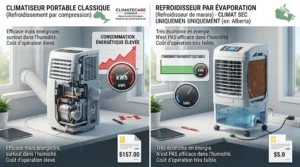
The evaporative cooler vs air conditioner difference comes down to how each machine removes heat. An air conditioner uses a compressor to cycle refrigerant, actively pumping heat out of a sealed space — that’s why it can drop a room’s temperature regardless of outdoor humidity. An evaporative cooler simply speeds up water evaporation and relies on the surrounding air having room to absorb that moisture, which only happens efficiently when humidity is already low.
Here’s what the spec sheet won’t tell you outright: evaporative coolers add moisture to the air as a byproduct of cooling it, while air conditioners remove moisture as a byproduct of cooling it. That single distinction explains almost every real-world complaint and compliment you’ll read about swamp coolers. In a dry climate, that added humidity feels pleasant and prevents the “over-air-conditioned” dry-skin sensation. In a humid climate, that same added moisture makes a room feel clammy rather than cool — which is precisely why the question “does evaporative cooling work in humid climate” doesn’t have a universal yes-or-no answer; it depends entirely on where you live and what month it is.
Cost is the other half of the story. Evaporative coolers typically draw a fraction of the wattage of a compressor-based AC unit, which is why manufacturers like Hessaire and Honeywell advertise electricity savings in the 50–75% range compared to refrigerated cooling — a genuine advantage in the right climate, and a moot point in the wrong one.
✨ Don’t Miss These Exclusive Deals!
🔍 Whether you’re leaning battery-powered or full-size, take a closer look at current pricing and availability on the models above. A few extra minutes of research now can save you from buying the wrong tool for your climate.
Relative Humidity and Cooling Performance: What the Numbers Actually Mean
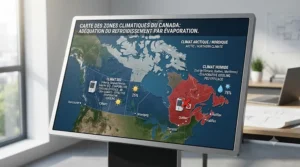
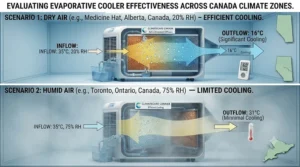
Relative humidity cooling performance isn’t linear — it falls off a cliff rather than sloping gently downward. Below roughly 30% relative humidity, most evaporative coolers can drop the surrounding air temperature by 15–25°F. Between 30% and 50%, expect a more modest 8–15°F drop. Past 60%, that number shrinks toward single digits, and above 70–80%, several manufacturers and independent testers report the units essentially become expensive fans with a faint misting effect.
This matters enormously for Canadian buyers because relative humidity here swings hard by region and season, and humid heat has a documented health impact that goes well beyond simple discomfort. The interior of British Columbia, the Prairies, and inland areas during dry spells can see humidity comfortably in the 30–45% range where evaporative cooling genuinely shines. Coastal cities and much of Ontario and Quebec through July and August routinely sit at 60–80% relative humidity, especially during humidex-driven heat events — precisely the conditions where these units lose most of their punch. Reviewers consistently note this pattern across brands: the same Luma Comfort EC110S or Honeywell CO60PM that impresses one buyer in a dry region disappoints another in a humid one, and the difference usually isn’t the product — it’s the weather outside the window.
Evaporative Cooling Pad Technology Explained
Evaporative cooling pad technology has moved well beyond the old straw-mat coolers of decades past. Most modern units, including the Hessaire MC18V, use rigid, honeycomb-structured cellulose or synthetic media — Hessaire brands its version XeL50 — engineered to maximize surface area for water contact while minimizing airflow resistance. More surface area means more evaporation per cubic foot of air pushed through, which translates directly into a bigger temperature drop.
Smaller personal units take a different approach: the Evapolar evaCHILL, for instance, uses a basalt-fibre cartridge rather than a traditional pad. Based on the spec comparison, basalt fibre offers two practical advantages — it’s inherently mineral-based rather than organic, which resists the mould and bacterial growth that can plague cheaper cellulose pads left damp, and it doubles as a light air filter, catching larger dust particles as air passes through. The trade-off is that these cartridges need periodic replacement (roughly every three to six months, depending on water quality and usage), an ongoing cost that’s easy to overlook when comparing sticker prices between models.
Swamp Cooler Water Tank Capacity: How Much Water Do You Actually Need?
Swamp cooler water tank capacity varies wildly across this roundup, from the Evapolar evaCHILL‘s 800 ml reservoir to the Honeywell CO60PM‘s 15.9-gallon tank — nearly a 75-fold difference. Tank size determines two practical things: how long the unit runs unattended, and how much water you’ll be hauling and refilling week to week.
As a rough rule of thumb, expect roughly three to eight hours of runtime per litre of water on personal units, depending on fan speed and ambient humidity (higher humidity actually stretches runtime slightly, since less water evaporates per hour — a small silver lining to an otherwise limiting factor). Larger corded units like the Hessaire MC18V and Honeywell CO60PM offer continuous garden-hose hookups specifically to sidestep the refill problem altogether, which is worth prioritizing if you plan to run a unit for a full workday in a garage or on a patio without checking on it constantly. For occasional personal use, a smaller tank is a minor inconvenience; for all-day operation, hose compatibility becomes a genuine deciding factor.
How to Choose an Evaporative Cooler for a Humid Canadian Climate
Picking the right unit comes down to matching the machine to your actual climate and use case, not just the biggest CFM number on the box. Here’s a practical framework:
- Check your region’s typical summer humidity first. If you’re in a coastal city or Southern Ontario, treat evaporative cooling as a supplement to fans or AC, not a full replacement.
- Match power source to use case. Battery units like the Arctic Air Outdoor Evaporative Cooler suit patios, camping, and mobility; corded units suit fixed rooms with reliable outlet access.
- Prioritize tank size for unattended runtime. If you won’t be around to refill, look for hose-hookup compatibility like the Hessaire MC18V offers.
- Size coverage to the actual room, not the whole house. A 250-square-foot unit in an 800-square-foot open-concept space will underperform regardless of specs.
- Budget for ongoing costs. Replacement cartridges, pads, and water treatment tablets add up over a season — factor them into your total cost, not just the sticker price.
- Set realistic expectations for humid stretches. Even the best unit here will feel weaker during a humidex warning; that’s physics, not a defective product.
- Consider pairing, not replacing. Running an evaporative cooler in a drier morning and switching to AC during peak humidity often beats relying on either exclusively.
Common Mistakes When Buying an Evaporative Cooler
The single most common mistake is buying based on square-footage claims without checking the manufacturer’s recommended humidity range — a mistake nearly every negative review in this category traces back to. Honeywell, for instance, explicitly maps out which regions its units suit, yet that detail rarely makes it into the product title buyers scan while shopping.
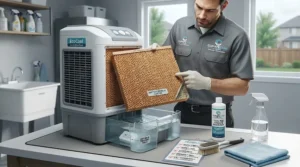
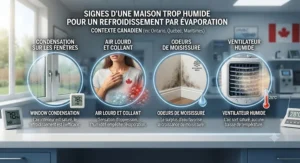
A second frequent misstep is underestimating ongoing maintenance. Cooling pads and cartridges need periodic replacement, and skipping that swap doesn’t just reduce cooling power — stagnant, dirty pads can develop odour and mould, especially in already-humid environments where things dry out slowly to begin with. Finally, plenty of buyers place these units in sealed, poorly ventilated rooms, which is nearly the opposite of what evaporative cooling needs; without a path for humid air to exit (an open window, door, or adjacent room), the unit just raises indoor humidity without meaningfully lowering temperature. As researchers at the University of Waterloo note, the health stakes of getting indoor cooling wrong during a heat event are real, which makes proper ventilation and placement more than just a comfort issue.
Practical Usage Guide: Setup, Maintenance & First 30 Days
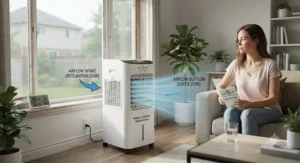
Getting the most out of any evaporative cooler starts before you even plug it in. Fill the tank with clean, cool water — some brands recommend a water-treatment tablet to slow bacterial growth, particularly for tanks that sit for days between uses. Position the unit near an open window, door, or otherwise ventilated area; evaporative cooling depends on humid exhaust air having somewhere to go, and sealing it into a closed room defeats the purpose almost immediately.
During the first 30 days, run the unit on a lower fan speed initially to gauge real-world cooling before cranking it to maximum, since higher speeds move more air but also drain battery or evaporate the tank faster. Wipe down and air-dry the pad or cartridge every one to two weeks depending on use, and inspect it monthly for mineral buildup if you’re using tap water rather than distilled. A common optimization trick that Amazon listings rarely mention: running the unit in early morning or evening, when ambient humidity is typically lower than midday, can noticeably improve performance even in a generally humid region. Battery-powered models benefit from a full charge cycle before first use, and it’s worth noting the manufacturer’s stated runtime is usually measured at a lower fan speed — expect shorter sessions at full blast.
Real-World Scenarios: Who Actually Benefits in Canada
Consider a university student in a Vancouver dorm room without central air, dealing with occasional dry-spell heat but generally moderate coastal humidity. A personal unit like the Evapolar evaCHILL, running off a USB power bank, fits both the budget and the modest square footage — and its quiet operation matters for shared living spaces.
Now picture a homeowner in the Okanagan Valley with a detached garage workshop and genuinely arid summer air. That’s the textbook use case for the Hessaire MC18V: real square footage, low humidity most of the season, and a garden-hose hookup that keeps it running through a full workday without babysitting. Finally, think about a family in the Greater Toronto Area weighing whether to skip central air entirely. Here, honesty matters most: a unit like the Honeywell CO60PM, however capable in dry climates, is a poor primary solution given how often the GTA sits above 60% relative humidity through July and August. That household is better served pairing a smaller evaporative unit for drier mornings with a proper air conditioner for the humid afternoon stretch — exactly the kind of nuanced, use-case-specific advice a spec sheet alone won’t give you.
Problem → Solution: Fixing the Most Common Complaints
Problem: “It’s not cooling my room at all.” This almost always traces back to high ambient humidity or a sealed, unventilated space. Solution: crack a window or door near the unit, and reset expectations — evaporative cooling narrows the temperature gap, it doesn’t eliminate it, especially above 60% relative humidity.
Problem: “The air feels muggy, not cool.” This is the evaporative cooler vs air conditioner difference showing up directly — you’re adding moisture to already-moist air. Solution: run the unit during lower-humidity windows (mornings, evenings) or switch to AC during peak humidity hours.
Problem: “It smells musty after a few weeks.” Standing water plus a damp pad is a recipe for bacterial growth. Solution: empty and dry the tank between extended uses, replace the pad or cartridge on schedule, and consider a water-treatment tablet.
Problem: “Battery life feels shorter than advertised.” Manufacturer runtimes are typically measured at lower fan speeds. Solution: drop to speed one or two for extended sessions and reserve turbo mode for short bursts.
Problem: “My tank needs refilling constantly.” Small personal units simply hold less water. Solution: for all-day use, step up to a hose-compatible model like the Hessaire MC18V or Honeywell CO60PM rather than fighting a small reservoir’s limits.
Frequently Asked Questions
❓ Does evaporative cooling work in humid climate conditions?
❓ How does a battery evaporative cooler work?
❓ What's the real evaporative cooler vs air conditioner difference?
❓ How much water does a swamp cooler use per day?
❓ Can I run an evaporative cooler indoors during a humid Ontario or Quebec summer?
Conclusion
So, does evaporative cooling work in humid climate summers across most of Canada? The honest, unglamorous answer is: partially, and only if you match the unit and your expectations to the actual weather outside. In genuinely dry stretches — inland B.C., the Prairies, early-season heat before humidity builds — these machines, from the pocket-sized Evapolar evaCHILL to the garage-sized Honeywell CO60PM, deliver real, energy-efficient cooling at a fraction of an air conditioner’s power draw. Once relative humidity climbs into humidex-warning territory, though, even the best-reviewed unit in this roundup starts acting more like a fan with a splash of mist.
The smartest approach for most Canadian households sitting in that humid middle ground is pairing, not replacing: run a battery evaporative cooler like the Hessaire DC18 or Arctic Air Outdoor Evaporative Cooler during cooler, drier mornings and evenings, and lean on proper air conditioning when the Humidex spikes. Environment and Climate Change Canada’s extreme heat guidance is worth bookmarking for exactly those high-humidity, high-risk days — a swamp cooler alone isn’t a substitute for real cooling when a heat warning is in effect. Match the tool to the climate, budget for the tank size and maintenance that fit your routine, and you’ll get genuine value out of any of the seven products covered here.
✨ Ready to Beat the Heat the Smart Way?
🔍 Compare current pricing on today’s top evaporative coolers and find the option that actually fits your climate — before the next heat warning hits.
Recommended for You
- Battery Evaporative Cooler vs Misting Fan: 7 Real Picks for 2026
- Battery Evaporative Cooler for Camping: 7 Picks That Actually Work (2026)
- 7 Best Battery Powered Evaporative Cooler Picks for Canadian Summers (2026)
Disclaimer: This article contains affiliate links. As an Amazon Associate, I earn from qualifying purchases. If you purchase products through these links, we may earn a small commission at no additional cost to you.
✨ Found this helpful? Share it with your friends! 💬🤗
