
In This Article
It’s 31°C at 4 p.m., the campsite has no hookups, and your rooftop unit is sitting there like an expensive skylight. Picking the right generator for RV air conditioner duty is the difference between a cool bunk and a sweaty, short-tempered evening. It’s also trickier than the numbers on the box suggest. 🌡️
Here’s the catch. An RV air conditioner is a diva. It sips politely once it’s running, then demands a violent gulp of current the instant the compressor kicks in. Plenty of generators advertise big numbers and still trip the breaker the moment you press “cool.” Others have the muscle but are so loud that you’ll be getting a visit from the camp host.
Noise matters more in Canada than many buyers realize. Alberta Parks restricts fuel generator use to set windows at participating campgrounds, allows it from 7 a.m. to 11 p.m. elsewhere, and explicitly encourages inverter models over big, rattling units. Other provinces and Parks Canada sites set their own hours. A quiet generator RV owners can actually run in the afternoon heat is worth paying for.
This guide does the legwork. We compared seven real models, from budget to premium, on starting watts vs running watts, noise, weight and Canadian practicality. Every spec comes from manufacturer or retailer listings. Every opinion is analysis of that data, not a claim of hands-on testing. Let’s find your match. ⚡
What Is a Generator for RV Air Conditioner?
A generator for RV air conditioner use is a portable, usually inverter-type engine generator sized to start and run a rooftop RV air conditioner, typically 13,500 or 15,000 BTU, without tripping. It must deliver enough starting (surge) watts for the compressor spike, enough running watts for continuous cooling, and ideally a 30-amp TT-30R outlet and low noise.
That definition separates it from the open-frame contractor unit in your neighbour’s garage. A proper RV generator uses inverter electronics to produce clean power (the models below quote under 3% total harmonic distortion). It throttles the engine up and down with demand, so it’s quieter and thirstier only when the load calls for it. You’ll also see it called a generator for RV AC, and the two phrases mean the same thing. The RV-ready TT-30R receptacle lets you plug your trailer’s shore cord straight in, no adapter gymnastics. 🔌
Quick Comparison: 7 Generators for RV Air Conditioner at a Glance
| Product | Starting / Running Watts | Noise | Weight | Price Range (CAD)* | Best For |
|---|---|---|---|---|---|
| WEN 56380i | 3,800 / 3,400 | 57 dBA at ¼ load | 45 kg | C$1,000–C$1,300 | Tight budgets |
| Champion 4000-Watt Dual Fuel RV Ready Inverter | 4,000 / 3,000 gas (2,700 propane) | 64 dBA at 7 m | Check listing | C$1,200–C$1,500 | Propane lovers |
| Champion 4500-Watt RV Ready Inverter | 4,500 / 3,500 | 61 dBA | 49 kg (shipping) | C$1,100–C$1,400 | Surge headroom per dollar |
| Westinghouse iGen4500 | 4,500 / 3,700 | As low as 52 dBA | 44 kg | C$1,400–C$1,900 | Remote start, heavy loads |
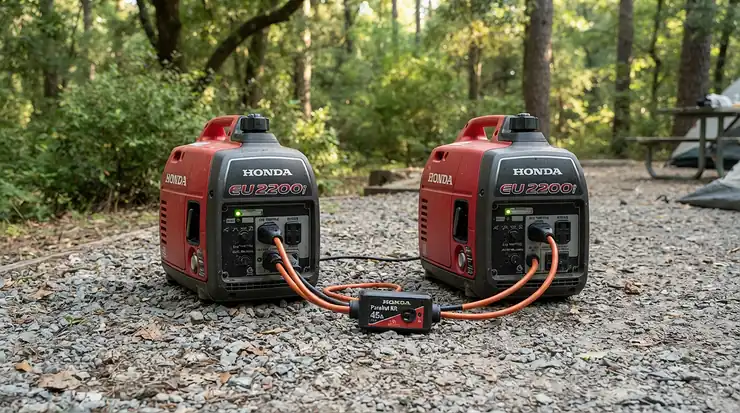
| Honda EU2200i | 2,200 / 1,800 each (4,400 paired) | 48–57 dBA | 21.5 kg each | C$1,900–C$2,400 each | Lightest, easiest to carry |
| Honda EU3200i | 3,200 / 2,600 | 54–58 dBA | 26.8 kg | C$3,300–C$4,200 | Quiet single-unit setup |
| Yamaha EF3000iSEB | 3,000 (+500 boost) / 2,800 | 53–60 dBA | 70 kg | C$3,000–C$4,000 | Boosted starts, built-in wheels |
*Approximate ranges at the time of research; prices vary, so check current price on Amazon.ca.
Looking at the table, the WEN 56380i and both Champion models deliver the most watts per dollar, while the Hondas cost two to three times as much for lower weight and a gentler noise profile. If you camp in quiet-hours parks and hate lifting heavy gear, that premium buys real daily convenience. If your trailer lives on a seasonal site and the generator rarely moves, the budget trio is hard to argue with. Note that the Yamaha EF3000iSEB is the heaviest here, so the wheels earn their keep.
💬 Just one click — help others make better buying decisions too!😊
Top 7 Generators for RV Air Conditioner: Expert Analysis
1. WEN 56380i — most running watts for the money
The headline is simple arithmetic: 3,400 running watts at a price well below the name-brand crowd.
The 212cc engine delivers 3,800 starting watts and 3,400 running watts. That comfortably covers a 13,500 BTU rooftop unit, which draws roughly 1,500 to 1,900 watts once running, with room left for a fridge and a converter. WEN quotes 57 dBA at quarter load, about conversation level. Quarter load is the flattering test, though, so expect it to be louder when the AC compressor is working. At 45 kg (99.2 lb), it’s a two-person lift or a ramp job.
Based on the spec comparison, this is the pick for budget-minded owners of a 30-amp trailer who set up once and stay put. The fuel shut-off lets the carburetor run dry before shutdown, which helps prevent stale-fuel gumming in storage.
Reviewer comments I could verify focus on value and on following a careful break-in routine. I couldn’t confirm a large independent review set for the RV-ready variant, so read the current reviews yourself.
Pros:
- ✅ 3,400 running watts at an entry-level price
- ✅ Fuel shut-off helps prevent carburetor gumming
- ✅ Low harmonic distortion protects electronics
Cons:
- ❌ At 45 kg, a solo lift is a struggle
- ❌ Louder under AC load than the quarter-load figure suggests
Expect roughly C$1,000–C$1,300 (check current price); it’s strong value if you can live with the weight.
2. Champion 4000-Watt Dual Fuel RV Ready Inverter — propane flexibility
Run it on gasoline today and propane tomorrow, and never worry about stale fuel again.
This 149cc inverter produces 4,000 starting watts and 3,000 running watts on gasoline. On propane, running output drops to 2,700 watts, a typical derate of about 10%. It’s quoted at 64 dBA from 7 m (23 ft) and runs up to 10 hours on a 5.8 L (1.54 gal) gasoline tank at 25% load. On a 9 kg (20 lb) propane cylinder, that stretches to roughly 25 hours. It has a TT-30R outlet, CO Shield auto shutoff and an optional parallel kit.
Here’s the thing most buyers overlook. Those 3,000 running watts are fine for one 13,500 BTU AC alone, but add a microwave or a battery-hungry converter and you’re on the edge, and propane trims the margin further. Pair it with a soft starter and it makes a lot more sense. Champion sells several 4,000-watt variants with different specs, so match the model number (201050) against the listing before buying.
Owner feedback I could verify for this exact variant is thinner than for Champion’s other inverters, so treat the details here as spec-sheet-based.
Pros:
- ✅ Runs on gasoline or propane
- ✅ Long propane runtime from one cylinder
- ✅ CO Shield auto shutoff built in
Cons:
- ❌ 3,000 running watts leaves a thin margin
- ❌ Louder rating than the Honda or Westinghouse
Plan on around C$1,200–C$1,500; the value verdict is good for propane users and mediocre for everyone else.
3. Champion 4500-Watt RV Ready Inverter — surge headroom per dollar
If you want the biggest surge number without a premium badge, this is the cheeky middle path.
It produces 4,500 starting watts and 3,500 running watts from a 212cc engine, with a 29.2 A TT-30R outlet, a 20 A household duplex, a 12 V outlet and total harmonic distortion under 3%. It’s rated at 61 dBA, runs up to 14 hours on an 8.7 L (2.3 gal) tank at 25% load, and carries a shipping weight near 49 kg. Intelligauge displays voltage, frequency and hours, a small touch that’s handy for maintenance tracking.
On paper, that 4,500-watt surge gives it better odds of starting a stubborn 15,000 BTU unit than the 3,200-watt-class machines. Reviewers on retail listings repeatedly mention quiet operation and clean power. One compared it favourably with a Honda EU3000-class unit, which is a single anecdote, but it lines up with the 61 dBA spec.
Pros:
- ✅ 4,500 starting watts for tough compressor starts
- ✅ Intelligauge shows voltage and hours
- ✅ Parallel ready with another 2,800-watt-plus Champion
Cons:
- ❌ Heavier than the Honda options
- ❌ Fuel-hungrier than the 2,200-watt class
Expect around C$1,100–C$1,400; it’s arguably the value sweet spot of this list.
4. Westinghouse iGen4500 — remote start from the bunk
Imagine switching the generator on from the air-conditioned side of the RV. 🛋️
That’s the party trick: a key fob starts and stops the engine from about 100 m (109 yards) away. The 224cc engine delivers 4,500 starting watts and 3,700 running watts, the highest running figure in this roundup, with a TT-30R outlet and push-button electric start. The 12.9 L (3.4 gal) tank runs up to 16–18 hours at 25% load, depending on the spec-sheet revision. Weight is about 44 kg dry. Westinghouse’s spec sheet labels the unit a “50 State and Canada Model,” which is reassuring for Canadian buyers.
On noise, treat the best-case “as low as 52 dBA” with caution. An older spec sheet lists 62 dBA at 25% load and 65 dBA at 50%. Based on the numbers, it’s powerful enough for a second AC with soft starts and parallel capability via a 50-amp cord.
Independent review data I could verify was thin, and many glowing write-ups came from affiliate-style roundups, so read recent buyer reviews critically.
Pros:
- ✅ 3,700 running watts, the most here
- ✅ Remote start from inside the RV
- ✅ Parallel capable for dual-AC rigs
Cons:
- ❌ Real-world noise is higher than the 52 dBA headline
- ❌ 44 kg needs a plan for loading
Budget roughly C$1,400–C$1,900; it’s a fair premium for the power and the fob.
5. Honda EU2200i — lightest option, run in pairs
The Honda EU2200i is the lightest machine here, and the pairing trick is why it earns a spot.
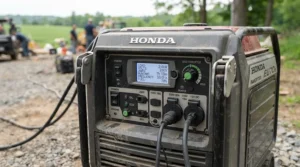
A single unit makes 2,200 starting and 1,800 running watts from the GXR120 engine, at 48 dBA at quarter load and 57 dBA at rated load. It weighs just 21.5 kg (47.4 lb). Run times are 3.2 hours at rated load and 8.1 hours at quarter load per tankful. Two identical units can be linked with an optional cable for 4,400 watts maximum, and the Companion variant has a built-in 30 A outlet for easier parallel hookup.
Here’s what the spec sheet won’t tell you, but owner reports suggest. One unit alone usually can’t start a 13,500 BTU AC without a soft starter. Micro-Air says its EasyStart does work with the earlier EU2000i, though results depend on the system. A pair solves the problem, and each half stays light enough to carry one-handed.
Forum owners consistently cite reliability and resale value, with price as the sticking point.
Pros:
- ✅ At 21.5 kg, one-person carry
- ✅ Very low noise at part load
- ✅ Parallel capability for two-unit power
Cons:
- ❌ A pair costs more than most single 4,000-watt units
- ❌ A single unit needs a soft starter for AC
Expect around C$1,900–C$2,400 each (check current price); the verdict is premium, but justified if you value weight and noise above all else.

6. Honda EU3200i — quiet single unit with real headroom
If you want one box, one quiet engine and no assembly, this is the grown-up choice.
The GX130 engine produces 3,200 watts max and 2,600 rated, at 54 dB(A) at quarter load and 58 dB(A) at rated load. It weighs 26.8 kg (59.1 lb), runs 8.6 hours at quarter load, and has Bluetooth monitoring through Honda’s app plus CO-Minder detection. Honda states plainly that it can run a 13,500 BTU RV air conditioner. It also parallels with another EU3200i for up to 6,400 watts.
One practical wrinkle: the receptacle is a 30 A locking plug, not the TT-30R found on the “RV-ready” models above. Plan for a compatible adapter or cord. And remember that the AC’s own start current matters as much as the label. One older EU3000is owner thread reports needing hard-start capacitors for a 13,600 BTU unit.
Pros:
- ✅ Among the quietest generators in its power class
- ✅ Light at 26.8 kg for 3,200 watts
- ✅ Bluetooth app and CO-Minder safety
Cons:
- ❌ Premium price for a 2,600-watt rated output
- ❌ 30 A locking outlet may require an adapter
Plan on C$3,300–C$4,200; it’s expensive, but strong for frequent campers who prioritize quiet.
7. Yamaha EF3000iSEB — boost for compressor starts
Yamaha’s party piece is the boost feature that adds battery voltage to the alternator output when the load demands it.
The EF3000iSEB is rated 3,000 watts maximum (plus a 500-watt boost) and 2,800 watts continuous, from a 171cc engine. Noise runs 53 to 60 dBA from quarter to rated load. The 12.9 L (3.4 gal) tank gives up to 19 hours at quarter load, and a 12 V DC output with charging cables can top up RV batteries. It weighs about 70 kg (154 lb), so the built-in wheels are essential.
That boost is the design answer to the compressor spike this whole guide is about. If you want a single unit that doesn’t rely on a soft starter, it’s one to shortlist. Check receptacle type on the listing, since adapters may be needed, and confirm Amazon.ca availability, which can be inconsistent for dealer-focused brands.
I couldn’t verify a meaningful body of independent reviews for this exact model, so rely on the spec sheet and warranty (three years) here.
Pros:
- ✅ Boost helps with AC compressor starts
- ✅ Wheels and long 19-hour runtime
- ✅ 12 V output charges RV batteries
Cons:
- ❌ At 70 kg, loading into a truck is a chore
- ❌ Receptacle layout may need an adapter
Expect about C$3,000–C$4,000; it’s best for owners who can leave it mounted or wheel it short distances.
Side-by-Side: Fuel, Runtime and Connectivity
| Product | Fuel | Runtime Claim | Parallel | Receptacle | Best For |
|---|---|---|---|---|---|
| WEN 56380i | Gasoline | Up to 8.5 h at 50% load | Check listing | RV-ready (TT-30R) | Budget buyers |
| Champion 4000-Watt Dual Fuel RV Ready Inverter | Gas/propane | 10 h gas, 25 h propane at 25% | Optional kit | TT-30R | Propane users |
| Champion 4500-Watt RV Ready Inverter | Gasoline | 14 h at 25% | Optional kit | TT-30R | Value hunters |
| Westinghouse iGen4500 | Gasoline | Up to 16–18 h at 25% | Yes, 50 A cord | TT-30R | Big loads |
| Honda EU2200i | Gasoline | 8.1 h at ¼ load | Yes, cable | Household (Companion adds 30 A) | Portability |
| Honda EU3200i | Gasoline | 8.6 h at ¼ load | Yes, to 6,400 W | 30 A locking | Quiet singles |
| Yamaha EF3000iSEB | Gasoline | Up to 19 h at ¼ load | Check listing | Check listing | Boosted starts |
The runtime figures aren’t directly comparable, because they’re quoted at different loads. A 14-hour claim at 25% load will shrink quickly once an AC is running, so judge by running watts and tank size rather than the headline hours. The Westinghouse iGen4500 and both Champion inverters offer the plug-and-play TT-30R experience. The Honda EU3200i wants an adapter but rewards you with the quietest, lightest build.
✨ Don’t Miss These Exclusive Deals!
🔍 Take your camping comfort to the next level with these carefully selected generators. Click on any highlighted item to check current pricing and availability on Amazon.ca. These picks will help you create a cool, quiet campsite your whole family will love! ❄️
Starting Watts vs Running Watts: The Number That Actually Decides Everything
Starting watts vs running watts is the single most misunderstood comparison on any generator box. Starting (or surge) watts is a short burst the generator can deliver for a few seconds. Running watts is what it can supply continuously. Marketing loves the big starting number, but the running figure is the honest one.
An RV AC is the classic mixed load. Micro-Air puts typical running draw at 12 to 16 amps, which at 120 V is roughly 1,440 to 1,920 watts. The compressor start, however, can pull several times that for a moment. Owner posts mention locked-rotor ratings in the 50 to 62 amp range for 15,000 BTU units.
Here’s the practical reading. A generator for RV AC needs both enough surge to get the compressor turning and enough running watts to cover the AC plus everything else you’ve left on. A good rule is to leave about 20% headroom on running watts. Two derates shave your margin. Propane typically costs about 10% of output, as on the Champion 4000-Watt Dual Fuel RV Ready Inverter. Altitude does too, and one RV forum owner describes a 2,000-watt unit struggling at about 1,200 m (4,000 ft).
A soft starter changes the math. Micro-Air says its EasyStart cuts start current by 65 to 75% versus the compressor’s locked-rotor amps. That’s why the Honda EU2200i can stretch to a 13,500 BTU unit, but each AC needs its own device.
RV AC BTU Rating: How Big a Generator Do You Need?
The RV AC BTU rating describes cooling capacity, not electrical demand. A 13,500 BTU unit moves about 4 kW of heat, yet draws only about 1.5 to 1.9 kW, because an air conditioner transports heat rather than creating it. Think of it as a bouncer, not a furnace.
For sizing, treat the RV AC BTU rating as your starting clue and the nameplate amps as the answer. Here are sensible ranges based on the running-watt data above:
- One 13,500 BTU AC, little else: about 3,000 running watts is comfortable, or 2,200 watts with a soft starter.
- One 15,000 BTU AC plus fridge and converter: aim for 3,400 to 3,700 running watts. The Westinghouse iGen4500 and Champion 4500-Watt RV Ready Inverter sit here.
- Two ACs: you’ll want roughly 4,000+ running watts or paired units, plus a soft starter on each AC.
The generator you choose should also match your RV’s shore-power plug. Most 30-amp trailers use the TT-30R, which is why RV-ready models dominate this list. If your RV AC BTU rating is higher than expected or your unit is old, check the capacitor and coil condition before you buy a bigger generator.
How to Choose a Generator for RV Air Conditioner: 7 Steps
- Read the AC nameplate. Note running amps and locked-rotor amps (LRA). Those two numbers beat any online chart.
- Add up your simultaneous loads. AC, fridge, converter charging a depleted battery bank and a microwave can stack up fast.
- Check the running watts, not just the surge. Match running watts to your total, with about 20% margin.
- Match the outlet. A TT-30R saves adapter hassle. The Honda EU3200i and Yamaha EF3000iSEB may need adapters.
- Set your noise ceiling. Check the generator noise level at the load you’ll actually run, not the quarter-load flattering figure.
- Weigh the weight. If you’ll lift it in and out of a truck every trip, anything above 30 kg becomes a daily chore.
- Confirm it’s a Canadian-market unit. Some brands sell regional variants, so check for warranty coverage and certification marks on the listing.
Generator Noise Level: Decoding the Decibels for a Quiet Generator RV Setup
Generator noise level numbers are easy to misread. Every manufacturer tests at a different load and distance. Honda EU2200i quotes 48 dBA at quarter load and 57 dBA at rated load, Champion quotes 64 dBA at 7 m, and Westinghouse iGen4500 lists “as low as 52 dBA” while an older sheet shows 62 dBA at 25% load. Those figures aren’t directly comparable.
A few rules of thumb help. A 10 dB difference sounds roughly twice as loud to most people. Sound also fades with distance, with roughly 6 dB less every time you double the gap in open air. And when your AC is running, you’re closer to rated load than quarter load, so use the higher number.
Why it matters: campground rules. Fundy National Park limits generator use to 8 a.m. to 11 p.m., and quiet hours bar generators outright. BC Parks has reportedly set front-country windows at 9 to 11 a.m. and 6 to 8 p.m. Those windows may fall right when you want cooling, which is the case for a quiet generator RV buyers can run without complaints. The Honda EU3200i and Honda EU2200i are quietest at part load, while the WEN 56380i and Champion models trade some decibels for savings.
Practical tip: place the unit as far from tents as your cord allows, and point the exhaust away from neighbours.
Benefits vs Traditional Alternatives: Inverter Generators, Open-Frame Units and Power Stations
| Option | Noise | Clean Power | Runs an AC for Hours? | Cost | Best For |
|---|---|---|---|---|---|
| Inverter generator | Low to moderate | Yes (under 3% THD) | Yes, with fuel | Moderate to high | Honda EU3200i, Westinghouse iGen4500 |
| Open-frame conventional | High | Often less clean | Yes | Low | Job sites, not campgrounds |
| Portable power station | Silent | Yes | Short bursts only | High per kWh | Overnight fans, small loads |
| Campground hookup | None | Yes | Yes | Site fee | Long stays |
Notice the logic behind each. A 2 kWh power station running a 1,700-watt AC lasts a little over an hour before inverter losses, which is why batteries suit fans and lights better than compressors. Open-frame generators are cheap but loud, which collides with campground rules, and Alberta Parks specifically encourages inverter models. For a Champion 4500-Watt RV Ready Inverter-class budget, you get an AC-capable machine with usable noise levels. Campground hookups remain the quietest and cheapest per night of cooling, but only where available.
Setting Up Your Generator for RV Air Conditioner: A First-30-Days Playbook
New owners tend to make the same mistakes. Here’s a calm sequence to follow.
Break-in and oil. Follow the manual. Several owner posts about the WEN 56380i emphasize careful early running and a prompt first oil change.
Placement. Put the generator outside, exhaust pointed away from the RV, windows and your AC intake. CBC reporting from PEI quotes the provincial fire marshal’s advice to run units outdoors with exhaust away from the house. The same logic applies to your trailer.
Start sequence. Start the generator, let it settle for a minute or two, switch off other big loads, then turn on the AC fan before the compressor.
Eco mode. For AC starts, many owners turn the throttle-saving mode off unless a soft starter is fitted.
Soft starter. If you’re using the Honda EU2200i alone, install one on each AC.
Maintenance. Track hours using the display on the Champion 4500-Watt RV Ready Inverter or the Westinghouse iGen4500. Add stabilizer to stored fuel, and don’t leave fuel sitting over winter.
Common 30-day mistakes: overloading the first week, ignoring altitude, and parking the unit under an awning where exhaust collects.
Real-World Scenarios: Which Generator for RV Air Conditioner Fits Your Rig?
These are illustrative profiles, not reviews, matched to the specs above.
The weekend couple, 6.5 m (21 ft) trailer, Ontario provincial parks. One 13,500 BTU AC, quiet hours, and a camper who lifts the gear alone. A pair of Honda EU2200i units with a soft starter, or one Honda EU3200i, keeps noise and weight low. Budget is the trade-off.
The prairie family of four, 9 m (30 ft) trailer. One 15,000 BTU AC, microwave in the afternoon, and three kids. The Champion 4500-Watt RV Ready Inverter or WEN 56380i supplies the running watts and TT-30R plug at a family-friendly price. Add a soft starter to take stress off the compressor.
The propane-heavy long-weekender. If you already carry a spare cylinder for the stove, the Champion 4000-Watt Dual Fuel RV Ready Inverter keeps fuel simple. Pair with a soft starter to protect the thinner margin.
The tech-forward remote worker. The Westinghouse iGen4500‘s fob start from the couch and the Yamaha EF3000iSEB‘s boost speak to people who value convenience over cost.
Problem → Solution Guide: When Your Generator for RV Air Conditioner Won’t Cooperate
The AC trips the breaker on startup
Locked-rotor current is usually the culprit. Switch off other loads, disable eco mode, or fit a soft starter. If a Honda EU3200i-class unit still struggles, check the AC’s capacitor, since a weak one raises start current.
The generator cuts out in the heat or at altitude
Output drops with heat and elevation. Give the machine airflow, keep it out of direct sun and enclosed spaces, and reduce other loads. A bigger running-watt number such as the Westinghouse iGen4500‘s 3,700 W gives you a buffer.
The neighbours are complaining
Increase distance, aim the exhaust away, and run only during permitted hours. The Honda EU2200i at part load is the quietest option here.
It won’t start after storage
Stale fuel is the usual suspect. Use stabilizer, run the carburetor dry using the WEN 56380i‘s fuel shut-off, or choose the Champion 4000-Watt Dual Fuel RV Ready Inverter and switch to propane.
Safety, Regulations and Compliance in Canada
Carbon monoxide is the serious one. Nova Scotia’s environment department is blunt: portable generators must never be used indoors, including garages, carports or other partly enclosed spaces, even with ventilation. It also flags electrocution and fire risks and recommends storing fuel in approved safety cans. In an RV, that means no storage-compartment operation and a working CO alarm.
Fire services across Ontario suggest keeping generators several metres, often up to about 6 to 7 m (20 ft), from windows, doors and vents. Always follow your manual first. Use heavy-duty, outdoor-rated cords, and refuel only after the engine has cooled.
On compliance, check that the listing shows certification marks recognized in Canada. Models are often regional: the Honda EU3200i is sold in 49-state and 50-state variants, and Westinghouse labels its iGen4500 as a 50-state and Canada model. Buy the version intended for the Canadian market so the warranty and parts support line up. Campground rules vary by province, so check hours before you pack, because a great generator is useless if you’re only allowed to run it two hours a day.
Long-Term Cost & Maintenance: What You’ll Really Pay
Sticker price is only the first line. A cheaper machine that runs hot and loud in a campground with limited hours isn’t cheaper in practice. The Champion 4500-Watt RV Ready Inverter runs about 14 hours at 25% load on an 8.7 L tank, roughly 0.6 L per hour. The Westinghouse iGen4500 works out to roughly 0.7 L per hour. Both numbers climb quickly with AC load.
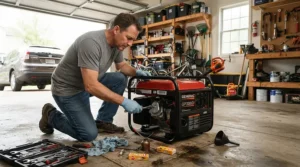
Maintenance is modest: oil changes, plug and air filter checks, fuel stabilizer, and a storage routine. The Honda and Yamaha units cost more upfront, but owner reports cite strong longevity and resale. For a casual camper doing ten nights a year, the WEN 56380i or a Champion inverter pays back fastest. Heavy users who run an AC every evening benefit from the efficiency and quiet of the premium options.
FAQ
❓ Can a 2000 watt generator run an RV air conditioner?
❓ Is 3500 watts enough for a 13,500 BTU RV AC?
❓ Can one generator run two RV air conditioners?
❓ Do I need a TT-30R outlet on my generator?
❓ Will a generator for RV air conditioner use run on propane?
Conclusion
The perfect generator for RV air conditioner duty comes down to four checks: running watts that cover your real loads, a surge or soft-start plan for the compressor, a noise level your campground will tolerate, and a weight you can live with.
If you want the cheapest sensible path, the WEN 56380i and Champion 4500-Watt RV Ready Inverter are hard to beat. If propane convenience matters, the Champion 4000-Watt Dual Fuel RV Ready Inverter earns its place. For power and a remote fob, the Westinghouse iGen4500 is the muscle pick. For quiet, light and long-term ownership, the Honda EU2200i pair or the Honda EU3200i lead, with the Yamaha EF3000iSEB as a boost-equipped alternative. Whichever you choose, treat the starting watts vs running watts math, your RV AC BTU rating, and local generator hours as your checklist.
✨ Ready to cool your campsite?
🔍 Compare the seven options above, check current pricing and availability on Amazon.ca, and match the winner to your trailer. Cool nights and quiet evenings are a few clicks away! ❄️🏕️
Recommended for You
- 7 Best Generator-Compatible Cooler Picks For 2026
- Foldable Solar Panel Camping Fridge: 7 Top Picks For 2026
- Portable Solar Fridge For Overlanding: 7 Best Picks (2026)
Disclaimer: This article contains affiliate links. As an Amazon Associate, I earn from qualifying purchases. If you purchase products through these links, we may earn a small commission at no additional cost to you.
✨ Found this helpful? Share it with your friends! 💬🤗
