
In This Article
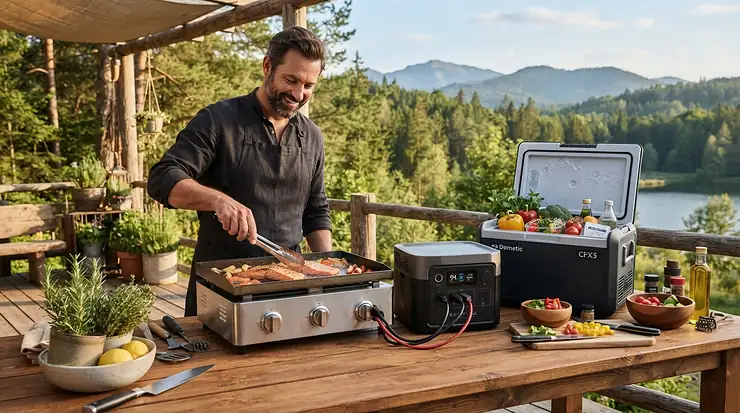
Soggy sandwiches. Lukewarm pop. A cooler lid you dread lifting on day three. If you’ve camped through a Canadian July, you know ice is a countdown timer, and it always hits zero before the trip does. A portable generator and cooler combo for camping fixes that by swapping the ice for a compressor fridge and a power source built to feed it.
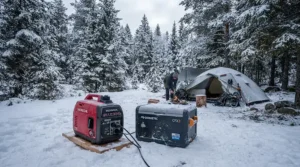
The catch is that “combo” means three different things depending on who’s selling. Sometimes it’s a fuel-burning inverter generator. Sometimes it’s a battery-based portable power station. And sometimes it’s one box that is both fridge and battery. Pick wrong and you end up with a loud engine you can’t run after 9 p.m., or a battery that taps out by Saturday lunch.
This guide compares seven real products and turns their spec sheets into campsite behaviour. It also does the runtime arithmetic, so your generator cooler bundle fits your trip instead of your wishful thinking. Rules matter too: Alberta Parks restricts fuel-generator hours at 11 campgrounds, encourages inverter models, and exempts quiet solar generators. A quiet camping power and cooling combo isn’t a luxury in that world. It’s the difference between a cold fridge and a chat with park staff. Rules vary across the country, so always check your own park. Your camping electrical setup starts with the rulebook.
What Is a Portable Generator and Cooler Combo for Camping?
A portable generator and cooler combo for camping is a paired power-and-cooling system: a compact power source (a fuel-burning inverter generator or a battery-based portable power station) matched with a 12V compressor fridge or cooler, so food stays cold without ice. Some products bundle both into one unit; most setups pair separate pieces.
In practice you’ll meet three flavours: fuel generator plus fridge, power station plus fridge, or all-in-one camping power in a single fridge-battery unit. Each trades noise, weight and runtime differently.
Quick Comparison Table: Your Generator Cooler Bundle at a Glance
| Product | Role in the combo | Key spec | Weight | Price range (CAD) | Best For |
|---|---|---|---|---|---|
| EcoFlow Glacier | Fridge-freezer plus plug-in battery | 38 L, dual-zone, ice maker | About 23 kg with battery | C$900–C$1,400 | Simplicity seekers |
| Jackery Explorer 1000 v2 | Portable power station | 1,070Wh / 1,500W | 10.8 kg | C$1,000–C$1,500 | Family base camps |
| EcoFlow RIVER 2 Pro | Portable power station | 768Wh / 800W | 7.8 kg | C$700–C$1,000 | Weekend car camping |
| Honda EU2200i | Gasoline inverter generator | 2,200W max / 1,800W rated | About 21.5 kg | C$1,500–C$2,200 | Frequent off-grid trips |
| Champion 2500W Dual Fuel | Dual-fuel inverter generator | 2,500W start / 1,850W gasoline | About 17.7 kg | C$800–C$1,300 | Fuel flexibility on a budget |
| BougeRV CRPRO30 | 12V compressor fridge | 30 qt, 36–45W | About 12.5 kg | C$370–C$500 | Solo campers and couples |
| ICECO VL45ProS | 12V compressor fridge | 47.5 qt, SECOP compressor | About 23.7 kg | C$1,000–C$1,300 | Families |
Read this table as a menu, not a ranking. The Jackery Explorer 1000 v2 and ICECO VL45ProS are the natural family-sized duo, while the EcoFlow RIVER 2 Pro and BougeRV CRPRO30 make a lighter camping power and cooling combo for couples. The two generators, Honda EU2200i and Champion 2500W Dual Fuel, work better as chargers than daily drivers, and the EcoFlow Glacier skips pairing altogether. Prices are approximate ranges, so check current price before committing.
💬 Just one click — help others make better buying decisions too!😊
Top 7 Portable Generator and Cooler Combo for Camping Picks: Expert Analysis
Think of these seven as building blocks: two power stations, two generators, two fridges and one all-in-one. Mix them to match your trip, and use the standout tags to find your starting point.
1. EcoFlow Glacier — built-in ice maker, no cords
The party trick is the ice maker: 18 cubes in about 12 minutes. The EcoFlow Glacier is the closest thing here to all-in-one camping power, a 38 L (40 qt) dual-zone fridge-freezer with a detachable 298Wh plug-in battery. Dual zones mean one side can hold drinks near 4°C while the other stays frozen (the range runs 10°C to −25°C), so dinner and beverages stop fighting over one thermostat.
EcoFlow quotes up to 40 hours on the battery in Eco mode, while one European retailer lists up to 24, so plan around the lower figure. Based on the specs, it suits campers who want one purchase and app control, not people who also need to run laptops all weekend. At roughly 23 kg with the battery on, it’s a car-camping tool.
I couldn’t verify a deep pool of recent independent owner reviews, so read current customer feedback, and confirm your listing includes the battery, since it’s sometimes sold separately.
Pros:
- ✅ Built-in ice maker is genuinely rare
- ✅ Dual-zone fridge and freezer in one box
- ✅ Cordless running via plug-in battery
Cons:
- ❌ Heavy at roughly 23 kg with battery
- ❌ Battery may be sold separately
Price range: roughly C$900–C$1,400 with battery at the time of research; check current price. Verdict: strong value if you’ll use both zones and the ice maker, pricey if you only need cold drinks.
2. Jackery Explorer 1000 v2 — one-hour emergency recharge
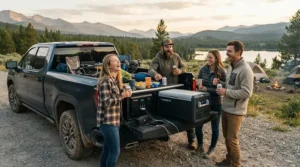
The headline feature is the app-activated emergency charge: 0–100% in about an hour, versus 1.7 hours in default wall mode. The Jackery Explorer 1000 v2 packs 1,070Wh into 10.8 kg, with 1,500W AC output (3,000W surge) and a 12V/10A car port. That port feeds a compressor fridge directly over DC, skipping inverter losses, while the AC side keeps headroom for a kettle.
On paper, 1,070Wh covers roughly three days of an efficient fridge, nearer two and a half once heat and door-opening bite. The LiFePO4 cells are rated for 4,000 cycles to 70% capacity. That chemistry, as Wikipedia explains, gives up some energy density in exchange for thermal and chemical stability, a sensible trade beside a nylon tent.
Roundups consistently pick it as the best 1 kWh all-rounder for base camps, though multi-day runtime claims come from retailers, not independent bench tests. It’s best for families who want fridge, lights and a CPAP on one box.
Pros:
- ✅ 1,500W output handles kettles and more
- ✅ Rapid one-hour emergency charge mode
- ✅ LiFePO4 cells rated for 4,000 cycles
Cons:
- ❌ About 10.8 kg is a carry for walk-in sites
- ❌ Car charging takes roughly 12 hours
Price range: roughly C$1,000–C$1,500, with promotions common; check current price. Verdict: premium, but the most flexible single box for multi-day trips.
3. EcoFlow RIVER 2 Pro — lightest, with 70-minute charging
Fast and featherweight: 0–100% in about 70 minutes from a wall outlet. The EcoFlow RIVER 2 Pro offers 768Wh and 800W continuous output (1,600W with X-Boost) in a 7.8 kg body, plus a 12V car port rated 10A. A compressor fridge sips far less than 800W, so capacity is the real question.
On paper 768Wh covers a bit over two days of an efficient fridge, closer to a day and a half in summer heat. That’s why it pairs naturally with a 30 qt fridge on a weekend trip. The LiFePO4 cells are rated for 3,000+ cycles, and the companion app shows live draw so you can see what the fridge costs per hour.
Roundups often recommend this size for a 12V fridge weekend, with fast charging the usual praise. I couldn’t verify a large independent review sample, so check current feedback. If you want an induction cooktop, look higher.
Pros:
- ✅ Recharges from a wall outlet in about 70 minutes
- ✅ Only 7.8 kg to carry
- ✅ 3,000-cycle LiFePO4 battery
Cons:
- ❌ 800W ceiling limits cooking gear
- ❌ Car charging takes roughly 8–9 hours
Price range: roughly C$700–C$1,000; check current price. Verdict: the best-value way into a quiet camping power and cooling combo for weekend trips.
4. Honda EU2200i — whisper-quiet at quarter load
Rated noise is 48 dBA at quarter load and 57 dBA at full rated load. The Honda EU2200i is a 2,200W (1,800W rated) gasoline inverter generator weighing about 21.5 kg (47.4 lb). It runs up to 8.1 hours on a 0.95-gallon (about 3.6 L) tank at quarter load, or 3.2 hours at full load. Here’s the practical bit: a fridge needs a sliver of that output, so running this engine all night just to chill sausages is silly, and often against quiet-hour rules. Its sweet spot is charging a portable power station for an hour or two at midday, then shutting up. CO-MINDER carbon monoxide detection and Bluetooth monitoring are meaningful extras, and a second unit can be paralleled later. I couldn’t verify enough independent review data, so treat runtime and noise figures as manufacturer-stated, and confirm availability, since this model often sells through dealers.
Pros:
- ✅ Low noise for its class
- ✅ CO-MINDER carbon monoxide detection built in
- ✅ Parallel-ready for more power
Cons:
- ❌ Gasoline only, no propane option
- ❌ Highest price in this guide
Price range: roughly C$1,500–C$2,200; check current price. Verdict: pay for the quiet engineering only if you camp off-grid often.
5. Champion 2500W Dual Fuel Inverter Generator — gasoline or propane, 17.7 kg
Two fuels, one light body. The Champion 2500W Dual Fuel Inverter Generator delivers 2,500 starting watts and 1,850 running watts on gasoline, or 1,665 running watts on propane. A 1.05-gallon (about 4 L) tank runs up to 11.5 hours at 25% load, while a 20 lb (9 kg) propane cylinder stretches that to up to 34 hours.
That’s the whole generator fuel type argument in one line: propane gives up roughly 10% of output for about three times the runtime and easier storage. Noise is rated at 53 dBA from 7 m (23 ft), and the inverter output is under 3% THD, safe for sensitive electronics. At about 17.7 kg (39 lb) it’s the lightest generator here.
Champion sells several 2500W dual-fuel variants with different weights and features such as CO Shield automatic shutoff, so verify the exact model. I couldn’t verify independent review data, so check current customer feedback.
Pros:
- ✅ Runs on gasoline or propane
- ✅ Lightweight at about 17.7 kg
- ✅ Clean inverter power for electronics
Cons:
- ❌ Variants differ in weight and safety features
- ❌ Output drops about 10% on propane
Price range: roughly C$800–C$1,300; check current price. Verdict: the best value for fuel flexibility.
6. BougeRV CRPRO30 — sips 36W in Eco mode
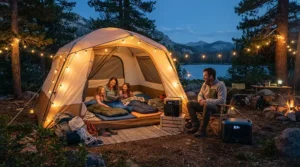
The power-sipper of the bunch. The BougeRV CRPRO30 is a 30 qt (28 L) compressor fridge rated at 45W in Max mode and 36W in Eco mode, with 12/24V DC and 110–240V AC inputs and a range of about −22°C to 10°C. Those wattages describe the compressor while it runs. It cycles on and off, so average draw is lower, which is why a small power station keeps it alive all weekend. Three-level battery protection cuts power before a vehicle battery goes flat, and the storage box fits a power bank. Reviewers of the 30-quart size describe it as affordable and well made, a touch small but enough for a couple. One hands-on review found it chilled quickly to about −12°C, then needed nearly half an hour to reach −18°C. At roughly 12.5 kg it carries easily. Feeding four people for five days? Buy bigger.
Pros:
- ✅ Low 36W Eco-mode draw
- ✅ Three-level battery protection
- ✅ Easy to carry at about 12.5 kg
Cons:
- ❌ Tight for more than two people
- ❌ Slow pull-down below −12°C
Price range: roughly C$370–C$500; check current price. Verdict: the best budget entry to a compressor fridge.
7. ICECO VL45ProS — SECOP compressor, five-year warranty
Built around a compressor with a five-year warranty. The ICECO VL45ProS is a 47.5 qt (45 L) single-zone fridge-freezer with a SECOP compressor (one year on other parts), a range of −18°C to 10°C, and a rated 0.347 kWh per 24 hours. That daily figure is gold. It’s the yardstick for the runtime math in this guide. Compressor noise is reported around 47 dB at 1.5 m, and dual DC plugs at opposite ends make cabling less fiddly. One reviewer ran it a week on a LiFePO4 power box as a fridge, then two weeks as a freezer, hearing the fan but not the compressor. Another reported a four-day trip without draining a deep-cycle battery. Reviewers also describe a sturdy, all-metal feel. At about 23.7 kg it’s heavy, and single-zone means no fridge-and-freezer split.
Pros:
- ✅ SECOP compressor with five-year warranty
- ✅ Low rated 0.347 kWh daily use
- ✅ Roomy 45 L interior
Cons:
- ❌ Heavy at about 23.7 kg
- ❌ Single zone only
Price range: roughly C$1,000–C$1,300; check current price. Verdict: the family-camping pick, if you can live with the weight.
Camping Electrical Setup: A First-Weekend Practical Guide
A good camping electrical setup is mostly habits, not hardware. Follow this order on trip day:
- Charge everything the night before. Fill the portable power station to 100%, and pre-chill the fridge on household power so the compressor isn’t hauling warm food on battery.
- Load pre-cooled food. Frozen water bottles double as ice packs you can drink later.
- Use the DC cable. The 12V port beats AC through an inverter, which wastes energy as heat.
- Give it air. Compressor fridges need ventilation clearance, so shade plus a gap on every vent side keeps the duty cycle down.
- Choose Eco mode unless you’re freezing. ICECO notes Eco reaches temperature more slowly but draws less.
- Park the generator, if you bring one, downwind and far from tents. Run it midday to top up the station, inside permitted hours.
For maintenance, check generator oil before every trip, follow the manual’s schedule for plugs and filters, and store fridges with the lid ajar to avoid odours. The classic first-month mistakes are forgetting the propane hose, leaving a fridge running in a hot, sealed vehicle, and trusting battery percentages without watching actual draw in the app. This is the unglamorous heart of any generator cooler bundle: ten minutes of prep saves a weekend of fiddling.
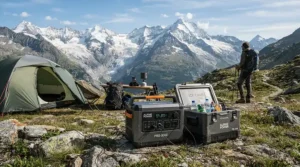
Real-World Camping Scenarios: Three Buyer Profiles
The Weekend Couple
Two nights at a provincial park, about 100 km from home, six trips a year, budget around C$1,000–C$1,500. The BougeRV CRPRO30 plus EcoFlow RIVER 2 Pro is a light camping power and cooling combo that covers the weekend on paper with margin for phones and string lights. Skip the generator entirely.
The Family Basecamp
Four people, five nights, a powered-but-unreliable site. The ICECO VL45ProS plus Jackery Explorer 1000 v2 gives about two and a half days of fridge time per charge on paper. Add the Champion 2500W Dual Fuel for a 90-minute midday top-up within park hours, and the generator cooler bundle covers the whole stay.
The Simplicity Seeker
One angler, long weekends, cold drinks and a frozen catch. The EcoFlow Glacier handles both zones and makes ice, so there’s no pairing homework. It’s the most direct all-in-one camping power option here, as long as you accept the weight.
✨ Ready to Build Your Setup?
🔍 Take your camping power and cooling combo to the next level with these carefully selected products. Click any highlighted product name to check current pricing and availability. A little planning now means cold drinks, fresh food and a quiet campsite later!
Problem → Solution: Fixing Five Classic Camping Power Headaches
- The fridge drained the battery overnight. Switch to Eco mode, use the 12V/DC port, shade the unit, and pre-chill at home. If you’re drawing from a vehicle, the BougeRV CRPRO30‘s three-level battery protection is a handy safeguard.
- The park bans generators after dusk. Run the engine at midday only, recharging a station, then switch to silent battery operation overnight.
- Food isn’t cold enough. Ventilation gaps and shade matter more than any setting. Compressor fridges also struggle in sealed, hot vehicles.
- The fridge freezes lettuce. Only dual-zone units like the EcoFlow Glacier let you split temperatures. With single-zone models, such as the ICECO VL45ProS, set a fridge temperature and keep greens away from the walls.
- Car charging is painfully slow. Roughly 12 hours for the Jackery Explorer 1000 v2 and 8–9 for the EcoFlow RIVER 2 Pro means the road is a top-up only. Charge at home, or use a generator or solar for real recharges.
How to Choose a Portable Generator and Cooler Combo for Camping
Seven steps keep this decision rational:
- Size the fridge first. A 30 qt model suits two people; families should look at 45 L or more. Its energy use drives every other choice.
- Find your daily watt-hours. The ICECO VL45ProS is rated at 0.347 kWh per day and the EcoFlow Glacier quotes about 0.18 kWh in Eco mode. Add roughly 200Wh for phones and lights, then multiply by nights.
- Add a 25% margin. Heat, door-opening and conversion losses are real. That margin is my rule of thumb, not a lab figure.
- Match the source to the trip. Short powered-park weekends favour a portable power station; remote multi-day trips add a generator or solar.
- Check the ports. A 12V/10A DC port, like the one on the Jackery Explorer 1000 v2, is plenty for a fridge.
- Pick your generator fuel type deliberately: gasoline for output, propane for runtime and storage, dual fuel for flexibility.
- Read campground rules before you buy any engine.
| Setup | Capacity | Fridge days on paper | Planning figure (−25%) | Best For |
|---|---|---|---|---|
| Jackery Explorer 1000 v2 + ICECO VL45ProS | 1,070Wh | About 3.1 | About 2.3 | Family base camp |
| EcoFlow RIVER 2 Pro + ICECO VL45ProS | 768Wh | About 2.2 | About 1.7 | Weekend trips |
| EcoFlow Glacier (own battery, 0.18 kWh/day) | 298Wh | About 1.7 | About 1.2 | Cordless day-and-night |
These numbers are simple division using manufacturer ratings, not field measurements. The Jackery Explorer 1000 v2 gives the most breathing room, while the EcoFlow RIVER 2 Pro suits weekends. The EcoFlow Glacier battery is a bridge between charges, so pair it with a wall outlet, vehicle or solar for longer stays.
Generator Fuel Type: Gasoline, Propane or Dual Fuel?
Your generator fuel type shapes noise, runtime and hassle more than most buyers expect.
Gasoline
Gasoline delivers the highest output. The Champion 2500W Dual Fuel makes 1,850 running watts on it, and the Honda EU2200i is gasoline only. It’s easy to top up mid-trip, but fuel degrades in storage, so use a stabilizer and don’t leave a tank sitting all winter.
Propane
Propane trades about 10% of output for up to 34 hours on a 20 lb (9 kg) cylinder at 25% load, against 11.5 hours on a full gasoline tank. Cylinders also store without going stale. Transport them upright and secured, and never refill disposable ones.
Dual Fuel
The Champion 2500W Dual Fuel lets you carry whichever is easiest that trip. For a camping power and cooling combo where the generator mostly recharges a battery, a dual-fuel engine is the most forgiving choice.
Portable Power Station vs Generator: Which Powers a Cooler Better?
For a fridge, the portable power station usually wins on peace and quiet. It’s silent, produces no exhaust, and sidesteps most noise rules. The generator wins on endurance: refuelling beats waiting for a battery to charge. That’s why the smartest generator cooler bundle often uses both, with the engine as a short midday charger.
Rules push in the same direction. Parks Canada campground notices show how tight the windows can get: one lists generator use only from 8 to 10 a.m. and 5 to 7 p.m., with quiet hours from 11 p.m. to 7 a.m., and violations can carry fines up to C$25,000.
| Option | Noise | Ongoing cost | Effort | Best For |
|---|---|---|---|---|
| Bagged ice and a cooler | Silent | Ice every day or two | Light | Day trips |
| Jackery Explorer 1000 v2 + ICECO VL45ProS | Near silent | Wall power or solar | Heavy | Multi-day base camps |
| Honda EU2200i or Champion 2500W Dual Fuel + fridge | 48–57 dBA engine | Fuel | Medium | Off-grid trips |
| EcoFlow Glacier | About 42 dB cooling | Charging only | About 23 kg | Simplicity |
Ice is cheapest on day one, but you buy it all over again every weekend. A battery-and-fridge pairing costs more upfront and almost nothing per trip. Generators sit in the middle: great reach, but you pay in fuel, noise and paperwork.
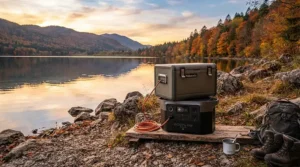
Features That Actually Matter (And Those That Don’t)
Worth Paying For
- A compressor, not a thermoelectric cooler. It holds a real fridge or freezer temperature.
- A 12V/DC output rated at 10A or more.
- Battery protection on the fridge, like the BougeRV CRPRO30‘s three levels.
- Low noise at your actual load, not just at the quietest setting.
- LiFePO4 cells in the power station.
Marketing Noise
- Giant surge ratings. Fridges don’t need 3,000W.
- App control, which is nice for monitoring but never essential.
- USB ports on the fridge itself, since the ICECO VL45ProS requires DC input for them anyway.
The hype-filtering rule is simple: if a feature doesn’t change how long food stays cold or how quietly you sleep, it’s decoration. All-in-one camping power sounds magical, yet the EcoFlow Glacier‘s real selling points are the dual zones and ice maker, not the Wi-Fi.
Common Mistakes When Buying a Generator Cooler Bundle
- Oversizing the engine. A fridge needs a trickle, so a 2,000W-class generator is for charging, not for chilling.
- Ignoring noise rules. A generator you can’t legally run at dusk is just 20 kg of luggage.
- Blocking vents. Packing a fridge against a wall or under a blanket raises power draw.
- Trusting the headline runtime. The EcoFlow Glacier battery claim ranges from 24 to 40 hours depending on the source.
- Forgetting weight. Add up the carry from car to site before buying a 23 kg fridge.
- Ignoring variants. Champion 2500W Dual Fuel listings differ in weight and safety features, so match the model number.
- Skipping your camping electrical setup plan, including cables, a CO alarm and fuel storage.
Long-Term Cost & Maintenance
Upfront price is only half the story. LiFePO4 stations are rated for thousands of cycles: 4,000 for the Jackery Explorer 1000 v2 and 3,000+ for the EcoFlow RIVER 2 Pro. Spread across the midpoint of the price ranges below, that works out to roughly 30 cents and 28 cents per full cycle on paper. Generators add recurring costs: fuel, oil changes and plugs per the owner’s manual. The all-in-one camping power route trades those costs for simplicity.
| Product | Price range (CAD) | Ongoing cost | Value signal |
|---|---|---|---|
| EcoFlow Glacier | C$900–C$1,400 | Charging only | Ice-maker premium |
| Jackery Explorer 1000 v2 | C$1,000–C$1,500 | Wall power or solar | Highest cycle rating |
| EcoFlow RIVER 2 Pro | C$700–C$1,000 | Wall power or solar | Best weekend value |
| Honda EU2200i | C$1,500–C$2,200 | Fuel and servicing | Quiet-engine premium |
| Champion 2500W Dual Fuel | C$800–C$1,300 | Fuel and servicing | Cheapest generator route |
| BougeRV CRPRO30 | C$370–C$500 | None | Lowest entry cost |
| ICECO VL45ProS | C$1,000–C$1,300 | None | Five-year compressor warranty |
Per-cycle cost isn’t per-trip cost, but it shows why batteries reward frequent campers. If you camp three or four times a year, the BougeRV CRPRO30 with a mid-size station is hard to beat. Heavy users should weigh the Champion 2500W Dual Fuel as insurance. Every generator cooler bundle ages differently, so budget for fuel, servicing and the occasional replacement cable.
Safety, Regulations and Campground Rules in Canada
Carbon monoxide is the one risk you cannot see or smell. Health Canada’s carbon monoxide guidance lists fuel-powered generators and camping stoves among typical sources, and advises operating a generator at least 6 m (20 ft) from any home or building and never indoors or in a garage or shed. Apply the same logic to tents and vehicles.
- Pack a battery-operated CO alarm. Technical Safety BC recommends one for tent camping.
- Keep generator exhaust away from neighbours. Alberta Parks also requires an occupant to be present while a fuel generator runs.
- Store and move propane cylinders upright and secured.
- Check certification marks on stations, cords and fridges, and follow each product’s manual.
Provincial and national park rules differ, so treat your camping electrical setup as incomplete until you’ve read the specific park’s page. A battery-based portable power station sidesteps most of these constraints, which is a big part of its appeal.
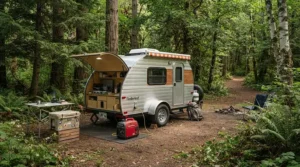
FAQ
❓ Can a portable generator run a camping fridge directly?
❓ What size generator cooler bundle do I need for a weekend?
❓ Is propane or gasoline the better generator fuel type for camping?
❓ Can I charge a portable power station while driving to camp?
❓ Do I still need a carbon monoxide alarm if the generator is outside?
Conclusion
There’s no single winner, only the right pairing for your trip. For a couple chasing quiet weekends, the BougeRV CRPRO30 and EcoFlow RIVER 2 Pro make the leanest portable generator and cooler combo for camping. Families will appreciate the ICECO VL45ProS and Jackery Explorer 1000 v2, with the Champion 2500W Dual Fuel as a fuel-flexible backup charger. If you camp off-grid often and prize quiet engines, the Honda EU2200i earns its premium. And if you simply want cold drinks, a frozen catch and no pairing homework, the EcoFlow Glacier is the tidiest all-in-one camping power option.
Remember the three habits that matter more than any spec: size the fridge first, do the runtime math with a safety margin, and read the campground rules before you buy an engine. Get those right and your camping power and cooling combo will fade into the background, which is exactly where good gear belongs. Prices and availability change, so check current price before you buy.
✨ Your Cold-Drinks Upgrade Starts Here! 🏕️
🔍 Compare the products above, click any highlighted name to check current pricing and availability, and build the setup that fits your next trip. Your future self, holding a properly cold drink on day three, will thank you!
Recommended for You
- Generator For RV Air Conditioner: 7 Best Picks For 2026
- 7 Best Generator-Compatible Cooler Picks For 2026
- Foldable Solar Panel Camping Fridge: 7 Top Picks For 2026
Disclaimer: This article contains affiliate links. As an Amazon Associate, I earn from qualifying purchases. If you purchase products through these links, we may earn a small commission at no additional cost to you.
✨ Found this helpful? Share it with your friends! 💬🤗
