
In This Article
There’s a very specific kind of heartbreak that happens around day three of a camping trip: you open the cooler expecting a cold beer and instead find lukewarm water, a soggy sandwich, and ice that gave up sometime around Tuesday. If you’ve lived that moment, you already understand why so many Canadians spend more time researching top rated camping coolers than they do picking their actual campsite. It sounds excessive until you realize a bad cooler doesn’t just ruin snacks — it can turn a weekend at the lake into a science experiment in bacterial growth.
What is a top rated camping cooler? In simple terms, it’s an insulated container — hard-sided or soft-sided — engineered to hold ice and keep perishable food and drinks below 4°C for multiple days in hot, unpredictable outdoor conditions, well beyond what a basic drugstore cooler can manage. Food safety isn’t just a nice-to-have footnote here, either: bacteria can grow rapidly once food sits between 4°C and 60°C, according to Health Canada’s food safety guidance, which is exactly the range a weak cooler drifts into by the second afternoon in direct sun.
This guide breaks down seven genuinely well-reviewed coolers — from budget blow-molded boxes to premium rotomolded beasts — based on real specs, aggregated review sentiment, and honest side-by-side analysis. Whether you’re outfitting a family minivan for a week at the provincial park or just need something that survives a canoe trip without leaking, there’s a top rated camping cooler on this list built for it.
Quick Comparison: Top Rated Camping Coolers at a Glance
| Cooler | Capacity | Claimed Ice Retention | Price Range (CAD) | Best For |
|---|---|---|---|---|
| YETI Tundra 45 | 45 qt / 26-42 cans | Up to 10 days | C$500-C$600 | Toughest all-rounder |
| RTIC 45 Ultra-Tough | 45 qt / 60 cans | Up to 5 days | C$280-C$330 | YETI-level performance, lower cost |
| Pelican 50QT Elite | 50 qt / 34 cans + ice | 7-8 days | C$430-C$520 | Lifetime-warranty premium pick |
| ORCA 40 Quart | 40 qt / 48 cans | Up to 10 days | C$400-C$460 | Made-in-USA family cooler |
| Igloo BMX 52 | 52 qt / 83 cans | Up to 5 days | C$160-C$210 | Best budget rotomolded-style value |
| Coleman Xtreme 70-Quart | 70 qt / 100 cans | Up to 5 days | C$120-C$170 | Cheapest large-capacity option |
| Dometic Patrol 35 | 35 L / 28 cans | Multi-day (brand states “days”) | C$300-C$360 | Compact, overland-style toughness |
Looking at the table above, the pattern that jumps out immediately when you scan these top rated camping coolers side by side is that price doesn’t map cleanly onto ice retention — the mid-priced ORCA 40 Quart claims the same ten-day ceiling as the far pricier YETI Tundra 45, while the Coleman Xtreme 70-Quart delivers the largest capacity here for a fraction of what the premium rotomolded models cost. What actually separates the tiers is construction quality, latch durability, and how the cooler performs after two years of driveway abuse, not just the number printed on the ice-retention sticker. If your trips rarely exceed a long weekend, the budget and mid-range picks may genuinely out-value the premium names.
💬 Just one click — help others make better buying decisions too!😊
Top Rated Camping Coolers: Expert Analysis
Below is the honest, spec-and-review-backed breakdown of seven real coolers currently sold in Canada, covering budget, mid-range, and premium tiers, plus a couple of lesser-known but genuinely capable alternatives.
1. YETI Tundra 45 — legendary ice retention and grizzly-resistant toughness
The YETI Tundra 45 is the cooler that basically created the premium rotomolded category, and it still sets the bar most competitors are measured against.
Under the hood, it uses up to three inches of PermaFrost pressure-injected insulation inside rotomolded walls, plus a full-frame freezer-quality gasket — a combination that, in independent Canadian testing, kept ice frozen through four full days in 30°C heat while sitting in a hot car, according to Canadian Geographic’s field test of the Tundra 45. In practice, that thickness is what separates it from cheaper blow-molded coolers: more foam means slower heat transfer, so the ice-to-water conversion simply happens on a longer timeline. The YETI Tundra 45 also meets Interagency Grizzly Bear Committee bear-resistant standards when locked, a detail that matters a lot more once you’re camping in the Rockies than it does at a city park.
This is the pick for people who camp often enough that cost-per-trip actually matters, and who want a cooler tough enough to double as a camp stool or truck-bed step. Reviewers consistently note the latches and hinges outlast cheaper coolers by years, though several also mention the price tag is the single biggest deterrent for casual users.
Pros:
- ✅ Multi-day ice retention even in extreme summer heat
- ✅ Bear-resistant certification when properly locked
- ✅ Freezer-grade gasket seals out warm air completely
Cons:
- ❌ Among the heaviest 45-quart coolers on this list
- ❌ Premium price relative to lower-tier alternatives
Expect the YETI Tundra 45 to sit around C$500-C$600 in the Canadian market at the time of research — a steep entry point, but one that’s genuinely justified for frequent, remote, or multi-day trips where cooler failure isn’t an option.
2. RTIC 45 Ultra-Tough — near-YETI performance at a friendlier price
The RTIC 45 Ultra-Tough exists almost entirely to answer one question: do you really need to pay premium prices for premium ice retention? Its 2.8 inches of closed-cell foam insulation, rotomolded shell, and freezer-style gasket read like a direct copy of the YETI playbook, and reviewers largely agree it performs that way too.
Independent side-by-side testing found the ice lasted roughly as long as a YETI Tundra of similar size across a multi-day Colorado camping trip in 80-90°F heat, with the RTIC’s latches feeling noticeably less rigid but still functional. That’s the practical trade-off here: you’re sacrificing some hardware refinement, not core cooling performance. The 60-can capacity in a 45-quart footprint also edges out several rivals, making it a strong pick for anyone packing a cooler for a full weekend crew.
Aggregated reviewer sentiment leans heavily positive on value, with the most common complaint being that the rubber T-latches feel “flimsier” than YETI’s under repeated hard use — a fair criticism, but not one that seems to affect actual sealing performance based on the retention data.
Pros:
- ✅ Ice retention nearly matching premium rotomolded rivals
- ✅ 60-can capacity in a compact 45-quart body
- ✅ Significantly lower price than comparable premium coolers
Cons:
- ❌ Latches feel less durable than top-tier competitors
- ❌ Heavier build than ultralight alternatives
At around C$280-C$330, the RTIC 45 Ultra-Tough is arguably the single best value pick among hard-sided coolers built for genuine multi-day ice retention.
3. Pelican 50QT Elite — up to 8 days of ice and a lifetime guarantee
Pelican built its name on protective cases for cameras and firearms, and the Pelican 50QT Elite carries that same engineering obsession into the cooler aisle. Its 2 inches of injection-molded polyurethane insulation, paired with a freezer-grade gasket, is rated for seven to eight days of ice retention under a proper 2:1 ice-to-contents ratio.
Independent testing in Southern California’s punishing summer heat found ice surviving past the four-day mark even with regular lid access, which lines up closely with Pelican’s own claims. What most buyers overlook about this model is the lifetime guarantee — not five years, not a decade, but a no-questions warranty that few competitors in this price bracket even attempt to match. For anyone who plans to own one cooler for the next fifteen years rather than replacing a cheap one every two, that warranty alone changes the math on total cost of ownership.
The 50-quart interior comfortably fits food for a family of four for several days plus ice, or roughly three dozen cans with cold retention to spare, making it a genuinely practical size for family car-camping rather than just solo trips.
Pros:
- ✅ Lifetime warranty against breakage or defects
- ✅ Up to 8-day ice retention in real-world heat testing
- ✅ Family-friendly 50-quart capacity
Cons:
- ❌ Heavier than comparable 45-50 quart rivals
- ❌ Premium pricing puts it alongside YETI-tier coolers
Look for the Pelican 50QT Elite in the C$430-C$520 range, positioning it as a direct, warranty-backed alternative to the premium YETI lineup.
4. ORCA 40 Quart — Made-in-USA rotomolded workhorse for families
The ORCA 40 Quart quietly does something few competitors can claim: full manufacturing, insulation, and assembly under one roof in Nashville, Tennessee, with an ice-retention rating that brand testing places as high as ten to twelve days under ideal conditions with minimal lid-opening.
Its rotomolded, one-piece polyethylene shell integrates the insulation directly into the wall structure rather than bonding separate panels together, which is part of why the seams — often a weak point on cheaper coolers — are essentially eliminated. In everyday terms, that means less risk of a slow insulation leak developing after a few seasons of bumping around a truck bed. The 48-can capacity strikes a genuinely useful middle ground: big enough for a long weekend with a family of four, small enough that one adult can still carry it to the picnic table without help.
Reviewers consistently single out the flex-grip handles and integrated cargo net as the small design touches that separate it from anonymous big-box coolers, while a handful note the drain spout could sit slightly lower for fully gravity-fed draining on uneven ground.
Pros:
- ✅ Fully USA-manufactured with strict quality control
- ✅ Rotomolded, seamless construction resists leaks
- ✅ Strong capacity-to-portability ratio for families
Cons:
- ❌ Drain placement isn’t ideal on sloped terrain
- ❌ Sits at a premium price point for its size
Expect to pay roughly C$400-C$460 for the ORCA 40 Quart, putting it squarely in premium territory but with a domestic manufacturing story few rivals can match.
5. Igloo BMX 52 — best budget rotomolded-style value
Igloo has been making coolers since long before “premium cooler” was a marketing category, and the Igloo BMX 52 is the company’s answer to the YETI-style boom — minus the YETI-style price tag.
Its Cool Riser Technology elevates the cooler body away from hot pavement or truck beds, while extra-thick foam walls and an insulated lid are rated for five days of ice retention at 90°F. Real-world owner reports are more mixed than the marketing suggests — some campers report a full three days of solid ice, others note performance closer to two and a half days in a warm garage — which is a useful reminder that “up to” ratings represent best-case, not typical, conditions. Reviewers consistently note this is the trade-off with blow-molded construction versus true rotomolded builds: it’s lighter and cheaper, but the insulation ceiling is lower.
Where the Igloo BMX 52 genuinely earns its keep is capacity-per-dollar. An 83-can capacity at well under half the price of a premium rotomolded rival makes it the practical choice for weekend campers, tailgaters, and beach-goers who don’t need five-star ice retention but do want stainless hardware and a built-in fish ruler.
Pros:
- ✅ Exceptional capacity for the price point
- ✅ Cool Riser Technology improves real-world performance
- ✅ Stainless steel hardware resists corrosion
Cons:
- ❌ Real-world ice retention often falls short of claims
- ❌ Blow-molded build isn’t as impact-resistant as rotomolded rivals
At around C$160-C$210, the Igloo BMX 52 is the clear budget pick for casual campers who prioritize capacity over multi-day extreme ice retention.
6. Coleman Xtreme 70-Quart — biggest capacity for the smallest price
If your camping crew is large and your budget isn’t, the Coleman Xtreme 70-Quart solves that math better than anything else on this list. Its insulated lid and extra-thick wall insulation are rated for five days of ice retention at temperatures up to 90°F, and the 100-can capacity dwarfs every other cooler here.
The “Keeps the Ice!” branding is Coleman’s way of saying this uses more foam than its entry-level lines, and reviewer feedback backs that up as a genuine step above disposable-tier coolers, even if it doesn’t approach rotomolded performance. What most buyers overlook is that the Have-A-Seat lid — rated for up to 250 pounds — turns the cooler into an actual camp chair, which matters more than it sounds like at a crowded campsite with limited seating. The leak-resistant channel drain also means you can empty melted ice without tipping a 70-quart cooler full of cans, which is a small detail that saves a genuinely annoying chore.
Reviewers describe it as solid value for casual, infrequent use, with the most common critique being that ice retention drops off faster than advertised once the lid gets opened repeatedly on a hot day — a limitation shared by essentially every cooler in this price bracket.
Pros:
- ✅ Massive 100-can capacity for large groups
- ✅ Built-in seat rated to 250 lbs
- ✅ Lowest price of any cooler on this list
Cons:
- ❌ Ice retention drops quickly with frequent opening
- ❌ Bulkier and heavier than mid-size alternatives when full
At roughly C$120-C$170, the Coleman Xtreme 70-Quart delivers unmatched capacity-per-dollar, provided you accept it isn’t built for week-long remote trips.
7. Dometic Patrol 35 — compact rotomolded toughness for solo and duo trips
The Dometic Patrol 35 comes from a brand better known for RV and overland refrigeration, and that pedigree shows in the details. Its one-piece rotomolded polyethylene shell, thick PU freezer-grade insulation, and labyrinth-seal lid design are engineered specifically to hold up on the kind of rough, dusty, bumpy overland routes that would eventually crack cheaper coolers.
At 35 litres and a 28-can capacity, this is deliberately the smallest cooler on this list — a size that makes sense for solo hikers, motorcycle campers, or anyone pairing it with a second, larger cooler split between food and drinks, a strategy that limits how often perishables get exposed to warm air every time the lid opens. One-handed rubber latches are a small but genuinely useful feature when you’re juggling gear with the other hand at a trailhead. The accessory dock system, which supports add-ons like cup holders, a bottle opener, or a fishing rod holder, is a level of modularity most rivals in this size class don’t offer.
Reviewer sentiment is strongly positive on build quality and portability, with the main critique being that at this price point, buyers expect a bit more raw ice-retention data from the brand than the marketing currently provides.
Pros:
- ✅ True rotomolded, one-piece construction
- ✅ Compact size ideal for solo or duo trips
- ✅ Modular accessory dock for add-ons
Cons:
- ❌ Smaller capacity limits use for larger groups
- ❌ Published ice-retention specifics are vaguer than rivals
Expect the Dometic Patrol 35 to run around C$300-C$360, a fair price for a genuinely rugged, compact rotomolded cooler with overland-grade hardware.
Practical Usage Guide: Getting the Most Out of Your Cooler
Buying one of these top rated camping coolers is only half the equation — how you use it in the first 30 days determines whether you actually get the ice retention printed on the box. Start by pre-chilling: fill the empty cooler with a bag of ice for a few hours (or overnight in a fridge, if it fits) before you ever load food or drinks into it. Skipping this step is the single most common mistake new owners make, since a warm plastic shell absorbs a surprising amount of cooling capacity before it even starts protecting your food.
Once you’re packed, follow a rough 2:1 ice-to-contents ratio, and use block ice or reusable ice packs on the bottom layer with cubes filling the gaps — block ice melts slower because it has less surface area exposed to warm air. Keep the cooler in shade, off hot pavement, and closed as much as possible; every lid opening is a small heat exchange that adds up fast over a weekend. For maintenance, rinse hard-sided coolers with warm water and mild soap after every trip, and periodically check gasket seals and drain plug threads for grit that can prevent a full seal. Over time, a cooler that’s cleaned and dried properly between trips will noticeably outlast one that gets tossed in the garage still damp.
✨ Don’t Miss These Exclusive Deals!
🔍 Take your camping cooler game to the next level with these carefully selected picks. Click on any highlighted item to check current pricing and availability. These coolers will help you create authentic, worry-free outdoor memories your family will love!
Real-World Scenarios: Which Cooler Fits Your Trip
Specs only tell part of the story — matching a cooler to your actual trip pattern matters more than chasing the highest ice-retention number on the shelf. Here’s how three common camper profiles line up against the models above.
If you’re a weekend car-camper heading to a provincial park two or three times a summer with a family of four, the ORCA 40 Quart or Pelican 50QT Elite make the most sense — both offer enough capacity for a few days of food plus drinks, with ice retention that comfortably outlasts a typical long weekend even with regular lid access. If you’re a budget-conscious tailgater or beach-day regular who needs volume more than five-star ice retention, the Coleman Xtreme 70-Quart or Igloo BMX 52 deliver serious capacity without the premium price, and their shorter ice-retention window rarely matters when the cooler empties out in a single afternoon anyway. And if you’re a backcountry hiker, canoe-tripper, or motorcycle camper who needs something rugged but genuinely portable, the Dometic Patrol 35 hits that narrow sweet spot of true rotomolded toughness in a size one person can actually carry.
For serious, remote, multi-day trips where cooler failure simply isn’t an option — hunting camps, extended fishing trips, or a week off-grid — the YETI Tundra 45 and RTIC 45 Ultra-Tough remain the two coolers on this list built specifically for that use case, with the RTIC offering nearly identical performance at a noticeably friendlier price.
How to Choose a Top Rated Camping Cooler
Picking the right cooler out of dozens of top rated camping coolers on the market comes down to weighing a handful of criteria against your actual trip patterns, not just chasing the biggest ice-retention claim on the label.
- Trip length — a weekend trip rarely needs more than three days of guaranteed ice retention, so paying for a ten-day-rated premium cooler may be overkill.
- Group size — count cans and meals, not just people; a family of four typically needs 45-50 quarts minimum for a multi-day trip.
- Transport method — hiking, canoeing, or motorcycle trips favour smaller, lighter coolers like the Dometic Patrol 35 over bulky 70-quart models.
- Climate and season — hot-weather trips justify spending more on thicker insulation; shoulder-season camping is more forgiving of budget options.
- Frequency of use — occasional campers get better value from budget picks like the Coleman Xtreme 70-Quart; frequent users see faster payback from premium rotomolded builds.
- Terrain and abuse level — rough 4×4 trails and boat decks favour rotomolded builds; smooth car-camping tolerates blow-molded construction just fine.
- Budget ceiling — decide your top price first, then look for the best-reviewed cooler within it rather than the other way around.
Hard-Sided Camping Cooler vs Soft-Sided: What’s the Real Difference
Every cooler on this list is a hard-sided camping cooler, and there’s a reason that category dominates multi-day trip recommendations over soft-sided coolers. A hard-sided camping cooler uses rigid rotomolded or blow-molded walls with thick foam insulation sandwiched inside, which physically holds more insulating material than a fabric-and-foam soft cooler of the same footprint can manage. That extra bulk translates directly into longer ice retention — often the difference between one or two days for a quality soft cooler and five-plus days for a hard-sided rival like the RTIC 45 Ultra-Tough.
Soft-sided coolers still win on portability and packability; they compress, fit into odd trunk spaces, and weigh a fraction of what a rotomolded box does. But for anyone planning to keep food safely below 4°C for more than a single day, a hard-sided camping cooler is the more reliable choice, and it’s also more resistant to punctures from sharp gear, coolers being sat on, or getting tossed around a truck bed.
Rotomolded Cooler Construction: Why It Costs More (and Often Is Worth It)
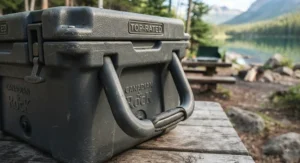
A rotomolded cooler is manufactured by heating powdered plastic inside a rotating mold, producing a single seamless shell with no glued seams or weak joints — the same basic process used to make whitewater kayaks. That seamlessness is the entire point: seams are where cheaper coolers eventually crack, warp, or develop slow insulation leaks after a couple of seasons of temperature swings and impact.
Among the coolers here, the YETI Tundra 45, RTIC 45 Ultra-Tough, ORCA 40 Quart, and Dometic Patrol 35 all use true rotomolded construction, which is a major reason their insulation performance and long-term durability outpace the blow-molded Igloo BMX 52 and Coleman Xtreme 70-Quart. The trade-off is manufacturing cost — rotomolding is slower and more material-intensive than blow-molding, which is exactly why rotomolded coolers consistently sit at a higher price point across every brand that makes both types.
Ice Retention Cooler Performance: What to Expect in Real Conditions
Manufacturer ice-retention numbers are tested under close-to-ideal lab conditions: a full cooler, minimal lid access, moderate ambient temperature. Real camping rarely looks like that, so it’s worth translating those claims into what actually happens on a trip. Based on the spec comparison across this list, expect real-world ice retention to land at roughly 40-60% of the advertised maximum once you factor in a hot vehicle interior, regular lid opening for drinks, and partial-fill ratios rather than a perfectly packed cooler.
That’s not a flaw specific to any one brand — it’s physics. Every lid opening exchanges cold air for warm air, and a half-full cooler has more empty air space to chill than a fully packed one. The practical takeaway: if a cooler claims five days and your trip is five days long, budget for closer to three, and consider a slightly higher-rated model than your trip length technically requires as a buffer against real-world conditions.
Ice Pack vs Block Ice vs Dry Ice: Maximizing Cold in Any Camping Cooler
The cold source you choose matters almost as much as the cooler itself. An ice pack — the reusable gel-filled kind — offers consistent, mess-free cooling and works well as a supplement layered around food, but it typically holds less total cold capacity than an equivalent volume of ice, since it isn’t melting and absorbing heat the way water-based ice does. Block ice, whether store-bought or frozen in a container at home, melts slower than cubed ice because of its lower surface-area-to-volume ratio, making it the better choice for the base layer on any multi-day trip.
Dry ice is the outlier: it’s dramatically colder than either option and can extend retention significantly, but it requires ventilation (it releases CO2 as it sublimates) and isn’t compatible with every cooler design — the YETI Tundra 45, for instance, is explicitly built to handle it, while thinner-walled budget coolers generally aren’t rated for the extreme cold. For most weekend trips, a smart combination — block ice or a reusable ice pack on the bottom, cubed ice filling the gaps around food — delivers the best balance of cold retention and convenience without the added complexity dry ice introduces.
Cooler Capacity Guide: Matching Quarts to Your Crew
Cooler capacity is usually the first spec shoppers look at, and also the one most frequently misjudged. As a rough rule, plan for roughly 25-30 quarts of cooler capacity per two people for a weekend trip, factoring in the 2:1 ice-to-contents ratio that real ice retention depends on — meaning a chunk of that quart figure is ice, not food or drinks.
A solo hiker or motorcycle camper is well served by something in the 25-35 quart range, like the Dometic Patrol 35. A couple or small family doing weekend trips fits comfortably into the 40-50 quart tier represented by the ORCA 40 Quart and YETI Tundra 45. Larger families or groups planning multi-day trips should look toward the 50-70 quart range covered by the Pelican 50QT Elite and Coleman Xtreme 70-Quart. Oversizing “just in case” is a common and costly mistake — a half-empty large cooler actually cools less efficiently than a properly packed smaller one, since there’s more air volume for cold to escape into every time the lid opens.
Common Mistakes When Buying a Camping Cooler
Even careful shoppers fall into a handful of predictable traps when picking a camping cooler, and most of them are easy to avoid once you know what to look for.
The first is buying based purely on the advertised ice-retention number without checking real-world reviews — as covered above, claims like “10 days” are best-case scenarios that rarely hold up once a lid gets opened regularly. The second is undersizing on capacity to save money, only to find the cooler can’t hold the recommended 2:1 ice ratio alongside actual food, which then tanks real-world performance regardless of how good the insulation is. The third is ignoring latch and hinge quality, which tends to be the first thing to fail on cheaper coolers — a broken latch on a rotomolded shell can turn an otherwise excellent cooler into an unreliable one. Finally, many buyers skip checking weight entirely, then discover a fully-packed 70-quart cooler is nearly impossible for one person to carry to a campsite without wheels or a second set of hands.
Food & Wildlife Safety While Camping in Canada
Even the best cooler on this list is only doing half its job if food safety and wildlife safety aren’t part of the plan. Bacteria multiply quickly once food sits between 4°C and 60°C — sometimes called the food safety “danger zone,” as Wikipedia’s summary of the concept explains — so the goal isn’t just “cold,” it’s keeping perishables reliably below that 4°C line for the whole trip, which is exactly what the ice-to-contents ratios and pre-chilling steps above are designed to protect.
Wildlife safety is the other half of the equation, and it’s a distinctly Canadian consideration in bear country. Parks Canada is explicit that coolers themselves are considered bear attractants, right alongside food, garbage, and scented toiletries — meaning even a closed, empty cooler left out overnight can draw wildlife into a campsite. The safest practice, per Parks Canada’s bear country guidance, is storing coolers in a locked vehicle trunk or designated food locker overnight, never in a tent or left unattended at a picnic table, regardless of how tough or “bear-resistant” the cooler’s marketing claims to be.
Frequently Asked Questions
❓ What is the best top rated camping cooler for a family of four?
❓ How long do top rated camping coolers actually keep ice?
❓ Are rotomolded coolers worth the extra cost?
❓ What's the difference between a hard-sided and soft-sided camping cooler?
❓ Is dry ice safe to use in any camping cooler?
Conclusion
There isn’t a single “best” cooler on this list — there’s a best cooler for your specific trips, group size, and budget. If you camp often enough that a cooler failure would genuinely ruin a trip, the YETI Tundra 45 or Pelican 50QT Elite justify their price with proven multi-day performance and serious warranty backing. If you want nearly the same ice retention without the premium markup, the RTIC 45 Ultra-Tough and ORCA 40 Quart are the smarter middle-ground picks. And if your trips are short, casual, or budget-conscious, the Igloo BMX 52 and Coleman Xtreme 70-Quart deliver real value without over-buying capability you won’t use.
Whichever you land on, remember that the cooler is only one half of the equation — pre-chilling, a proper ice ratio, and keeping the lid closed matter just as much as the model you choose. Match the cooler to your actual camping pattern rather than the flashiest spec sheet, and you’ll spend a lot less time researching top rated camping coolers next summer and a lot more time actually enjoying the trip.
✨ Don’t Miss These Exclusive Deals!
🔍 Ready to upgrade your setup? Click on any of the coolers above to check current pricing and availability, and head into your next trip with ice that actually lasts.
Recommended for You
- Do Solar Coolers Work on Cloudy Days? 7 Picks Tested for 2026
- Solar Powered Cooler: 7 Top Picks to Beat Canadian Heat (2026)
- Solar Cooler Off-Grid Cottage: 7 Powerful Picks for 2026
Disclaimer: This article contains affiliate links. As an Amazon Associate, I earn from qualifying purchases. If you purchase products through these links, we may earn a small commission at no additional cost to you.
✨ Found this helpful? Share it with your friends! 💬🤗
