
In This Article
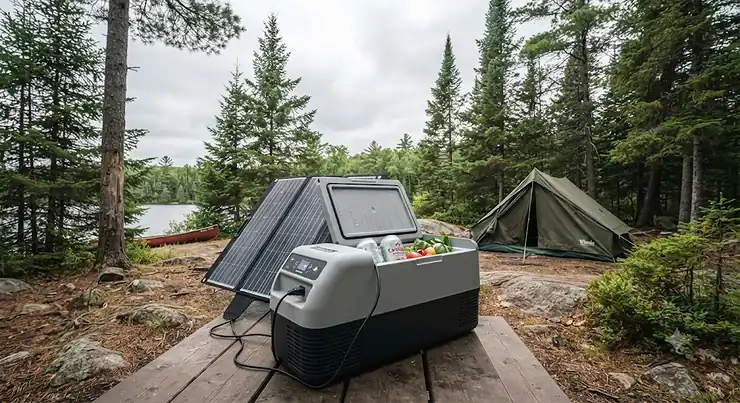
You’ve packed the cooler, checked the forecast, and of course, it’s calling for clouds. So do solar coolers work on cloudy days, or are you about to spend a long weekend babysitting warm cold cuts? Here’s the short version: yes, they work — just not at full strength, and understanding that gap is what separates a good purchase from a disappointing one.
A solar cooler is a portable fridge or freezer that draws power from a built-in or attachable solar panel, usually backed by a rechargeable battery, so it can run without a wall outlet or ice. That battery buffer, more than the panel itself, is the real reason these units keep working when the sky turns grey.
This guide digs into the actual physics of cloud cover, walks through seven real solar-powered coolers sold in Canada — from budget soft coolers to serious off-grid fridge-freezers — and breaks down what changes when the sun disappears. Canada’s solar resource varies enormously by region, and Natural Resources Canada’s photovoltaic potential maps are a genuinely useful starting point if you want to know what your own backyard or favourite campsite can realistically deliver before you buy anything.
We’ll compare solar cooler vs battery cooler runtime, look at how efficient solar powered coolers actually are in mixed weather, and cover the hybrid solar battery cooling fan setups that some campers swear by. None of the specific dollar figures below are exact live prices — Amazon and manufacturer pricing shifts constantly, so treat every number as a starting reference point and always check current pricing before you buy.
Quick Comparison Table
Before the deep dive, here’s how the seven picks stack up at a glance. “Best For” reflects the buyer profile each model actually suits, not just its price tag.
| Product | Capacity | Power Sources | Best For | Price Range (CAD) |
|---|---|---|---|---|
| GoSun Chill + SolarTable 60 | 40 L | Battery, solar, 12V, AC | Multi-day off-grid trips | C$900–C$1,100 |
| GoSun Chillest | 45 L (dual zone) | Battery, solar, 12V, AC | RV/van fridge-freezer combo | C$1,000–C$1,300 |
| ICECO VL45 | 47.5 QT | 12V, AC (solar via add-on) | Overlanding durability | C$600–C$750 |
| EENOUR D18 | 19 Qt / 18 L | 5 sources incl. solar+battery | Budget flexibility | C$380–C$480 |
| BougeRV CRX3 23QT | 23 QT | Battery, solar (add-on), 12V, AC | Weekend/week-long camping | C$400–C$500 |
| ACOPOWER LiONCooler Pro | 30–52 L | Battery, solar, 12V, AC | Flexible sizing, app control | C$650–C$950 |
| Preferred Nation Solar Cooler Bag | 36-can | USB only (not cooling) | Cheap cooler + phone charging | C$60–C$90 |
Looking at the spread above, the biggest split isn’t price — it’s whether solar actually powers the cooling compartment or just a USB port, which is exactly the trap the Preferred Nation Solar Cooler Bag illustrates. Among the true hybrid units, runtime buffer (battery capacity relative to power draw) matters more for cloudy-day reliability than panel wattage, which is why the BougeRV CRX3 and EENOUR D18 punch above their price class despite smaller batteries than the GoSun models.
💬 Just one click — help others make better buying decisions too!😊
Top 7 Solar Coolers: Expert Analysis
Every product below was researched using manufacturer specifications, retailer listings, and aggregated owner feedback from independent reviews. Prices are approximate ranges in Canadian dollars — always confirm current pricing before purchasing, since Amazon adjusts prices frequently and this article does not display exact figures by policy.
1. GoSun Chill + SolarTable 60 — true solar-plus-battery hybrid, works day and night
The GoSun Chill pairs a 40 L ice-free electric cooler with the SolarTable 60, a 60-watt folding solar array that doubles as a camp table — the closest thing on this list to an actual “solar cooler” rather than a cooler that merely tolerates solar charging. The compressor is a DC brushless 12/24V unit drawing 35–45W, cools down to -20°C, and the panel is rated up to 230W output in full sun; GoSun’s own documentation states the system works under clouds and even at night, because the Power 144/266 battery bank — not the panel — is the actual power source moment-to-moment.
Based on the spec comparison, a 60W panel isn’t going to fully power the compressor in real time on an overcast Ottawa afternoon, but it doesn’t need to: the panel’s job is topping up the battery over the course of a day, which is exactly the deployment style that survives genuinely grey weather. This is the pick for people who camp off-grid for multiple days at a stretch — a cottage with no shore power, a canoe basecamp, a remote worksite — where “no outlet, ever” is the real constraint, not just a preference.
Reviewers consistently confirm, based on independent write-ups and GoSun’s product documentation, that the unit keeps drawing from its power bank through cloudy stretches without a hitch, though several sources flag the price as the main hesitation point for casual buyers.
Pros:
- ✅ Genuine solar-plus-battery hybrid, not just a marketing label
- ✅ No ice needed — 100% of interior space usable for food and drinks
- ✅ Touchscreen control down to -20°C
Cons:
- ❌ Premium price puts it out of reach for casual campers
- ❌ 60W panel alone can’t match compressor draw without the battery buffer
At around C$900–C$1,100 for the fridge-plus-solar-table bundle at the time of research, the value case is strongest for full-time off-gridders — the cost per trip of ice you never buy again starts closing the gap faster than it looks on paper.
2. GoSun Chillest — dual-zone fridge and freezer on wheels
The Chillest takes the same ice-free approach as the Chill and adds a second, independently controlled temperature zone, so one side can run as a freezer while the other stays fridge-cold — genuinely useful rather than a gimmick once you’ve packed a cooler full of meat and drinks together and watched everything end up lukewarm. It holds 45 L, runs on a built-in 87Wh lithium battery, and each zone independently ranges from -20°C to 20°C, all mounted on all-terrain wheels with a telescoping handle.
What most buyers overlook about this model is that dual-zone control matters more than raw capacity for family or group trips — being able to freeze meat on one side while keeping drinks merely chilled on the other avoids the classic “everything is slightly warm” problem that plagues overstuffed single-zone coolers. The built-in 87Wh battery is modest on its own — expect roughly a day of runtime before a top-up is needed — but pairing it with GoSun’s smaller 30W panel is enough for maintenance charging on the hazy, in-and-out sun typical across much of Canada outside a genuine heatwave.
Based on GoSun’s published specifications and retailer documentation from Canadian sellers like M-Oceans, the wheeled, telescoping-handle design draws consistent praise for portability given the unit’s overall weight, while reviewers flag the price point as steep next to a basic ice chest.
Pros:
- ✅ Independent fridge and freezer zones in one unit
- ✅ All-terrain wheels make the 45 L size manageable solo
- ✅ Compatible with GoSun’s full solar panel lineup for scalable charging
Cons:
- ❌ 87Wh built-in battery is small without an add-on solar panel
- ❌ Among the heaviest units on this list
Priced around C$1,000–C$1,300 depending on solar bundle, the GoSun Chillest suits RV and van-life owners who already budget for off-grid power gear more than it suits a weekend cooler buyer.
3. ICECO VL45 — steel-body reliability overlanders actually trust
The ICECO VL45‘s metal shell and Secop compressor have made it a favourite in the overlanding community, and it earns its spot here on durability and power efficiency rather than solar bragging rights out of the box. It holds 47.5QT, averages roughly 55W of draw, is rated at 0.347 kWh per 24 hours, includes 3-stage battery protection, runs on AC or DC, and carries a 5-year compressor warranty — long for this category.
At roughly 55W average draw, a 100W solar panel comfortably keeps this fridge topped up on a sunny day, and testers cited in independent overlanding coverage report a 110Ah AGM battery paired with just 20W of solar sustaining nearly a week of continuous running — the kind of margin that survives several consecutive overcast days without the fridge ever going dark. Based on the spec comparison, this isn’t a “solar cooler” out of the box — the battery and panel are sold separately — but its low, steady power draw is precisely what makes solar charging realistic in the first place, which is arguably more important than any bundled panel.
Verified through owner reports on independent overlanding sites and ICECO’s own Canadian customer testimonials, reviewers repeatedly cite reliable temperature holding in extreme heat and quiet operation as standout traits, with occasional mentions of the unit’s weight once fully loaded.
Pros:
- ✅ Low, steady power draw makes solar pairing genuinely practical
- ✅ 5-year compressor warranty, longer than most competitors
- ✅ Metal shell holds up to rough handling better than plastic rivals
Cons:
- ❌ No bundled battery or solar panel — extra cost to go off-grid
- ❌ Heavier than comparable plastic-shell coolers
Priced around C$600–C$750 for the fridge alone, the verdict is simple: pair the ICECO VL45 with a modest 100W panel and it becomes one of the most solar-efficient options on this list, provided you budget for the extra hardware.
4. EENOUR D18 — five power sources for maximum charging flexibility
The EENOUR D18 is built around the idea that you should never be stuck with a single way to keep it cold, offering DC car power, AC wall power, its own detachable battery, solar-plus-battery, or power-station-plus-solar as options. It holds 19Qt/18L (about 23 cans), its fluorine-free compressor cools from 25°C to 0°C in 10 minutes, the 171Wh detachable battery is rated for roughly 24 hours at 0°C, and it draws 25W in ECO mode versus 38W in MAX mode — with EENOUR recommending a 100W solar panel pairing.
Here’s what to weigh: the detachable battery is the real selling point, since it means you can charge it indoors on AC the night before a trip and skip solar entirely if the forecast turns grey, then switch to solar top-ups once the sun cooperates. That ECO mode’s 25W draw is genuinely low — even a middling, partly-cloudy charging day on a 100W panel can realistically keep the battery topped up rather than merely slowing the drain, which matters more for typical Canadian weather than headline wattage.
Aggregated from EENOUR’s own documentation and third-party retail listings, reviewers highlight the fast cooling time and quiet 43dB operation, while a recurring theme is that the battery is sometimes sold separately on certain bundle listings, which catches first-time buyers off guard.
Pros:
- ✅ Five separate power sources, more flexible than most rivals
- ✅ Low-power ECO mode extends realistic solar-only runtime
- ✅ Fast cooling and quiet 43dB operation
Cons:
- ❌ Smaller 18 L capacity limits it to short trips or 1–2 people
- ❌ Battery sometimes sold separately, adding to real total cost
At around C$380–C$480 for fridge-plus-battery bundles, the EENOUR D18 is the best value pick for buyers who want genuine multi-source charging without GoSun-tier pricing.
5. BougeRV CRX3 23QT with 240Wh Battery — fastest cooling and longest standalone runtime in its class
BougeRV has built its reputation as one of the best-selling car-fridge brands in its category, and the CRX3 with its bundled 240Wh battery backs that up with genuinely fast cooling and long standalone runtime. It holds 23QT, claims 12-minute fast cooling, delivers up to 29 hours of runtime on the included 240Wh LiFePO4 battery, includes 3-level battery protection, and is compatible with BougeRV’s 100W and 200W foldable solar panels sold separately.
What most buyers overlook about this model is that battery capacity matters more for cloudy-day resilience than solar panel wattage — 29 hours of runtime means the fridge can coast through two or three consecutive grey days on stored charge alone before charging speed becomes relevant at all. That’s the single biggest practical buffer against a run of typical Canadian shoulder-season weather on this list outside the pricier GoSun units.
Based on BougeRV’s published specifications and its documented position as a top-selling car refrigerator brand on Amazon per 2025 category sales data, the brand draws consistently positive sentiment for cooling speed, with some buyers noting the panels are sold separately from the fridge-battery combo, which adds to the real total cost.
Pros:
- ✅ 29-hour runtime buffers multiple consecutive cloudy days
- ✅ 12-minute fast cooling, quicker than most rivals
- ✅ 3-level battery protection prevents over-discharge
Cons:
- ❌ Solar panels sold separately, adding to total system cost
- ❌ 23QT capacity is tight for family-sized trips
Priced around C$400–C$500 for the fridge-plus-battery bundle with panels extra, the BougeRV CRX3 sits as a strong middle ground between the EENOUR D18‘s flexibility and the ICECO VL45‘s build quality.

6. ACOPOWER LiONCooler Pro — app-controlled cooling with the widest size lineup
The LiONCooler Pro line spans 30L to 52L, giving buyers more size options than any other model on this list, and adds Bluetooth app control that most rivals skip entirely. It rapid-cools from 20°C to -20°C in about 20 minutes, the removable battery runs up to 10 hours at fridge temperatures or 5 hours at freezer temperatures, and it recharges from AC in roughly 4.5 hours or from a 90W solar panel in about 5–6 hours under ideal sun.
That 5–6 hour full solar charge time under ideal conditions is honest marketing, but based on the cloud-cover efficiency data further down this guide, that window can realistically stretch to a full day or more under overcast Canadian skies — worth knowing before planning a trip around solar-only charging. The spec sheet won’t tell you this, but user reports from independent hands-on testing suggest the battery held over 40% capacity after a full day of intermittent car and ambient heat exposure, which points to reasonably efficient insulation.
Drawn from an independent hands-on review and ACOPOWER’s own FAQ documentation, reviewers consistently praise the quick cooling speed and telescoping handle, while noting the higher-capacity 50L+ models get heavy enough that the wheels become essential rather than optional.
Pros:
- ✅ Widest size range (30–52 L) of any brand here
- ✅ Bluetooth app adds remote battery monitoring
- ✅ Removable battery simplifies indoor pre-charging
Cons:
- ❌ Solar charge time roughly doubles or worse under real cloud cover
- ❌ Higher-capacity models are heavy even with wheels
At around C$650–C$950 depending on capacity and solar bundle, the ACOPOWER LiONCooler Pro is the most size-flexible option here, best for buyers who aren’t sure yet whether they need 30L or 50L.
7. Preferred Nation Solar Cooler Bag — budget soft-sided pick, with an honest caveat
This collapsible 36-can soft cooler bag earns a spot on this list precisely because its solar panel is a common source of buyer confusion worth clearing up before you spend money expecting it to do something it doesn’t. It’s a soft-sided main compartment with a removable, leak-proof liner and a foil-lined front pocket, with a built-in solar panel wired to USB ports only.
The manufacturer states plainly that the solar panel charges USB devices only and does not power any cooling function — this is a traditional insulated soft cooler with a phone-charging perk, not a solar-powered refrigeration unit, and that distinction matters enormously if cloudy-day cooling performance is what you’re actually shopping for. Here’s what to weigh: if your search brought you to this guide because you assumed “solar cooler” always means active solar-powered cooling, this product is the clearest illustration of why reading the power specs matters more than the word “solar” printed on the box.
Based on the manufacturer’s own product listing, which is unusually direct about the panel’s USB-only function, reviewers consistently describe the bag itself performing like any decent soft cooler — fine for a beach day with ice packs, not a substitute for compressor cooling on a multi-day trip.
Pros:
- ✅ Genuinely useful USB charging perk while ice does the cooling
- ✅ Collapsible design stores flat when not in use
- ✅ Budget-friendly entry point compared to every powered option above
Cons:
- ❌ Solar panel does not power cooling at all — ice or freezer packs required
- ❌ No temperature control, so cooling duration is entirely ice-dependent
At around C$60–C$90, the Preferred Nation Solar Cooler Bag is fine as a cheap cooler bag with a charging bonus, but skip it if active solar-powered cooling on cloudy days is your actual goal — that’s what picks one through six above are built for.
Practical Usage Guide: Getting the Most Charge on Cloudy Days
Getting real-world performance out of any of these units starts before the trip, not during it. First, pre-charge everything on AC power the night before you leave — every model above with a detachable or built-in battery accepts wall power, and starting at 100% removes the guesswork entirely for day one, regardless of what the sky does.
Second, angle matters more than most buyers assume, even under cloud cover. Diffuse light still arrives predominantly from overhead, so tilting a panel to roughly match your latitude (steeper in winter, flatter in summer) captures noticeably more of what’s available than laying it flat on a picnic table. Third, keep the panel clean; a film of dust or pollen cuts output more than most people expect, and it’s a thirty-second wipe-down.
Fourth, run in the lowest power mode the trip allows — the EENOUR D18‘s ECO mode versus MAX mode is a good example of how much draw varies by setting, and every extra watt saved is a watt the battery doesn’t need clawed back on a grey afternoon. Fifth, avoid opening the lid repeatedly; every open cycle forces the compressor to work harder to recover, which matters even more when charging input is already reduced. Finally, in the first 30 days, track roughly how long a full charge lasts under your typical use — that number, more than any spec sheet figure, tells you how much solar margin you actually need to budget for.
Real-World Scenarios: Who Actually Needs a Solar Cooler
The weekend car camper. Sarah drives two hours to a provincial park campsite for a Friday-to-Sunday trip, with the car parked nearby the whole time. For this profile, a 12V-powered cooler like the BougeRV CRX3 or EENOUR D18 running off the car battery covers 90% of the need — solar is a nice-to-have for topping up during the day, not a requirement, since the trip never exceeds the battery’s standalone runtime.
The off-grid cottage owner. Marcus has a lakefront cottage in cottage country with no shore power and spends full weeks there each summer. This is the clearest case for the GoSun Chill + SolarTable 60 or a ICECO VL45 paired with a dedicated 100–200W panel and larger battery bank — multi-day, no-outlet use is exactly the scenario a real solar-battery hybrid was designed to solve, and the upfront cost amortizes over a whole season rather than one trip.
The coastal road-tripper. Priya is driving Vancouver Island’s west coast for ten days, a region known for persistent overcast and fog even in summer. Here, battery buffer trumps panel wattage entirely — the BougeRV CRX3‘s 29-hour runtime or the GoSun Chillest‘s dual-zone flexibility matter more than solar charge speed, since Priya should plan to top up at AC outlets during town stops rather than relying on marginal coastal sun.
Problem → Solution: Fixing Common Cloudy-Day Cooling Issues
Problem: the battery drained faster than expected on a grey day. Solution: switch to the lowest available power mode (ECO on the EENOUR D18, for instance) and reduce lid openings; both moves cut draw substantially without touching the charging side at all.
Problem: the solar panel seems to be doing nothing under overcast skies. Solution: this is normal and expected — per the efficiency data below, output commonly drops to 10–25% of rated capacity under heavy cloud, so the panel is trickle-charging, not failing; give it hours, not minutes, to make a dent.
Problem: food temperature crept above the safe zone on a multi-day trip. Solution: pre-chill all food before loading, pack the unit fuller rather than half-empty (less air volume to keep cold), and use a separate thermometer rather than trusting the display alone — see the food safety section below for the specific numbers that matter.
Problem: the panel is producing power but the battery isn’t charging. Solution: check the connector orientation and confirm the panel’s open-circuit voltage matches what the battery input expects; a mismatched connection is a far more common culprit than a genuinely broken panel.
Problem: unsure whether cloudy-day performance will be enough for an upcoming trip. Solution: run a dry test at home a week before departure — fully charge the unit, then let it run on battery alone in a shaded spot to see how many hours you actually get, which is more reliable than any spec-sheet estimate for your specific unit and climate.
How to Choose a Solar Cooler
- Start with battery capacity, not panel wattage. A larger buffer (like the BougeRV CRX3‘s 240Wh) matters more for cloudy-day reliability than a bigger panel, since the battery is what actually runs the compressor moment to moment.
- Match capacity to trip length, not aspiration. An 18–23 QT unit like the EENOUR D18 or BougeRV CRX3 suits weekend trips; multi-day off-grid use justifies the 40L+ GoSun models.
- Check the compressor’s average draw. Lower-wattage compressors, like the ICECO VL45‘s roughly 55W average, stretch battery runtime and make solar charging genuinely realistic rather than symbolic.
- Confirm what “solar” actually means on the listing. As the Preferred Nation Solar Cooler Bag demonstrates, some “solar cooler” products only charge USB devices — verify the panel connects to the cooling system itself.
- Factor in bundled versus separate accessories. Several models here, including the ICECO VL45 and BougeRV CRX3, sell the fridge and the solar panel separately, which changes the real total cost significantly.
- Weigh weight and portability against capacity. Larger dual-zone units like the GoSun Chillest deliver more flexibility but are meaningfully heavier — wheels help, but only up to a point on uneven terrain.
- Look for verifiable owner feedback, not just marketing copy. Aggregated sentiment from independent reviews, like those covering the ACOPOWER LiONCooler Pro, tends to surface real-world charge times that differ from ideal-condition marketing claims.
Common Mistakes When Buying a Solar Cooler
The single most common mistake is buying based on panel wattage alone, assuming a bigger number means faster charging regardless of weather — as the efficiency data below shows, cloud cover erases most of that advantage anyway, so battery capacity deserves at least equal weight in the decision. A close second is assuming “solar powered” always means the panel drives the cooling system directly; as the Preferred Nation Solar Cooler Bag shows, that’s not universally true, and the fine print matters more than the product name.
Buyers also frequently underestimate total system cost by focusing only on the fridge price, missing that models like the ICECO VL45 and BougeRV CRX3 sell their solar panels separately. Another recurring mistake is buying more capacity than a typical trip requires — a 52L ACOPOWER LiONCooler Pro is excellent for extended off-grid living but overkill (and needlessly heavy) for a weekend at a serviced campground. Finally, many buyers skip a home test run entirely and discover charging limitations for the first time mid-trip; the dry-run test described in the problem-solution section above costs nothing and prevents that exact scenario.
How Weather Affects Your Solar Cooler’s Performance
How Efficient Are Solar Powered Coolers, Really?
Under full, direct sun, a well-matched panel can offset a meaningful share of a low-draw cooler’s daytime power use — the ICECO VL45‘s roughly 55W average draw against a 100W panel is a reasonable real-world match, for instance. But “efficient” needs context: even in ideal conditions, panel output varies with angle, temperature, and time of day, so treat manufacturer charge-time claims (like the ACOPOWER LiONCooler Pro‘s 5–6 hour solar charge estimate) as best-case figures rather than guarantees.
Cloud Cover Impact on Solar Charging
This is where the headline question of this article actually gets answered with numbers. According to independent solar-industry data aggregated from multiple sources, panels typically produce 10–25% of rated output under heavy overcast, and 50–80% of rated output under light or partial cloud cover — a wide enough range that a “cloudy” forecast can mean very different things for your charging plans. One frequently cited study from a tropical-climate research context found a 250W monocrystalline panel retained about 76% of normal output under light cloud but dropped to roughly 33% under heavy cloud, which lines up closely with the broader industry consensus.
Practically, this means a 100W panel that would deliver close to its rated output in full sun might realistically deliver 10–25W under thick cloud — still useful for a low-draw unit like the EENOUR D18 in ECO mode, but not enough to keep pace with a compressor in MAX mode without battery support carrying the difference.
Solar Panel Efficiency in Different Weather Conditions
Panel technology also matters here. Monocrystalline panels — used across most of the products in this guide — generally handle diffuse, indirect light better than older polycrystalline designs, converting roughly 15–20% more energy from scattered light per independent industry comparisons. Interestingly, cold temperatures actually improve photovoltaic efficiency slightly per unit of light received, since solar cells are semiconductors that generate more voltage when cool — a small silver lining for Canadian shoulder-season trips where cloud and cool weather often arrive together. For a deeper technical grounding in how photovoltaic cells convert both direct and diffuse light into electricity, Wikipedia’s overview of photovoltaics is a solid, accessible starting point.
✨ Don’t Miss These Exclusive Deals!
🔍 Take your off-grid cooling setup to the next level with these carefully researched picks. Click on any highlighted product to check current pricing and availability. The right combination of battery capacity and panel size will keep your food and drinks genuinely cold, cloudy days included!
Solar Cooler vs Battery Cooler: Runtime Compared
A “battery cooler” here means a unit that runs on a rechargeable battery with no solar input at all — you charge it at home or in the car and it runs until depleted. A true solar cooler adds a panel to extend that runtime indefinitely, weather permitting. The table below breaks down how that plays out across three cloud scenarios for a mid-size unit drawing roughly 30–40W.
| Scenario | Battery-Only Cooler | Solar-Assisted Cooler |
|---|---|---|
| Full sun, panel matched to draw | Runs until battery depletes (10–29 hrs typical) | Can run indefinitely; battery holds or grows |
| Partial/light cloud (50–80% output) | Same fixed runtime, no change | Meaningfully extends runtime, doesn’t fully offset draw |
| Heavy overcast (10–25% output) | Same fixed runtime, no change | Slightly extends runtime; battery buffer does most of the work |
The pattern here is consistent across every product in this guide: a battery-only cooler’s runtime is fixed and predictable regardless of weather, while a solar-assisted cooler’s real advantage shows up specifically in full or partial sun, not under heavy cloud. Under thick overcast, a solar cooler behaves almost identically to a battery-only one for that stretch of time, which is exactly why battery capacity — not panel size — should be the deciding factor for anyone genuinely worried about consecutive cloudy days. This is also why models like the BougeRV CRX3, with its 29-hour standalone runtime, hold up so well in cloudy-region reviews despite a comparatively modest panel option.
Hybrid Solar-Battery Cooling Fans: Are They Worth It?
A hybrid solar-battery cooling fan is a smaller, separate accessory category worth mentioning alongside full solar coolers — typically a small evaporative or DC fan powered by its own compact solar panel and battery, used to circulate air around a traditional ice cooler or inside a tent rather than to actively refrigerate anything. Based on the spec comparison with the full fridge units above, these fans draw a fraction of the power (often under 5W), which means even a small attached panel can realistically keep one running through cloudy stretches where a full compressor cooler would need to lean on stored battery power instead.
Reviewers of this accessory category note real value for keeping air moving inside a tent or a shaded picnic area, improving comfort meaningfully, but the honest analytical take is that a cooling fan does nothing to lower food temperature — it doesn’t replace a compressor cooler or ice for actual food safety, only for personal comfort. For campers weighing whether to add one, the calculation is simple: pair a hybrid fan with a soft cooler and ice for a budget setup focused on comfort, or skip it entirely if a compressor unit like the EENOUR D18 or ICECO VL45 is already handling both food cooling and, incidentally, radiating a little less ambient heat than a running generator would.
Long-Term Cost & Maintenance
Total cost of ownership for a solar cooler extends well past the sticker price. Budget for a replacement or backup battery every few years of regular use — lithium batteries in units like the BougeRV CRX3‘s 240Wh pack or the EENOUR D18‘s 171Wh pack typically hold meaningful capacity for several hundred charge cycles before noticeable degradation sets in, which for a weekend-warrior user often translates to 4–6 years of service. Panels themselves are comparatively low-maintenance — a periodic wipe-down and avoiding physical damage is usually the extent of the care required, and most foldable panels in this category carry multi-year warranties.
Compressor units like the ICECO VL45, backed by a 5-year compressor warranty, tend to have the lowest long-term repair risk in this category, since the compressor is typically the most expensive component to replace. On a cost-per-use basis, buyers who use their unit ten or more times per season see the strongest return relative to repeatedly buying bagged ice, which averages several dollars per trip and adds up quickly over a full Canadian camping season. Buyers who camp only once or twice a year, by contrast, may find a basic ice cooler paired with the Preferred Nation Solar Cooler Bag‘s USB-charging convenience delivers better value for their actual usage pattern.
Food Safety Guide for Off-Grid Cooling
None of this charging math matters if the food inside isn’t actually safe to eat, so it’s worth grounding this in Canadian food safety guidance directly. The Government of Canada’s food safety guidelines define the bacterial “danger zone” as 4°C to 60°C — perishable food left in that range for more than about two hours (or one hour above roughly 32°C ambient) should be discarded, regardless of how good the cooler looks on paper.
For solar and battery coolers specifically, this means treating a low-battery warning as a genuine food safety signal, not just an inconvenience — if a unit’s compressor stops entirely during a run of heavy cloud with a depleted battery, the same two-hour rule applies as it would for any warm fridge. Practical safeguards include packing a separate stick thermometer rather than trusting a built-in display alone, pre-chilling food fully before loading it (warm food loaded into a cold compartment raises the whole unit’s temperature and taxes the compressor harder), and keeping the unit as full as practical, since a fuller compartment holds cold longer than a half-empty one. For anyone planning a genuinely remote, multi-day trip, Natural Resources Canada’s solar photovoltaic buyer’s guide resources are worth a look before finalizing a battery-and-panel setup, since undersizing the system is the single most common cause of a food safety failure on a cloudy-weather trip.
Frequently Asked Questions
❓ Do solar coolers work on cloudy days?
❓ How efficient are solar powered coolers compared to plugging into a wall?
❓ Can a solar cooler run on battery power with no sun at all?
❓ Is a solar cooler worth it for Canadian camping trips?
❓ How do I know if a 'solar cooler' actually cools using solar power?
Conclusion
So, do solar coolers work on cloudy days? Yes — reliably enough for real camping and off-grid use, as long as the battery capacity, not the panel size, is doing the heavy lifting during those grey stretches. Every hybrid model covered here, from the budget-friendly EENOUR D18 to the premium GoSun Chill + SolarTable 60, is built around that same principle: the panel tops up, the battery carries the load, and cloud cover just slows the top-up rather than stopping the cooling.
For most Canadian campers, the practical takeaway is straightforward. Weekend trips near the car are well served by battery-first units like the BougeRV CRX3 or EENOUR D18. Multi-day, truly off-grid trips justify stepping up to the ICECO VL45 with a dedicated panel, the size-flexible ACOPOWER LiONCooler Pro, or the fully integrated GoSun lineup. And if what you actually need is just a decent cooler bag with a phone-charging bonus, the Preferred Nation Solar Cooler Bag is honest about what it does — and doesn’t — do.
Whichever unit fits your trip style, the core lesson holds across all seven picks: check the battery capacity and average power draw before you check the panel wattage, run a home test before you rely on it in the field, and keep a stick thermometer in the mix so cloudy-day charging numbers never turn into a food safety guess.
Recommended for You
- Solar Powered Cooler: 7 Top Picks to Beat Canadian Heat (2026)
- Solar Cooler Off-Grid Cottage: 7 Powerful Picks for 2026
- Can a Power Bank Cooler Cool a Tent? 7 Real Options for 2026
Disclaimer: This article contains affiliate links. As an Amazon Associate, I earn from qualifying purchases. If you purchase products through these links, we may earn a small commission at no additional cost to you.
✨ Found this helpful? Share it with your friends! 💬🤗
