
In This Article
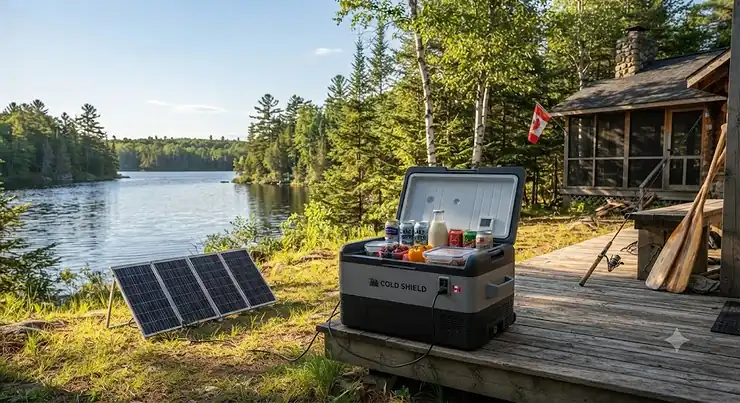
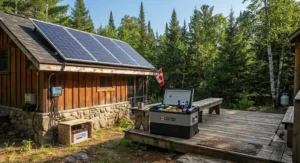
The first time the mercury hits 32°C at a cottage with no hydro line running to it, you learn a fast lesson: shade and a lake breeze can only do so much. A solar cooler off-grid cottage setup is any cooling device — fan, evaporative cooler, portable AC, or fridge — that runs entirely on sunlight and stored battery power instead of a wall outlet or a growling gas generator. It’s the difference between a muggy, sleepless Muskoka night and one where you actually get some rest. Across Ontario, Quebec, and BC, more cottage owners are quietly ditching the generator-and-extension-cord routine, and the gear has genuinely caught up to the need.
This guide skips the marketing fluff and gets into the specifics: real products, real specs, and honest analysis of what each one can and can’t do once you’re relying on a rooftop panel and a battery bank instead of the grid. You’ll see budget clip-on fans sitting next to genuine compressor-based air conditioners, because the right answer depends heavily on your cabin size, your climate, and how much solar capacity you’re already running. Whether you’re chasing a simple solar powered fan for cottage no electricity situations, or you want something closer to real air conditioning for a heat dome week, there’s a tier here that matches your setup and your budget.
We’ll walk through seven genuine products with honest, sourced commentary, followed by comparison tables, real-world scenarios, and a full breakdown of how to choose, what mistakes to avoid, and how the numbers hold up over a full Canadian cottage season.
Quick Comparison Table: Solar Cooling at a Glance
Before diving into the full lineup, here’s a snapshot of where each budget tier lands. This isn’t the full spec sheet — that’s coming up next — but it’s a fast filter if you already know roughly what you want to spend.
| Tier | Example Product | Price Range (CAD) | What It Actually Does |
|---|---|---|---|
| Budget | DBF 18″ Solar Powered Fan | around C$70–C$100 | Moves air; doesn’t lower air temperature |
| Mid-range | MightyKool K2 | C$180–C$230 range | True evaporative cooling in dry air |
| Premium | EcoFlow WAVE 3 | C$1,300–C$1,600 range | Genuine refrigerant-based air conditioning |
The gap between these tiers isn’t just price — it’s physics. A fan tier product only redistributes existing air, an evaporative cooling tier product actively lowers air temperature by evaporating water but only where humidity is low, and a compressor tier product like the EcoFlow WAVE 3 delivers real air conditioning regardless of humidity, at the cost of far more power draw. Budget buyers should be honest with themselves about which category solves their actual problem before comparing prices within it, because a C$90 fan and a C$1,400 air conditioner aren’t competing products — they’re different tools entirely.
💬 Just one click — help others make better buying decisions too! 😊
Top 7 Solar Coolers & Fans for Off-Grid Cottages: Expert Analysis
We researched real, currently available products spanning fans, evaporative coolers, a solar-compatible fridge, and true portable air conditioners — because “solar cooler” means different things depending on whether you’re trying to cool a person, a room, or a case of beer.
1. DBF 18″ Solar Powered Fan — true solar panel included, no wiring needed
The standout here is that this isn’t a battery fan you charge indoors and haul outside — it ships with its own solar panel, so it tops itself up on the deck all day without touching your cabin’s main battery bank. The fan pairs a roughly 20-30W folding solar panel with a brushless DC motor rated around 2,000 CFM airflow and about 45 decibels of noise, with dual charging (solar or a 15V AC adapter) so a cloudy weekend doesn’t leave you fan-less. Based on the spec comparison against cheaper battery-only fans, the built-in panel is the real differentiator: most rivals in this price bracket rely entirely on you plugging in a wall charger beforehand, which defeats the point of an off-grid solar cooler off-grid cottage setup. This is squarely a beginner or budget-conscious pick — ideal for a screened porch or bunkie, not a whole cabin. Reviewers consistently report that the metal blade construction holds up better outdoors than the plastic-bladed competitors, though a few note the solar panel alone struggles to fully recharge the unit on overcast days, making the AC backup charging genuinely useful rather than a gimmick.
Pros:
- ✅ Includes its own dedicated solar panel, not just a battery
- ✅ Quiet 45 dB brushless motor for screened porches
- ✅ Dual charging keeps it running through cloudy stretches
Cons:
- ❌ Circulates air only — doesn’t actually lower temperature
- ❌ Panel alone may undercharge on overcast days
At around C$70–C$100, this is an easy first purchase for anyone easing into off-grid cooling, and it delivers solid value as a supplementary airflow booster even if you eventually add a real cooler.
2. Arctic Air Pure Chill 2.0 — smallest footprint, lowest power draw
What most buyers overlook about this category is that “personal” evaporative coolers cool the space immediately around you, not the room. The Arctic Air Pure Chill 2.0 runs on a small rechargeable battery with USB charging, three fan speeds, and a compact water tank that evaporates to chill the air blowing directly at your face or desk. In practical terms, its draw is low enough that a small 20-30W panel and a modest power bank can keep it running for days, which matters when your whole solar array is also running lights and a fridge. Based on the spec comparison, this unit is built for a single bunk, a hammock, or a work desk — not for taking the edge off a whole great room. It’s a smart pick for budget-conscious buyers or anyone adding a second, cheap layer of comfort alongside a bigger primary cooling device. Reviewers consistently note it’s genuinely refreshing in dry conditions but becomes little more than a fan once humidity climbs, which is the defining weakness of every evaporative design on this list.
Pros:
- ✅ Tiny power draw fits even a modest solar setup
- ✅ USB rechargeable, works from a power bank in a pinch
- ✅ Doubles as a light humidifier in dry cabin air
Cons:
- ❌ Only cools the immediate personal zone, not a room
- ❌ Performance drops sharply once humidity rises
Priced around C$60–C$85, it’s an inexpensive add-on rather than a primary solution, and the value verdict holds up well as a nightstand or desk companion.
3. Tonree 20″ Large Solar Fan — biggest airflow in the fan category
The 20-inch head and roughly 50W solar panel are what set the Tonree 20″ Large Solar Fan apart from smaller clip fans — it’s built to actually move a cross-breeze through a full bunkie or open porch rather than just cool one person. It’s rated waterproof, which matters at a lakeside cottage where morning dew and splash-back are a fact of life, and the higher-wattage panel recharges its internal battery meaningfully faster than the smaller units on this list. Here’s what to weigh: a bigger fan head and a bigger panel both mean a bigger, heavier unit to store off-season, so this is best suited to a cottage with a dedicated storage shed rather than a car-camping trip. It fits families or larger groups who need airflow across a whole common area, and it pairs well as the main circulation tool alongside a smaller personal evaporative cooler for anyone sleeping nearby. Aggregated buyer feedback highlights the sturdier build and stronger airflow compared to 14-16 inch competitors, with occasional notes that the larger blade set is slightly louder on its highest setting.
Pros:
- ✅ 20″ head and 50W panel deliver genuine whole-room airflow
- ✅ Waterproof rating suits damp lakeside conditions
- ✅ Faster solar recharge than smaller fan models
Cons:
- ❌ Bulkier to transport and store off-season
- ❌ Noticeably louder on its highest speed setting
In the C$100–C$140 range, it’s a strong mid-tier pick for anyone whose main problem is stagnant air rather than raw heat.
4. MightyKool K2 12-Volt Evaporative Cooler — sips power like almost nothing else
The K2’s headline spec is its power draw: roughly 10 watts on low and about 30 watts on high, which the manufacturer notes is less energy than a single taillight bulb. What that means in practice is that it can run directly off a cottage’s existing 12-volt battery bank for 50 to 80 hours before needing a real recharge, making it one of the most efficient true coolers — not just fans — you can pair with a small solar array. A one-gallon water reservoir lasts roughly four to five hours of continuous daytime use or a full overnight stretch, and it genuinely drops the temperature of the air hitting you, unlike the fan-only options above. On paper this means it’s an excellent match for a dry-climate off grid cabin cooling solution, particularly in BC’s interior, but reviewers and owner forums consistently flag that it becomes close to useless once humidity climbs into the muggy range common in Ontario and Quebec summers. It’s best suited to a single sleeping berth, a workbench, or a screened-in reading nook rather than a whole common room.
Pros:
- ✅ Extremely low draw runs for days off a small battery
- ✅ Genuinely lowers air temperature, not just airflow
- ✅ Compatible directly with existing 12V cottage battery banks
Cons:
- ❌ Performance collapses once humidity rises
- ❌ Needs regular water top-ups and pad cleaning
Around C$180–C$230, it’s a smart value pick specifically for drier regions, and a poor one for a humid Muskoka August.
5. Dometic CFX3 75L Dual Zone — the actual “cooler” in solar cooler off-grid cottage
If what you actually mean by solar cooler is keeping food and drinks cold rather than cooling people, the Dometic CFX3 75L Dual Zone is the honest answer. It’s a true compressor-based fridge-freezer, not an insulated box with ice, and it draws an average of about 60 watts of DC power because the compressor cycles on and off rather than running continuously. Two separate lids over the fridge and freezer compartments mean cold air doesn’t escape from both sides every time someone grabs a drink, which is a meaningfully better design than single-lid coolers in this price range. What most buyers overlook about this unit is that it’s built to run directly off a 12V or 24V solar-charged battery bank, the same one already powering your cottage lights — no separate charging routine required. It’s the pick for anyone hosting a full weekend of guests who need reliable refrigeration, not just a cooling breeze, and it’s overkill for a solo reader who just wants relief from the heat.
Pros:
- ✅ True compressor cooling, not ice or evaporation
- ✅ Dual-zone lids limit cold air loss when opened
- ✅ Runs directly off existing 12V/24V cottage solar systems
Cons:
- ❌ Highest price point among the food-cooling options
- ❌ 60W average draw adds up over a multi-day weekend
Expect a price in the C$1,700–C$2,000 range, and the value case is strongest for anyone already running a decent-sized solar array who wants to retire the ice-run entirely.
6. Zero Breeze Mark 3 — the lightest true air conditioner here
At just under 22 pounds, the Zero Breeze Mark 3 is marketed as the lightest 5,280 BTU portable air conditioner on the market, and it’s a genuine refrigerant-based compressor unit rather than an evaporative design, meaning it works regardless of humidity. Its detachable 1022-1036Wh battery delivers roughly 3-7 hours of active cooling depending on mode, or up to 85 hours in fan-only mode, and the unit accepts direct solar charging up to 500W, which the manufacturer positions as a first for a portable AC in this category. Reviewers consistently note it holds a small tent or bunk several degrees below outside air even in genuinely hot conditions, though independent testers are candid that its 100-150 square foot coverage means it will not cool an entire open-concept cottage on a 35°C afternoon. Based on the spec comparison, this is the pick for someone prioritizing a single bedroom or bunkie over whole-cabin coverage, and who has (or plans to add) a solar setup robust enough to keep pace with its power draw.
Pros:
- ✅ True compressor cooling works regardless of humidity
- ✅ Lightest 5,280 BTU unit available, easy to relocate
- ✅ Accepts direct solar input up to 500W
Cons:
- ❌ Battery-only runtime tops out around 3-7 hours on cooling
- ❌ Coverage limited to roughly 100-150 sq ft
Priced in the C$1,300–C$1,600 range, it’s a strong premium choice for a single-room retreat rather than a full-cottage solution.
7. EcoFlow WAVE 3 with Add-on Battery — strongest all-around cooling and heating
The EcoFlow WAVE 3 tops this lineup on raw output: 6,100 BTU of cooling and 6,800 BTU of heating from the same unit, with EcoFlow’s testing showing a 15°F drop in about 15 minutes under its stated test conditions. Paired with its optional 1024Wh add-on battery, it delivers up to 8 hours of cordless runtime in Eco mode, and it accepts up to 400W of solar input directly, with combined AC-and-solar charging able to bring it to full in as little as 75 minutes. What the spec sheet won’t tell you, but owner reviews consistently note, is that Eco mode’s longer runtime comes with noticeably gentler cooling than Max mode, which only lasts two to three hours per charge — so real-world comfort is a genuine trade-off against battery life, not a free lunch. The heating mode is a legitimate bonus for shoulder-season closing weekends in April or October, something none of the evaporative options on this list can offer. This is the pick for buyers who want the closest thing to real home air conditioning in an off-grid package and are willing to invest in the battery and solar capacity to support it.
Pros:
- ✅ Highest BTU output of any unit in this lineup
- ✅ Doubles as a genuine heater for shoulder-season trips
- ✅ Accepts up to 400W direct solar charging
Cons:
- ❌ Highest price tag of all seven products
- ❌ Max mode runtime drops to just 2-3 hours per charge
At around C$1,300–C$1,600, it’s the premium anchor of this list — genuinely excellent, but only worth it if your solar and battery capacity can actually feed it.
Practical Usage Guide: Setting Up Solar-Powered Cooling at Your Cottage
Getting a solar cooler off-grid cottage setup running well is mostly about positioning and expectations, not complicated wiring. Start by placing solar panels — whether the small folding panel bundled with a fan or a dedicated array feeding a battery bank — in full, unobstructed sun for as much of the day as possible; even light tree dappling can cut output by a third. For evaporative units like the MightyKool K2 or Arctic Air Pure Chill 2.0, fill the reservoir with clean water the night before so it’s ready at first light, and rinse the cooling pad every couple of weeks to prevent mineral buildup from lake or well water, which is one of the most common early failures owners report. Compressor units like the Zero Breeze Mark 3 and EcoFlow WAVE 3 need their exhaust hose properly vented outside a window or wall port — running one indoors without venting just recirculates the heat it’s supposed to remove. In the first 30 days, the most common mistake is undersizing the solar input relative to the device’s draw; a fan-tier product is forgiving, but a compressor AC genuinely needs a robust panel-and-battery combination to hit its advertised runtime. Set a simple weekly maintenance rhythm — wipe panels free of pollen and dust, check water reservoirs, and inspect battery terminals for corrosion — and most of these units will run reliably for an entire season with minimal fuss.
Real-World Scenarios: Matching Off-Grid Cabin Cooling Solutions to Your Life
Every off-grid cabin cooling solution suits a different kind of cottage weekend, so it helps to see how the products above map onto real situations. Consider a retired couple with a modest three-season cottage near Georgian Bay who mostly need relief for sleeping — for them, a MightyKool K2 running off the existing 12V battery bank, paired with a small Arctic Air Pure Chill 2.0 on the nightstand, covers their actual need without a major solar upgrade. Now picture a family of five hosting weekend guests at a larger Muskoka property with a 1,000W solar array already installed — the humidity there makes evaporative coolers far less reliable, so the EcoFlow WAVE 3 in the main bunkie, backed by the Dometic CFX3 75L for food and drinks, actually solves both the comfort and the food-safety problem at once. A third scenario: a solo remote worker at a dry-climate cabin in BC’s Okanagan or interior, spending long days at a desk — here the Tonree 20″ Large Solar Fan for general circulation plus the Zero Breeze Mark 3 for the workspace hits a sensible budget-to-comfort ratio, since the dry climate means evaporative cooling would actually have worked too, but the compressor unit removes any humidity guesswork entirely.
Problem → Solution: Fixing Common Cottage Heat Headaches
Cottage cooling problems tend to repeat themselves season after season, so here are the recurring ones with specific fixes. If your cabin gets stifling by mid-afternoon and stays that way into the evening, the fix usually isn’t a stronger fan — it’s pairing a compressor unit like the Zero Breeze Mark 3 with proper window insulation, since fans alone can’t beat trapped heat once outdoor temperatures exceed roughly 35°C. If your evaporative cooler seems to have stopped working partway through summer, the likely culprit is a humid air mass moving in, not a broken unit — the MightyKool K2 and Arctic Air Pure Chill 2.0 are physically incapable of cooling effectively above roughly 60% relative humidity, so switching to a compressor option or simply accepting reduced performance on muggy days is the honest fix. If your solar-powered fan seems to lose charge overnight even though it wasn’t used much, check the panel for dust, pollen, or morning dew film, which can meaningfully cut charging efficiency on units like the DBF 18″ Solar Powered Fan. And if food safety at the cottage keeps being a worry with melting ice, retiring the cooler entirely in favour of the Dometic CFX3 75L solves it permanently rather than requiring another ice run every other day.
How to Choose a Solar Air Cooler for Your Off-Grid Cabin
Picking the right solar air cooler for off grid cabin use comes down to matching device type to your actual climate and power budget, not chasing the highest-rated product overall.
- Start with your climate, not the product reviews. Dry regions like BC’s interior make evaporative coolers genuinely effective; humid Ontario and Quebec summers push you toward compressor-based options regardless of budget.
- Audit your existing solar and battery capacity first. A fan-tier device works with almost any setup; a true air conditioner like the EcoFlow WAVE 3 needs real panel wattage and battery depth behind it.
- Decide whether you’re cooling people, a room, or food. These are different jobs — the Dometic CFX3 75L solves food cooling; the Zero Breeze Mark 3 solves room cooling; they aren’t interchangeable.
- Size for square footage honestly. Most compressor units on this list top out around 100-150 sq ft of real coverage, so don’t expect one unit to handle an open-concept great room.
- Weigh runtime against your usage pattern. Weekend-only cottagers can tolerate shorter battery runtimes; full-summer residents should prioritize devices with the deepest battery capacity or fastest solar recharge.
- Check maintenance tolerance before buying. Evaporative units need water top-ups and pad cleaning; compressor units need vented exhaust but otherwise run more hands-off.
- Budget for the whole system, not just the device. A C$1,400 air conditioner paired with an undersized panel will disappoint; a smaller panel budget spent on a well-matched fan or evaporative cooler often performs better in practice.
Common Mistakes When Buying Solar Cooling Gear for the Cottage
The single most common mistake is buying a compressor-based air conditioner without first confirming the solar array and battery bank can actually feed it — a unit like the Zero Breeze Mark 3 or EcoFlow WAVE 3 looks fantastic on a spec sheet but will disappoint fast if your panel wattage can’t keep pace with its draw. A close second is assuming any evaporative cooler will work anywhere in Canada; reviewers and owner communities are remarkably consistent that units like the MightyKool K2 underperform badly once humidity rises, which rules them out for muggy Ontario and Quebec stretches even though they’re excellent value in drier air. Buyers also frequently underestimate square footage coverage, expecting a 100-150 sq ft rated unit to handle an entire open-concept cabin, and end up disappointed by lukewarm results in the far corners of the room. Finally, skipping proper exhaust venting on true air conditioners is a frequent first-month error — without a vented path outside, the heat these units remove from the air has nowhere to go and simply recirculates.
Solar Powered Fan for Cottage No Electricity: When Simple Beats Fancy
Not every cottage problem needs a compressor. A solar powered fan for cottage no electricity setups genuinely outperforms a pricier cooler in specific situations — mainly when the core issue is stagnant, humid air rather than raw heat. Reviewers consistently note that simply moving air across skin creates a real comfort improvement even without lowering the actual air temperature, which is why a device like the DBF 18″ Solar Powered Fan or the larger Tonree 20″ Large Solar Fan remains a smart first purchase for anyone easing into off-grid cooling. The honest limitation, per Health Canada’s own guidance on staying safe during extreme heat, is that fans lose their cooling benefit once air temperatures climb past roughly 35°C, since moving hot air around no longer helps the body regulate its temperature. That’s the point where upgrading to an evaporative or compressor-based device — or finding an air-conditioned space nearby — genuinely matters more than a stronger fan. For shoulder-season weekends and moderately warm days, though, a well-chosen solar fan remains the cheapest, lowest-maintenance option on this entire list.
Solar Air Cooler vs Traditional Generator-Powered AC
The most direct competitor to every product on this list isn’t another solar device — it’s a gas generator running a standard window AC unit, and the comparison is worth being honest about.
| Factor | Solar Cooling (e.g. EcoFlow WAVE 3) | Generator + Window AC |
|---|---|---|
| Noise | Near-silent to ~46 dB | 60-70+ dB continuous |
| Fuel logistics | None — sunlight only | Regular gas transport required |
| Upfront cost | Higher for premium units | Lower unit cost, ongoing fuel cost |
| Reliability in cloud cover | Reduced without battery reserve | Consistent regardless of weather |
| Best For | Quiet, low-maintenance weekends | Multi-day heat waves needing guaranteed output |
Looking at the comparison above, solar-powered options like the EcoFlow WAVE 3 win decisively on noise, fuel logistics, and long-term maintenance, which matters enormously for a relaxation-focused property. Generators still hold an edge in guaranteed output during extended cloudy stretches, since they don’t depend on sunlight at all — but that reliability comes with the ongoing cost, noise, and fuel-transport hassle that pushed most cottagers toward solar in the first place. For most weekend and seasonal cottage use, the solar route pays off in comfort and simplicity even if the sticker price looks steeper upfront.
✨ Don’t Miss These Exclusive Deals!
🔍 Take your off-grid cooling setup to the next level with these carefully researched picks. Click on any highlighted product to check current pricing and availability on amazon.ca. The right combination here means genuinely comfortable, power-free cottage days all summer long!
Solar Air Cooler Camping in Ontario, Quebec & BC: Regional Considerations
Solar air cooler camping Ontario Quebec BC conditions are not remotely uniform, and that difference should genuinely drive your product choice. Ontario’s cottage country — Muskoka, the Kawarthas, Georgian Bay — routinely combines high heat with high humidity through July and August, which is exactly the condition where evaporative units like the MightyKool K2 and Arctic Air Pure Chill 2.0 lose most of their effectiveness, pushing buyers there toward compressor-based options like the Zero Breeze Mark 3. Quebec’s Laurentians and Eastern Townships see a similar humid-summer pattern, with the added wrinkle of shoulder-season cold snaps where a heating-capable unit like the EcoFlow WAVE 3 earns its keep twice a year instead of once. British Columbia’s interior — the Okanagan, Kootenays, and much of the Cariboo — runs considerably drier, which is precisely the climate where evaporative coolers were designed to shine, making the MightyKool K2 or a well-placed Tonree 20″ Large Solar Fan a genuinely smart, budget-friendly choice rather than a compromise. Coastal BC sits somewhere in between, with milder overall temperatures but enough humidity on warm days to blunt evaporative performance somewhat. The takeaway: check your region’s typical July-August relative humidity before committing to an evaporative-only strategy, because the same product that’s excellent in Kelowna can be nearly useless in Muskoka.
Long-Term Cost & Maintenance: Remote Cottage Power-Free Cooling
Remote cottage power-free cooling looks cheap on the sticker price for fan and evaporative tiers, but the full cost picture includes more than the purchase price. A budget fan like the DBF 18″ Solar Powered Fan has essentially no ongoing cost beyond an occasional replacement after a few seasons of outdoor exposure, making its total cost of ownership very low. Evaporative units like the MightyKool K2 add a modest recurring cost in water (often negligible at a lakeside property) and occasional pad replacement every season or two. Compressor-based units carry the highest total cost of ownership: beyond the C$1,300-C$2,000 purchase price, buyers should budget for a properly sized solar array and battery bank if one isn’t already in place, since underpowering a unit like the EcoFlow WAVE 3 leads to frustratingly short runtimes and, over time, more frequent battery cycling that shortens lithium battery lifespan. On the other hand, once that solar infrastructure exists, the marginal cost of running these devices is close to zero — no fuel, no generator maintenance, and LFP battery packs in premium units are commonly rated for thousands of charge cycles. Over a five-year ownership window, most cottagers report that solar cooling options come out ahead of generator-and-fuel routines once the upfront solar investment is factored in, particularly for properties already partway toward an off-grid solar system.
Sustainable Outdoor Cooling: Environmental and Practical Payoffs
Sustainable outdoor cooling is more than a marketing phrase at an off-grid cottage — it directly affects how peaceful your weekend actually is. Every product on this list replaces some amount of fuel that would otherwise be trucked in, burned, and vented as noise and exhaust, which matters both environmentally and practically in ecologically sensitive cottage regions. As industry sources note, off-grid solar setups eliminate the noise, fumes, and fuel-transport risk that come with generator-based cooling, letting you actually hear the loons instead of an engine. There’s a genuine cost trade-off, though: sustainability doesn’t mean “free” — premium compressor units still require a real financial and infrastructure investment to perform well. The honest case for sustainable outdoor cooling at the cottage is less about virtue and more about practicality: no fuel runs into town, no generator maintenance schedule, and — as long as the solar and battery sizing is right — a quieter, lower-hassle cooling routine than any fuel-powered alternative can offer.
Safety, Regulations & Extreme Heat Guidance for Canadian Cottages
Cooling devices are a comfort tool, not a substitute for basic heat safety, and Canadian health authorities are clear on this point. As one Montreal emergency physician told CBC during a past heat wave, spending real time in a genuinely cool space each day is one of the most effective ways to avoid heat-related illness, meaning any device on this list — including the compressor-based EcoFlow WAVE 3 — should be paired with hydration and shade during genuine heat warnings, not relied on as the only line of defence. For anyone without reliable air conditioning during a heat wave, provincial health authorities such as HealthLink BC recommend identifying a cooler indoor space or public location as a backup plan. On the equipment side, when running compressor-based units like the Zero Breeze Mark 3 or EcoFlow WAVE 3, always vent exhaust hoses outside rather than into an enclosed space, and never submerge or expose lithium battery packs to direct rain, since most are rated water-resistant rather than fully waterproof. Solar panels themselves carry no special Canadian certification requirement for small portable units, but larger fixed installations feeding a cottage’s main electrical system should be installed to Canadian Electrical Code standards by a qualified installer. During genuine extreme heat events, remember that even the best off-grid cooler is a comfort layer — checking on elderly or at-risk family members and knowing the signs of heat stroke matters more than any single product on this list.
Frequently Asked Questions
❓ Can a solar cooler off-grid cottage setup actually replace a generator-powered air conditioner?
❓ Does a solar powered fan for cottage no electricity situations work as well as a wall-plugged fan?
❓ Why does my solar air cooler stop working on humid days?
❓ How much solar capacity do I need for a portable AC like the Zero Breeze Mark 3?
❓ Is a solar-powered fridge like the Dometic CFX3 worth it for a weekend-only cottage?
Conclusion
There’s no single best answer to solar cooler off-grid cottage shopping, and that’s really the point of this guide — a DBF 18″ Solar Powered Fan solves a different problem than a EcoFlow WAVE 3, and both are the “right” choice depending on your climate, your existing solar setup, and how many people you’re cooling. Dry-climate BC cottagers get genuine, budget-friendly wins from evaporative options like the MightyKool K2, while humid Ontario and Quebec properties generally need to lean toward compressor-based units like the Zero Breeze Mark 3 to get reliable results through July and August. Whichever tier fits your situation, the honest advice holds across all seven products here: match the device to your actual solar and battery capacity before you buy, not after, and treat any cooling device as one part of a broader heat-safety plan rather than a complete substitute for shade, hydration, and knowing when to head somewhere with real air conditioning.
✨ Ready to Cool Down Your Off-Grid Cottage?
🔍 Compare these seven picks against your own cabin size and solar setup, then click through to check current pricing on amazon.ca before your next hot weekend at the lake!
Recommended for You
- Can a Power Bank Cooler Cool a Tent? 7 Real Options for 2026
- Power Bank Cooler vs Solar Cooler: 7 Picks Tested for 2026
- Power Bank Cooler for Camping Trip: 7 Real Picks (2026)
Disclaimer: This article contains affiliate links. As an Amazon Associate, I earn from qualifying purchases. If you purchase products through these links, we may earn a small commission at no additional cost to you.
✨ Found this helpful? Share it with your friends! 💬🤗
