
In This Article
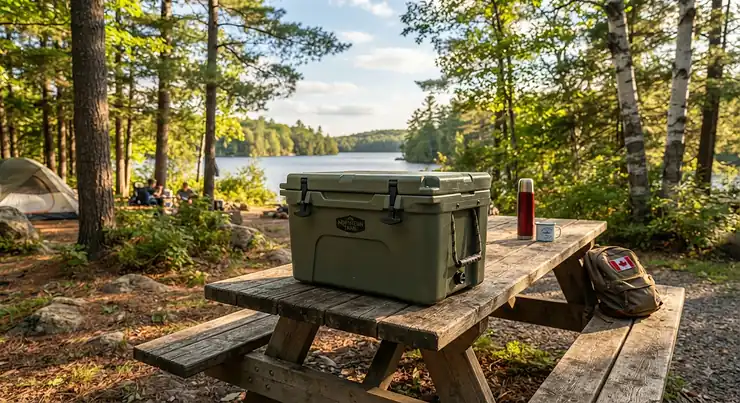
There’s a very specific kind of heartbreak that happens around hour thirty of a long weekend: you reach into the cooler for a cold drink and your hand comes back wet, lukewarm, and disappointed. An insulated camping cooler is the one piece of gear standing between “still crisp” and “please don’t make me eat that potato salad.” It’s not glamorous. Nobody posts a sunset photo of their cooler. But ask any seasoned camper what they’d replace last, after the tent and the stove, and the cooler usually wins by a landslide.
So what is an insulated camping cooler, exactly? It’s a portable, thermally sealed container — built with either rigid rotomolded plastic or dense closed-cell foam wrapped in fabric — designed to slow heat transfer and keep ice, food, and drinks cold for anywhere from several hours to several days, depending on construction quality and how it’s packed.
This guide breaks down seven real, currently available coolers spanning budget to premium, hard-sided to soft-sided, and featherweight to family-sized. You’ll get honest analysis grounded in actual specs and aggregated review sentiment, not marketing copy dressed up as advice — because food safety agencies broadly agree on a temperature “danger zone” where bacteria multiply fastest, and a cooler that can’t hold its own against that range isn’t doing its job. Whether you’re weekend camping with the family, portaging into a backcountry site, or just need something for short trips to the beach, there’s a model here that fits.
Quick Comparison Table
| Cooler | Type | Ice Retention (claimed) | Price Range (CAD) | Best For |
|---|---|---|---|---|
| YETI Hopper Flip 18 | Soft-sided | Up to 2 days | C$420-C$460 | Premium weekend camping gear |
| RTIC Soft Pack 20 | Soft-sided | Up to 2 days | C$105-C$140 | Budget soft cooler for camping |
| Coleman Xtreme 50-Quart Wheeled | Hard-sided | Up to 5 days | C$180-C$230 | Long weekends, family trips |
| Igloo BMX 52-Quart | Hard-sided | Up to 5 days | C$170-C$210 | Rugged mid-range durability |
| Arctic Zone Titan Deep Freeze 30-Can | Soft-sided | Up to 3 days | C$70-C$100 | Cooler for short trips |
| IceMule Pro Large 23L | Soft-sided (roll-top) | Up to 24 hours | C$150-C$190 | Lightweight camping cooler |
| YETI Roadie 24 | Hard-sided | Multi-day | C$330-C$360 | Compact premium performance |
Looking at the table, the split between hard-sided and soft-sided is really a split between two different camping styles. If you’re the type who drives to a campsite and sets up for a few days, the Coleman Xtreme 50-Quart Wheeled or Igloo BMX 52-Quart give you the longest runway for the least money. If you’re hiking, canoeing, or just don’t want a bulky box taking up trunk space, the IceMule Pro Large 23L or Arctic Zone Titan Deep Freeze 30-Can trade some ice life for portability. And if budget isn’t the constraint, the YETI Hopper Flip 18 and YETI Roadie 24 sit at the top for a reason we’ll unpack below.
💬 Just one click — help others make better buying decisions too!😊
Top 7 Insulated Camping Coolers: Expert Analysis
1. YETI Hopper Flip 18 — best all-round soft cooler for weekend trips
The Hopper Flip 18 is the cooler most other soft coolers get measured against, and the standout feature is its ColdCell closed-cell rubber foam, which behaves more like a rigid cooler’s wall than the thin batting found in cheaper bags. Inside, it fits roughly 20 cans plus ice, or about 16 lbs of ice on its own, in a cubed shape that’s easy to load and easy to stack in a trunk. The HydroLok zipper is the real party trick here: unlike most soft cooler zippers, which tend to weep once the ice starts melting, this one is genuinely sealed, which matters if you’re tossing it in the backseat next to your gear. Based on the spec comparison with budget alternatives, the extra cost buys you a shell that resists punctures and UV degradation rather than cracking or fading after a season or two outdoors. This is the cooler for campers who want hard-cooler-level performance without the bulk — weekend warriors, tailgaters, and anyone hauling gear by hand rather than by trunk. Reviewers consistently report that the Hopper Flip 18 performs best when packed near capacity; leave it half-empty and the ice life drops noticeably faster than YETI’s marketing photos suggest.
Pros:
- ✅ ColdCell foam insulation rivals many hard coolers
- ✅ HydroLok zipper genuinely resists leaks after days of use
- ✅ Durable DryHide shell shrugs off punctures and UV
Cons:
- ❌ Premium price for a soft-sided cooler
- ❌ Needs to be packed full to hold temperature well
At around C$420-C$460, this sits at the top of the soft-cooler price bracket — check current price before buying, since YETI occasionally shifts colourways and bundle offers. For campers who want one cooler that does almost everything well, it’s a strong long-term value even at that price.
2. RTIC Soft Pack 20 — best value semi-rigid soft cooler
RTIC built its whole business model on undercutting premium competitors without gutting quality, and the Soft Pack 20 is a clean example of that. With up to 2 inches of closed-cell foam insulation packed into a welded, waterproof shell, it holds roughly 20 cans plus ice and weighs in around 2.4 to 3 lbs empty — genuinely light for what it offers. What most buyers overlook about this model is the Cold Lock press lid, which lets you grab a drink without unzipping the whole main compartment, a small feature that meaningfully cuts down how much cold air escapes over a weekend. Independent testers comparing it directly against the pricier YETI Hopper Flip line have noted the RTIC holds up reasonably well on ice retention despite selling for roughly a third of the price. This is the pick for budget-conscious campers, students, or anyone building out a car-camping kit from scratch who doesn’t want to drop premium-cooler money on a first purchase. Aggregated review sentiment points to a slightly less refined zipper pull compared to top-tier brands, though most users say it hasn’t affected performance.
Pros:
- ✅ Roughly a third of YETI’s price for similar foam thickness
- ✅ At just a few pounds empty, easy to sling anywhere
- ✅ Cold Lock press lid speeds up grab-and-go access
Cons:
- ❌ Zipper feels less refined than premium competitors
- ❌ Smaller aggregated review pool than more established brands
Priced in the C$105-C$140 range at the time of research, the RTIC Soft Pack 20 is arguably the best entry point into serious soft-sided coolers without overspending on your first trip.
3. Coleman Xtreme 50-Quart Wheeled — best budget-friendly multi-day ice retention
Coleman’s Xtreme line exists specifically to compete with premium rotomolded coolers on ice retention, and the 50-Quart Wheeled model is the practical, family-friendly version of that pitch. The standout feature is the insulated lid combined with thicker wall insulation, which Coleman rates for up to five days of ice retention under ideal conditions — heavy-duty recessed wheels and a telescoping handle make it manageable even fully loaded with 84 cans’ worth of capacity. Based on the spec comparison, five-day claims from any brand should be read as a best-case number achieved with block ice, minimal lid-opening, and shade, not a guarantee; several owners testing the cooler at home report ice melting noticeably faster than advertised, particularly with cube ice in warm ambient conditions. Still, for the price, this is one of the more genuinely capable long-haul coolers on this list, and it’s a sensible pick for families doing multi-day weekend camping trips who need to feed a group without buying ice every morning. What the spec sheet won’t tell you, but reviewer feedback suggests, is that the wheels and handle are the weak point — treat them gently rather than dragging a fully loaded cooler over rocky terrain.
Pros:
- ✅ Rated for up to 5 days of ice retention
- ✅ Wheels and telescoping handle ease hauling loaded coolers
- ✅ Wide availability and accessible price point
Cons:
- ❌ Real-world retention often falls short of marketing claims
- ❌ Wheels and handle reported as flimsy by some owners
Expect a price in the C$180-C$230 range, making the Coleman Xtreme 50-Quart Wheeled one of the better value-per-litre picks in this whole roundup.
4. Igloo BMX 52-Quart — toughest hard cooler for rough handling
The Igloo BMX line leans into build quality first, ice retention second, which shows in details like the stainless-steel kick plate, reinforced swing-up handles, and oversized hinges. Its standout feature, Cool Riser Technology, lifts the cooler body slightly off whatever surface it’s sitting on, reducing heat transfer from hot pavement or rock. Igloo rates the BMX 52 for up to five days of retention at 90°F thanks to extra-thick foam walls and rubberized T-latches, and it holds up to 83 twelve-ounce cans at 52 quarts (49 litres) of capacity. Here’s what to weigh: aggregated customer feedback is genuinely split — plenty of owners report three to five days of usable cold, while a smaller but vocal group describes latches or hinges failing within the first year, which points to some batch-to-batch inconsistency rather than a fundamental design flaw. For campers who prioritize a cooler that can survive being tossed in a truck bed and dragged across a campsite, this is a strong mid-range option; for anyone gentler on gear, the trade-off toward lighter soft coolers might make more sense.
Pros:
- ✅ Cool Riser Technology lifts cooler off hot ground
- ✅ Reinforced hinges and stainless kick plate add durability
- ✅ Strong balance of price and 5-day retention claim
Cons:
- ❌ Some owners report latches and hinges breaking early
- ❌ Heavier than soft-sided alternatives at over 7 kg empty
At roughly C$170-C$210, the Igloo BMX 52-Quart undercuts most premium rotomolded coolers while still delivering multi-day performance for the average car camper.
5. Arctic Zone Titan Deep Freeze 30-Can — best zipperless design for quick access
Not every trip needs five days of ice retention, and the Titan Deep Freeze line is built around that reality. Its standout feature is the patented zipperless flip-top lid, which trades the fussy zipper most soft coolers rely on for a quick, one-handed open-close motion — genuinely useful with wet or cold hands at a lake or river. Inside, a removable SmartShelf keeps drinks separated from food that would otherwise get crushed, and the whole unit is built around a hard plastic liner rather than a simple fabric pouch. Coleman-owned Arctic Zone rates it for up to three days of ice retention on the larger sizes, though independent reviewers who’ve tested it against premium rivals note the wall insulation is noticeably thinner — around a quarter-inch versus an inch or more on brands like YETI — so realistic performance in warm weather tends to land closer to half a day to a full day of properly cold contents rather than the marketing number. What most buyers overlook here is that this isn’t a knock against the product; it’s simply a cooler built for its actual use case, which is picnics, beach afternoons, and short overnight trips rather than a week at the lake.
Pros:
- ✅ Zipperless flip lid is easy to use one-handed
- ✅ SmartShelf keeps drinks separate from crushable food
- ✅ Among the lowest prices in this roundup
Cons:
- ❌ Thin wall insulation limits it to short trips
- ❌ Real-world ice life often trails the multi-day claim
With pricing typically in the C$70-C$100 range, the Arctic Zone Titan Deep Freeze 30-Can is the easiest cooler on this list to justify as a second, grab-and-go option.
6. IceMule Pro Large 23L — lightest pick for portages and hike-in sites
If your idea of camping involves a canoe portage, a trailhead with no parking lot, or a paddleboard, the IceMule Pro solves a problem hard coolers simply can’t. Its standout feature is a roll-top, dry-bag-style closure sealed with an air valve, which lets you add extra air into the insulating layer for better cold retention or let it out to compress the bag flat for storage on the way home. At around 3.2 lbs (1.5 kg) empty, it’s genuinely one of the lightest coolers with real insulating capability on the market, and independent testing has recorded it holding contents below 4°C for over 50 hours in controlled conditions — a strong result for something you can wear like a backpack. The padded, ventilated straps mean it’s actually comfortable loaded, which matters more than it sounds like it would after the first kilometre of trail. Reviewers consistently note that the roll-top seal takes a little practice — you generally need three full rolls before clipping it closed — and that it isn’t always perfectly leakproof if that step gets rushed, so it’s better suited to campers who read the instructions than those who assume it works like a zipper.
Pros:
- ✅ Among the lightest coolers in this lineup at 1.5 kg
- ✅ Padded backpack straps make hike-in access painless
- ✅ Independently tested to hold cold temperatures over 50 hours
Cons:
- ❌ Roll-top seal isn’t always fully leakproof if rushed
- ❌ Awkward to lift overhead when packed to capacity
Priced around C$150-C$190, the IceMule Pro Large 23L earns its spot as the lightweight camping cooler pick for anyone whose trip starts where the parking lot ends.
7. YETI Roadie 24 — most compact premium hard cooler
The Roadie 24 is YETI’s answer to the question “what if a hard cooler could actually fit behind a car seat?” Its standout feature is a rotomolded build that YETI says is roughly 10% lighter and performs about 30% better thermally than the model it replaced, while still holding 33 cans or 26 lbs of ice, and standing tall enough to keep wine bottles upright — a small but telling detail about who this cooler is designed for. The InterLock lid system and a freezer-quality ColdLock gasket do a lot of the thermal heavy lifting here, and the pressure-injected Permafrost insulation in the walls is the same category of tech found in YETI’s larger, pricier coolers, just scaled down. On paper this means road-trippers and solo or duo campers get near-flagship cold retention in a footprint that actually fits in a compact car’s trunk or behind a seat. Reviewer sentiment on this specific size is largely positive, with owners repeatedly highlighting how well it performs relative to its compact dimensions, though a few note it’s tall and narrow enough to tip more easily than a squatter, wider cooler when set on uneven ground.
Pros:
- ✅ Rotomolded build is roughly 10% lighter than its predecessor
- ✅ Tall enough to stand wine bottles upright
- ✅ InterLock lid and ColdLock gasket boost retention
Cons:
- ❌ Premium price relative to similarly sized competitors
- ❌ 24-quart capacity limits it to solo or duo trips
At roughly C$330-C$360, the YETI Roadie 24 is a splurge for a cooler this size, but for anyone who genuinely needs premium performance in a compact footprint, it earns its keep.
Top 7 Products: Specs & Value Comparison
| Cooler | Capacity | Empty Weight | Insulation Type | Best For |
|---|---|---|---|---|
| YETI Hopper Flip 18 | ~20 cans + ice | ~2.3 kg | Closed-cell rubber foam | Weekend camping gear |
| RTIC Soft Pack 20 | ~20 cans + ice | ~1.1-1.4 kg | Closed-cell foam (up to 2″) | Budget soft cooler |
| Coleman Xtreme 50-Quart | ~84 cans | ~8-9 kg | Extra-thick wall foam | Multi-day family trips |
| Igloo BMX 52-Quart | ~83 cans | ~7.4 kg | Foam wall + insulated lid | Rugged durability |
| Arctic Zone Titan Deep Freeze 30-Can | ~30 cans + ice | ~1.5 kg | Radiant-barrier foam | Cooler for short trips |
| IceMule Pro Large 23L | ~24 cans + ice | ~1.5 kg | Air-valve PolarLayer foam | Lightweight camping cooler |
| YETI Roadie 24 | ~33 cans / 26 lbs ice | ~5.9 kg | Pressure-injected Permafrost | Compact premium performance |
This table makes the trade-off pattern obvious once you line the numbers up side by side: capacity and ice retention climb together on the hard-sided coolers, while weight and portability climb together on the soft-sided ones, and almost nothing on the market wins at both simultaneously. If you need to feed a group for a week, the Coleman Xtreme 50-Quart and Igloo BMX 52-Quart are doing more real work per dollar than anything else here. If your priority is getting cold drinks somewhere a wheeled cooler can’t go, the IceMule Pro Large 23L and Arctic Zone Titan Deep Freeze 30-Can are built for exactly that trade-off.
How to Pack and Maintain Your Insulated Camping Cooler
Buying the right cooler only gets you halfway there — how you pack and maintain it determines whether you actually see the ice retention numbers on the box. Pre-chill the cooler itself for a few hours before loading it, ideally with a bag of ice sitting inside overnight; a cooler that starts warm has to absorb that heat before it can start protecting your food. Use block ice rather than cubes wherever possible, since it has less surface area and melts significantly slower — freezing water in a clean yogurt tub or loaf pan works fine at home. Pack strategically: put dense, cold items on the bottom and layer ice around and over everything rather than just on top, since cold air sinks and an air gap at the bottom does you no favours. Keep the lid closed as much as you can stand; every opening lets warm air rush in and cold air spill out, and this single habit affects retention more than almost any spec on the box.
After the trip, the maintenance side matters just as much. Dry hard coolers out completely before storing them, since trapped moisture breeds odour and mildew over time, and wipe down soft-cooler liners with a mild soap solution rather than harsh chemicals that can degrade the leakproof coating. Check hinges, latches, and zippers each season — a five-minute inspection catches the kind of wear that review sections are full of complaints about. A common mistake in the first thirty days of ownership is assuming a new cooler performs at its rated best right out of the box; give it one or two trips to “learn” your packing habits before judging its real-world ice life against the marketing number.
Food safety should factor into your packing routine too. Health authorities generally advise keeping perishable food out of the danger zone between roughly 4°C and 60°C for no more than two hours, so a cooler that’s merely “cool” rather than genuinely cold isn’t just a comfort issue — it’s a food safety one, especially on longer trips where you’re relying on the same ice for several days.
Which Cooler Fits Your Trip? Real Camper Scenarios
Matching cooler to trip type saves more money and frustration than any single spec comparison. Consider a university student planning weekend car-camping trips with two or three friends: budget matters, trunk space is limited, and nobody’s hauling gear more than fifty metres from the car. The RTIC Soft Pack 20 or Arctic Zone Titan Deep Freeze 30-Can cover this scenario well, keeping costs low while still holding a weekend’s worth of drinks and snacks.
Now picture a family of four heading to a provincial park campground for five nights, running a cooler daily for meals, snacks, and drinks in July heat. This is where the Coleman Xtreme 50-Quart Wheeled or Igloo BMX 52-Quart earn their higher price tags — the extra capacity and multi-day retention mean fewer ice runs into town, which on a five-night trip can genuinely save both money and vacation time.
Finally, imagine a paddler doing a two-day canoe route with a portage in between, carrying every kilogram on their back or in the canoe. Capacity matters less here than weight and how the cooler carries. The IceMule Pro Large 23L is purpose-built for exactly this: it straps on like a backpack, compresses when partially empty, and floats if it goes overboard — features none of the hard-sided coolers in this list can match. Worth noting for anyone camping in bear country: Parks Canada’s guidance on camping in bear country applies to whatever’s inside your cooler too, so backcountry campers should still store food in a bear-resistant container or vehicle overnight regardless of how well the cooler itself seals.
Common Cooler Problems (And How to Fix Them)
Even a good cooler runs into predictable issues, and most have straightforward fixes. If ice is melting faster than expected, the most common culprit isn’t the cooler itself but how full it is — a half-empty cooler has far more air space to keep cold than a packed one, so top up with extra ice or frozen water bottles rather than leaving room. If a soft cooler’s zipper starts sticking or leaking, a thin application of zipper lubricant (sold specifically for this purpose, though beeswax works in a pinch) on both sides of the teeth usually restores smooth function and improves the seal. Musty odours in a hard cooler after storage typically mean it wasn’t fully dried before being closed up; a wash with diluted white vinegar or baking soda, followed by air-drying with the lid propped open, resolves most cases. Finally, if a hard cooler’s drain plug leaks under load, check that the internal gasket hasn’t shifted or worn — most manufacturers, including Igloo and Coleman, sell replacement plugs and gaskets rather than requiring a full cooler replacement.
How to Choose an Insulated Camping Cooler
- Match capacity to trip length and group size. A rough rule of thumb is 1 litre of cooler space per person per day for a weekend trip, scaling up for longer stays.
- Decide hard-sided or soft-sided first. Hard coolers win on multi-day retention and durability; soft coolers win on weight, portability, and price.
- Check the actual insulation type and thickness, not just the marketing name — closed-cell foam thickness correlates directly with real-world ice life.
- Consider how you’ll carry it. Wheels matter for flat campgrounds; backpack straps matter for portages; simple handles are fine for short car-to-picnic-table hauls.
- Look past the headline ice-retention number to how it was tested — most brands quote best-case, block-ice, minimal-opening scenarios.
- Factor in maintenance and warranty. A cooler with a multi-year warranty and available replacement parts (latches, gaskets, drain plugs) tends to cost less over its real lifespan.
- Set a realistic budget band and buy the best cooler within it rather than stretching for a premium name that outpaces your actual camping frequency.
Understanding Insulation Ratings: What the Numbers Actually Mean
Unlike home insulation, which uses a standardized R-value system, most cooler brands don’t publish an official insulation rating. Major manufacturers, including Coleman, have acknowledged they typically skip official R-values for recreational coolers in favour of real-world ice-retention claims from their own internal testing. That’s a meaningful gap for shoppers, because it means the “5-day ice retention” printed on a box is a brand’s own internal benchmark, not a figure verified against a shared industry standard the way appliance energy ratings are. In practice, insulation performance comes down to three factors that do correlate reliably across brands: wall thickness (thicker foam almost always outperforms thinner foam of the same material), foam density and type (closed-cell rubber foam and pressure-injected polyurethane both outperform basic open-cell foam), and seal quality at the lid or zipper, since even excellent wall insulation is undermined by a gasket that lets warm air seep in. What most buyers overlook is that ambient temperature, how often the lid opens, and the ice-to-contents ratio affect real-world performance more than the printed number does — brands themselves generally admit that outdoor temperature, how often you open the lid, your ice-to-contents ratio, and whether you use block or cube ice all swing results significantly. Treat every brand’s headline retention claim as a ceiling reached under ideal lab-like conditions, and plan your trip around a more conservative real-world estimate — generally 40-60% of the advertised number for average summer camping conditions.
Soft-Sided Cooler vs Hard-Sided Cooler: Which Wins for Camping?
This is the debate that decides almost every cooler purchase, and the honest answer is that neither type wins outright — they win at different jobs. A soft-sided cooler like the RTIC Soft Pack 20 or YETI Hopper Flip 18 wins on weight, typically running one-third to one-half the empty weight of a comparably sized hard cooler, and it collapses or compresses for storage when empty, which matters if trunk or closet space is tight. Soft coolers also tend to be gentler on interior car upholstery and easier to carry one-handed or as a shoulder bag for short distances. A hard-sided cooler like the Coleman Xtreme 50-Quart or Igloo BMX 52-Quart, on the other hand, wins decisively on multi-day ice retention, structural durability under load (you can genuinely sit or stand on most rotomolded coolers), and resistance to punctures from sharp gear, fish hooks, or overeager dogs. Hard coolers also seal more consistently over years of use, since a rigid gasket degrades more slowly than a fabric-and-zipper seal exposed to repeated stretching. For weekend camping gear where the cooler travels short distances by vehicle and needs to last three to five days, hard-sided wins on pure performance. For day trips, backpacking-adjacent camping, or anyone who values portability and price over maximum ice life, soft-sided is the more practical choice — and increasingly the gap has narrowed, with premium soft coolers like the Hopper Flip line now rivalling mid-range hard coolers on retention.
What to Expect: Real-World Performance Beyond the Marketing Numbers
Marketing copy tends to describe cooler performance in absolutes — “5 days of ice,” “leakproof,” “keeps drinks ice cold” — but real camping conditions rarely match a controlled lab test. Here’s what to weigh: a cooler rated for five days of retention in a climate-controlled test at a steady ambient temperature will likely deliver two to three days of genuinely useful cold in a July campsite where the lid opens a dozen times a day and direct sun hits the exterior for hours. Humidity plays a role too — coastal and inland camping in Canada can see very different real-world results even with identical packing habits, since higher humidity accelerates condensation and heat transfer at the seals. The practical takeaway, echoed across aggregated reviews of nearly every brand in this roundup, is to buy one capacity and retention tier above what your typical trip length suggests. If you camp for three days, a cooler rated for five gives you a realistic buffer once you account for lid-opening, direct sun, and imperfect ice-to-contents ratios, rather than leaving you with warm cold cuts on the last morning.
Common Mistakes When Buying an Insulated Camping Cooler
The single biggest mistake is buying based on price or brand recognition alone without matching capacity to actual trip patterns — a family that camps once a year doesn’t need the same cooler as one that camps every second weekend all summer. A close second is ignoring empty weight entirely; a 52-quart hard cooler that’s brilliant at the campsite becomes a genuine hazard to lift into a vehicle once loaded with ice and food, particularly for solo campers or anyone with back or shoulder issues. Buyers also frequently overlook maintenance costs and part availability — a cooler with a broken latch or a torn liner and no replacement parts available effectively becomes disposable, which erodes the value of even a well-built product. Finally, many first-time buyers trust headline ice-retention numbers without checking how they were tested, then feel misled when real-world performance comes in lower; reading a handful of aggregated, verified customer reviews before purchase generally gives a far more accurate picture than the box copy alone.
Long-Term Cost & Maintenance: What a Cooler Really Costs Over Time
Sticker price is only part of the real cost of cooler ownership. A budget soft cooler in the C$70-C$140 range might need replacing every two to four seasons of regular use as zippers wear and foam compresses, while a premium hard cooler in the C$300-C$450 range with a multi-year warranty can realistically last a decade or more of moderate use — which changes the cost-per-use math considerably once you spread it across the cooler’s lifespan.
| Price Tier | Example Model | Typical Lifespan | Approx. Cost Per Camping Season* |
|---|---|---|---|
| Budget | Arctic Zone Titan Deep Freeze 30-Can | 2-4 years | Low |
| Mid-range | Igloo BMX 52-Quart | 5-8 years | Moderate |
| Premium | YETI Roadie 24 | 8-12+ years | Low-to-moderate over the long run |
*Based on typical seasonal camping frequency; actual results vary with use and care.
Interpreting the table, the mid-range and premium tiers actually converge in cost-per-season once you account for how much longer a well-built cooler lasts and how few replacement parts it typically needs, while the budget tier stays cheapest upfront but requires the most frequent replacement. Ongoing costs beyond the purchase price are modest across the board — occasional zipper lubricant for soft coolers, replacement gaskets or drain plugs for hard coolers every few years, and the ongoing cost of ice itself, which a higher-retention cooler reduces by cutting down on mid-trip ice runs. One Canadian cooler retailer’s breakdown of food safety versus ice retention makes a useful distinction here: a well-packed premium cooler can hold food safely cold for days, while a warm, half-empty budget cooler can drift into unsafe territory well before the last ice cube actually melts — a cost that shows up as spoiled food and a ruined trip rather than a line item, but is worth weighing against the sticker price all the same.
✨ Don’t Miss These Exclusive Deals!
🔍 Take your next camping trip to the next level with a cooler that actually matches how you camp. Click on any highlighted pick above to check current pricing and availability before your next weekend away!
Frequently Asked Questions
❓ How long does an insulated camping cooler actually keep ice?
❓ Is a soft-sided cooler good enough for a weekend camping trip?
❓ What's the best lightweight camping cooler for hiking or portaging?
❓ Do insulated camping coolers actually have an official insulation rating?
❓ How much should I budget for a good insulated camping cooler in 2026?
Conclusion
There’s no single best insulated camping cooler — there’s only the best one for how you actually camp. If your trips are short, your budget is tight, or you’re carrying gear on your back, the lighter, more affordable soft coolers on this list — the RTIC Soft Pack 20, Arctic Zone Titan Deep Freeze 30-Can, and IceMule Pro Large 23L — will serve you well without overspending on capacity you won’t use. If you’re feeding a family for five nights at a campground, the extended retention of the Coleman Xtreme 50-Quart Wheeled or Igloo BMX 52-Quart genuinely pays for itself in fewer ice runs and less wasted food. And if performance and compact size both matter more than price, the YETI Hopper Flip 18 and YETI Roadie 24 remain the benchmarks other brands are still chasing.
Whatever you choose, remember that even the best cooler is only as good as how it’s packed and maintained — pre-chill it, pack it full, keep the lid shut, and check current pricing before you buy, since availability and promotions shift regularly on Amazon.ca. Match the cooler to the trip, not the other way around, and you’ll spend a lot less time thinking about ice and a lot more time actually enjoying the weekend.
✨ Ready to upgrade your camp kitchen? Check current pricing on today’s picks and grab the cooler that fits your next trip!
Recommended for You
- 12V Camping Fridge Guide 2026: 7 Real Picks, No Guesswork
- Solar Powered Cooler vs Battery Powered Cooler: 7 Top Picks 2026
- Top Rated Camping Coolers 2026: 7 Picks Canadians Trust
Disclaimer: This article contains affiliate links. As an Amazon Associate, I earn from qualifying purchases. If you purchase products through these links, we may earn a small commission at no additional cost to you.
✨ Found this helpful? Share it with your friends! 💬🤗
