
In This Article
There’s a very specific kind of misery that comes with reaching into a cooler on day three of a trip and pulling out a lukewarm sandwich floating in what used to be ice. A power bank cooler for camping trip use is any battery-driven device — from a personal evaporative mister to a full 12-volt compressor fridge — that keeps you or your food cool without needing a wall outlet or a bag of melting cubes. Some models even double as an actual power bank, charging your phone while they work.
That last part matters more than people expect. Once you’re off-grid, “cooling” and “power” stop being separate problems — they’re the same problem, solved (or not) by the same battery. Reviewers, campers, and cottage owners across Canada have been experimenting with everything from C$40 personal fans to nearly C$1,000 fridge-freezer combos, and the results are, frankly, mixed. Some devices genuinely change how you camp. Others are marketing dressed up as innovation.
This guide breaks down seven real products currently sold through Amazon.ca, spanning personal coolers, wearable fans, true 12V fridges, and a premium fridge-and-power-station combo. Every product mention here includes honest analysis grounded in real specifications and aggregated reviewer sentiment — not invented testimonials. We’ll also walk through setup, common mistakes, cost of ownership, and Canadian-specific safety guidance, because a good cooling gadget is only half the equation; using it correctly on a hot July long weekend at the lake is the other half.
Whether you’re weighing a power bank cooler road trip setup for the car, hunting for road trip essentials that double as emergency device chargers, or trying to figure out whether an off-grid power and cooling combo is worth the splurge for cottage season, there’s a fit somewhere in this list.
Quick Comparison Table
| Product | Type | Battery Runtime | Best For | Price Range (CAD) |
|---|---|---|---|---|
| Arctic Air Pure Chill 2.0 | Personal evaporative cooler + power bank | 5–6 hours | Budget tent camping, first-timers | C$45–C$65 |
| ChillWell 2.0 | Personal evaporative cooler | Up to 4 hours cordless | Skeptics who want to try the category cheaply | C$130–C$160 |
| Ontel Arctic Air Outdoor Evaporative Cooler | Outdoor personal cooler | Up to 6 hours | Cottage deck, dock, picnic table | C$70–C$90 |
| Arctic Air Breeze Jet | Wearable clip-on fan | 4–5 hours | Hiking, kayaking, festival-style trips | C$30–C$45 |
| Alpicool Y16T | 12V compressor fridge | Runs off vehicle/battery | Weekend road trips, small groups | C$220–C$280 |
| Alpicool C20 | 12V compressor fridge/freezer | Runs off vehicle/battery | Multi-day cottage stints, families | C$300–C$380 |
| EcoFlow GLACIER Classic 35L | Fridge-freezer + power station | Up to 43 hours (plug-in battery) | True off-grid basecamp setups | C$700–C$950 |
Looking at the spread, the gap between the personal coolers and the true fridges is really a gap in job description, not just price. The Arctic Air Pure Chill 2.0 and ChillWell 2.0 cool the air around your body; they don’t refrigerate food. The Alpicool units and the EcoFlow GLACIER Classic 35L actually chill perishables to safe temperatures, which is a completely different (and more expensive) engineering problem. If your goal is “don’t melt while sitting at the campsite,” the personal coolers win on price. If your goal is “keep the potato salad safe for four days,” you need a real fridge.
💬 Found the table useful? A quick share helps other campers plan their trip too!😊
Top 7 Power Bank Coolers for Camping: Expert Analysis
Picking the right power bank cooler for camping trip use really comes down to matching the device’s actual job — personal comfort versus food safety — to your trip length and destination. Below are seven real, currently available products, covering budget, mid-range, and premium tiers, plus a mix of personal cooling and true refrigeration.
1. Arctic Air Pure Chill 2.0 — best budget power bank + cooler combo
The standout here is the 5-in-1 design: personal cooler, fan, humidifier, LED light, and genuine USB power bank in one compact unit. It runs on Hydro-Chill evaporative technology, pulling roughly 8–10 watts, which is why the rechargeable battery stretches to 5–6 hours of use per charge. Add water (or ice for a bigger drop) and the three-speed fan lowers the air temperature immediately around you by several degrees.
Based on the spec comparison with similar personal coolers, this is one of the few genuinely dual-purpose devices in the category — most “cooler” gadgets skip the power bank function entirely, or bolt it on as an afterthought with a weak trickle-charge USB port. Here it’s a stated, marketed feature. It’s best suited to solo tent campers or festival-goers who want one compact item instead of a fan and a battery pack.
Reviewers consistently note that this style of evaporative cooler works best within about a 1–1.5 metre radius; it will not cool a whole tent or screen room, and it should be understood as personal comfort gear, not air conditioning. Aggregated feedback on similar Ontel Arctic Air products is generally positive for build quality and ease of use, with occasional complaints about battery life falling short of the advertised window in hot, dry conditions where evaporation happens faster.
Pros:
- ✅ Combines cooler, fan, humidifier and power bank in one
- ✅ Low power draw extends runtime between charges
- ✅ Compact enough for a backpack or car door pocket
Cons:
- ❌ Cools a small personal zone, not a whole tent
- ❌ Battery life shortens noticeably on the highest speed
At around C$45–C$65, this is one of the easiest entry points into the category — a reasonable low-risk way to see if a power bank cooler for camping trip use actually fits how you camp before spending on something bigger.
2. ChillWell 2.0 — honest pick for skeptics who want proof first
The standout feature on paper is the 550ml refillable reservoir paired with “Insta-Frost” technology, four fan speeds, and up to 8 hours of runtime when plugged in (roughly 4 hours cordless). It’s a similar evaporative concept to the Pure Chill 2.0, just packaged with heavier marketing language.
Here’s what the spec sheet won’t tell you, but user reports suggest otherwise: this is genuinely the most divisive product on this list. Some buyers report it working as described for close-range personal cooling and humidity control. But a meaningful share of aggregated reviews describe shorter-than-advertised cordless runtime, occasional units that stayed powered on unexpectedly, and — most consistently — buyers feeling the roughly C$130–C$160 price tag doesn’t match a device that is functionally similar to cheaper Arctic Air competitors.
This isn’t a case where we can point to fabricated five-star praise to sell you on it. If you’re specifically looking for a power bank air cooler camping review that’s straight with you: the honest read is that ChillWell 2.0 is a legitimate personal evaporative cooler, but value-conscious buyers are consistently better served by the cheaper Pure Chill 2.0 or the Arctic Air Outdoor Cooler below, which deliver a comparable cooling effect for less money.
Pros:
- ✅ Larger 550ml tank than most personal coolers
- ✅ Four fan speeds for finer airflow control
- ✅ Works well within its stated close-range use case
Cons:
- ❌ Reviewer sentiment on value for money is largely negative
- ❌ Some reports of shorter real-world battery life than advertised
Include this on your shortlist only if you specifically want its higher tank capacity — otherwise, the value math favours its cheaper Arctic Air rivals.
3. Ontel Arctic Air Outdoor Evaporative Cooler — best for cottage dock and deck use
The standout feature is right there in the name: this is one of the few personal coolers actually engineered for outdoor exposure, using three 8-inch high-velocity blades and two cooling jets to push more air volume than the smaller desktop-style models. It runs USB-rechargeable for up to 6 hours per charge across four speeds, including a turbo setting.
What most buyers overlook about outdoor-rated evaporative coolers is that “outdoor” mostly refers to airflow strength, not weatherproofing — you’ll still want to keep it out of direct rain. Based on the wattage and blade size relative to the indoor Pure Chill model, this unit is genuinely built for open-air spaces like a dock, patio, or picnic table, where a smaller personal cooler’s airflow gets lost outdoors almost immediately.
For anyone specifically hunting for a battery pack cooler for cottage country that isn’t a full fridge, this is a strong candidate — cottage decks are exactly the semi-open, breeze-competing environment this model was designed to handle. Aggregated reviewer sentiment on the broader Arctic Air outdoor line highlights the stronger airflow as the main upgrade over indoor models, with the usual caveat that evaporative cooling loses effectiveness in already-humid lakeside air.
Pros:
- ✅ Higher-velocity blades built for open outdoor spaces
- ✅ Four speeds including a stronger turbo setting
- ✅ Six-hour rechargeable runtime suits a full afternoon
Cons:
- ❌ Performs worse in already-humid cottage-country air
- ❌ Not designed to be left out in rain
At roughly C$70–C$90, it sits comfortably between the cheapest personal cooler and the true fridges — a sensible middle step for dock and deck comfort.
4. Arctic Air Breeze Jet — the lightest outdoor adventure cooling gadget
The standout feature is versatility of wear: this clip-on fan attaches to a waistband, sits under a shirt, or hangs from the included lanyard around your neck, delivering targeted airflow to your neck, back, or chest. Three speeds let you dial intensity up on a steep trail or down while sitting at a fire.
Unlike the evaporative coolers above, there’s no water tank here — it’s a rechargeable fan, which means less maintenance and a lighter overall package. Based on the spec comparison, this is really the outdoor adventure cooling gadget of the group: it’s the only product in this lineup genuinely meant to move with you on a hike, paddle, or bike ride rather than sit at a campsite.
Reviewers on similar Arctic Air wearable fans consistently flag battery life as the trade-off for the compact form factor — expect a handful of hours per charge rather than a full day, so it works best paired with a separate small power bank on longer excursions. It won’t refrigerate anything, but for keeping your own body temperature manageable during activity, it fills a gap none of the other products here address.
Pros:
- ✅ Hands-free wearable design for hikes and paddling
- ✅ Three adjustable speeds for changing exertion levels
- ✅ Lightest, most compact product in this lineup
Cons:
- ❌ No cooling reservoir, so effect is airflow only
- ❌ Shorter runtime than tank-based evaporative coolers
Priced around C$30–C$45, it’s an inexpensive add-on for anyone whose “camping trip” involves more movement than sitting at a picnic table.
5. Alpicool Y16T — best true fridge for road trip essentials
The standout feature is real refrigeration: an inverter compressor that pulls the interior from 25°C down to 0°C in about 15 minutes, and down to -20°C within the hour if you want freezer-level cold. At roughly 15 litres (16 quarts) and 6.6 kg, it holds about 20 cans or 18 bottles — enough for a weekend without needing a second cooler bag.
Key specs matter here in practical terms: dual 12/24V DC and 100–240V AC power input means it runs off a vehicle’s cigarette lighter socket on the drive, then switches to a wall outlet at the campsite or cottage without swapping hardware. This is precisely the kind of item that belongs on any road trip essentials checklist, because it removes ice runs from the itinerary entirely — no more detouring into town for a bag of cubes on day two.
Aggregated owner feedback on this class of compact Alpicool fridge is broadly positive on cooling speed and quiet operation, with the most common complaint being that direct sunlight on the casing can warp the lid over time — manageable with basic shade, like a towel or the vehicle’s trunk.
Pros:
- ✅ True compressor cooling, not just evaporative airflow
- ✅ Dual AC/DC power for car and campsite use
- ✅ Reaches near-freezer temperatures in under an hour
Cons:
- ❌ Heavier and bulkier than personal evaporative coolers
- ❌ Casing can warp if left in direct sun for hours
In the C$220–C$280 range, this is the point where a power bank cooler for camping trip use stops being about personal comfort and starts being about genuine food safety.
6. Alpicool C20 — best mid-premium pick for multi-day cottage stints
The standout feature is capacity paired with battery protection: at roughly 21 quarts (20 litres), it’s noticeably larger than the Y16T, and its three-level low/medium/high battery-protection setting stops it from draining a vehicle battery flat if it’s left running unattended overnight.
This model’s temperature memory function is the kind of detail that separates a fridge built for daily off-grid use from one built for the occasional weekend. Based on the spec comparison, the extra volume over the Y16T comfortably covers a family of four or a couple on a week-long trip, particularly when paired with a small secondary cooler for drinks that get opened constantly (splitting food and drink coolers is one of the most effective food-safety habits for longer trips).
Aggregated review sentiment across owners running the C20 for extended periods highlights reliable, consistent cooling and a surprisingly quiet compressor for the unit’s size, with occasional notes that the larger footprint takes up meaningful trunk or storage space compared to a soft cooler bag.
Pros:
- ✅ Larger 21-quart capacity suits families or longer trips
- ✅ Adjustable battery-protection levels prevent a dead car battery
- ✅ Reliable, consistently quiet compressor per owner feedback
Cons:
- ❌ Bulkier footprint takes up more vehicle or cottage space
- ❌ Higher price point than the smaller Y16T model
At around C$300–C$380, it’s the practical upgrade for anyone whose trips regularly run past a single weekend.
7. EcoFlow GLACIER Classic 35L — best off-grid power and cooling combo
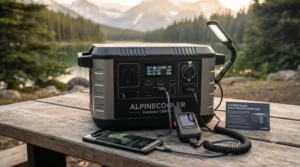
The standout feature is the dual identity: this is simultaneously a dual-zone fridge-freezer and a genuine power bank, built around a detachable 298Wh plug-in battery that can also charge laptops and phones over 100W USB-C output. It’s the only product on this list that fully earns the description of an off-grid power and cooling combo rather than just a cooler with a USB port bolted on.
Key specs translate into real freedom here: up to 43 hours of cooling runtime on the plug-in battery alone, six different charging options including solar input up to 240W, and app-based monitoring for real-time battery status and temperature alerts. For anyone planning an extended, genuinely off-grid stay — no shore power, no generator — this is built to be the anchor device the rest of camp charges from.
Based on the spec comparison with the Alpicool units, the GLACIER Classic trades portability and price for redundancy: you’re not dependent on a single power source, since it accepts AC, car, and solar charging interchangeably. Manufacturer and early-adopter reporting frames it as reliable for multi-day trips, though as with any newer premium product, independently verified long-term reliability data across a large sample of Canadian buyers is still limited — worth factoring in if you’re weighing it against the more established Alpicool line.
Pros:
- ✅ Functions as both a real fridge-freezer and a power bank
- ✅ Up to 43 hours of runtime on the detachable battery
- ✅ Six charging methods including solar for true off-grid use
Cons:
- ❌ Significant upfront cost compared to standard 12V fridges
- ❌ Detachable battery and wheels are sold as separate accessories
Expect a C$700–C$950 range for the 35L unit with the plug-in battery — a serious investment, but one built specifically for the off-grid crowd this whole category exists for.
Practical Usage Guide: Setting Up Your Power Bank Cooler Before You Leave
Getting a power bank cooler for camping trip use to actually perform starts well before you hit the highway. First, charge fully at home — not in the car the morning of departure, since a partial charge is the single biggest reason these devices underperform on day one. For evaporative coolers like the Pure Chill 2.0 or ChillWell 2.0, pre-fill the reservoir with cold (not room-temperature) water, and consider ice cubes for the first few hours of stronger cooling.
For true fridges like the Alpicool units, run them for a couple of hours at home before packing food — a fridge that starts cold holds temperature far more efficiently than one racing to cool down while also trying to chill your groceries. Pre-chilling food in your home fridge the night before amplifies this effect.
A common first-30-days mistake is treating these devices like set-and-forget appliances. Battery-powered units benefit from a mid-trip top-up whenever you’re near any power source — a car outlet during a driving leg, a cottage plug overnight — rather than waiting until the battery is fully drained. For solar-compatible units like the GLACIER Classic, position the panel for direct sun exposure during midday hours specifically, since output drops sharply in shade or low-angle morning light.
Maintenance is minimal but matters: rinse evaporative cooling cartridges between trips to prevent mineral buildup from tap water, and wipe fridge interiors dry before long-term storage to avoid lingering odours.
✨ Ready to gear up? Check current availability on today’s picks before your next trip fills up your calendar! 🔋
Real-World Scenarios: Matching the Right Power Bank Cooler to Your Trip
Picture a university student packing for a three-day music festival with a tent and a backpack. Budget is tight, trunk space doesn’t exist, and the priority is staying comfortable in a crowd, not refrigerating food. The Arctic Air Breeze Jet or the Arctic Air Pure Chill 2.0 fits this profile — lightweight, cheap enough to risk losing, and genuinely useful for personal comfort in direct sun.
Now picture a family of four driving six hours to a cottage for a week, with groceries for the whole stay in the trunk. This is squarely a power bank cooler road trip scenario, and personal evaporative coolers don’t solve the actual problem — food safety over multiple days does. The Alpicool C20 or even the EcoFlow GLACIER Classic 35L, if the budget allows, replaces the ice-run cycle entirely and keeps perishables in a safe temperature range for the full stay.
Finally, consider a couple doing a multi-week off-grid van trip through backcountry roads with no reliable power stops. Here, the calculus changes again: it’s not just about cooling, it’s about total energy independence. The EcoFlow GLACIER Classic 35L‘s solar charging and dual-purpose power bank function directly answers a problem the Alpicool units can’t — what happens when there’s no vehicle running and no wall outlet for days at a time.
Problem → Solution Guide: Common Power Bank Cooler Headaches
Problem: The evaporative cooler feels weak or barely noticeable. This usually means humidity is too high for evaporation to work efficiently, or the device is being used more than a couple of metres away from your body. Move closer, or accept that lakeside humidity limits how much these devices — including the Ontel Arctic Air Outdoor Evaporative Cooler — can achieve.
Problem: The fridge is draining the car battery. Units like the Alpicool C20 include adjustable battery-protection cutoffs specifically to prevent this — set the protection level to “high” if the vehicle will sit unused overnight, which shuts the fridge off before the battery drops too low to start the engine.
Problem: Battery runtime falls short of advertised numbers. This is a near-universal complaint across the category, and it’s usually caused by running the highest fan speed constantly, cold outdoor temperatures reducing lithium battery efficiency, or an aging battery after repeated charge cycles. Running a middle speed setting instead of maximum typically extends real-world runtime meaningfully.
Problem: Food safety uncertainty on multi-day trips. A cheap thermometer placed inside any cooler or fridge removes the guesswork — perishables need to stay at or below 4°C, and Health Canada’s food safety guidance is worth reviewing before a longer trip, particularly around raw meat storage.
Problem: A personal cooler’s water tank grows odour or residue. Rinse the tank and cartridge with clean water after every trip rather than storing it wet, and let it air-dry fully before the next use.
How to Choose a Power Bank Cooler for Camping
Choosing the right power bank cooler for camping trip use comes down to matching a handful of specific criteria to your actual travel pattern, rather than chasing the highest-rated single product:
- Define the job first. Decide whether you need personal comfort (fan/evaporative cooler) or actual food refrigeration (12V compressor fridge) — these are different product categories, not different tiers of the same one.
- Match capacity to trip length. A weekend needs far less than a week-long cottage stay; oversizing a fridge wastes battery, undersizing it means a second ice run.
- Check power flexibility. Dual AC/DC input, like on the Alpicool units, means one device works in the car and at the campsite without extra adapters.
- Weigh portability against runtime. Smaller, lighter devices generally trade away battery life — decide which matters more for how you’ll actually carry it.
- Factor in humidity where you’re headed. Evaporative coolers lose effectiveness in humid lakeside or forested environments; compressor fridges don’t have this weakness.
- Look at real battery-protection features. For anything plugging into a vehicle, adjustable low-battery cutoffs prevent a dead car battery at the worst possible time.
- Set a realistic budget band. Personal coolers sit well under C$100; true fridges start around C$200; premium power-and-cooling combos run into four figures — decide your ceiling before browsing.
Power Bank Cooler vs Traditional Ice Cooler: Which Wins?
| Factor | Battery-Powered Cooler | Traditional Ice Cooler |
|---|---|---|
| Ongoing cost | Electricity/solar (near-free) | Repeated ice purchases |
| Temperature consistency | Stable, thermostat-controlled | Drifts as ice melts |
| Setup effort | Charge battery in advance | Buy and load ice each trip |
| Weight when full | Consistent | Increases with ice, drains with meltwater |
| Best for | Multi-day trips, off-grid stays | Short trips, tight budgets |
The honest answer is that neither option is universally better — it depends entirely on trip length and access to charging. For a single overnight, a traditional cooler packed with ice and gel packs is cheaper and requires zero technology to fail. For anything beyond about three days, a compressor-based power bank cooler for camping trip use, like the Alpicool models, actually costs less over a season once you stop buying ice bags weekly, and it holds a genuinely stable temperature rather than drifting upward as ice melts.
Power Bank Coolers for Cottage Country vs the Road Trip Crowd
Cottage country and road trips put different demands on the same category of gear, even though both fall under “power bank cooler road trip” style shopping searches. A cottage stay typically means the device sits in one place for days, often near an actual wall outlet at night, with the battery only needed for daytime dock or deck use — this favours something like the Ontel Arctic Air Outdoor Evaporative Cooler for personal comfort, backed by a proper fridge like the Alpicool C20 for food, since overnight AC charging keeps both topped up.
A road trip, by contrast, means hours of driving where the only reliable power is the vehicle’s 12V socket, followed by unpredictable access to outlets at campsites or motels along the way. This is where dual-power flexibility becomes non-negotiable — a battery pack cooler for cottage country that assumes overnight wall access isn’t well-suited to five straight driving days with unreliable stops. The Alpicool Y16T, running natively off the car’s 12V socket during driving legs, is built precisely for that pattern, while the EcoFlow GLACIER Classic 35L‘s multiple charging paths (car, solar, AC) offer the most resilience for road trips with genuinely unpredictable power access.
Long-Term Cost and Maintenance: What a Power Bank Cooler Really Costs
The upfront price tag is only part of the real cost. A traditional ice cooler used weekly through a Canadian camping season (roughly May through September) can easily consume C$150–C$250 in ice purchases alone, before factoring in the gas spent on extra store trips. A compressor fridge like the Alpicool C20, by contrast, has a higher purchase price but a near-zero marginal cost per trip beyond charging — the electricity or fuel used to run a vehicle alternator or a cottage outlet is negligible compared to bagged ice.
Battery degradation is the main long-term cost to factor into premium units like the EcoFlow GLACIER Classic. Lithium batteries lose some capacity over hundreds of charge cycles, and a replacement plug-in battery is a genuine future expense worth budgeting for if you plan to keep the unit for many seasons. Personal evaporative coolers have the opposite cost profile — minimal maintenance, but a shorter expected lifespan overall since they’re built to a lower price point from the start.
Total cost of ownership over three to five seasons generally favours the mid-range 12V fridges for anyone camping more than a handful of times per year; the math tips back toward cheap personal coolers or plain ice for occasional, once-a-summer trips.
Features That Actually Matter (and Those That Don’t)
Marketing copy across this category loves to lead with LED light colours and “5-in-1” functionality counts. In practice, the features that actually change your experience are: real cooling capacity (evaporative radius or fridge liters), dual AC/DC power flexibility, and honest battery runtime under normal use rather than best-case lab conditions.
Features that matter less than they sound: extra fan speed counts beyond three or four (most people settle on one favourite speed and leave it there), app connectivity for personal coolers (genuinely useful on a fridge for temperature alerts, mostly a novelty on a C$50 personal fan), and LED mood lighting, which is a nice-to-have with zero functional impact on cooling. If a product’s marketing spends more time on the light show than the wattage draw or cooling method, treat that as a signal worth noticing.
Safety, Batteries and Food Safety: What Canadian Campers Should Know
Two separate safety conversations matter here, and they get blurred together far too often. The first is personal heat safety — a fan or evaporative cooler helps you feel cooler, but Health Canada notes that fans lose effectiveness above roughly 35°C, so on genuinely dangerous heat-warning days, shade and hydration matter more than any gadget on this list. The CBC’s roundup of heat-wave safety tips is a useful, quick refresher before a hot-weather trip.
The second conversation is food safety inside an actual fridge or cooler, which is a harder line. Perishable food needs to stay at or below 4°C, and food sitting in the 4°C–60°C “danger zone” for more than two hours becomes a genuine risk — a rule the Canadian Red Cross also highlights as part of general hot-weather safety. A cheap fridge thermometer removes the guesswork on any of the Alpicool or EcoFlow units reviewed above.
On the battery side, treat lithium batteries the way you’d treat any electronics on a trip — avoid leaving units in direct, prolonged sun exposure that heats the battery itself, and store spares away from metal objects in a bag pocket rather than loose.
Frequently Asked Questions
❓ Does a power bank cooler really keep food safe for camping?
❓ How long does a power bank cooler battery last while camping?
❓ Can I run a power bank cooler off my car battery overnight?
❓ What's the difference between an evaporative cooler and a real fridge for camping?
❓ Is a power bank cooler worth it for a single weekend camping trip?
Conclusion
There isn’t one universal answer to “which power bank cooler for camping trip use is best” — the honest answer depends entirely on what you’re actually trying to cool. Solo campers and festival-goers on a tight budget are well served by the Arctic Air Pure Chill 2.0 or the wearable Arctic Air Breeze Jet. Cottage owners wanting deck-side comfort should look at the Ontel Arctic Air Outdoor Evaporative Cooler. Anyone actually trying to keep food safe on a multi-day trip needs a real compressor fridge — the Alpicool Y16T for weekends, the Alpicool C20 for longer family stays — and off-grid travellers who need power and cooling from a single, solar-capable source should weigh the investment in the EcoFlow GLACIER Classic 35L.
Match the device to the actual problem, check current prices before you buy since they shift regularly, and prioritize real cooling and power specs over flashy extras like LED colour modes. Done right, the right pick genuinely changes how comfortable — and how well-fed — a Canadian camping season can be.
✨ Don’t Miss These Exclusive Deals!
🔍 Take your next trip to the next level with one of these carefully compared picks. Click through to check current pricing and availability before your next camping trip, road trip, or cottage weekend. 🏕️
Recommended for You
- Power Bank Cooler 2026: 7 Best Picks Canadians Actually Love
- Do USB Mini Air Conditioners Actually Work 7 Picks Tested (2026)
- USB Mini AC vs Rechargeable Personal AC: 7 Best Picks (2026)
Disclaimer: This article contains affiliate links. As an Amazon Associate, I earn from qualifying purchases. If you purchase products through these links, we may earn a small commission at no additional cost to you.
✨ Found this helpful? Share it with your friends! 💬🤗
