
In This Article
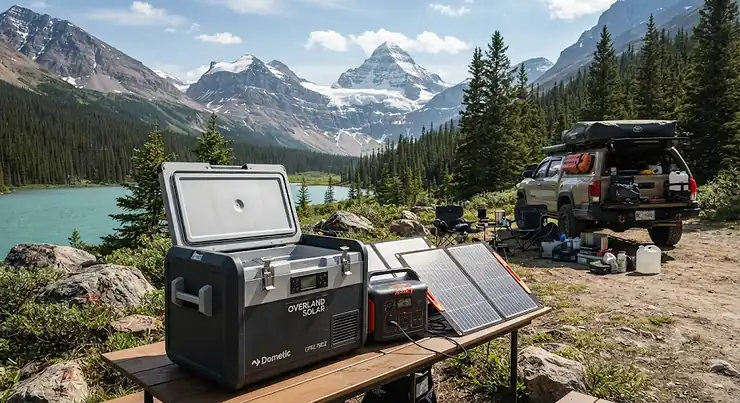
Somewhere around hour six of a washboard forestry road, your cooler ice has turned into a lukewarm soup that’s somehow gotten into the cheese. That’s usually the moment overlanders start Googling “portable solar fridge for overlanding” at 1 a.m. from a campsite with one bar of signal. A portable solar fridge for overlanding is a 12V/24V compressor-driven cooling unit, charged through a vehicle’s dual battery system or a dedicated solar panel, built to keep food safely below 4°C (39°F) for days or weeks without ice. Unlike a cooler, it doesn’t care how many days you’ve been off-grid — as long as the sun comes up and your electrical system is sized properly, dinner stays cold. This guide breaks down seven real units — from budget-friendly compressor boxes to rugged, purpose-built rigs — and shows exactly how each one behaves once you’re three days past cell coverage.
Quick Comparison Table
| Fridge | Capacity | Best For | Price Range (CAD) |
|---|---|---|---|
| BougeRV 53QT Portable Fridge | 50L | First-time overlanders on a tight budget | C$300–C$400 |
| ICECO JP50 Portable Fridge | 49L | Best SECOP compressor value | C$800–C$1,000 |
| Alpicool CR85X | 85L | Big-family or long-haul storage | C$800–C$1,000 |
| Dometic CFX3 55 | 53L | Quietest option for rooftop tent sleeping | C$1,300–C$1,600 |
| ARB Zero 63QT Dual Zone | 60L | Toughest daily-driver 4×4 build | C$1,900–C$2,300 |
| National Luna 60L Legacy Smart | 60L | Lowest power draw on multi-week trips | C$2,600–C$2,900 |
| EcoFlow Glacier | 38L | Only fridge with true built-in solar charging | C$1,900–C$2,200 |
Looking at this lineup, the spread isn’t really about who “wins” — it’s about matching amp-hour budget to trip length. Budget compressor boxes like the BougeRV and ICECO JP50 are excellent for weekend trips off a single dual-battery setup, while units like the National Luna and ARB Zero exist specifically because their lower current draw and heavier insulation pay for themselves on week-plus trips where every watt-hour matters.
💬 Found a fridge that fits your rig? One click helps you compare specs side-by-side before you buy.
Top 7 Portable Solar Fridges for Overlanding: Expert Analysis
1. BougeRV 53QT Portable Fridge — best budget entry point for first-timers
If you’re not ready to spend four figures before you even know if overlanding is your thing, this is where most people start. The BougeRV 53QT Portable Fridge runs a compressor rated for -20°C to 10°C (-4°F to 50°F), which is genuinely wide enough to double as a freezer for a weekend fishing trip or a fridge for a week of car camping. At a max draw of around 45W and roughly 36W in ECO mode, it sips power gently enough to run comfortably off a modest 100Ah dual-battery bank without babysitting the voltage all weekend. What most buyers overlook about entry-level 12V fridges like this one is that the compressor brand matters more than the badge on the lid — this unit uses the same general compressor family found in far pricier boxes, just with lighter insulation and simpler electronics. Aggregated buyer feedback on deal-tracking sites consistently flags strong cooling performance and good value against pricier alternatives, though a few users note the folding handles feel flimsy and the internal divider runs noticeably warmer than the main compartment.
Pros:
- ✅ Wide -20°C to 10°C range covers fridge and freezer duty
- ✅ Low ECO-mode draw suits smaller battery banks
- ✅ Included long DC cable simplifies rear-cargo installs
Cons:
- ❌ Folding handles feel flimsy under load
- ❌ Secondary compartment runs warmer than the main bin
In the C$300–C$400 range, this is hard to argue with as a first solar fridge for overlanding — just budget for a battery upgrade before your first multi-day trip.
2. ICECO JP50 Portable Fridge — best SECOP compressor value
Once you’re ready to commit to overlanding as more than a once-a-year hobby, the ICECO JP50 Portable Fridge is where a lot of experienced builders land. It uses a SECOP (formerly Danfoss) compressor — the same lineage found in several premium fridges on this list — at a price that undercuts them by hundreds of dollars. In practice, that means near-identical efficiency and noise levels to fridges costing twice as much, with a roughly 49L capacity that swallows a week of groceries for two people. Based on the spec comparison against Dometic’s equivalent-size units, the JP50 trades away app connectivity and some fit-and-finish polish, not cooling performance. Reviewers consistently note that the compressor is genuinely quiet enough to sleep next to in a rooftop tent, with occasional mentions of a faint fan hum during hot-weather cycling.
Pros:
- ✅ SECOP compressor matches premium-brand efficiency
- ✅ Roughly 49L capacity fits a week of groceries
- ✅ Significant savings versus SECOP-equipped competitors
Cons:
- ❌ No smartphone app or Bluetooth monitoring
- ❌ Basic latch hardware feels less refined than premium builds
Around C$800–C$1,000, the JP50 is the fridge to recommend when someone asks “what’s the best value overlanding fridge that won’t quit on me?”
3. Alpicool CR85X — best large-capacity option for weekend rigs
Families or groups running longer loops need volume, and the Alpicool CR85X delivers 85L of usable space in a footprint that still fits most SUV cargo areas. Running on 12V/24V DC with a peak draw around 80W, its 3-stage battery protection is worth understanding in practice: it automatically cuts power at a set voltage threshold to protect your starter battery, which matters enormously once you’re relying on a dual battery system rather than a home outlet. The reversible door is a small but genuinely useful detail for drawer-system installs where clearance is tight on one side. Here’s what to weigh: with that much internal volume, the compressor has more air to chill on startup, so expect slightly longer pull-down times than the smaller units on this list, particularly in summer heat.
Pros:
- ✅ 85L capacity handles multi-family or week-long grocery loads
- ✅ Reversible door adapts to tight drawer-system layouts
- ✅ 3-stage battery protection guards against a dead starter
Cons:
- ❌ Slower pull-down time than smaller-capacity fridges
- ❌ Bulkier footprint limits placement in compact SUVs
At roughly C$800–C$1,000, this is the lesser-known alternative worth cross-shopping against pricier 80L-plus fridges before committing to a name brand.
4. Dometic CFX3 55 — quietest compressor for rooftop-tent sleeping
The Dometic CFX3 55 earns its reputation the unglamorous way: it’s simply one of the quietest 12V compressors on the market, which matters far more than it sounds like until you’ve tried sleeping four feet above a fridge that cycles on every twenty minutes. Its ExoFrame construction adds genuine impact resistance around the corners and lid, addressing the most common failure point on cheaper units — cracked plastic from a dropped tailgate or a shifted load. The extended evaporator plate lining all interior walls, rather than just the back panel, means more even cooling and less hot-spotting near the lid. What the spec sheet won’t tell you, but reviewers note, is that the companion Dometic app genuinely gets used in the field, since remote temperature checks save you from opening the lid and losing cold air on a hot trail day.
Pros:
- ✅ Near-silent operation, ideal for rooftop tent camping
- ✅ ExoFrame shell resists impact and lid cracking
- ✅ App-based remote monitoring reduces lid-opening heat loss
Cons:
- ❌ Commands a premium over SECOP-based alternatives
- ❌ Removed dairy compartment reduces internal organization
In the C$1,300–C$1,600 range, the CFX3 55 is the mid-range pick for anyone whose fridge sits within arm’s reach of their pillow.
5. ARB Zero 63QT Dual Zone Fridge Freezer — toughest daily-driver 4×4 build
ARB built its reputation on gear that survives being strapped to a roof rack across the Australian Outback, and the ARB Zero 63QT Dual Zone Fridge Freezer carries that DNA. Quick-release lids and both front and rear DC power inlets solve a real installation headache: you can wire it once and access power from whichever direction your drawer system or canopy layout demands. The removable compartment divider converts the dual-zone unit into a single large fridge, which is the kind of practical flexibility that matters on trips where you’re freezing meat on the way in and running pure fridge mode on the way home. Anti-slip lid inserts sized for a bottle and glass sound like a gimmick until you’re parked on a 15-degree slope trying to pour coffee. Based on the spec comparison with ARB’s flagship Elements line, the Zero trades some of that unit’s fully weatherproof exterior-mount rating for a lighter, more affordable dual-zone package suited to interior cargo installs.
Pros:
- ✅ Front and rear DC inlets simplify wiring in any layout
- ✅ Removable divider converts dual-zone to single large fridge
- ✅ Anti-slip lid inserts genuinely useful on uneven ground
Cons:
- ❌ Heavier than comparable single-zone units
- ❌ Premium pricing reflects ARB’s brand and build reputation
At around C$1,900–C$2,300, this is the pick for a rig that gets driven hard and often, not babied.
6. National Luna 60L Legacy Smart Fridge/Freezer — lowest power draw for multi-week remote runs
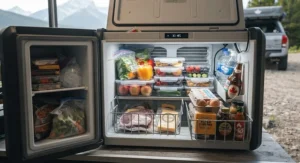
For trips measured in weeks rather than days, power efficiency stops being a nice-to-have and starts being the entire equation, and this is where National Luna built its name among expedition builders. The 60L Legacy Smart uses 42–60mm high-density polyurethane insulation — thicker than most competitors — paired with a compressor engineered specifically to minimize runtime. Its programmable intelligent controller lets you set an exact depth-of-discharge cutoff, protecting your dual battery system with far more granularity than a simple low-voltage shutoff. Bluetooth connectivity through the NL Connect app adds remote diagnostics, including a fault-ID display that flags issues before they become a ruined week of groceries in a remote valley. What most buyers overlook is the 8-year compressor warranty, which signals a company betting heavily on long-term reliability rather than planned obsolescence.
Pros:
- ✅ Thick 42–60mm insulation minimizes compressor runtime
- ✅ Adjustable depth-of-discharge protects dual battery systems
- ✅ 8-year compressor warranty reflects serious build confidence
Cons:
- ❌ Among the highest sticker prices in this category
- ❌ Heavier than most 60L-class competitors
Priced around C$2,600–C$2,900, this is the fridge extended-trip overlanders reach for when downtime in the backcountry isn’t an option.
7. EcoFlow Glacier — only fridge with true built-in solar charging
Every other fridge on this list is “solar-compatible” only in the sense that it can be wired into a broader solar and dual battery system. The EcoFlow Glacier is different: it’s a genuine 3-in-1 fridge, freezer, and ice maker with a plug-in 298Wh battery that accepts direct solar input up to 240W, charging fully in as little as roughly 2.1 hours of good sun. Its dual-zone design independently controls two compartments across a -25°C to 10°C range, and the vacuum insulation panels keep daily energy use down to about 0.18kWh in Eco mode. On paper this means a self-contained cooling system that doesn’t strictly require a vehicle electrical system at all — set it on a picnic table with a portable panel angled at the sun, and it recharges itself. The ice-maker function, producing 18 cubes in about 12 minutes, is a genuine novelty that becomes surprisingly practical after the third warm drink of a hot trail day.
Pros:
- ✅ Direct solar charging without needing a vehicle battery bank
- ✅ Dual-zone control from -25°C to 10°C independently per side
- ✅ Built-in ice maker adds real convenience on hot trips
Cons:
- ❌ Plug-in battery is sold separately, adding to total cost
- ❌ Heavier and bulkier than compressor-only fridges of similar volume
Between the fridge and battery, expect to land around C$1,900–C$2,200 — a premium for being the one fridge on this list that’s actually, literally solar.
Setting Up Your Rig: A 30-Day Off-Grid Power Playbook
The first month with a new overlanding fridge is where most power problems get discovered, usually the hard way. Before your first trip, run the fridge for 24 hours at home on household power to confirm the compressor cycles normally and the thermostat holds steady — a dead-on-arrival unit is far easier to return before it’s covered in trail dust. Once installed, set your fridge to ECO mode by default; MAX mode exists for rapid pull-down after loading warm groceries, not for continuous running, and leaving it on MAX quietly drains a dual battery system faster than most people expect. In the first week, check your battery voltage with a simple multimeter each morning before the vehicle starts — a healthy 12V lead-acid bank should read above 12.4V after a full night of fridge use. A common early mistake is packing the fridge completely full on day one; cold air needs to circulate around items to cool evenly, so leave modest gaps for the first cool-down cycle, then load fully once it’s reached temperature.
Real-World Scenarios: Matching the Fridge to the Trip
Picture three different trips and the maths gets a lot clearer. A weekend warrior doing two-night trips within a few hours of home, driving daily and recharging the starter battery constantly, is well served by the BougeRV 53QT or ICECO JP50 — daily drive time keeps a modest dual battery system topped up without solar at all. A family running a week-long loop through backcountry forest service roads, parked for two or three days at a time between drives, needs the buffer that the Alpicool CR85X or Dometic CFX3 55 provides, paired with even a basic 100W portable solar panel to offset the days without driving. A serious overlander doing a three-week traverse with unpredictable weather and long stationary stretches needs the National Luna or ARB Zero‘s lower power draw and heavier insulation working alongside a proper 200W+ solar array — or the self-contained convenience of the EcoFlow Glacier, which sidesteps the vehicle electrical system question entirely by charging directly from its own panel.
How to Choose a Portable Solar Fridge for Overlanding
- Match capacity to trip length, not group size. A 40–50L fridge suits two people for a week; longer trips or larger groups push you toward 60L or more.
- Check the compressor brand. SECOP/Danfoss-based compressors, found in the ICECO and Dometic lines, generally deliver the best efficiency-to-noise ratio.
- Confirm your dual battery system’s capacity first. A 100Ah bank comfortably runs most fridges on this list for 3–5 days without recharging.
- Prioritize insulation thickness for longer trips. Thicker walls, like the National Luna’s 42–60mm foam, mean fewer compressor cycles and lower total power draw.
- Decide whether you need true built-in solar. If you don’t want to wire a fridge into your vehicle at all, the EcoFlow Glacier is the only unit here designed for that.
- Weigh weight against your storage location. A drawer-mounted or roof-rack fridge benefits enormously from shaving a few kilograms versus a similarly sized alternative.
- Read the warranty as a durability signal. National Luna’s 8-year compressor warranty and Dometic’s established support network say something real about expected lifespan.
Common Mistakes When Buying an Overlanding Fridge
The most frequent and expensive mistake is buying fridge capacity based on cooler habits — a 30-quart cooler feels small, so buyers jump to an 80L-plus fridge that then draws more power than their electrical system can realistically replace on a cloudy week. A close second is skipping the battery isolator or DC-DC charger entirely and wiring a fridge straight to the starter battery, which risks a dead vehicle at the worst possible trailhead; a proper dual battery system isolates the two circuits so fridge use never touches your ability to start the engine. Buyers also frequently underestimate ambient heat’s effect on power draw — a fridge that sips 30W in a 20°C garage can pull noticeably more in direct summer sun on black cargo carpet, so shade and airflow around the unit matter as much as the spec sheet. Finally, plenty of first-time buyers skip solar entirely, assuming daily driving will keep batteries topped up, only to discover that a rest day at a scenic overlook is exactly when the fridge needs the most help.
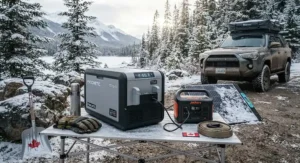
Rugged Solar Fridge vs Traditional Cooler: What Changes on Extended Off-Grid Trips
| Factor | Rugged Solar Fridge (12V Compressor) | Traditional Ice Cooler |
|---|---|---|
| Cold retention | Indefinite, powered by dual battery/solar | 2–4 days before ice fully melts |
| Food safety | Holds below 4°C consistently | Temperature rises as ice melts |
| Ongoing cost | Power only — no ice purchases | Recurring ice costs on every resupply |
| Weight when packed | Consistent regardless of duration | Increases with ice, decreases as it melts and leaks |
| Best For | Extended off-grid trips, multi-day remote travel | Short single-day outings near town |
The gap widens the longer a trip runs: a cooler’s performance degrades daily as ice melts, while a properly powered fridge holds a stable temperature on day ten just as well as day one. According to Health Canada, food should be kept below 4°C to avoid the temperature “danger zone” where bacteria multiply quickly — a threshold a melting cooler reliably fails to maintain past the first couple of days, while a compressor fridge holds it as a baseline function. The one place a cooler still wins is short trips where the upfront cost and complexity of installing a fridge simply isn’t justified.
💬 Comparing fridge specs to your build? A quick click helps others weighing the same decision.
Dual Battery Systems and 4×4 Accessories: Powering Your Fridge Without Killing Your Starter
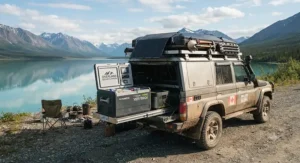
None of the fridges above matter much without the electrical system behind them, which is why a dual battery system is really the core piece of overlanding fridge infrastructure — more so than the fridge itself. In practice, this means a second deep-cycle or lithium battery, isolated from your starter battery by a voltage-sensing relay or a DC-DC charger, so the fridge draws down the auxiliary bank while your engine-starting capacity stays untouched. As one Canadian retailer specializing in overland fridge setups notes, a 100Ah deep-cycle battery will typically run a fridge for three to five days without any charging input, and adding a 100W solar panel extends that runtime indefinitely under normal sun conditions. Beyond the battery itself, a handful of 4×4 accessories round out a reliable setup: a proper fridge slide lets you access the unit from a tailgate without hauling it out entirely, tie-down straps prevent shifting on rough terrain, and a simple voltage monitor mounted in the cabin means you’ll spot a charging problem before your groceries do. A quality DC-DC charger, in particular, is worth the investment over a basic isolator — it actively manages the charge profile for lithium batteries rather than just connecting two circuits, which matters enormously as more overlanders switch to lithium auxiliary banks.
Off-Road Durability: What Actually Survives Washboard and Whoops
Fridge marketing loves the word “rugged,” but off-road durability comes down to a handful of specific, testable details rather than vibes. Latch design matters more than most buyers realize — a simple over-centre latch under constant vibration will loosen over a long drive, while quick-release or lockable designs like those on the ARB Zero stay seated through genuinely rough terrain. Corner protection is the next tell: impact-resistant ASA plastic corners, as used on ARB’s Elements line, absorb the kind of knock that would crack a bare plastic shell when a fridge shifts against a drawer wall on a sharp descent. Compressor mounting also plays a role most spec sheets don’t advertise — a compressor isolated with rubber grommets survives sustained corrugated roads far better than one bolted rigidly to the housing, since constant vibration is a leading cause of premature compressor failure. Finally, an anti-tilt design rated for a 45-degree incline, common across the Alpicool and BougeRV lines, isn’t just a marketing number; it directly reflects whether the compressor’s oil stays properly circulated when your rig is nose-down on a steep, rutted climb.
Long-Term Cost & Maintenance
The sticker price on any of these fridges is only the entry fee — total cost of ownership plays out over years, not one purchase. A budget fridge in the C$300–C$400 range might need a compressor replacement or full unit swap within three to five years of hard use, while a National Luna’s 8-year compressor warranty reflects a genuinely different expected lifespan, spreading a higher upfront cost over a much longer service life. Maintenance itself is minimal across this category: wipe door seals periodically to maintain a tight compressor cycle, keep the exterior condenser vents free of dust and debris, and avoid running a fridge completely empty for extended periods, since a partially loaded fridge actually holds temperature more efficiently than an empty one. The real long-term cost driver isn’t the fridge at all — it’s the battery. A quality lithium auxiliary battery costs more upfront than lead-acid but handles thousands more charge cycles, which over a five-year ownership period often makes it the cheaper option per year of use once you factor in a lead-acid battery’s shorter typical lifespan under deep-cycle fridge duty.
Frequently Asked Questions
❓ Can a portable fridge run off just a solar panel without a battery?
❓ How many amp-hours does an overlanding fridge use per day?
❓ Is a dual battery system necessary for a car fridge?
❓ What size solar panel do I need for an overlanding fridge?
❓ Do rugged solar fridges work in cold Canadian winters?
Conclusion
There’s no single best portable solar fridge for overlanding — there’s a best fridge for your specific trip length, battery setup, and budget. Someone doing weekend loops close to home doesn’t need the power efficiency the National Luna is built around, just like someone running three-week remote traverses shouldn’t gamble on a budget unit’s thinner insulation. What all seven of these fridges share is the same basic promise a cooler can’t make: consistent, reliable cold that doesn’t degrade the longer you’re off-grid. Pair whichever unit fits your trips with a properly sized dual battery system — and solar if your trips run long enough to need it — and the days of soggy sandwiches and lukewarm drinks are genuinely behind you. Check current prices and availability before you commit, since stock and pricing on these units shift often.
✨ Ready to stop losing food to melted ice?
Check today’s prices on the fridge that fits your rig — your next trip’s dinner depends on it! 🧊🚙
Recommended for You
- Portable Freezer For Off-Grid RV: 7 Top Picks for 2026
- 12V Cooler for Off-Grid Living: 7 Best Picks for 2026
- 7 Best Fish Bag Coolers in Canada for 2026 (Compared; Ranked)
Disclaimer: This article contains affiliate links. As an Amazon Associate, I earn from qualifying purchases. If you purchase products through these links, we may earn a small commission at no additional cost to you.
✨ Found this helpful? Share it with your friends! 💬🤗
