
In This Article
Picture a long weekend at a Crown land campsite north of Sudbury. Day one, the ice in your old plastic cooler is glorious. Day two, it’s slush. Day three, your hot dogs are swimming in a lukewarm soup that smells faintly of regret. Meanwhile, the little inverter generator you hauled along for the coffee maker sits there, humming, doing almost nothing.
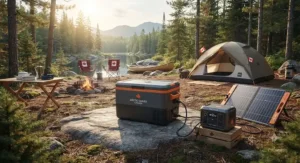
That’s the gap a generator-compatible cooler closes.
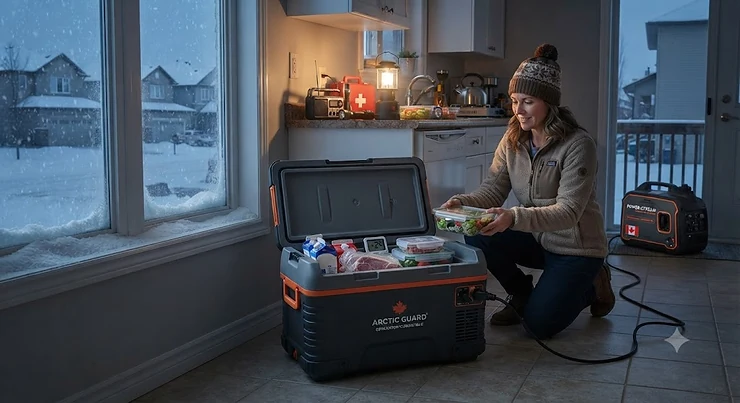
In plain terms, a generator-compatible cooler is a compressor-driven electric fridge-freezer that runs on AC power (usually through a 100-240V adapter) as well as 12V DC, and draws little enough wattage — typically 45-65W while running — that even a small inverter generator can keep it cold for days without breaking a sweat.
The short version: the cooler doesn’t need a big generator. It needs a clean one, a sensible extension cord, and a buyer who understands wattage compatibility and surge power before swiping the credit card. Get those three things right and a generator cooler combo turns a weekend of soggy food into a week of properly frozen steaks.
So I dug into the real spec sheets, manufacturer documentation and aggregated reviewer findings for the models Canadians actually find on amazon.ca. What follows is analysis, not a showroom brochure: seven real products, what their numbers mean in the bush and at the cottage, and the mistakes that quietly kill compressors. Whether you’re prepping for an Atlantic hurricane outage, a Prairie hunting trip or a B.C. overlanding loop, you’ll know exactly which generator-compatible cooler fits — and why.
Quick Comparison Table: Top 7 at a Glance
| Product | Capacity | Running Draw (rated) | Temp Range | Price Range (CAD) | Best For |
|---|---|---|---|---|---|
| Alpicool C20 | 20 L | ~45W class | Down to about -20°C | C$200-C$300 | Budget weekenders & solo trips |
| BougeRV CRD45 | 45 L dual-zone | 60W (under 45W Eco) | -20°C to 20°C | C$450-C$650 | Best value dual-zone |
| Whynter FM-45G | 42.5 L (45 qt) | 65W AC | -22°C to 10°C | C$700-C$950 | Cottage & home-backup duty |
| ICECO VL45ProS | 45 L | ~45-60W class | -18°C to 10°C | C$850-C$1,100 | Rough roads & overlanding |
| EcoFlow Glacier Classic 45L | 45 L dual-zone | 55W | -20°C to 20°C | C$900-C$1,250 | Power-station ecosystems |
| Dometic CFX3 45 | 46 L | ~45-60W class | Down to -22°C | C$1,100-C$1,450 | Premium, app-driven campers |
| Anker SOLIX EverFrost 2 58L | 58 L dual-zone | Battery-buffered | -20°C to 20°C | C$1,300-C$1,700 | Families & quiet-hours camping |
Prices are approximate ranges at the time of research; prices may vary — check current price on amazon.ca.
Reading across the table, the headline is almost boring: every one of these draws well under 100W while running, so wattage compatibility with even a 1,000W inverter generator is a non-issue on paper. The real differences are capacity, dual-zone flexibility and how each unit behaves when the generator shuts off at night. That’s why the Anker SOLIX EverFrost 2 58L and EcoFlow Glacier Classic 45L, with their plug-in batteries, earn their premium for campgrounds with quiet hours, while the BougeRV CRD45 gives you most of the capability for roughly half the money.
💬 Just one click — help others make better buying decisions too!😊
What Is a Generator-Compatible Cooler, Really?
Before we get to the products, it’s worth clearing up a common confusion. Lots of things plug into a generator. A cheap thermoelectric “cooler” plugs into a generator. So does a dorm mini-fridge. Neither is what serious campers mean.
A true generator-compatible cooler has three traits:
- A compressor, not a Peltier plate. Compressors cool to a set temperature regardless of ambient heat — thermoelectric units only cool about 15-20°C below the surrounding air, which is useless on a 32°C July afternoon in the Okanagan.
- Dual power input. It runs natively on 12/24V DC and ships with (or supports) an AC adapter, making it an AC powered cooler at the cottage and a vehicle fridge on the road.
- Low, steady draw with a gentle start. The small variable-speed DC compressors inside these units ramp up softly, so the surge power demand is tiny compared with a household fridge.
Here’s what most buyers overlook: the “generator” part isn’t really about the cooler — it’s about the electricity. A conventional open-frame engine-generator produces power whose quality wobbles with engine speed. An inverter generator converts that raw output to DC and then rebuilds a cleaner AC sine wave. The switching power adapters that feed these coolers are fairly tolerant, but cleaner power means less heat and stress on that adapter over hundreds of hours.
So a generator compatible fridge is a system: the right cooler, the right generator, and the right cord in between.
Top 7 Generator-Compatible Coolers: Expert Analysis
1. Alpicool C20 — best budget entry into compressor cooling
The Alpicool C20 proves you don’t need a four-figure budget to escape the ice-and-slush cycle. It’s a 20-litre (21-quart) compressor fridge-freezer that runs on 12/24V DC and ships with an AC adapter, so it doubles as an AC powered cooler at a campsite or cottage.
On paper, the roughly 45W-class draw means a 1,000W inverter generator is running at under 5% load to keep it going — you’ll hit the generator’s idle floor long before you stress it. The 20 L box holds a couple of days’ worth of food for one or two people, but here’s the catch: a 2 L milk jug and a pack of burgers already eat a surprising chunk of that space.
My honest read is that this is the ideal “first compressor cooler” for solo anglers, truckers and couples doing weekend trips. It’s also a smart backup fridge for insulin or baby formula during outages, where small and reliable beats big and expensive.
Reviewers consistently praise how quickly it pulls down to freezing and how little it costs relative to name brands; the most common complaints in user reviews centre on the plastic build and a lid latch that feels less robust than premium units.
Pros:
- ✅ Genuine compressor cooling at a budget price
- ✅ Light enough to carry one-handed when empty
- ✅ Low draw suits the smallest inverter generators
Cons:
- ❌ 20 L fills fast for families
- ❌ Plastic shell feels less rugged than steel rivals
Expect roughly C$200-C$300 at the time of research — the best cost-per-litre entry point for anyone testing whether a generator cooler combo fits their camping style.
2. BougeRV CRD45 — best value dual-zone fridge-freezer
The BougeRV CRD45 is the model that makes the premium brands sweat, packing two independently controlled zones into a 45-litre (48-quart) body for mid-range money.
BougeRV rates it at 60W, with Eco mode dropping under 45W, and says it pulls from 20°C to 0°C in about 15 minutes. In practice, that means ice cream in one zone and crisp lettuce in the other — no more choosing between “freezer mode” and “fridge mode.” At 19.3 kg (42.5 lb) it’s hefty, so plan on two people or a cargo slide. The noise rating of ≤45 dB matters more than it sounds: in a tent pad setting, that’s about the level of a quiet library, meaning it won’t compete with your generator’s hum.
Based on the spec comparison, this is the sweet spot for families and hunters who need both freezing and refrigerating at once but refuse to pay C$1,200 for the privilege. The app control is a genuine convenience when the cooler sits in a truck box.
Across reviews, owners report strong cooling for the price and appreciate the dual-zone flexibility; recurring criticism mentions slight temperature variation between compartments and small wheels that struggle on gravel.
Pros:
- ✅ True dual-zone control at a mid-range price
- ✅ Fast pull-down from room temperature
- ✅ Two-year warranty covering compressor and accessories
Cons:
- ❌ Heavy for one person to lift loaded
- ❌ Small wheels dislike rough campsites
Usually around C$450-C$650 — the strongest value-per-feature in this round-up.
3. Whynter FM-45G — best for cottage and home-backup duty
The Whynter FM-45G is the old reliable of the group: a 45-quart (about 42.5 L) fridge-freezer built more like a small appliance than a gadget.
Whynter specifies an AC draw of 65W at 115V (just 0.75A), and 4.5A on 12V DC. Translation for generator owners: that 0.75A is a rounding error on a 15A generator outlet, so wattage compatibility is essentially automatic. The -22°C to 10°C range (-8°F to 50°F) and “Fast Freeze” mode mean it can act as a proper deep freezer — useful when a winter ice storm knocks out power and your chest freezer is thawing. It also keeps working when tilted up to 30°, a nice touch for sloped cottage lots or bouncing truck beds.
My analytical take: this is less about overlanding and more about the cottage, the ice-fishing shack, or the garage emergency kit. Its built-in AC cord (no external brick to lose) makes it a natural AC powered cooler, and at 20.4 kg (45 lb) it’s not something you’ll want to hike with anyway.
Reviewers frequently highlight its freezing power and long service life; a common complaint is that the design feels dated and the one-year warranty trails newer competitors.
Pros:
- ✅ Deep-freeze capability down to -22°C
- ✅ Integrated AC cord — no adapter brick to lose
- ✅ Keeps running tilted up to 30°
Cons:
- ❌ Dated styling and no app control
- ❌ Only a one-year warranty
Typically in the C$700-C$950 range; availability on amazon.ca can fluctuate, so check current listings before planning around it.
4. ICECO VL45ProS — best for rough roads and overlanding
The ICECO VL45ProS is built for people whose “campsite” is at the end of a forestry service road, with a hardened steel case and a genuine Secop compressor at its heart.
That Secop compressor is the headline. Secop (the former Danfoss mobile-compressor line) is a well-regarded name in portable refrigeration, and ICECO backs it with a five-year compressor warranty — compared with a one-year warranty on other parts. The 47.5-quart (45 L) single-zone box ranges from about -18°C to 10°C (0°F to 50°F) and accepts both 12/24V DC and 110-240V AC. The multi-directional lid opens from either side, which sounds trivial until your fridge is wedged in a truck bed with only one side accessible.
Here’s what to weigh: you’re paying for durability, not features. There’s no dual zone, and steel adds weight. But if your trips include washboard gravel and freeze-thaw cycles, the metal shell and vibration-rated build are exactly what the money buys.
Owner reviews are strongly positive on reliability and build quality, with the manufacturer’s own page reporting a high share of five-star ratings; the most repeated drawback is that it’s heavy and pricier than plastic-bodied rivals.
Pros:
- ✅ Secop compressor with five-year warranty
- ✅ Steel case survives rough, vibrating roads
- ✅ Lid opens from either side
Cons:
- ❌ Single zone only — no simultaneous freeze/fridge
- ❌ Heavier than plastic competitors
Expect roughly C$850-C$1,100 — premium, but justified for serious off-pavement users.
5. EcoFlow Glacier Classic 45L — best for power-station ecosystems
The EcoFlow Glacier Classic 45L is designed for people who already think in watt-hours, with dual-zone cooling and an optional 298Wh plug-in battery.
EcoFlow rates the running draw at 55W, while its AC adapter is rated for 95W max and accepts 100-240V at 50/60Hz. That adapter spec is quietly important: it’s the ceiling the cooler can ever pull from your generator, so you can size your inverter generator with total confidence. The cooling range spans -20°C to 20°C, and the IPX4 rating means splashes and light rain won’t end the trip. At 23.1 kg (51 lb), though, this is a cooler you’ll wheel rather than carry.
My read: this shines for campers who run a generator for a few hours, then shut it down overnight. The battery bridges quiet hours, and the unit also accepts solar input up to 110W — turning the generator into a backup rather than the main event.
Reviewers generally praise the build, the app and the flexibility of battery power; the common complaints involve weight and the premium price once you add the battery.
Pros:
- ✅ Optional 298Wh battery covers generator quiet hours
- ✅ Dual-zone cooling from -20°C to 20°C
- ✅ IPX4 splash resistance for exposed campsites
Cons:
- ❌ Heavy at over 23 kg
- ❌ Battery adds significantly to total cost
Around C$900-C$1,250 depending on bundle — strong value if you’ll actually use the battery and solar input.
6. Dometic CFX3 45 — best premium app-driven all-rounder
The Dometic CFX3 45 is the name overlanders drop at the campfire, and for good reason: Dometic has refined this 46-litre platform with app connectivity and a notably efficient compressor system.
The single zone cools as low as about -22°C and runs on 12/24V DC or 100-240V AC. Independent testing from outlets like OutdoorGearLab has repeatedly ranked Dometic’s CFX line near the top for temperature accuracy and insulation, and the CFX3’s power draw sits in the same modest class as its rivals — meaning a small inverter generator handles it comfortably. The app lets you monitor temperature and battery-protection settings, which is genuinely useful when the cooler lives in a truck canopy.
Here’s the honest analysis: you’re paying for refinement, resale value and a large dealer/service network across Canada, not for dramatically better raw cooling. If you replace gear often, that premium hurts. If you want one cooler for a decade, it starts to make sense.
Aggregated reviews highlight excellent insulation, quiet operation and reliable temperature holding; frequent complaints focus on the high price and occasional fussiness with the lid or latch.
Pros:
- ✅ Class-leading insulation and temperature accuracy
- ✅ Useful app with battery-protection settings
- ✅ Strong brand service network in Canada
Cons:
- ❌ Among the priciest options per litre
- ❌ Single zone despite the premium price
Typically in the C$1,100-C$1,450 range — a long-term investment rather than a bargain.
7. Anker SOLIX EverFrost 2 58L — best big-family pick with battery backup
The Anker SOLIX EverFrost 2 58L is the largest cooler here, pairing 58 litres (61 quarts) of dual-zone space with a removable 288Wh LFP battery and wheels for towing.
Anker quotes around 39 hours of runtime on one battery (and about 3.2 days with two) at 4°C in Eco mode, plus pull-down from 25°C to 0°C in roughly 15 minutes. Those numbers change the generator equation entirely: you run the generator during the day, the battery tops up, and nights at a campground with strict quiet hours become effortless. LFP chemistry is also more tolerant of repeated charge cycles than older lithium-ion types, which matters for a battery that’ll be cycled every trip. Recharging works from AC, 12V, USB-C, or a 100W solar panel.
My take: this is the family road-trip machine. Fifty-eight litres swallows a week of groceries for four, and the battery buffering makes it the most forgiving option if your generator runs out of fuel at 2 a.m.
Reviewers tend to praise runtime and convenience, while the common complaints are bulk, weight and price.
Pros:
- ✅ Largest capacity, with two independent zones
- ✅ LFP battery bridges overnight quiet hours
- ✅ Four ways to recharge, including solar
Cons:
- ❌ Bulky footprint in smaller vehicles
- ❌ Highest price in the round-up
Around C$1,300-C$1,700 at the time of research — the priciest, but the only one that nearly makes the generator optional.
✨ Don’t Miss These Exclusive Picks! 🔍
Take your camping, cottage and emergency prep to the next level with these carefully selected coolers. Click on any highlighted product to check current pricing and availability on amazon.ca. The right generator-compatible cooler means crisp salads, frozen steaks and zero soggy sandwiches — the kind of trip your family actually remembers!
Practical Usage Guide: Setting Up Your Generator Cooler Combo
A generator cooler combo is only as good as its set-up. These steps come straight from manufacturer guidance and common owner experience reported in reviews.
Before the trip
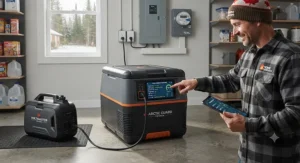
- ⚡ Pre-cool at home on wall power. Pull-down is the most energy-hungry phase. Run the cooler overnight on household AC so the generator only needs to maintain temperature on site.
- 🧊 Load cold food, not warm groceries. Every warm item you add forces the compressor back into Max mode.
- 🔌 Use the right cord. A 14-gauge (or heavier) outdoor-rated extension cord, CSA-certified, prevents voltage drop over long runs.
At camp
- Place the generator downwind, at least 6 m (20 ft) from tents, trailers and the cooler. Exhaust heat and carbon monoxide are the enemy.
- Shade the cooler. A cooler baking in direct sun can easily run its compressor far more often than one under a tarp.
- Leave ventilation gaps. Compressor coolers vent heat through side grilles; keep 5-10 cm clear on all vented sides.
- Switch to Eco mode once at temperature. On the BougeRV CRD45, Eco mode drops draw below 45W.
Maintenance schedule
| Frequency | Task |
|---|---|
| Every trip | Wipe interior, open drain plug, dry fully before storage |
| Monthly (in season) | Vacuum dust from condenser vents |
| Yearly | Check AC adapter cable and DC plug for wear |
First-30-days mistake to avoid: running the generator in “eco-throttle” mode with only the cooler attached is fine — but many owners then plug in a kettle or hair dryer and trip the breaker, cutting the cooler off without noticing. Check your generator after every big appliance use.
Real-World Scenarios: Matching Coolers to Canadians
Specs only matter in context. Here are three realistic buyer profiles and the reasoning behind each match.
Profile 1: The weekend angler in Northern Ontario
Budget around C$300, solo, 8-10 weekends a year, a 1,000W-class inverter generator already in the boat shed. Choose the Alpicool C20. Twenty litres covers two days of food and a limit of walleye fillets on ice, and its tiny draw barely registers on a small generator. Spending more wouldn’t change the experience much at this frequency.
Profile 2: The Alberta family doing summer road trips
Budget up to C$1,700, four people, two weeks every July, mostly serviced and unserviced provincial park sites. Choose the Anker SOLIX EverFrost 2 58L. Capacity handles a week of groceries, and the battery means the generator can stay off during quiet hours — critical at parks with strict generator rules. The EcoFlow Glacier Classic 45L is the runner-up if the family already owns EcoFlow power stations.
Profile 3: The Nova Scotia cottage owner prepping for outages
Budget C$700-C$1,000, occasional camping, but the real concern is hurricane-season power loss. Choose the Whynter FM-45G. Its deep-freeze capability to -22°C and built-in AC cord make it a straightforward generator compatible fridge for protecting frozen food, and it doubles as a beer fridge on the deck the rest of the year.
The pattern? Frequency and whether the generator runs overnight matter more than the brand.
Problem → Solution Guide: Common Headaches, Fixed
Problem 1: The cooler shuts off randomly on generator power. Solution: Check the low-voltage battery protection setting. On AC this rarely triggers, but if the cooler switched to DC when the generator ran dry, it may have protected the vehicle battery. Units like the Dometic CFX3 45 and BougeRV CRD45 let you adjust the cut-off level.
Problem 2: The generator surges and the cooler clicks off. Solution: Your generator is likely hunting at very low load. Switch eco-throttle off briefly, or add a small steady load (like a LED work light) to stabilize output.
Problem 3: Food freezes in the fridge zone. Solution: Airflow. Don’t pack items against the evaporator wall. On dual-zone units like the EcoFlow Glacier Classic 45L, reviewers commonly note that zone placement matters.
Problem 4: The cooler can’t keep up on a 35°C day. Solution: Shade, pre-chilled contents and fewer lid openings. Also check that vents aren’t blocked by gear in the truck bed.
Problem 5: Nights at the campground go warm. Solution: If quiet hours stop your generator, choose a battery-buffered model like the Anker SOLIX EverFrost 2 58L, or pre-freeze water bottles as thermal mass inside a single-zone model like the ICECO VL45ProS.
How to Choose a Generator-Compatible Cooler (7 Steps)
- Start with capacity. Budget roughly 10-15 L per person for a weekend, more for a week. Too small is the most common regret.
- Decide single or dual zone. If you want frozen and fresh at once, dual-zone is non-negotiable.
- Check the AC input spec. Confirm the adapter or cord covers 100-240V or 115V — the core of wattage compatibility with Canadian 120V generators.
- Note the maximum adapter rating. That figure (95W on the EcoFlow Glacier Classic 45L, for example) is the most the cooler will ever pull from the generator.
- Match to an inverter generator. Clean power from an inverter generator is kinder to the cooler’s electronics.
- Consider battery buffering. If your campground enforces quiet hours, a battery bridge changes everything.
- Weigh the warranty. Compressor warranties range from one year to five; longer coverage signals confidence.
Wattage Compatibility Explained: How Much Generator Do You Really Need?
Wattage compatibility is the question at the heart of every generator-compatible cooler purchase, and the good news is that it’s reassuringly simple once you separate three numbers.
Running watts are what the cooler draws while the compressor is working: roughly 45-65W for everything in this round-up. Surge power (or starting watts) is the brief spike at start-up. Rated generator output is what your generator can sustain continuously.
The golden rule: add up the running watts of everything you’ll run at the same time, then make sure the largest surge still fits within the generator’s peak rating.
| Generator Size (Running) | Cooler Only | Cooler + Extras | Best For |
|---|---|---|---|
| 1,000-1,200W inverter | Easily | Cooler + lights + phone charging | Solo and couple campers |
| 1,800-2,200W inverter | Easily | Cooler + coffee maker (not together with microwave) | Families, cottages |
| 3,000W+ inverter | Overkill for cooler alone | Cooler + RV A/C or microwave | RVs, home backup |
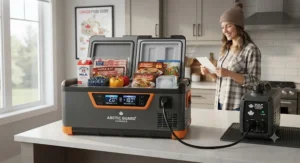
Looking at the table, even the smallest class of inverter generator has massive headroom for a cooler alone. A popular model like Honda’s EU2200i is rated at 1,800W running and 2,200W maximum; a 65W cooler uses under 4% of that. The real sizing decision is driven by what else you want to plug in — kettles, hair dryers and microwaves are the power hogs, not the cooler.
One more subtle point: a generator running at very light load is less fuel-efficient per watt delivered. If the cooler is the only load most of the time, a smaller generator (or a battery-buffered cooler) will burn noticeably less fuel over a week.
Surge Power: The Number That Trips Breakers (And Why Coolers Rarely Do)
Surge power gets a lot of scary coverage, mostly because of household refrigerators. A standard kitchen fridge uses an induction motor compressor that can briefly draw several times its running wattage when it kicks on. That’s why a small generator sometimes stalls when the house fridge starts.
Portable compressor coolers are a different animal. Most use small variable-speed DC compressors (Secop is the well-known name in the ICECO VL45ProS) controlled by electronics that soft-start the motor. Combined with an AC adapter that converts generator power to DC first, the start-up surge power seen by the generator is modest and short.
What does that mean in practice?
- ✅ The cooler itself will almost never be the reason a generator trips.
- ✅ The adapter’s maximum rating is a safe ceiling for planning.
- ❌ The danger is stacking: if the cooler’s compressor starts at the exact moment you turn on a 1,500W kettle on a 2,000W generator, the combined draw can trip the overload.
The practical fix is sequencing. Start big appliances one at a time, let them settle, and keep a comfortable margin — many experienced campers aim to stay under about 80% of rated generator output for sustained loads. That margin also reduces engine strain and noise.
For a household-fridge backup during an outage, surge power deserves serious attention. For a generator-compatible cooler, it’s mostly a footnote — as long as you respect the combined load.
Inverter Generator vs Conventional Generator for an AC Powered Cooler
This is where the “compatible” in generator-compatible cooler earns its keep.
A conventional (open-frame) generator spins its alternator at a fixed speed to produce 60Hz power. Its output waveform can carry more distortion, measured as total harmonic distortion (THD). It’s also loud — often in the high-60s to 70s dB range — and burns fuel at a steady clip regardless of load.
An inverter generator generates raw AC, converts it to DC, then electronically rebuilds a clean sine wave. The upside for an AC powered cooler is threefold:
- Cleaner power. Inverter generators commonly advertise THD under about 3%, which is friendlier to switching power adapters and electronics.
- Throttle control. The engine slows when demand is low, cutting fuel use and noise dramatically when only a 55W cooler is attached.
- Campground-friendly noise. Many parks across Canada restrict generator hours and noise; quieter inverter models are simply easier to live with.
Is a conventional generator unusable? No. Many owners run coolers on them without trouble, because the cooler’s adapter does a lot of the heavy lifting. But over hundreds of hours, cleaner power means less heat and stress on the adapter — and replacing a proprietary adapter mid-trip is not a fun errand in Tofino.
The verdict: if you’re buying a generator specifically for camping and cooler duty, choose an inverter generator. If you already own a conventional unit for the house, it’ll likely work — just keep an eye on the adapter’s temperature and consider a spare.
Generator Compatible Fridge vs Traditional Ice Cooler
Rotomolded ice coolers have their fans, and for good reason. So how does a generator compatible fridge really stack up?
| Factor | Compressor Cooler (e.g., BougeRV CRD45) | Premium Ice Cooler | Best For |
|---|---|---|---|
| Temperature control | Set exact temp, incl. freezing | Gradually warms | Compressor for trips over 3 days |
| Ongoing cost | Fuel/electricity only | Ice every 2-4 days | Compressor for frequent use |
| Usable space | 100% (no ice) | Roughly 1/3 lost to ice | Compressor for families |
| Power required | Yes | No | Ice for true off-grid, no generator |
| Up-front cost | C$200-C$1,700 | C$150-C$600 | Ice for occasional use |
The comparison shows the trade-off clearly: ice coolers win on simplicity and up-front cost, while a compressor unit wins on everything that happens after day two. A bag of ice at a Canadian gas station can easily cost several dollars; over a two-week trip that adds up fast, and melted ice still leaves soggy food. If you camp more than a handful of long weekends each year and already own a generator, the Alpicool C20 or BougeRV CRD45 will likely pay back part of its price in ice savings alone.
Long-Term Cost & Maintenance: The Real Price of Cold
The sticker price is only the opening act. Here’s what total cost of ownership looks like.
Energy use. BougeRV says its CRD45 uses “well below 1kWh per day” in Max mode. On a generator, that’s a small slice of fuel; at home on grid power, it’s typically well under a dollar a day in most provinces.
Fuel on the road. A small inverter generator running at light load can often go many hours on a few litres of fuel. If you only run the generator a few hours a day and rely on a battery-buffered cooler like the Anker SOLIX EverFrost 2 58L overnight, fuel costs drop further.
Warranty coverage.
| Model | Compressor Warranty | Value Verdict | Best For |
|---|---|---|---|
| ICECO VL45ProS | 5 years (Secop) | Excellent long-term confidence | Decade-long owners |
| BougeRV CRD45 | 2 years (all parts) | Strong for price | Value hunters |
| Alpicool C20 | 2 years compressor, 1 year full | Fair for budget | First-time buyers |
| Whynter FM-45G | 1 year | Weakest coverage | Occasional cottage use |
The table highlights why the ICECO VL45ProS costs more than its feature list suggests: five years of compressor coverage is a genuine financial hedge. Meanwhile, the Whynter FM-45G‘s one-year warranty means you’re self-insuring sooner — acceptable for light use, less so for heavy overlanding.
Maintenance is minimal: keep vents dust-free, dry the interior before storage and inspect cords yearly.
Common Mistakes When Buying a Generator-Compatible Cooler
- Buying thermoelectric by accident. Many cheap “electric coolers” are thermoelectric and can’t freeze. Confirm the word compressor.
- Oversizing the generator. Buying a 4,000W unit just for a 55W cooler wastes money and fuel.
- Ignoring quiet hours. Many Canadian campgrounds restrict generator use at night. Without battery buffering or thermal mass, your cooler warms up.
- Forgetting the adapter. Some models ship with DC cables only in certain bundles. Confirm the AC adapter is included before buying.
- Skimping on extension cords. A thin indoor cord over 15 m causes voltage drop and heat.
- Choosing too small. Twenty litres sounds big in the store. It isn’t, once a watermelon is involved.
Safety & Regulations in Canada: Generators, CO and Cords
The cooler is the easy part; the generator is where safety lives.
Carbon monoxide is the big one. Health Canada’s backyard and outdoor safety guidance is a useful starting point for outdoor hazards, and the rule for generators is simple: never run one inside a tent, trailer, garage, cottage or covered porch, and keep it well away from doors, windows and vents.
Certification. Look for CSA or cUL marks on extension cords, adapters and generators sold in Canada — these indicate the product has been evaluated against Canadian electrical safety standards.
Fuel handling. Let the generator cool before refuelling, and store fuel outdoors in approved containers.
Wet conditions. Keep the generator dry and never operate it with wet hands or in a flooded area.
Park rules. Parks Canada and provincial park systems commonly limit generator hours and may restrict generators at certain sites. Check your park’s rules before you go — they directly affect which cooler setup makes sense.

FAQ: Generator-Compatible Cooler Questions Answered
❓ Can a 1,000W inverter generator run a generator-compatible cooler?
❓ Is a generator compatible fridge worth it over a regular ice cooler?
❓ Do AC powered cooler models work with Canadian 120V outlets?
❓ What is the best generator cooler combo for camping?
❓ How long can a cooler stay cold if the generator stops?
Conclusion: Stay Cold, Stay Smart
Choosing a generator-compatible cooler isn’t really about horsepower. It’s about matching the right compressor unit to the way you actually travel, and pairing it with clean power from an inverter generator you already trust.
If budget matters most, the Alpicool C20 delivers real compressor cooling at an entry price. For the best all-round value, the BougeRV CRD45 packs dual-zone flexibility into a mid-range budget. Cottage owners and outage-preppers will appreciate the deep-freeze muscle of the Whynter FM-45G, while rough-road travellers should lean toward the ICECO VL45ProS and its five-year Secop warranty. Power-station users will feel at home with the EcoFlow Glacier Classic 45L, premium buyers get refinement from the Dometic CFX3 45, and families who value quiet nights will love the battery-buffered Anker SOLIX EverFrost 2 58L.
Whichever you choose, remember the three rules: understand wattage compatibility, respect combined surge power, and keep that generator well away from where you sleep. For outage prep, the Canadian Red Cross generator safety guide is worth a read before the next storm season.
🚀 Ready to Ditch the Soggy Ice for Good? 🔍
Click any highlighted product above to check current pricing and availability on amazon.ca, and build the generator cooler combo that keeps your food fresh from the first campfire to the last!
Recommended for You
- Foldable Solar Panel Camping Fridge: 7 Top Picks For 2026
- Portable Solar Fridge For Overlanding: 7 Best Picks (2026)
- Lithium Battery Cooler: 7 Best Picks Tested For 2026
Disclaimer: This article contains affiliate links. As an Amazon Associate, I earn from qualifying purchases. If you purchase products through these links, we may earn a small commission at no additional cost to you.
✨ Found this helpful? Share it with your friends! 💬🤗
