
In This Article
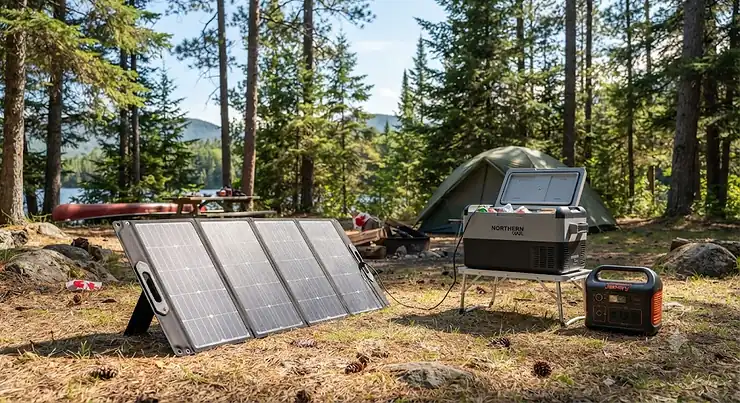
Nothing tanks a camping trip faster than opening the cooler on day three to find warm cheese floating in lukewarm water. A 12-volt camping fridge fixes that problem completely, but it also introduces a new one: it needs a steady diet of electrons, and gas stations don’t exactly dot the Trans-Canada backcountry. That’s where a foldable solar panel for camping fridge use earns its keep — it turns idle daylight into cold beer and unspoiled groceries without a drop of gasoline or a single decibel of generator hum.
A foldable solar panel for camping fridge setups is a portable, hinged photovoltaic panel — typically monocrystalline — that packs down to briefcase size and unfolds to charge a portable power station or battery bank via MC4 connectors, keeping a 12V fridge compressor running on sunlight alone. That’s the short version. The long version involves wattage math, charge controllers, and matching the right panel to your rig, your climate, and how much patience you have for babysitting a battery meter.
This guide breaks down seven real, currently available panels — from lightweight 100-watt units built for weekend car camping to 400-watt bifacial monsters meant for extended off-grid van life — with honest analysis of who each one actually suits. We’ll dig into panel wattage output, why MC4 connectors matter more than most shoppers realize, and how a charge controller changes everything about your charging speed. According to the Natural Resources Canada photovoltaic systems buyer’s guide, matching panel output to real-world load — not just the sticker wattage — is the single biggest factor separating a system that works from one that leaves you fridge-less by day two, and that principle runs through every recommendation below.
Prices shift constantly on Amazon.ca, so every figure here is a range based on research at the time of writing — check current pricing before you buy.
Quick Comparison Table
| Product | Wattage | Efficiency | Weight | Best For |
|---|---|---|---|---|
| Jackery SolarSaga 100W | 100W | ~24% | 10.3 lbs | Weekend car campers, Jackery owners |
| BigBlue SolarPowa 100 ETFE | 100W | ~23% | 8.8 lbs | Budget-conscious, brand-agnostic buyers |
| Renogy 200W Portable Suitcase | 200W | 22.5–25% | 34.4 lbs | RVers wanting a built-in charge controller |
| ALLPOWERS SE200 | 200W | 23–25% | 11–16 lbs | Slim storage, mixed-brand power stations |
| BLUETTI PV200 | 200W | 23.4% | 16.1 lbs | Bluetti station owners running 12V fridges |
| EcoFlow 220W Bifacial | 220W | up to 25% | ~20 lbs | Reflective terrain (sand, snow, water) |
| Anker SOLIX PS400 | 400W | ~23% | ~22 lbs | Extended off-grid trips, larger fridges |
A few sentences on what this table actually tells you: wattage isn’t destiny — the Renogy 200W Portable Suitcase and BLUETTI PV200 both claim 200 watts, but one ships with its own charge controller while the other assumes you already have a compatible power station. Weight and folded efficiency matter just as much as the number on the box, especially once you’re the one carrying it from the trunk to the campsite. If your fridge is a compact 40L unit that sips power, a 100-watt panel like the Jackery SolarSaga 100W or BigBlue SolarPowa 100 ETFE may genuinely be enough; anything larger, or any trip longer than a weekend, pushes you toward the 200W-and-up tier.
💬 Just one click — help others make better buying decisions too!😊
Top 7 Foldable Solar Panels for Camping Fridge Use: Expert Analysis
1. Jackery SolarSaga 100W — best entry point for Jackery power station owners
The standout here is compatibility: this panel was engineered specifically to pair with Jackery’s Explorer line, and that tight integration shows in how predictably it charges. Rated at up to 100W with roughly 24% conversion efficiency thanks to its bifacial monocrystalline cells, it produces a real-world 60–80W on a clear Canadian summer afternoon — enough to offset the 35–45W draw of most compact 12V camping fridges during peak sun, with surplus going toward battery storage for overnight running. The DC8020 output plugs straight into compatible Explorer stations, and it also carries a USB-A and USB-C port for topping up phones directly.
Based on the spec comparison, this is the panel for someone who already owns (or plans to buy) a Jackery power station and wants zero cable-adapter headaches. Reviewers consistently note the magnetic fold closure and retractable kickstand legs as genuinely well-engineered touches rather than marketing fluff — you can set it up and tear it down in under a minute. What most buyers overlook is that it’s IP65 rated, meaning it shrugs off splashes but shouldn’t be left out in a downpour.
Pros:
- ✅ Tight Jackery ecosystem integration, no adapters needed
- ✅ Genuinely fast, one-motion fold-and-carry design
- ✅ USB-A and USB-C ports for direct device charging
Cons:
- ❌ Locked into Jackery-compatible power stations without an adapter
- ❌ 100W ceiling means slower charging on cloudy days
Expect to pay in the C$280-C$360 range for the Jackery SolarSaga 100W at the time of research — solid value if you’re already in the Jackery ecosystem, less so if you’re shopping around.
2. BigBlue SolarPowa 100 ETFE — lightest 100W panel that plays well with any brand
What immediately sets this one apart is portability without sacrifice: at 8.8 lbs, it’s among the lightest full-size 100W panels on the market, and independent lab testing has clocked it generating close to 50-65 watts of real output in direct sun — competitive with panels costing considerably more. The ETFE-laminated surface and N-type cells resist scratches and heat degradation better than the cheaper PET-coated alternatives flooding Amazon listings.
Here’s what to weigh: because the BigBlue SolarPowa 100 ETFE outputs via a standard MC4 connector rather than a proprietary DC barrel plug, it charges a much wider range of power stations — Bluetti, EcoFlow, Renogy, you name it — provided you’ve got the right adapter cable. That flexibility is the whole pitch. Reviewers who’ve tested it side-by-side against Jackery and Bluetti panels report it consistently lands in the top tier for direct-sun charging speed, even if its indirect/shaded performance trails slightly behind competitors.
Pros:
- ✅ Universal MC4 output works across power station brands
- ✅ Among the lightest 100W panels tested for portability
- ✅ ETFE coating resists scratches and heat better than PET
Cons:
- ❌ No built-in USB ports for direct device charging
- ❌ Weaker performance specifically in shaded or indirect light
Look for the BigBlue SolarPowa 100 ETFE in the C$180-C$240 range — arguably the sharpest value pick in this whole lineup for anyone not married to a single power station brand.
3. Renogy 200W Portable Solar Suitcase — best for buyers who want a charge controller built in
The Renogy solar suitcase kit skips the “just a panel” approach entirely: it bundles two 100W N-Type monocrystalline panels with a 20A Voyager PWM charge controller and alligator-clip battery leads in one folding case. That’s the standout — you’re not just buying a panel, you’re buying a complete 12V charging system that can top up a deep-cycle battery directly, which matters enormously if your camping fridge runs off a standalone AGM or lithium battery rather than an all-in-one power station.
The 22.5-25% cell efficiency (Renogy’s newer N-type versions push toward the higher end) translates to genuinely useful output even in the shoulder-season low-angle sun that plagues spring and fall trips across most of Canada. Reviewers who’ve run this for multiple seasons note the built-in charge controller occasionally throws a fault code if wiring isn’t fully seated — a minor annoyance, not a dealbreaker, and easily diagnosed. Based on the spec comparison, the trade-off for that all-in-one convenience is weight: at 34.4 lbs, this is not something you’re tossing in a backpack.
Pros:
- ✅ Includes 20A charge controller, ready for direct battery charging
- ✅ N-Type cells hold up well in low-angle shoulder-season sun
- ✅ Alligator clips work with AGM, gel, or lithium batteries
Cons:
- ❌ Considerably heavier than single-panel alternatives
- ❌ Bulkier folded footprint takes up more trunk space
Current pricing sits in the C$300-C$400 range for the full kit — a strong value once you account for the charge controller you’d otherwise buy separately.
4. ALLPOWERS SE200 — best for slim storage in a packed vehicle
The SE200’s defining feature is its profile: this is a laminated, one-piece 200W panel that folds impressively flat, which matters enormously when your trunk is already stuffed with a tent, a cooler, and camp chairs. ALLPOWERS rates it at 23-25% conversion efficiency with an IP68 waterproof rating — genuinely one of the higher water-resistance certifications in this category, meaning brief submersion in a sudden downpour won’t kill it, unlike the IP65-rated panels that only tolerate splashes.
What most buyers overlook about this model is its connector versatility. It ships with a multi-adapter kit covering DC8020, XT60, DC7909, Anderson, and DC5521 connections, so it’s genuinely brand-agnostic in a way few 200W panels manage — you’re not locked into one power station ecosystem the way you are with some proprietary designs. Reviewers describe the anti-sag laminated construction as noticeably sturdier underfoot than fabric-backed competitors, though the trade-off is a slightly heavier folded package than the thinnest single-fold designs.
Pros:
- ✅ IP68 rating, among the best water resistance in its class
- ✅ Five-connector adapter kit fits nearly any power station
- ✅ Slim, anti-sag laminated design folds impressively flat
Cons:
- ❌ Weight varies noticeably between reported model versions
- ❌ Adapter kit adds a step versus native MC4 plug-and-play
Expect the ALLPOWERS SE200 to run in the C$380-C$480 range, positioning it as a genuine mid-range value pick.
5. BLUETTI PV200 — best for Bluetti station owners running a 12V fridge
BLUETTI built the PV200 as the natural companion to its own power stations, and the standout is how directly it addresses camping-fridge use cases in its own marketing and support documentation — this isn’t a generic panel repurposed for camping, it’s designed around exactly this scenario. At 200W with 23.4% cell efficiency and a standard MC4 connector, it charges compatible Bluetti units (and most third-party stations with an adapter) at a steady 9.7A under full sun.
The spec sheet won’t tell you this, but user reports suggest the four-panel unfold design with multiple integrated kickstands makes fine-angle adjustment easier than two-panel suitcases, which genuinely helps when you’re chasing low autumn sun through tree cover. Reviewers who’ve run the PV200 alongside a Bluetti station and a 12V fridge report it comfortably keeps pace with typical fridge draw through a full sunny day, with enough surplus to build a reserve for overnight compressor cycling. The IP65 junction box rating means the electronics stay protected even though the panel face itself isn’t meant for submersion.
Pros:
- ✅ Purpose-matched to Bluetti stations and 12V fridge loads
- ✅ Four-panel design allows finer sun-angle adjustment
- ✅ Reliable 9.7A output under full-sun conditions
Cons:
- ❌ Best performance is genuinely Bluetti-specific
- ❌ Adapters required for non-Bluetti brands add cost and clutter
Pricing tends to land in the C$500-C$650 range — a premium ask, but justified if you’re already invested in the Bluetti ecosystem.
6. EcoFlow 220W Bifacial Solar Panel — best for reflective terrain like sand, snow, or open water
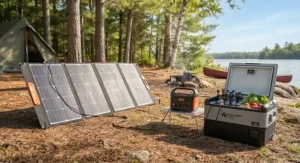
EcoFlow’s bifacial design is the genuine differentiator here: the panel captures light on both the front and rear face, and EcoFlow’s own testing shows meaningful ambient-light gains — over 14% extra on snow and nearly 10% on sand — which is a real advantage for Canadian campers pitching near lakeshores, beaches, or shoulder-season snowbanks where reflected light is abundant. Rated at 220W with up to 25% front-face efficiency and IP68 waterproof protection, it’s built around a slim tempered-glass design that’s reportedly five times more impact-resistant than comparable folding panels.
Reviewers consistently note the case-as-kickstand design (adjustable from roughly 30 to 80 degrees) as one of the more thoughtful setup solutions in this category — you’re not fumbling with separate legs. What most buyers overlook is that the bifacial advantage only really pays off with the right backdrop; pitched against a dark tent wall or dense forest floor, it behaves more like a standard 220W monofacial panel. Based on the spec comparison, this is the pick for campers who frequent open, reflective terrain rather than shaded forest sites.
Pros:
- ✅ Bifacial cells add meaningful output over reflective surfaces
- ✅ IP68 tempered-glass design resists impact and water
- ✅ Case doubles as an adjustable 30–80° kickstand
Cons:
- ❌ Bifacial benefit disappears on dark or shaded ground
- ❌ Heavier than single-face panels at a similar wattage
Look for it in the C$450-C$580 range — worth the premium specifically for beach, snow, and open-water camping.
7. Anker SOLIX PS400 — best for extended off-grid trips with larger fridges
The Anker SOLIX PS400 is the clear premium pick, and its standout achievement is weight-to-output ratio: at roughly 22 lbs including the stand, Anker claims it’s over 50% lighter than comparable 400W panels while still delivering enough output to run a larger upright camping fridge, charge a power station, and keep devices topped up simultaneously. The bifacial N-type cells hit approximately 23% efficiency, and four selectable angle positions (30°, 40°, 50°, 80°) mean you can chase the sun properly through the day rather than settling for one fixed tilt.
What the spec sheet won’t tell you, but the IP68 rating and reinforced aluminum frame suggest, is genuine confidence in long-term durability — Anker backs this unit with a notably long service-life claim and multi-year warranty, uncommon in the folding-panel category. Reviewers who’ve run 400W setups on extended trips describe them as the difference between rationing power and simply not thinking about it. Based on the spec comparison, this is overkill for a weekend cooler run, but for anyone spending a week or more fully off-grid with a full-size compressor fridge, freezer, and lighting rig, it’s the panel that lets everything run simultaneously without a generator backup plan.
Pros:
- ✅ 400W output comfortably runs larger fridges plus extras
- ✅ Class-leading weight for its power output tier
- ✅ Four adjustable angles for accurate sun-tracking
Cons:
- ❌ Significant investment relative to smaller panels
- ❌ Overkill and unwieldy for short weekend trips
Expect a C$750-C$900 range for the Anker SOLIX PS400 — a genuine investment, but one aimed squarely at serious off-grid travellers.
Practical Usage Guide: Setting Up Your Foldable Solar Panel for Camping Fridge
Getting a foldable solar panel for camping fridge use actually performing at its rated output takes more than unfolding it and hoping for the best. First, orient the panel perpendicular to the sun — not flat on the ground — using the built-in kickstands; even a rough 30-45 degree tilt toward true south (adjusted seasonally) can meaningfully boost output versus laying it flat. Second, check your MC4 connections are fully seated before walking away; a loose connector is the single most common cause of “my panel isn’t charging” complaints in owner reviews across every brand in this roundup.
Third, reposition the panel two to three times through the day if you’re relying on a single fixed panel rather than a tracking mount — the sun moves more than most first-time buyers expect, and a stationary panel can lose 20-30% of its potential output by midafternoon. Fourth, keep the panel surface clean; dust, pollen, and tree sap accumulate fast at a campsite and can measurably cut output, especially on ETFE-coated surfaces that otherwise resist scratching well. Finally, budget for a battery buffer — pairing your panel with a power station or deep-cycle battery rather than trying to run the fridge directly off the panel avoids the compressor cycling problem that happens the moment a cloud passes overhead.
Common first-30-days mistakes include undersizing the system (buying a 100W panel for a fridge-plus-lighting-plus-device-charging setup), skipping a charge controller entirely when running a bare battery, and leaving panels connected overnight without disconnecting from a nearly-full battery — most modern charge controllers prevent overcharge automatically, but it’s worth confirming yours does before relying on it.
Real-World Scenarios: Matching Panel Wattage Output to Your Camping Style
Picture Mariam, a weekend car camper in Ontario cottage country running a 40L compact fridge that draws about 35W. A single Jackery SolarSaga 100W or BigBlue SolarPowa 100 ETFE paired with a small power station comfortably covers her needs across a typical five- to seven-hour sunny day, with margin left for phone charging.
Now picture Devon, who tows a small trailer through the Rockies for two weeks at a stretch, running a 60L upright fridge alongside LED lighting and a laptop. His panel wattage output needs to sit closer to 200-220W minimum — the BLUETTI PV200 or EcoFlow 220W Bifacial territory — because his daily draw is higher and he can’t count on plugging into shore power to top off a shortfall.
Finally, consider Priya and her partner, who van-life full time and run a compressor fridge, a small freezer drawer, a laptop, and camera-charging gear continuously. For them, the math only works with the Anker SOLIX PS400‘s 400W output, since a smaller panel would leave them perpetually behind on battery state-of-charge, especially through the shorter daylight windows of a Canadian shoulder season.
How to Choose a Foldable Solar Panel for Camping Fridge Use
- Calculate your fridge’s real daily draw. Most 12V compressor fridges list amp-hour or watt-hour consumption in the manual; multiply by hours run per day for a baseline number.
- Add a 20-30% buffer for cloudy days and inefficiency. Real-world solar output rarely matches the rated panel wattage output, especially with haze, humidity, or partial shade.
- Match connector type to your power station or battery. MC4 connectors are the closest thing to a universal standard, but confirm your station’s input port before buying.
- Check the charge controller situation. Panels sold with an integrated charge controller (like the Renogy suitcase) simplify battery charging; standalone panels need one added separately if you’re not using an all-in-one power station.
- Weigh portability against wattage. A 400W panel is powerful but heavy; a 100W panel is light but limited — pick based on trip length, not aspiration.
- Confirm the water-resistance rating fits your climate. IP65 tolerates splashes; IP68 tolerates genuine downpours and brief submersion — relevant if you’re camping through coastal B.C. or Maritime weather.
- Read aggregated review sentiment for real-world output, not just marketing efficiency claims. The gap between rated and real-world wattage varies meaningfully by brand.
Panel Wattage Output: What the Numbers Actually Mean for Your Fridge
A 100-watt rating doesn’t mean 100 watts, all day, guaranteed — it means 100 watts under ideal lab conditions (direct overhead sun, cool panel temperature, perfect angle). Real-world panel wattage output for foldable camping panels typically runs 55-75% of the rated figure across a full day, once you factor in morning and evening low-sun angles, occasional cloud cover, and panel heating that reduces efficiency slightly on hot days. That’s not a flaw specific to any one brand — it’s physics, and every panel in this roundup behaves the same way relative to its own rating.
For fridge-specific planning, a 35-45W compact 12V fridge needs roughly 3-5 peak-sun hours from a 100W panel to offset a full day’s compressor cycling, assuming no other loads. Step up to a 60-80W upright fridge, and you’re realistically looking at a 200W panel minimum to keep pace without slowly draining your battery reserve over multiday trips — which is exactly why the mid-tier panels in this list cluster around that 200-220W mark.
MC4 Connectors and Charge Controllers Explained
If you’ve shopped for a foldable solar panel for camping fridge use and felt lost in a soup of connector names, you’re not alone. The MC4 connector is the closest thing the solar industry has to a universal standard — a weatherproof, push-to-connect plug originally developed for rooftop solar arrays that’s now the default output on the majority of portable panels, including five of the seven products in this roundup. Its main advantage is that it locks securely enough to survive being jostled around a campsite, but requires a small tool to intentionally disconnect, preventing accidental disconnection mid-charge.
A charge controller, meanwhile, is the component that actually regulates how power flows from panel to battery, preventing overcharging and, in MPPT versions, squeezing meaningfully more usable power out of the same panel than a basic PWM controller would. If you’re buying a bare panel to pair with a standalone deep-cycle battery — rather than an all-in-one power station with a controller already built in — you need one of these in the mix, and it’s worth budgeting for as a separate line item. The Renogy suitcase kit sidesteps this entirely by bundling a 20A controller, which is precisely why it’s worth the extra bulk for battery-based setups.
Foldable Solar Panel vs Rigid Roof-Mount Panels
A foldable solar panel wins on flexibility: you can reposition it to chase the sun through the day, store it flat when not in use, and take it with you if you switch vehicles or camp somewhere your roof can’t reach direct sun. A rigid roof-mounted panel wins on convenience and durability — it’s permanently angled toward the sky, immune to theft or accidental folding damage, and requires zero daily setup or teardown. For most weekend and multi-week campers running a portable fridge, the foldable format simply makes more sense, since you’re not committing to a permanent vehicle modification and can angle the panel far more precisely than a flat roof mount ever could. Overlanders and full-time van dwellers, by contrast, often run both — a rigid roof panel for passive baseline charging while driving, plus a folding panel like the ones above for stationary camp days when the vehicle itself sits in shade.
Common Mistakes When Buying a Solar Panel for Fridge Setups
The single most common misstep is buying based on wattage alone without checking connector compatibility — a gorgeous 200W panel is useless if it can’t physically plug into your power station without three adapters you didn’t know you needed. Close behind is underestimating fridge draw; campers routinely assume a 100W panel covers “any small fridge” without checking the actual amp-hour spec, then wonder why their battery drains overnight. A third mistake is ignoring water resistance ratings entirely, assuming “foldable camping panel” automatically means “weatherproof,” when IP ratings vary meaningfully between IP65 and IP68 across this category. Finally, plenty of buyers skip reading aggregated review sentiment on real-world charging speed, trusting only the manufacturer’s lab-condition efficiency percentage — a number that, as covered above, rarely matches actual campsite performance.
Long-Term Cost & Maintenance of Portable Solar Charging Camping Systems
A quality foldable panel is genuinely a buy-once purchase for most campers — monocrystalline cells in this category are commonly rated for 20-25 years of gradual, minor efficiency decline, and the folding hardware (hinges, kickstands, zippered pouches) is typically the first thing to wear out well before the cells themselves degrade meaningfully. Maintenance is minimal: wipe the surface clean of dust and sap after each trip, store it dry to prevent the fabric backing from mildewing, and inspect the MC4 connectors periodically for corrosion if you camp near saltwater. Compared to a gas generator’s ongoing fuel costs, oil changes, and eventual engine wear, portable solar charging camping setups have a dramatically lower total cost of ownership over a five-year span — the upfront price is higher, but there’s no recurring spend beyond the occasional replacement cable.
Safety, Regulations & Compliance Guide for Solar Charging at Canadian Campgrounds
One underrated advantage of solar charging over a gas generator is that it sidesteps a growing list of campground restrictions entirely. Many national and provincial parks now enforce strict generator-use windows — Parks Canada’s restricted activity bulletins for parks like Jasper limit generator operation to specific morning and evening hours, with fines up to $25,000 for violations — while a silent foldable solar panel faces no such limitation and can run all day without disturbing neighbouring campsites. That regulatory reality is quietly becoming one of the strongest arguments for solar over fuel power in Canadian backcountry and drive-in camping alike.
On the durability side, water-resistance claims aren’t just marketing language — they’re tied to internationally recognized IP Code testing standards, adopted in Canada through CSA Group’s ingress protection standard, which is worth understanding before trusting a panel to survive a genuine Canadian downpour rather than a light drizzle. Beyond that, basic electrical safety applies: never connect a bare panel directly to a fridge without a controller or power station buffering the connection, and keep MC4 connections dry and seated to avoid arcing.
✨ Ready to build your off-grid power kit? 🔋
Compare the panels above against your fridge’s actual draw before you buy — the right match keeps your food cold and your trip stress-free!

Frequently Asked Questions
❓ What is a foldable solar panel for camping fridge use?
❓ How many watts do I need to run a 12V camping fridge on solar?
❓ Can a camping fridge run on solar power alone overnight?
❓ What size charge controller do I need for a foldable solar panel?
❓ Are foldable solar panels waterproof enough for Canadian rain?
Conclusion
Choosing the right foldable solar panel for camping fridge use really comes down to matching wattage to your actual fridge draw, your trip length, and how much weight you’re willing to carry from the trunk to the campsite. Weekend car campers with a compact fridge are well served by a 100W panel like the Jackery SolarSaga 100W or BigBlue SolarPowa 100 ETFE, while anyone running a larger fridge across multiday or multiweek trips should look toward the 200-220W tier — the Renogy 200W Portable Suitcase, ALLPOWERS SE200, BLUETTI PV200, or EcoFlow 220W Bifacial — depending on which extra feature (built-in charge controller, slim storage, brand compatibility, or bifacial gain) matters most to your setup. For serious off-grid travel with larger appliances running continuously, the Anker SOLIX PS400 earns its premium price with genuine headroom.
Whichever you pick, remember that panel wattage output on the box is a ceiling, not a guarantee — real-world performance depends on angle, weather, and connector compatibility just as much as the number printed on the panel. Get those fundamentals right, and a foldable solar panel for camping fridge use pays for itself in cold food, quiet campsites, and one less thing to worry about once the sun comes up.
✨ Don’t Miss These Exclusive Deals! 🔍
Take your off-grid camping setup to the next level with these carefully selected solar panels. Click on any highlighted item to check current pricing and availability — these tools will help you keep every trip powered, cold, and worry-free!
Recommended for You
- Portable Solar Fridge For Overlanding: 7 Best Picks (2026)
- Lithium Battery Cooler: 7 Best Picks Tested For 2026
- Portable Freezer For Off-Grid RV: 7 Top Picks for 2026
Disclaimer: This article contains affiliate links. As an Amazon Associate, I earn from qualifying purchases. If you purchase products through these links, we may earn a small commission at no additional cost to you.
✨ Found this helpful? Share it with your friends! 💬🤗
