
In This Article
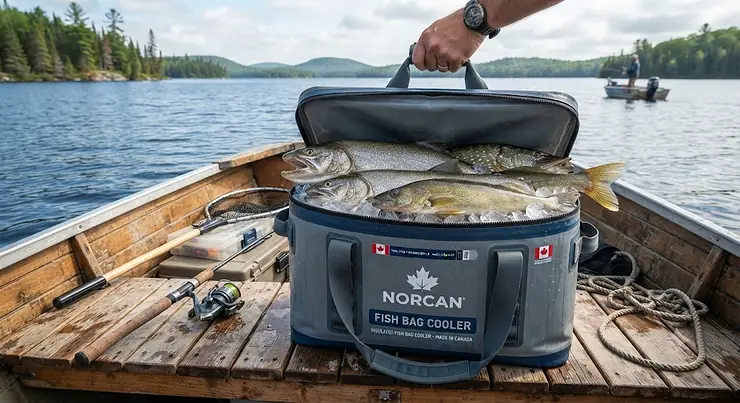
A fish bag cooler is a soft-sided, insulated bag designed to hold ice and a fresh catch the way a hard cooler would, except it folds flat, weighs a fraction as much, and doesn’t eat your entire truck bed on the drive home. That’s it. That’s the whole pitch, and it’s a surprisingly good one.
Here’s the thing nobody tells you when you buy your first hard-sided cooler for fishing: it’s brilliant right up until you have to carry it, store it, or fit it into a kayak hatch. A fish bag cooler solves the exact problems a rotomolded box creates. It rolls up into a duffel-sized lump in your trunk. It doesn’t crack when a 12-kilogram (26 lb) Chinook lands on it wrong. And, crucially, it’s built specifically around the mess of transporting an actual dead fish — blood, slime, melting ice, and all — rather than adapted from a picnic cooler that just happens to hold fish.
Canadian anglers have particular reasons to care about this. Between salmon runs on the Fraser, walleye trips on Lake of the Woods, and long summer weekends where the cooler has to survive a bumpy forestry road before it even sees water, a fish bag cooler earns its keep. Whether you’re hauling a soft fish cooler onto a kayak, packing a budget shore fishing cooler for a weekend at a provincial park, or just trying to keep a stringer of pickerel from stinking up the minivan, the right bag changes the whole experience. Below, we’ve dug into seven real, currently available options — from entry-level backpack coolers to premium welded-seam builds — and broken down what the spec sheets actually mean once you’re standing on a dock with wet hands and a fish that won’t stop flopping.
Quick Comparison: 7 Fish Bag Coolers at a Glance
Before the deep dive, here’s the short version for anyone who just wants a starting point.
| Fish Bag Cooler | Best For | Approx. Price Range (CAD) |
|---|---|---|
| Piscifun Insulated Cooler Backpack | Budget shore fishing, hike-in spots | C$45–C$70 |
| Buffalo Gear Flat Bottom Fish Cooler Bag | All-round budget/mid pick | C$65–C$160 |
| Mustad Addicted “Bonk Em All” Kill Bag | Budget salmon/steelhead kill bag | C$75–C$95 |
| THKFISH Insulated Fish Cooler Bag | Best insulated fish bag material for the price | C$55–C$110 |
| Calcutta Pack Fish Cooler | Catch-and-keep gear with built-in ruler | C$95–C$150 |
| Hobie Insulated Fish Bag | Kayak fishing decks and hatches | C$140–C$250 |
| Engel HD20 / HD30 Soft-Sided Cooler | Premium multi-day ice retention | C$225–C$300 |
A quick pattern jumps out here: price climbs steadily with seam construction quality, not just size. The Piscifun Insulated Cooler Backpack and Buffalo Gear Flat Bottom Fish Cooler Bag compete on value and portability, while the Engel HD20 / HD30 Soft-Sided Cooler justifies its premium price with fully welded (rather than stitched) seams that hold ice noticeably longer. If your priority is simply getting a fish off the water and into a bag without a leak, almost anything on this list will do the job for a day trip — the differences show up on multi-day trips, hot summer afternoons, and anything involving saltwater.
Just one click — help others make better buying decisions too!😊
Top 7 Fish Bag Coolers: Expert Analysis
We picked these seven to cover the realistic range of what a Canadian angler actually buys: backpack-style bags for hikers, flat-bottom kill bags for boats, kayak-specific bags, and a premium option for anyone who wants their soft fish cooler to outlast three or four seasons of saltwater abuse.
1. Piscifun Insulated Cooler Backpack — best budget backpack for shore anglers
Piscifun built this as a general-purpose insulated backpack, but it does double duty as one of the more practical portable fish storage options for anglers who walk into their spots rather than boat to them. The appeal here is simple: it carries like a daypack, not a cooler.
Construction leans on a heat-welded, leakproof liner paired with a food-grade TPU coating, which in plain terms means the inside won’t absorb fish odour the way a cheap nylon liner would, and it won’t crack the way rigid plastic liners do when folded repeatedly. The padded, adjustable straps distribute weight across both shoulders instead of one arm, which matters a lot more than it sounds like it should once you’re two kilometres down a trail with a dozen trout and a rod tube.
Based on the spec comparison with dedicated kill bags on this list, this backpack isn’t built for 20-kilogram tuna hauls — it’s built for the angler who needs to walk to the water and back with a manageable catch and maybe lunch. Reviewers on major retail platforms consistently note that the shoulder straps and back panel are more comfortable over distance than competing backpack coolers, though a recurring theme in aggregated feedback is that seams on the lower end of the price range are less abuse-tolerant than the welded seams on purpose-built fish bags — worth keeping in mind if you’re regularly hauling sharp-finned species.
Pros:
- ✅ Genuinely comfortable to carry long distances on foot
- ✅ Leakproof, heat-welded liner resists fish odour buildup
- ✅ Doubles as a general camping or lunch cooler off-season
Cons:
- ❌ Smaller capacity than dedicated flat-bottom fish bags
- ❌ Less puncture resistance against sharp fins than PVC tarpaulin bags
Priced in the C$45–C$70 range depending on retailer and size, the Piscifun Insulated Cooler Backpack is a smart entry point if your fishing style is more “walk to a spot” than “load the boat.”
2. Buffalo Gear Flat Bottom Fish Cooler Bag — best all-round standup fish bag
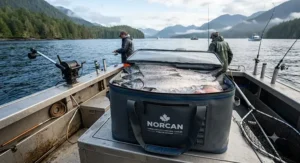
Buffalo Gear built its reputation specifically on fish bags rather than adapting a general cooler line, and it shows. The flat-bottom design is the standout feature here: instead of an envelope-style bag that flops over the moment you set it down, this one stands upright on a boat deck or tailgate, which sounds minor until you’re trying to load a second fish one-handed while the first bag tips over.
The 13-millimetre (0.5-inch) closed-cell foam insulation, combined with heat-welded seams, is rated by the manufacturer to hold ice for 24 to 36 hours in summer conditions, with some of the larger models claiming up to 48 hours. In practice, that range depends heavily on how much ice-to-fish ratio you load and how often the bag gets opened — every time you unzip it to check on your catch, you’re letting warm air in and resetting part of that clock. The 22-ounce polyester tarpaulin lining is genuinely tough against blood and slime, and the screw-on drain valve lets you dump meltwater without unzipping the whole bag, which keeps a boat deck drier than most competitors manage.
Sizes run from a compact 26-litre bag suited to a day of bass fishing up to a 71-inch flat-bottom bag built for offshore tournament anglers hauling multiple large fish. Aggregated buyer feedback across retail platforms repeatedly praises the shoulder strap comfort and the bag’s resistance to punctures from spiny rockfish and similar species, while a smaller number of reviewers mention that the largest sizes are bulkier than expected for anglers who only occasionally land big fish — sizing down is usually the fix.
Pros:
- ✅ Flat bottom stands upright on deck or tailgate
- ✅ Heat-welded seams genuinely resist leaks under real use
- ✅ Available in a wide range of sizes for different catch volumes
Cons:
- ❌ Larger sizes are bulky if you rarely land big fish
- ❌ Ice retention claims assume the bag stays mostly closed
At roughly C$65 for the smallest size up to C$160 for the largest tournament-grade bag, the Buffalo Gear Flat Bottom Fish Cooler Bag is the pick most anglers should default to unless they have a specific reason to go elsewhere.
3. Mustad Addicted “Bonk Em All” Kill Bag — best budget kill bag for salmon runs
Developed by the Addicted Fishing team in partnership with Mustad, the Bonk Em All leans hard into the salmon-and-steelhead crowd, and the branding makes no apologies about what it’s for. It’s built from 500-denier PVC tarpaulin with roughly a centimetre of insulating foam, which is thinner than some premium competitors but keeps the price and the folded size down considerably.
An independent field review from AllOutdoor tested the 38-inch version through a full day in 24–27°C (75–80°F) daytime heat, opening it repeatedly to simulate real fishing conditions rather than leaving it sealed. The ice stayed fully solid through the first day, with visible meltwater only appearing by the end of that period — a reasonable result for a bag in this price bracket, especially given the test deliberately worked against the bag by opening it often. What most buyers overlook about this model is that the zipper is explicitly not airtight or watertight, so it’s a genuine kill bag for transport rather than a sealed cooler for multi-day ice storage.
The screw-type drain and 5-centimetre (2-inch) nylon web handles are straightforward and durable, and the bag folds down small enough to live behind a truck seat permanently rather than taking up dedicated storage space. For anglers who mostly need something to get a fish from the boat or bank to the cleaning station without a mess, this hits the mark without asking for premium-cooler money.
Pros:
- ✅ Compact folded size fits behind a truck seat easily
- ✅ Handled real-world heat and repeated opening well in testing
- ✅ Simple, durable screw-drain design
Cons:
- ❌ Zipper is water-resistant, not fully watertight
- ❌ Thinner insulation than premium PVC tarpaulin competitors
Typically priced around C$75–C$95 CAD depending on the 38-inch or 45-inch size, the Mustad Addicted “Bonk Em All” Kill Bag is a strong budget shore fishing cooler pick for anyone chasing salmon or steelhead on a modest budget.
4. THKFISH Insulated Fish Cooler Bag — best insulated fish bag material for the price
If you’re specifically shopping around insulated fish bag material and want to understand what’s actually inside the walls of a budget-to-mid-range bag, THKFISH is a useful reference point because the brand is unusually transparent about its layering. The construction stacks a 420-denier nylon TPU inner liner (puncture-resistant and odour-blocking), a middle layer of more than 10 millimetres of high-density pearl cotton insulation, and an outer shell of tear- and abrasion-resistant nylon TPU — three distinct jobs handled by three distinct materials rather than one generic foam layer doing everything.
Radio-frequency welded seams tie the whole thing together, which the spec sheet won’t spell out but matters practically: RF welding fuses the material at a molecular level rather than relying on stitching and glue, so there’s no needle-hole seam for water to seep through over time. The manufacturer rates the smaller 25×17.5-inch bag for up to 24 hours of ice retention and the larger 60×20-inch version for up to 48 hours, which lines up with the general rule that bigger bags lose relative surface-area heat more slowly than small ones.
One honest caveat surfaces in the product documentation itself: THKFISH notes plainly that certain models are waterproof but not fully leakproof, because they use a standard water-resistant zipper rather than a fully sealed one. That’s a meaningful distinction for anyone planning to store a bag loaded with ice and fish on its side in a moving vehicle. Reviewers commonly mention the push-down drain valve as a genuine improvement over screw-plug designs, since it’s faster to operate with cold, wet hands.
Pros:
- ✅ Three-layer construction with a clearly documented material stack
- ✅ RF-welded seams reduce long-term leak risk versus stitched bags
- ✅ Push-down drain valve is fast to use with wet or gloved hands
Cons:
- ❌ Standard zipper is water-resistant, not fully sealed
- ❌ Smaller sizes rated for 24 hours max, shorter than premium bags
Expect to pay roughly C$55 for the compact size up to about C$110 for the largest 60-inch model, making the THKFISH Insulated Fish Cooler Bag a strong choice for anyone prioritizing insulation quality over brand prestige.
5. Calcutta Pack Fish Cooler — best built-in features for catch-and-keep gear
Calcutta’s Pack series is one of the more established names in this category, and it’s actually stocked by Canadian retailers rather than being an import-only option, which matters if you’d rather see a bag in person before buying. The standout practical touch is the external built-in ruler sewn along the bag’s edge — a small thing, but it means you can measure a fish for slot-limit compliance the moment it goes into the bag, without fumbling for a separate tape measure while standing in a boat.
Available in 90-centimetre (36-inch) and 100-centimetre (40-inch) lengths, the bag uses a welded waterproof inner liner and taped, sealed zippers, plus a genuinely useful “no-sweat” insulated design that keeps the exterior from getting clammy and slippery the way some bargain bags do after a few hours in the sun. The fold-up design compresses down to roughly a third of its open size for storage, and the strong woven nylon shoulder strap holds up well under a loaded bag’s weight based on documented specs and dealer descriptions.
Here’s what most buyers overlook about “catch and keep” gear generally: a bag is only as useful as how quickly you can verify a fish is legal to keep, and Calcutta clearly designed around that reality rather than treating it as an afterthought. On angler forums, owners report the insulation is “slight” rather than dramatic compared to thicker premium bags, and most use it as a short-haul transport bag from cleaning station to vehicle rather than an all-day ice chest — a fair trade-off for the built-in measuring convenience and lower bulk.
Pros:
- ✅ Built-in ruler speeds up slot-limit compliance checks
- ✅ No-sweat exterior stays manageable to handle after hours in the sun
- ✅ Available through Canadian retail channels, not just import listings
Cons:
- ❌ Insulation is lighter than dedicated multi-day ice-retention bags
- ❌ Best suited to short transport rather than all-day ice storage
Priced roughly C$95 to C$150 CAD depending on size and retailer, the Calcutta Pack Fish Cooler earns its spot for anglers who care as much about compliance and convenience as raw ice retention.
6. Hobie Insulated Fish Bag — best fit for kayak fishing decks
Kayak anglers have a different problem than boat or shore anglers: deck space is measured in centimetres, not feet, and a bag has to actually fit the hatch or tank well it’s designed for. Hobie built its Insulated Fish Bag specifically around its own kayak lineup, and the tapered shape reflects that — the medium runs about 60 centimetres (24 inches) long and tapers from 18 to 41 centimetres (7 to 16 inches) wide, front to back, matching the shape of a typical kayak hatch rather than a generic rectangle.
Construction uses vinyl-coated polyester with UV-resistant double-stitched threading, backed by 13 millimetres (half an inch) of closed-cell foam insulation and YKK zippers — the same zipper brand used across a lot of premium outdoor gear because of its corrosion resistance in saltwater. D-rings on each side let you lash the bag down to kayak tie-down points, which matters more than it sounds like on open water where a wave or hard paddle stroke can send an unsecured bag sliding. The larger size holds roughly 66 litres (70 quarts) and includes an adjustable bungee on top for stacking additional gear.
Team feedback cited by Hobie itself notes the bag “holds up to the spines of a red snapper” without puncturing — a claim that lines up with the vinyl-coated polyester’s reputation for abrasion resistance in the kayak fishing community. On paper, this means the bag is genuinely built for the rough handling of a hooked, spiny, thrashing fish rather than just cosmetic marketing language, though it comes at a real price premium over generic import bags of similar size.
Pros:
- ✅ Tapered shape matches kayak hatch and deck geometry precisely
- ✅ D-ring tie-down points prevent sliding on open water
- ✅ YKK zippers hold up well to repeated saltwater exposure
Cons:
- ❌ Premium price relative to non-kayak-specific competitors
- ❌ Tapered shape is less space-efficient for non-kayak use
Running roughly C$140 for the medium size up to about C$250 for the large, the Hobie Insulated Fish Bag is the clear pick for anyone fishing from a kayak rather than a boat or shoreline.
7. Engel HD20 / HD30 Soft-Sided Cooler — best premium build and multi-day ice retention
Engel has built its reputation on hard coolers since 1962, and the HD line applies that same engineering standard to a soft-sided design. The key technical difference from every other bag on this list is that the seams are fully welded rather than sewn — a distinction Engel is explicit about in its own marketing, and one that holds up under scrutiny, since stitched seams create thousands of tiny needle holes that are a bag’s most common failure point over time.
The shell combines TPU lamination with an 840-denier outer fabric, which is a meaningfully heavier-duty material than the 420- to 500-denier fabrics used on most budget and mid-range competitors, translating to better resistance against punctures from boat hardware, dock nails, and sharp-finned fish alike. Independent coverage from The Fisherman noted the 30-quart version weighs just 2.4 kilograms (5.25 lbs) empty while holding ice for three to four days, a genuinely impressive ratio given how much lighter that is than an equivalent-capacity hard cooler.
Here’s what most buyers overlook about “premium” soft coolers: the price difference from budget bags isn’t really about capacity, it’s about how the bag performs after two or three seasons of real use, when stitched competitors start to show seam wear and this one generally doesn’t. The waterproof zipper and integrated bottle opener are nice touches, but the welded-seam construction is the actual reason to pay the premium. Available directly through Amazon.ca, it’s one of the few bags on this list you can reliably source from a Canadian storefront without cross-border shipping uncertainty.
Pros:
- ✅ Fully welded seams outperform stitched competitors long-term
- ✅ Exceptional weight-to-ice-retention ratio at roughly 2.4 kg empty
- ✅ Reliably available through Canadian retail channels
Cons:
- ❌ Meaningfully more expensive than fabric-tarpaulin competitors
- ❌ Overkill capacity and cost for occasional, casual anglers
At around C$225 for the HD20 and closer to C$275–C$300 for the larger HD30, the Engel HD20 / HD30 Soft-Sided Cooler is the one to buy if you fish often enough that seam failure on a cheaper bag would actually cost you more over three seasons than paying up front.
Top 7 Fish Bag Coolers: Detailed Spec Comparison
| Fish Bag Cooler | Capacity | Insulation | Claimed Ice Retention | Price Range (CAD) | Best For |
|---|---|---|---|---|---|
| Piscifun Insulated Cooler Backpack | ~20–30 L | TPU-coated liner | ~12–24 hrs | C$45–C$70 | Hike-in shore fishing |
| Buffalo Gear Flat Bottom Fish Cooler Bag | 26–84 L | 13 mm closed-cell foam | 24–48 hrs | C$65–C$160 | All-round budget/mid pick |
| Mustad Addicted “Bonk Em All” | ~38–45 in bag | ~1 cm PVC foam | ~24 hrs | C$75–C$95 | Budget salmon/steelhead |
| THKFISH Insulated Fish Cooler Bag | 25–70 in bag | 10 mm+ pearl cotton, 3-layer | 24–48 hrs | C$55–C$110 | Insulation value |
| Calcutta Pack Fish Cooler | 36–40 in bag | No-sweat insulated liner | Short-haul focus | C$95–C$150 | Built-in ruler, compliance |
| Hobie Insulated Fish Bag | 26–70 qt | 13 mm closed-cell foam | Multi-hour to full day | C$140–C$250 | Kayak fishing decks |
| Engel HD20 / HD30 | 20–32 qt | Welded, TPU-laminated | 3–4 days | C$225–C$300 | Premium multi-day use |
Reading across this table, the split between “day trip” bags and “multi-day” bags becomes obvious fast: the Engel HD20 / HD30 is in a different league for ice retention because of its welded construction, while the Mustad Addicted “Bonk Em All” and Calcutta Pack Fish Cooler are honestly built around short transport rather than extended ice storage. If your trips rarely exceed a single day, paying premium prices for multi-day retention is money you don’t need to spend — put it toward gear you’ll actually use every outing instead.
Fish Bag Cooler vs Hard-Sided Cooler: Which Wins Where
The comparison Canadian anglers actually need to make isn’t between fish bag coolers — it’s between a soft fish cooler and the hard-sided cooler sitting in the garage already. Both have a legitimate place, and pretending one categorically beats the other does anglers a disservice.
| Factor | Fish Bag Cooler (Soft) | Hard-Sided Cooler |
|---|---|---|
| Weight (empty) | 1–3 kg typical | 4–10+ kg typical |
| Storage when empty | Folds flat | Fixed bulky shape |
| Ice retention (premium tier) | 1–4 days | 3–10+ days |
| Puncture resistance | Good to very good (varies by model) | Excellent |
| Typical price | C$45–C$300 | C$150–C$600+ |
| Best For | Kayaks, hike-in spots, day trips | Extended boat trips, camp base |
A hard cooler still wins outright on raw ice retention over five-plus days and on resistance to a bear or a dropped tailgate, which is exactly why serious offshore and multi-day trips often carry both: a hard cooler as the main ice chest and a soft fish bag cooler as the transport bag that actually touches the fish. For the vast majority of Canadian day-trip and weekend anglers, though, the flexibility and portability of a soft bag outweighs the marginal ice-retention gap, especially once you factor in how much easier a folded bag is to store in a condo, apartment, or small SUV between trips.
How to Prep and Use Your Fish Bag Cooler for Maximum Ice Retention
Buying a good bag is half the equation — how you prep and load it accounts for the rest, and it’s the part most product listings skip entirely.
Start the night before a trip, not the morning of. Pre-chilling the bag itself in a cold garage or basement for a few hours means the insulation isn’t fighting to bring warm fabric down to temperature at the same time it’s trying to hold your ice. Once you’re loading up, aim for roughly a 2:1 ratio of ice to fish by volume if you’re expecting a full day out — that ratio compensates for the ice you’ll lose simply from repeated opening.
Block ice consistently outperforms cubed ice for retention time because it has less total surface area exposed to melt, even though cubes pack more tightly around irregular fish shapes. A practical middle ground many guides use is a layer of block ice on the bottom with cubed ice packed around the catch on top. Bleed and gut your fish before bagging when regulations and your own preference allow it — a fish carrying its full digestive tract will spoil faster and warm the surrounding ice more quickly than one that’s been field-dressed.
A few common first-30-days mistakes are worth flagging directly: overfilling the bag so the zipper can’t fully seal, leaving the bag in direct sun on a boat deck instead of in shade, and skipping the drain valve until the bag is already sloshing. Draining meltwater every couple of hours — rather than waiting until the bag is heavy and sagging — keeps the remaining ice colder for longer, since standing water actually accelerates heat transfer into the ice compared to melting in place and draining immediately.
Which Fish Bag Cooler Fits Your Fishing Style? Real Angler Scenarios
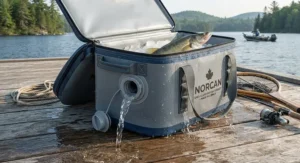
Consider a university student who fishes for smallmouth bass from shore three or four times a month, hiking in from a bus stop or bike path with a rod tube and a backpack. Budget and portability dominate here, and a Piscifun Insulated Cooler Backpack or a compact Buffalo Gear Flat Bottom Fish Cooler Bag covers the realistic catch volume without adding bulk to an already loaded pack.
Now picture a retiree who kayak-fishes twice a week on a coastal inlet for salmon and rockfish, launching from a beach with limited deck space and a real chance of sharp fins puncturing cheap fabric. The Hobie Insulated Fish Bag solves the fit problem a generic rectangular bag can’t, and the D-ring tie-downs matter far more once you’re actually on moving water than they do on a spec sheet.
Finally, think about a small charter operator or serious weekend tournament angler running multi-day trips out of a 6-metre boat, needing a bag that survives a full season of saltwater, ice, and blood without seam failure. The Engel HD20 / HD30 Soft-Sided Cooler is the one purchase that pays for itself across a season rather than needing replacement after one hard year, and the multi-day ice retention actually gets used rather than being a marketing number that never comes into play.
Fish Bag Cooler Decision Framework
If you fish mostly from shore and carry gear on foot, choose a backpack-style bag like the Piscifun Insulated Cooler Backpack, because comfort over distance matters more than raw ice-holding time.
If you fish from a boat for a single day at a time and want the safest all-round choice, choose the Buffalo Gear Flat Bottom Fish Cooler Bag, because its balance of price, capacity options, and real-world durability covers the most common Canadian fishing scenario.
If slot-limit compliance and quick measuring matter to your fishery, choose the Calcutta Pack Fish Cooler for its built-in ruler, because fumbling for a separate tape measure while a conservation officer is nearby is a genuinely avoidable hassle.
If you fish from a kayak, choose the Hobie Insulated Fish Bag without much debate, because a bag that doesn’t fit your hatch geometry is a bag you’ll stop using within a season regardless of its other merits.
If you fish often enough that gear failure costs you more than gear price, choose the Engel HD20 / HD30 Soft-Sided Cooler, because welded-seam construction is the one feature on this list that compounds in value the longer you own it.
How to Choose a Fish Bag Cooler
Shopping for a fish bag cooler comes down to a handful of concrete decisions, in roughly this order of importance:
- Match capacity to your realistic catch, not your best-case dream trip. A bag sized for tournament hauls is dead weight on the average outing.
- Check the seam construction. Heat-welded or RF-welded seams outlast stitched-and-glued seams by a wide margin once punctures and repeated flexing enter the picture.
- Confirm insulation thickness in millimetres, not just marketing claims. Thicker closed-cell foam or pearl cotton correlates directly with longer ice retention.
- Decide whether you need a drain valve or can live without one. Screw plugs are simple and reliable; push-down valves are faster to operate with cold or gloved hands.
- Think about your launch point. Kayak anglers need tapered, tie-down-friendly shapes; boat and shore anglers generally don’t.
- Weigh folded storage size against your actual storage space. A bag that never gets unpacked because it’s inconvenient to store isn’t saving you anything.
- Set a realistic budget band and stick to the segment that matches your fishing frequency, since paying for multi-day ice retention you’ll never use is the single most common overspend in this category.
Common Mistakes When Buying a Fish Bag Cooler
The most frequent mistake is buying based on length alone without checking the taper or flat-bottom design, which affects real usable capacity more than the headline dimension suggests. A second common error is assuming “waterproof” and “leakproof” mean the same thing — as THKFISH’s own documentation makes clear, a water-resistant zipper is not a sealed one, and that distinction matters the moment a bag gets laid on its side in a vehicle.
Buyers also frequently underestimate how much insulation thickness matters relative to bag size; a large bag with thin foam will often lose the ice-retention race against a smaller bag with thick, high-quality insulation. Finally, skipping the drain valve feature to save a few dollars is a false economy for anyone fishing more than the occasional weekend, since the alternative is unzipping a heavy, sloshing bag every time it needs emptying.
Insulated Fish Bag Material Explained: What Actually Keeps Ice Frozen
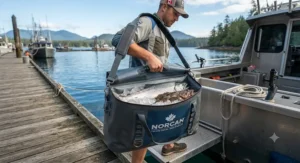
Every bag on this list relies on the same basic physics, but the materials used to achieve it vary more than most listings explain clearly. The insulation core — closed-cell foam in most premium bags, dense pearl cotton in budget-to-mid options like THKFISH — works by trapping tiny pockets of air that resist heat transfer, the same principle behind a winter jacket’s insulation layer. Thickness matters more than material type within a reasonable range: 13 millimetres (half an inch) of quality closed-cell foam consistently outperforms a thinner layer of even premium material.
The inner liner’s job is different: it’s about puncture and odour resistance rather than insulation, which is why TPU-coated nylon and vinyl-coated polyester dominate this layer across nearly every brand. The outer shell, meanwhile, is chosen for abrasion resistance against boat decks, dock cleats, and truck beds — heavier denier ratings (840D on the Engel HD20 / HD30, for example, versus 420D–500D on budget competitors) translate directly into how many seasons the exterior survives before showing wear.
Seam construction ties all three layers together, and it’s arguably the single most underrated spec on any product page. Heat-welded or RF-welded seams fuse material without needle holes; stitched seams, even when taped, create thousands of potential leak points over years of flexing. If you take one thing away from comparing insulated fish bag material across brands, let it be this: check how the seams are made before you check the foam thickness, because a puncture at a weak seam empties a bag’s ice regardless of how good the insulation was.
Soft Fish Cooler for Shore Anglers vs Boat and Kayak Anglers
Shore anglers and hike-in fishers should prioritize weight and comfort above all else, since a soft fish cooler that’s genuinely comfortable to carry two kilometres gets used every trip, while a heavier, higher-capacity bag gets left in the truck. This is exactly the gap the Piscifun Insulated Cooler Backpack fills, and it’s why backpack-style designs consistently outsell flat-bottom bags among bank and shore anglers despite offering less raw capacity.
Boat anglers face the opposite trade-off: deck space is more forgiving than a hiker’s back, so capacity and stability (a flat bottom that won’t tip) matter more than portability. The Buffalo Gear Flat Bottom Fish Cooler Bag and Calcutta Pack Fish Cooler both lean into this reality with designs meant to sit upright and stay put rather than fold into a compact shape for carrying.
Kayak anglers sit in their own category entirely, constrained by hatch dimensions and the very real risk of gear sliding overboard on rough water. This is a case where a generic “large capacity” bag is often the wrong purchase entirely — a Hobie Insulated Fish Bag, shaped and tie-down-equipped specifically for kayak decks, will outperform a technically larger bag that simply doesn’t fit the available space.
Long-Term Cost, Maintenance & Catch-and-Keep Gear Care
Treat your fish bag cooler as gear with a maintenance schedule, not a disposable purchase, and it’ll last considerably longer than the one- or two-season lifespan many budget buyers experience. Rinse the interior with mild soap and fresh water after every trip involving fish, then invert the bag to dry fully before folding it away — trapped moisture inside a closed bag is the single fastest route to mildew odour that no amount of soap will fully remove later.
On a cost-per-use basis, the math tends to favour paying more up front if you fish regularly. A C$75 budget bag that needs replacing every season costs more over three years than a C$225 welded-seam bag that lasts the same period, before even factoring in the frustration of a mid-season failure. For catch-and-keep gear specifically — the bags, rulers, and drain systems that handle your actual harvest — that durability calculation matters even more, since a failure here doesn’t just cost money, it costs the catch itself.
Inspect zippers and drain valves each spring before the season starts; a stuck zipper slider or a cracked drain plug is a cheap, easy fix in April and a ruined weekend in July. Store bags loosely folded rather than tightly compressed for months at a time, since permanent creases in PVC and TPU materials can eventually crack along stress points.
Safety, Regulations & Cold-Chain Rules for Canadian Anglers
Keeping fish cold isn’t just about taste — it’s a genuine food safety issue, and Health Canada is direct about the guidance: raw fish and seafood should go into a cold environment as soon as possible, kept out of the temperature danger zone between roughly 4°C and 60°C where bacteria multiply quickly. A well-insulated fish bag cooler with adequate ice is doing real food-safety work, not just convenience work, particularly on hot summer days when a fish can sit in a warm boat for hours before reaching a fridge.
On the regulatory side, Canadian anglers need a valid recreational fishing licence for the water they’re fishing — federal tidal-water licences through Fisheries and Oceans Canada in coastal regions, and provincial freshwater licences elsewhere — along with awareness of species-specific catch limits and mandatory catch-reporting requirements in some provinces. A built-in ruler, like the one on the Calcutta Pack Fish Cooler, isn’t just a convenience feature here; it directly supports compliance with size-based possession limits that vary by species and region.
There’s also a less obvious regulatory angle worth knowing: transporting wet gear, including fish bags, between different bodies of water carries a real risk of spreading aquatic invasive species. Canada’s national Clean, Drain, Dry program asks anglers to inspect, drain, and fully dry gear — bags included — before moving between waterbodies, and in some provinces this is now a legal requirement rather than a suggestion. A bag with a fast-draining valve, like several of the models above, makes this step considerably less of a chore than one that has to be fully unzipped and tipped over.
✨ Don’t Miss These Exclusive Deals!
🔍 Take your fishing gear setup to the next level with these carefully selected fish bag coolers. Click on any highlighted item to check current pricing and availability. These bags will help you bring home fresh, well-cared-for catches your family will actually enjoy eating!
FAQ: Fish Bag Coolers
❓ What is a fish bag cooler?
❓ How long do fish bag coolers keep ice?
❓ Are fish bag coolers better than hard coolers for fishing?
❓ What size fish bag cooler do I need?
❓ Can you put a fish bag cooler in a kayak?
Conclusion
There’s no single best fish bag cooler for every Canadian angler, and honestly, that’s the correct takeaway rather than a cop-out. If you’re hiking to a shore spot on a budget, the Piscifun Insulated Cooler Backpack earns its keep through comfort alone. If you want the safest all-round purchase for typical boat fishing, the Buffalo Gear Flat Bottom Fish Cooler Bag covers the widest range of realistic scenarios at a fair price. Kayak anglers should stop comparing capacity numbers and go straight to the Hobie Insulated Fish Bag, because fit beats volume every time it actually matters on the water.
For anglers who fish often enough that gear durability becomes a real cost factor, the Engel HD20 / HD30 Soft-Sided Cooler pays for itself in avoided seam failures and replacement purchases over a few seasons. And if compliance features or budget-friendly kill-bag simplicity matter more to your specific fishery, the Calcutta Pack Fish Cooler and Mustad Addicted “Bonk Em All” Kill Bag both deliver exactly what they promise without overcomplicating things.
Whatever you land on, the underlying principle holds across every option on this list: check the seam construction, match the size to your real catch volume rather than your dream trip, and remember that keeping fish properly cold is as much a food-safety habit as it is a gear purchase.
✨ Ready to upgrade your next trip? Check current prices on the fish bag cooler that fits your fishing style before your next outing sells it out! 🎣❄️
Recommended for You
- Backpack Cooler for Ice Fishing: 7 Tough Picks for 2026
- Fish Cooler for Boat: 7 Top Picks That Won’t Fail You in 2026
- Portable Fan for Hiking: 7 Best Budget Picks (2026)
Disclaimer: This article contains affiliate links. As an Amazon Associate, I earn from qualifying purchases. If you purchase products through these links, we may earn a small commission at no additional cost to you.
✨ Found this helpful? Share it with your friends! 💬🤗
