
In This Article
A Midea vs Frigidaire window air conditioner comparison pits two philosophies against each other. Midea bets on a U-shaped inverter body that straddles the window sash and keeps the compressor outdoors. Frigidaire answers with a broad, familiar lineup of box-style units, several now wired for Wi-Fi. Both brands sell widely in Canada, and both can keep a bedroom civil on a 30 °C night.
Here’s the catch. Canadian summers are short, sticky and gloriously unpredictable, so you only get a handful of truly miserable nights to justify the purchase. Pick a unit that’s too loud and it gets unplugged by August. Pick one that’s too heavy and it never leaves the box. Pick the wrong size and you’ve bought a very expensive fan with opinions.
Cooling capacity is quoted in BTU, and a 10,000 BTU unit moves roughly 2.9 kW of heat, which is plenty for a typical bedroom or small living room. Everything below is built from published specs, manufacturer and Canadian retailer data, and Government of Canada efficiency guidance. I haven’t hauled these units into a window myself, so read the analysis as careful research rather than a lab test.
You’ll also find dedicated sections on the U-shaped window air conditioner review Canada question, smart WiFi window AC for cottage setups, casement window compatibility, Amazon.ca warranty and return policy, and app and voice assistant control. Let’s get to it.
Quick Comparison: 7 Window Air Conditioners at a Glance
Before the deep dive, here’s the whole field on one screen. Room-size figures come from manufacturer or retailer listings, so confirm them against the current Amazon.ca page, since model numbers sometimes differ between Canadian sellers.
| Model | Capacity / Rated Room | Smart Control | Best For |
|---|---|---|---|
| Midea U-Shaped 10,000 BTU | 10,000 BTU / up to 450 sq ft (42 m²) | Wi-Fi app, Alexa, Google Assistant, Apple Home | Light sleepers who still want to open the window |
| Midea U-Shaped 12,000 BTU | 12,000 BTU / 550 sq ft (51 m²) | App, Alexa, Google Assistant | Big living areas and open-plan cottages |
| Frigidaire FHWW123WB1 | 12,000 BTU / 550 sq ft (51 m²) | Frigidaire app, Alexa, Google Assistant | Smart control in a conventional box |
| Frigidaire FHWW064WD1 | 6,000 BTU / 250 sq ft (23 m²) | Frigidaire app, remote | Condos, dorms and bunkies |
| Frigidaire FHWC083TC1 | 8,000 BTU / mid-size bedroom | Remote only | No-fuss bedroom cooling |
| Frigidaire FFRE053ZA1 | 5,000 BTU / small rooms | Remote only | Tight budgets and small windows |
| Frigidaire FHSC082WB1 | 8,000 BTU / casement slider | None | Tall, narrow casement openings |
Looking at the table, the Midea U-Shaped 10,000 BTU is the only unit here promising both a very low noise claim and a window you can still open. The Frigidaire FHWW123WB1 matches the Midea U-Shaped 12,000 BTU on room coverage but gives up the U-shape. The bottom three Frigidaire models are about simplicity and price, not gadgets.
💬 Just one click — help others make better buying decisions too!😊
Top 7 Midea vs Frigidaire Window Air Conditioner Picks: Expert Analysis
A quick honesty note before the list. I couldn’t verify aggregated Amazon.ca review scores for every model, so the review notes below describe what retailer reviews and published specs suggest, and I flag the gaps. Prices are planning ranges in Canadian dollars, so check current price before you buy.
1. Midea U-Shaped 10,000 BTU — the quiet one that lets you open the window
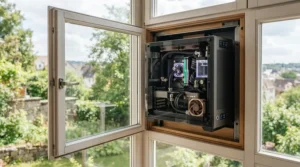
The U-shaped body straddles your window sash, so the noisy compressor lives outside while the sash stays free to move.
Canadian Tire’s spec sheet lists coverage up to about 450 sq ft (42 m²) and a sound claim as low as 32 dBA. Older Midea material quotes 42 dBA, so treat decibel figures as best-case numbers. Midea Canada says the DC inverter pushes airflow up to 6 m (20 ft), which in practice means the cold air reaches your bed instead of dying on the dresser. The listing shows a minimum opening height near 49.5 cm (19.5 in) and a width of roughly 58 to 91 cm (23 to 36 in).
Based on the spec comparison, this is the pick for light sleepers and for cottage owners whose window is also the only breeze source. At about 24.8 kg (54.7 lb) per one ENERGY STAR listing for a 10,000 BTU Midea straddle-style model, it’s also easier to lift than the Frigidaire FHWW123WB1.
Reviewer sentiment I could verify comes from Canadian Tire reviews, where one buyer described it as a cheaper alternative to central air and another said it was their second Midea. I couldn’t confirm an Amazon.ca aggregate.
Pros:
- ✅ Compressor noise stays outside the room
- ✅ Window still opens and closes
- ✅ Voice control with Alexa, Google and Apple Home
Cons:
- ❌ Needs a window with enough sash opening
- ❌ Premium over box-style units
Price: around C$450-C$550. Strong value if sleep quality is the goal.
2. Midea U-Shaped 12,000 BTU — big-room cooling with inverter efficiency
This is the Midea U-Shaped 10,000 BTU formula scaled up for open living spaces.
Midea Canada lists the 12,000 BTU model under numbers such as MW12MSWBA5RCM and MW12MSWBA6RCM, claiming over 35% energy savings from the inverter. The US sibling is rated at 550 sq ft (51 m²) with EER 15.0 and a noise range of 42 to 52 dB on one retailer listing. A US retailer lists a minimum window height of about 56 cm (22 in).
Here’s what most buyers overlook. Bigger isn’t automatically better, and Natural Resources Canada warns that an oversized unit is less effective and wastes energy. A 12,000 BTU unit in a 20 m² bedroom will cool fast, cycle off, and leave the air clammy. Pair this one with a genuine 40 m² or larger space, or a sun-baked room with big south glass.
I couldn’t verify Amazon.ca review data for this exact model. Expect the same design praise as its smaller sibling, while the usual window-unit grumble, fiddly sealing, is likely to apply.
Pros:
- ✅ Covers roughly 51 m² of floor area
- ✅ Inverter efficiency with U-shaped quiet design
- ✅ Smart app plus voice control
Cons:
- ❌ Overkill for bedrooms under 30 m²
- ❌ Priciest unit in this round-up
Price: roughly C$550-C$750. Worth it only if the room genuinely needs the capacity.
3. Frigidaire FHWW123WB1 — Wi-Fi 12,000 BTU in a conventional box
If you want app control without changing how your window works, this is Frigidaire’s answer.
Specs from retailer listings: 12,000 BTU, 550 sq ft (51 m²), CEER 12, ENERGY STAR certification with an Energy Saver mode, R-32 refrigerant and 3.8 pints per hour of dehumidification. Airflow runs 244 to 300 CFM with a swing louver and fresh air vent. It fits openings 64 to 91 cm (25 to 36 in) wide and at least 39 cm (15.5 in) tall, and it weighs about 32.3 kg (71.25 lb).
That weight is the real-world catch: this is a two-person install. On efficiency, CEER 12 sits below the Midea’s EER 15.0 and CEER 16.0 figures, though those are different metrics, so read them as directional rather than a perfect match. On paper, the trade is conventional hardware and a 1-year parts and labour warranty versus the Midea’s quieter, pricier design.
Verified reviews for this model weren’t available to me. The Frigidaire name carries broad Canadian retail presence, which is reassuring for service access.
Pros:
- ✅ App, Alexa and Google Assistant support
- ✅ ENERGY STAR with Energy Saver mode
- ✅ Auto restart after power loss
Cons:
- ❌ Heavy at about 32 kg
- ❌ Lower efficiency than Midea inverter claims
Price: around C$450-C$550 (Canex listed it near C$500). Solid smart value.
4. Frigidaire FHWW064WD1 — the smallest Wi-Fi unit for tiny rooms
Tiny rooms rarely get smart features, and this 6,000 BTU unit is the exception.
It’s rated for about 23 m² (250 sq ft) and measures 47 × 34 × 42 cm (18.5 × 13.25 × 16.5 in), with Wi-Fi control through the Frigidaire app, a bundled remote, three fan speeds and multi-direction airflow. That footprint slides into narrow condo windows that would reject a 12,000 BTU brute.
My analysis: this is the cottage bunkie and basement-bedroom pick. Smart scheduling matters most where you aren’t always present, and a small unit is the sensible match for a small, closed-off space. The trade-off is a ceiling of around 23 m², so open-plan rooms will outrun it.
I couldn’t verify Amazon.ca review aggregates for this model. One Canadian retailer listing positions it for apartments, condos and dorms, which matches what the specs imply.
Pros:
- ✅ Wi-Fi control in a compact body
- ✅ Fits narrow windows
- ✅ Remote included
Cons:
- ❌ Limited to roughly 23 m²
- ❌ Fewer retailer reviews to lean on
Price: roughly C$300-C$400 (I couldn’t confirm a reliable Amazon.ca figure, so check current price). Good value for small spaces.
5. Frigidaire FHWC083TC1 — no-frills 8,000 BTU workhorse
Not every purchase needs an app and a personality.
It’s a 120V, 8,000 BTU window unit with 244, 280 and 320 CFM fan speeds, a 24-hour on/off timer, remote, sleep mode, automatic restart and a washable filter with a clean-filter alert. Sound runs 53.5 to 59 dBA depending on speed, which is noticeably louder than Midea’s U-shaped claims. It fits windows 58 to 91 cm (23 to 36 in) wide and at least 36 cm (14 in) tall.
What does 59 dBA mean? Roughly a normal conversation held at your pillow. Light sleepers should bring earplugs or choose a U-shaped model, while heavy sleepers will barely register it. It also lacks Wi-Fi and a fresh-air vent, so you’ll manage it with the remote.
I couldn’t verify Amazon.ca review scores for this model. Retailer spec pages emphasize its simple controls, which is exactly the appeal.
Pros:
- ✅ Straightforward controls with timer
- ✅ Fits a wide range of windows
- ✅ Clean-filter alert
Cons:
- ❌ Louder than U-shaped designs
- ❌ No Wi-Fi or fresh-air vent
Price: roughly C$300-C$400. A fair, sensible bedroom workhorse.

6. Frigidaire FFRE053ZA1 — budget ENERGY STAR 5,000 BTU
Small windows and tight budgets meet here.
This 5,000 BTU unit is ENERGY STAR certified and comes with SpaceWise adjustable side panels, an extra-long three-prong cord, a 24-hour timer, remote control and a washable filter. It fits windows at least 58 cm (23 in) wide and 33 cm (13 in) tall.
Analysis: the extra-long cord is a small but real safety win, because extension cords on a window AC are a fire-risk habit worth avoiding. The catch is capacity: 5,000 BTU suits a small bedroom, home office or den, and nothing grander. A sibling 5,000 BTU model showed up at Canex near C$250, which frames the budget.
Verified Amazon.ca reviews weren’t available. For an entry-level unit, the realistic expectation is basic cooling and little ceremony.
Pros:
- ✅ ENERGY STAR certified at low cost
- ✅ Long power cord reduces extension-cord temptation
- ✅ Adjustable side panels
Cons:
- ❌ Only suited to small rooms
- ❌ No smart features
Price: roughly C$200-C$300. Best budget entry point.
7. Frigidaire FHSC082WB1 — the casement slider (hunt carefully)
Casement windows crank outward, and most window ACs simply can’t live there. This one was built for exactly that headache.
It’s an 8,000 BTU slider casement unit with 199, 228 and 263 CFM airflow, manual louvres, front discharge, a window kit and Canadian energy-efficiency verification. Listed dimensions suggest tall, narrow openings: about 39 cm (15.5 in) wide and 55 cm (21.5 in) tall minimum.
The important caveat: Frigidaire Canada’s own product page marks it as discontinued. That means any listing you find is leftover or third-party stock, so verify the seller, the condition and the warranty chain before buying. If it’s gone, see the Casement window compatibility section below for alternatives.
I couldn’t verify review data. Treat it as a niche rescue option rather than a mainstream recommendation.
Pros:
- ✅ Designed for casement-style openings
- ✅ Window kit included
- ✅ Canadian energy-efficiency verification
Cons:
- ❌ Discontinued per Frigidaire Canada
- ❌ No Wi-Fi, no fresh air vent
Price: varies widely on leftover stock, so check current price. Value depends entirely on the seller.
Midea vs Frigidaire Window Air Conditioner: Head-to-Head Verdict
So who wins the Midea vs Frigidaire window air conditioner matchup? It depends on what you’re optimizing. Here’s the scoreboard:
| Category | Midea U-Shaped | Frigidaire Window Line |
|---|---|---|
| Noise approach | Compressor outside; claims from 32 to 52 dB by model | Conventional box; Frigidaire FHWC083TC1 lists 53.5 to 59 dBA |
| Efficiency | Listing shows CEER 16.0; 12,000 BTU sibling lists EER 15.0 | Frigidaire FHWW123WB1 lists CEER 12 |
| Window use | Window opens and closes with unit installed | Sash typically stays shut |
| Weight | About 24.8 kg for a 10,000 BTU listing | Frigidaire FHWW123WB1 about 32.3 kg |
| Smart control | App, Alexa, Google, Apple Home on the 10,000 BTU | App, Alexa, Google on the 12,000 BTU |
| Lineup breadth | 10,000 and 12,000 BTU U-shaped | 5,000 to 12,000 BTU plus a casement slider |
| Best for | Quiet, efficient bedrooms | Budget, small spaces and odd windows |
Midea wins on noise, efficiency claims and window freedom. Frigidaire wins on price range, small-room options and the Frigidaire FHSC082WB1 casement niche. If you sleep light and have a standard sash window, the Midea is the stronger bet. If you’re furnishing a rental with a tight budget, the Frigidaire line makes more financial sense.

U-Shaped Window Air Conditioner Review Canada: What the Design Really Buys You
Midea says its own research found more than 70% of consumers wanted to open the window where a window AC sits. That’s a manufacturer survey, so apply a grain of salt, but the instinct is sound: a standard AC turns a window into a wall.
For this U-shaped window air conditioner review Canada angle, the real gains are threefold. First, noise: the compressor sits outside, so the room hears mostly airflow. Second, ventilation: on a cool shoulder-season evening you can slide the window up for fresh air without uninstalling anything. Third, the included mounting bracket, which gives better support than a typical foam-and-faith install.
The trade-offs matter, too. You need a sash-type window with enough opening for the U-shaped groove, and foam seals around the body must be fitted carefully or draughts creep in. Security also depends on your sash lock, so check how the window latches once the unit’s in place. And like every window AC in Canada, it has to come out before freezing weather.
For a U-shaped window air conditioner review Canada buyers can trust, the verdict is that the design earns its premium when noise or ventilation matters, and it’s wasted money when you only need a cold box in a spare room.
How to Choose a Midea vs Frigidaire Window Air Conditioner: 7 Steps
Use these steps in order and you’ll sidestep most buyer’s remorse.
- Measure the room, then pick BTU. A common rule of thumb is about 20 BTU per sq ft, but oversizing backfires, since a unit that cycles off too fast won’t dehumidify properly.
- Measure the window. Record the sash opening height and width, and note whether it slides vertically, slides sideways or cranks outward.
- Read the efficiency label. Natural Resources Canada’s EnerGuide label for room air conditioners shows the efficiency rating and compares your model against similar ones. Higher is better.
- Judge noise honestly. Treat manufacturer decibel claims as best-case, and weigh bedroom placement.
- Decide what “smart” means to you. Do you want app scheduling, voice control, or just a remote?
- Check the weight. A 32 kg unit is a two-person job, and a lighter one is friendlier for anyone installing solo.
- Confirm warranty and seller. Know who’s responsible when something breaks. More on that below.
If you tick all seven, you’ll know within a minute which pick on this list fits.
Casement Window Compatibility: Will Any of These Actually Fit?
Short answer: mostly no. Conventional window air conditioners and U-shaped designs rely on a sash that slides vertically to clamp or straddle the unit. A casement window swings outward on a crank, so there’s no sash to hold the unit.
For Casement window compatibility, you have three real options. The first is a purpose-built slider casement unit such as the Frigidaire FHSC082WB1, which suits tall, narrow openings but is discontinued, so hunt carefully. The second is a through-the-wall unit such as the Frigidaire FHTC083WA1, an 8,000 BTU built-in model with a 65.9 cm (25 15/16 in) sleeve width and ENERGY STAR certification, which needs a proper wall sleeve rather than a window. The third is a portable or ductless mini-split, which avoids the window problem altogether.
Before buying anything, measure the casement opening and check clearance for the crank hardware, screens and any trim. And never cut, modify or remove window components to make a unit fit. Hire a pro if the opening needs altering. Casement window compatibility is the single most common reason window AC purchases get returned, so measure twice.
Smart WiFi Window AC for Cottage: A Setup That Survives Spotty Internet
A smart WiFi window AC for cottage use sounds dreamy. Pre-cool the place from the highway, arrive to a crisp 22 °C, and skip the sweaty first night. Reality has a few more edges, so here’s a problem-to-solution run.
Problem: no reliable internet. Remote control needs the unit to stay online. A cellular or satellite hub works, and test the signal before you rely on it.
Problem: power cuts. Cottages lose power. Choose a model with automatic restart, like the Frigidaire FHWW123WB1, so it resumes after an outage. If you run a generator, check the manufacturer’s guidance first.
Problem: cooling an empty cottage. Schedule a pre-cool two or three hours before arrival instead of running all week.
Problem: bunkie versus main cabin. The Frigidaire FHWW064WD1 suits a small sleeping cabin, while a Midea U-Shaped 12,000 BTU suits an open living area where you also want fresh-air flexibility.
One more thing: the app only works if the outlet has power. If you unplug at season’s end, you’ll be controlling nothing, so keep the cottage’s cooling plan simple.
App and Voice Assistant Control: What Works, What Doesn’t
App and voice assistant control is where the marketing gets slippery. Here’s what the listings actually say.
The Canadian Tire listing for the Midea U-Shaped 10,000 BTU names Google Assistant, Amazon Alexa and Apple Home. Midea’s own pages describe control through its smart home app, smartwatch and voice assistants. The Frigidaire FHWW123WB1 lists the Frigidaire app, Alexa and Google Assistant, but no Apple Home mention. Small models like the Frigidaire FHWW064WD1 offer the app and remote but no voice support in the listings I found.
In practice, voice commands usually handle on/off, temperature and mode, while detailed scheduling lives in the app. Before you buy, check three things: which Wi-Fi band the unit uses (confirm in the manual), whether your router handles it, and whether the app is supported in Canada. Good app and voice assistant control saves a trip to the thermostat, but a clunky one is worse than a remote.

Window Air Conditioner vs Portable and Mini-Split
Window units aren’t the only game. Here’s how they stack up.
| Type | Noise | Install | Efficiency | Best For |
|---|---|---|---|---|
| Midea U-Shaped 10,000 BTU | Very low claim | Moderate, with bracket | High (inverter) | Bedrooms, ventilation lovers |
| Frigidaire FHWC083TC1 (box window) | Moderate | Moderate | Standard | Budget bedrooms |
| Portable (hose) | Moderate-high | Easy, but hose kit needed | Lower | Renters, casement windows |
| Ductless mini-split | Low | Professional | High | Permanent whole-room solutions |
Window units cool efficiently for the money. Portables trade efficiency for flexibility, since pulling air through a hose and an indoor compressor costs you cooling power and quiet. Mini-splits are the long-term champions but demand professional installation and a bigger upfront bill, so they only make sense if you own the property. Pick the tool that matches your living situation, not just the cheapest sticker.
Long-Term Cost & Maintenance
Sticker price is only the first bill. An ENERGY STAR listing for a 10,000 BTU Midea straddle-style model shows annual energy use of about 469 kWh and 47% less energy than the US federal standard, under test assumptions. At 13 to 20 cents per kWh, that’s roughly C$60 to C$95 a season. A standard unit of the same class could plausibly use nearly double that.
| Model | Price Range | Value Verdict |
|---|---|---|
| Midea U-Shaped 10,000 BTU | C$450-C$550 | Best for sleep quality |
| Midea U-Shaped 12,000 BTU | C$550-C$750 | Only for large rooms |
| Frigidaire FHWW123WB1 | C$450-C$550 | Smart control, heavier body |
| Frigidaire FHWW064WD1 | C$300-C$400 | Small-space smart pick |
| Frigidaire FHWC083TC1 | C$300-C$400 | Straightforward value |
| Frigidaire FFRE053ZA1 | C$200-C$300 | Budget champion |
Over a typical lifespan of eight to ten years, the Midea U-Shaped 10,000 BTU can recover part of its premium through lower electricity use, while the Frigidaire FFRE053ZA1 wins on cash outlay. Maintenance is cheap: wash the filter when it clogs, keep the outdoor fins clear and cover or store the unit in winter.
Amazon.ca Warranty and Return Policy: Read This Before You Click Buy
The Amazon.ca warranty and return policy is where heavy appliances get tricky, so slow down here.
Frigidaire’s published specs show 1 year of parts and labour coverage. Midea’s own notice for Québec consumers lists a 6-year legal warranty of good working order for air conditioners, which is a regional rule rather than a national guarantee. Amazon.com’s published policy allows returns of most items sold and fulfilled by Amazon within 30 days of delivery, but check the Amazon.ca Returns page for the Canadian specifics, since heavy items and third-party seller listings can differ. For large items, return pickup may need arrangement through customer service.
One US appliance-review outlet cautions that brands don’t always honour warranties on purchases made through third-party sellers. So before ordering, confirm the listing says it’s sold and shipped by Amazon.ca or an authorized dealer, and keep your invoice, box and serial number photo.
A practical rule: test the unit within the return window. Plug it in, run it, listen for rattles and check the seal. Know the Amazon.ca warranty and return policy for your exact listing before you click, and don’t let the box sit in the garage for 45 days.
Installation and First 30 Days: A Practical Guide
Installing a window AC is simple, as long as you’re not doing it alone. Here’s how to keep it that way.
Install day. Get a second person for anything near 30 kg. Use the included bracket, seal gaps with the supplied foam, and follow the manual’s guidance on tilt so water drains correctly. Plug directly into a grounded outlet, and avoid extension cords.
First week. Listen for rattles, check for drips and confirm the window seals. If you notice draughts, add weatherstripping.
First month. Wash the filter, avoid setting the thermostat unreasonably low, since icing up is a common first-summer headache, and note how often it cycles.
End of season. Natural Resources Canada’s guidance on room air conditioners recommends removing and properly storing your unit over winter to extend its life and maintain efficiency. Clean it, dry it and store it upright.
Real-World Scenarios: Which Pick Fits Which Canadian Buyer
Picture three buyers.
The Toronto condo renter. A 25 m² bedroom, a tight budget and a sliding window. The Frigidaire FHWC083TC1 or Frigidaire FFRE053ZA1 fits the budget, with the Midea U-Shaped 10,000 BTU as the upgrade if noise matters.
The Muskoka cottage owner. An open-plan main room and a small sleeping bunkie, visited most weekends. A Midea U-Shaped 12,000 BTU for the main room and a Frigidaire FHWW064WD1 for the bunkie, with a cellular hub so scheduling works.
The Montréal duplex tenant with casement windows. Look for leftover Frigidaire FHSC082WB1 stock from a trustworthy seller, or consider a portable unit that avoids the window problem.
Budget, windows and how often you’re home decide the winner, far more than brand loyalty.

FAQ
❓ Does a Midea window air conditioner work without Wi-Fi?
❓ Do window air conditioners run on a standard Canadian outlet?
❓ How loud is a window air conditioner in decibels?
❓ Can I install a window air conditioner by myself?
❓ How long does a window air conditioner last?
Conclusion
So, Midea or Frigidaire? If quiet nights, open windows and efficiency matter most, the Midea U-Shaped 10,000 BTU is the most compelling pick here, with the Midea U-Shaped 12,000 BTU for large spaces. If budget, small rooms or a conventional box matter more, the Frigidaire line wins, from the Frigidaire FFRE053ZA1 and Frigidaire FHWC083TC1 at the thrifty end to the Frigidaire FHWW123WB1 for smart control and the Frigidaire FHWW064WD1 for tiny spaces. Casement owners should treat the Frigidaire FHSC082WB1 as a hunt-and-verify option.
Whichever you choose, measure twice, confirm the seller on Amazon.ca, and test the unit inside the return window. Then enjoy sleeping through a heat wave like a well-rested, slightly smug Canadian.
✨ Don’t Miss These Exclusive Deals!
🔍 Take your Midea vs Frigidaire window air conditioner shortlist to the next level with these carefully selected models. Click on any highlighted item to check current pricing and availability. These units will help you create the cool, quiet summer nights your family will love!
Recommended for You
- 8000 BTU Window AC For Small Cottage: 7 Best Picks (2026)
- Smart WiFi Ductless AC For Cottage: 7 Best Picks For 2026
- 12000 BTU Ductless AC For Cottage: 7 Proven Picks 2026
Disclaimer: This article contains affiliate links. As an Amazon Associate, I earn from qualifying purchases. If you purchase products through these links, we may earn a small commission at no additional cost to you.
✨ Found this helpful? Share it with your friends! 💬🤗
