

In This Article
An 8000 BTU window AC for small cottage use is a room air conditioner that removes about 8,000 British thermal units of heat per hour (roughly 2.3 kW of cooling). That is enough for a single open-concept space of about 28 to 32 square metres (300 to 350 sq ft), and it runs on a standard 120 V plug.

Let’s be honest about the cottage problem. A city condo has an easy cooling life: one thermostat, one landlord to blame. A cottage has a wasp nest above the screen door, a hydro panel older than your uncle’s boat, and a window that was built by someone who did not believe in standard measurements. Cooling it is a different sport.
That is why the 8000 BTU window AC for small cottage setups deserves its own guide. It sits right in the middle. It is strong enough to knock the stuffiness out of a 30 m² main room, and it is small enough that a typical cottage circuit will not collapse when you also run the fridge. If you have ever wondered how the British thermal unit became the unit of choice for cooling, the short answer is history and habit. What matters here is what it means for your sleeping loft.
This guide covers seven real models sold in Canada, the best window air conditioner for cottage buyers at each budget, window opening dimensions, seasonal removal and storage (just in time, since Thanksgiving weekend has wrapped), and the 15-amp circuit limits that decide whether your cooling plan works at all.
Quick Comparison Table: 8000 BTU Window AC for Small Cottage Options
| Product | Standout Trait | Window Fit / Install Note | Price Range (CAD)* | Best For |
|---|---|---|---|---|
| Midea 8,000 BTU U-Shaped Smart Inverter | Inverter compressor, quiet running | U-shaped body lets the sash close over the unit | C$600–C$800 | Light sleepers, long summers |
| Frigidaire FAA086P7A | 8-way air direction, ionizer | 58–91 cm (23–36 in) wide, 36 cm (14 in) min. height | C$400–C$550 | Standard sash windows |
| Danby DAC080EB6WDB | ETL-listed for Canada, 24-hour timer | Included window adaptor kit | C$400–C$550 | Canadian-brand buyers |
| TOSOT GJC08BK-A6NRNC5D | R32 refrigerant, washable filter | About 25 kg (55 lb) | C$350–C$500 | Value shoppers |
| Garrison 8000 BTU Electronic | Temperature display, 24-hour timer | Sold at Canadian Tire | C$350–C$450 | Budget cottages |
| BLACK+DECKER BD08WT6 | Three cooling and fan speeds, remote | Standard kit | C$350–C$500 | Simple, no-fuss use |
| LG 8,000 BTU Window AC | Well-known brand, remote control | Standard kit | C$450–C$650 | Brand-loyal buyers |
*Prices are approximate ranges at the time of research and change often. Check current price before you buy.
Looking at the table, the Midea 8,000 BTU U-Shaped Smart Inverter is the clear premium pick, mainly because its design addresses the two things cottage owners complain about most: noise and awkward windows. The Garrison 8000 BTU Electronic and TOSOT GJC08BK-A6NRNC5D are where value hunters should start. They cost noticeably less and still cover the same 30 m² room. The Frigidaire FAA086P7A and Danby DAC080EB6WDB sit in between, with proven brands and published window specs that make installation easier to plan.
💬 Just one click — help others make better buying decisions too!😊
Top 7 Picks: Expert Analysis of the Best Window Air Conditioner for Cottage Use
Each product below is analyzed from published specs and aggregated review themes, not hands-on testing. Where reviews could not be verified, that is stated plainly.
1. Midea 8,000 BTU U-Shaped Smart Inverter — quietest, window stays usable
The U-shaped design is the standout. Rather than blocking the whole sash, the unit sits in a way that lets the window close over its centre. In a cottage, that means a screen-friendly window you can still open on cool evenings. A June 2026 buying roundup named this model its top overall pick.
The inverter compressor adjusts its output instead of cycling on and off like a conventional unit. Natural Resources Canada notes that variable-speed designs run more quietly and save significant energy. For a sleeping loft, that quiet matters more than any spec on the box. On paper, it also means gentler electrical demand, which helps when your cottage runs on a modest panel.
Reviewers across retailers generally point to quiet operation and smart-app control, though I could not verify review counts, so treat that as a theme rather than a score. Expect to pay noticeably more than conventional models, and check that your window fits the unit’s published width range.
Pros:
- ✅ Inverter compressor runs quietly and efficiently
- ✅ Window remains usable around the unit
- ✅ Smart controls for remote pre-cooling
Cons:
- ❌ Highest price among 8000 BTU options
- ❌ Smart features need Wi-Fi many cottages lack
Price range: around C$600–C$800. Verdict: worth it if you cool a bedroom nightly; overkill for a weekend-only cabin.

2. Frigidaire FAA086P7A — widest published window-fit specs
This Canadian-model unit publishes its fit clearly: windows 23 to 36 inches wide (58 to 91 cm) and at least 14 inches high (36 cm). Spec transparency helps cottage buyers, because the quickest way to waste a weekend is to haul a box up the dock and discover your window is too narrow.
It offers three fan speeds and an 8-way air direction control, plus a clean-air ionizer. High airflow is rated at 240 CFM, which is modest but adequate for a single room. What the spec sheet implies is that this is a mini-compact cooler, not a whole-cottage solution. If your main room flows into a kitchen and a sleeping nook, the air will not travel far past the first doorway.
I could not verify enough independent reviews to summarize them honestly, so check recent ratings at your retailer before buying.
Pros:
- ✅ Clear published window width and height limits
- ✅ Eight-way airflow direction control
- ✅ Quick-mount pleated side panels
Cons:
- ❌ Mini-compact airflow won’t stretch far
- ❌ Ionizer adds little for most cottage owners
Price range: around C$400–C$550. Verdict: sensible value for a standard double-hung window.
3. Danby DAC080EB6WDB — Canadian brand, ETL-listed
Danby is headquartered in Guelph, Ontario, and this model is listed as meeting ETL electrical safety standards for the U.S. and Canada. That matters in a cottage, where electrical confidence counts for more than a fancy remote.
It is rated for roughly 32 m² (350 sq ft), has a 3-speed fan and a 4-way air direction feature, plus a 24-hour programmable timer. The timer is the hidden gem for cottages: set it to cool the room an hour before you arrive on Friday, or switch off at midnight to save energy. A window adaptor kit is included.
Danby’s older owner manuals for similar units list a nameplate draw of about 11 amps or less and suggest a 15-amp individual branch circuit. That points to the key planning step for this unit: give it its own circuit if you can.
Pros:
- ✅ Listed for safety use in Canada
- ✅ 24-hour timer for pre-cooling
- ✅ Window kit included
Cons:
- ❌ Mechanical-feel controls on some units
- ❌ Heavier than compact alternatives
Price range: around C$400–C$550. Verdict: good all-round pick for safety-minded cottage owners.
4. TOSOT GJC08BK-A6NRNC5D — R32 refrigerant, great value
Sold through Home Depot Canada, this unit is rated for up to 350 sq ft, includes a remote, an electronic thermostat and a washable, reusable filter. The retailer lists R32 refrigerant, which has a significantly lower environmental footprint than the older R410A.
Its published dimensions are roughly 18 inches wide (46 cm), 14.4 inches high (36.5 cm) and 22 inches deep (56 cm). The deep chassis matters on thick-walled log cottages, because the body must protrude past the window frame and be supported. Weight is about 55 lb (25 kg), so plan a two-person lift or build a small outdoor support bracket.
A 2026 roundup described the brand as quiet and energy efficient. Reviews I could verify were limited, so treat this as an early signal, not a verdict.
Pros:
- ✅ Lower-impact R32 refrigerant
- ✅ Washable filter reduces ongoing costs
- ✅ Remote and electronic thermostat included
Cons:
- ❌ Deep body needs extra outdoor support
- ❌ Fewer verified reviews than major brands
Price range: around C$350–C$500. Verdict: strong value if your window frame can carry 25 kg.
5. Garrison 8000 BTU Electronic — Canadian Tire budget pick
Garrison is Canadian Tire’s house brand, which makes returns and replacement convenient in a country with a Canadian Tire in nearly every cottage town. The unit offers multi-directional airflow, a room temperature display and a 24-hour on/off timer.
The product page includes one revealing review. A buyer who replaced a noisy portable unit reported better bedroom cooling and quieter running, and mounted the Garrison in a sliding window with scrap wood and a sheet of plexiglass in about 45 minutes. That is useful because side-to-side windows are common in cottages and most kits assume vertical sashes. Treat it as one data point, not a trend.
If your cottage has sliding windows, the lesson is that plexiglass or plywood infill is a workable DIY fix. Add weatherproofing and a support bracket for any unit that overhangs.
Pros:
- ✅ Easy returns through Canadian Tire stores
- ✅ Temperature display and timer included
- ✅ Proven workable in sliding windows
Cons:
- ❌ Kit assumes vertical windows
- ❌ Basic feature set, no smart controls
Price range: around C$350–C$450. Verdict: best budget pick for a first cottage AC.
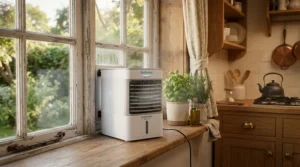
6. BLACK+DECKER BD08WT6 — simplest controls
This model is rated to cool up to 350 sq ft, with three cooling speeds, three fan speeds and a remote. It is the “no surprises” option: a recognizable brand, a basic feature list and almost nothing that can go wrong.
Simplicity helps at a cottage because you may be the only person who ever troubleshoots it. There is no app to pair, no firmware, no menu. The trade-off is less control: no inverter, no fancy airflow modes.
The thing to check is that the unit you order is the window model, as the brand also sells portable air conditioners at the same BTU rating. Confusing the two is a common buying mistake. I could not verify review counts for this specific model, so read recent buyer feedback before ordering.
Pros:
- ✅ Straightforward controls and remote
- ✅ Recognizable brand with accessible service
- ✅ Three speeds for fine-tuned airflow
Cons:
- ❌ No inverter, so louder on and off cycles
- ❌ Easy to confuse with the brand’s portable units
Price range: around C$350–C$500. Verdict: reliable pick for plug-it-in-and-forget-it cottages.
7. LG 8,000 BTU Window AC — familiar brand, broad availability
LG’s window unit is rated for about 350 sq ft and appears in multiple 2026 roundups. The brand is widely stocked across Canadian retailers, so parts, manuals and service information are easy to find, a real advantage when your cottage is three hours from the nearest appliance depot.
Exact features vary by model year and retailer, so compare the listed model numbers against the product page you actually buy from. Some LG window units add Wi-Fi control. In most cottages with no internet, that feature will sit idle, so do not pay extra for it unless you have reliable connectivity.
Because I could not verify detailed review data for the exact model, treat the brand’s reputation as supporting evidence, not proof of this unit’s performance.
Pros:
- ✅ Widely stocked across Canadian retailers
- ✅ Brand support documents are easy to find
- ✅ Suitable for typical 30 m² rooms
Cons:
- ❌ Wi-Fi extras may go unused at cottages
- ❌ Priced above some equivalent value models
Price range: around C$450–C$650. Verdict: sensible if you prefer a mainstream brand.
How to Choose the Best Window Air Conditioner for Cottage Use
A good choice starts with matching the machine to the building. Follow these seven steps:
- Measure the room first. Multiply length by width. An 8000 BTU unit suits roughly 28–32 m² (300–350 sq ft). Natural Resources Canada warns that an oversized air conditioner is less effective and wastes energy, so do not assume bigger is better.
- Check your window opening dimensions. Measure width and height of the opening with the sash raised, and compare them with the unit’s published range (see the dedicated section below).
- Confirm your electrical limits. Find out what size breaker or fuse serves the outlet and what else shares it.
- Look for an ENERGY STAR label. NRCan states that certified room air conditioners use about 10 per cent less energy than standard models.
- Prioritize noise if the unit cools a bedroom. Inverter units run more quietly because they vary compressor speed.
- Think about weight. At around 25 kg, many units need two people and an outdoor support bracket.
- Plan for seasonal removal. A unit that is easy to lift out and store will last longer than one you leave to freeze.
If you only follow one rule, make it step three. Cooling capacity is easy to fix. Wiring is not.

Window Opening Dimensions: How to Measure and Fit Your Unit
Window opening dimensions are the number-one reason cottage installs go wrong. Standard window kits, including the Frigidaire FAA086P7A’s published range, assume a vertical sash between 58 and 91 cm wide and at least 36 cm tall. Older cottage windows rarely follow the script.
Here is the measuring routine. Raise the sash fully and measure the width between the side jambs, then the height from the sill to the top of the opening. Write both down in centimetres and inches, because most spec sheets use inches. Add a note on the sill depth, since deep window sills on log cottages change how the unit tilts. Window air conditioners need a slight outward tilt so condensate drains outside, so check that the sill is level and strong.
Three common problem windows:
- Casement or crank-out windows. Standard kits will not work. Consider wall-mount sleeves or a different cooling approach.
- Sliding windows. The Garrison reviewer’s plexiglass-and-wood solution works, but seal edges well against rain and insects.
- Narrow windows under 58 cm. Look at narrower “slim” units or install a custom panel.
Whatever the window, secure the unit with the supplied brackets and add an exterior support if it overhangs significantly. A 25 kg unit sitting on an old sill is a dropped-appliance story waiting to happen.
Seasonal Removal and Storage: Closing the Cottage Without Killing Your AC
Seasonal removal and storage matter more at a cottage than anywhere else, because winter is the real enemy. Freezing temperatures, rodents and a sealed, unheated building are hard on a compressor and a plastic chassis.
Thanksgiving weekend is the traditional closing time, so here is the routine, in order:
- Unplug and let it dry. Run the fan-only mode for an hour to dry the coil first.
- Remove it with a helper. Two people, one on each side, keep it level.
- Clean it. Wash the filter, vacuum dust from the front grille, and gently brush the coil fins without bending them.
- Drain residual water. Tilt gently toward the drain side outdoors.
- Seal and store upright. Keep the unit upright, since tilting can move compressor oil into the wrong places.
- Choose a safe place. A heated closet at home is best. If it must stay at the cottage, use a sealed plastic bin or heavy bag inside a rodent-proof space.
- Close the gap. Seal the empty window opening with a proper panel, insulation and weatherstripping.
Do not leave it in the window all winter. Besides the freeze risk, an exposed unit is a draft source and an easy target for break-ins. Treat removal as part of the cost of ownership, and choose a lighter model if your back will be the one hauling it.
15-Amp Circuit Limits: What Your Cottage Wiring Can Really Handle
This is the section most buyers skip, and the one that should not be skipped. In Canada, most household receptacle circuits are 15 A at 120 V, and manufacturer manuals for window units routinely call for a dedicated single-outlet circuit protected by a 15-amp time-delay fuse or breaker.
Do the arithmetic. Using EER figures from published specs, an 8000 BTU unit with a 12.0 EER draws about 667 W, or roughly 5.6 A while running. A model with a 9.5 EER draws about 842 W, or about 7 A. Those are running estimates, and the compressor draws more for a moment when it starts. Danby’s manuals for similar models list nameplate draws near 11 A or less, which is the number to plan around.
The usual 80 per cent guideline for continuous loads leaves about 12 A on a 15 A circuit, or around 1,440 W. That means the air conditioner plus a 1,500 W kettle, space heater or hair dryer on the same circuit is a tripped breaker waiting to happen.
Practical rules:
- Use a dedicated circuit if possible.
- Never daisy-chain power bars or ordinary extension cords. If a cord is necessary, the manuals say to use only an approved “air conditioner” cord.
- Warm outlets or flickering lights mean stop and call a licensed electrician.
- If you run a generator, check its continuous wattage rating first.
The Canadian Electrical Code governs how circuits are installed, and local inspectors enforce it. When in doubt, ask a qualified electrician, because older cottage wiring may not match modern assumptions.
Real-World Scenarios: Matching the 8000 BTU Window AC for Small Cottage Use to Your Life
Specs are abstract. Here are three typical cottage profiles and the logic that fits each.
Scenario 1: The weekend family cabin. A 28 m² cabin used about 25 weekends a year, with no internet and a single 15 A panel feed. The best fit is a basic, low-complexity unit such as the Garrison 8000 BTU Electronic or the BLACK+DECKER BD08WT6, with the 24-hour timer or remote set to pre-cool. Budget stays low, and the main priority is a dedicated circuit.
Scenario 2: The retired couple who stay from June to September. Nightly use, light sleepers, and a bedroom with a standard double-hung window. Here the Midea 8,000 BTU U-Shaped Smart Inverter earns its price. Quiet nights and lower running demand are worth more than saving a few hundred dollars.
Scenario 3: The rental cottage with changing guests. Durability and service access matter. The Danby DAC080EB6WDB or LG 8,000 BTU Window AC fit because documentation, parts and support are easy to find, and a 24-hour timer limits guests who leave it running overnight with the door open.
Each profile follows the same logic: choose the electrical fit first, the window fit second, and the extras last.
Features That Actually Matter (And Those That Don’t)
Marketing loves feature lists. Cottage life is much pickier.
Features that matter:
- Inverter or variable-speed compressor. Quieter and more efficient, according to NRCan guidance.
- Published window dimensions. Saves failed installs.
- Washable filter. Dusty cottages clog filters quickly.
- 24-hour timer. Lets you pre-cool a room before you arrive.
- Rust-resistant casing. Humid lakeside air is rough on metal.
Features you can skip:
- Wi-Fi control if the cottage has no reliable internet.
- Ionizers. Marketing claims outpace practical benefits for most users.
- Fancy remote modes you will never touch after the first day.
The simplest summary is this: pay for quiet and fit, not for apps. A unit that stays lighter and simpler also makes your seasonal removal and storage routine easier.

What to Expect: Real-World Performance in a Small Cottage
An 8000 BTU unit does not turn a cottage into a freezer. It brings a hot room down to comfortable, and the key word is “room.” Heat leaks matter more than horsepower. Poorly insulated walls, a metal roof in July sun, and a west-facing window can overwhelm the unit.
A few honest expectations. Cooling is strongest near the unit and fades down a long hallway. A closed door between the AC room and the rest of the cottage helps a lot. Rooms with high ceilings or vaulted pine boards need more capacity than the square footage suggests, a point that ENERGY STAR guidance echoes with its higher CADR advice for taller spaces.
Condensation also surprises people. The unit removes humidity, and that water has to go somewhere, so make sure the slight outward tilt is set properly. Starting the unit before the afternoon heat peaks makes a visible difference, and the manuals for Danby units say as much: start it before the outdoor air gets hot, so the unit is not fighting an already-baked room.
8000 BTU Window AC vs Portable, Mini-Split and Fans for Cottage Use
| Option | Cooling Power | Install Effort | Typical Cottage Fit | Best For |
|---|---|---|---|---|
| 8000 BTU window AC | Strong for one room | Moderate, removable | Standard windows | Seasonal cottages |
| Portable AC (e.g., BLACK+DECKER 8,000 BTU portable) | Often weaker in practice | Easy but needs venting | Casement or odd windows | Renters, odd windows |
| Mini-split heat pump | Strong, efficient | Professional install | Year-round cottages | Four-season use |
| Fans only | Minimal | None | Very mild climates | Tiny budgets |
Window units usually beat portables in efficiency, because a portable draws indoor air and exhausts it, pulling warm replacement air in through gaps. A mini-split wins on efficiency and quiet but costs far more and needs a licensed installer. For a seasonal cottage that closes in October, the removable window unit is usually the most sensible balance.
In short, if you use the cottage for months at a time and plan to keep it for a decade, the mini-split pays back. If you use it a few summer weekends and want a low upfront cost, an 8000 BTU window unit comfortably wins.
Long-Term Cost and Efficiency: Reading the Energy Label
Total cost of ownership is more than the sticker price. NRCan says ENERGY STAR certified room air conditioners use about 10 per cent less energy on average, and Canadian regulations set minimum efficiency standards for all room air conditioners. You can read the NRCan room air conditioner guidance and the NRCan guide to room air conditioners for the full details.
Consider the running cost logic. A 12.0 EER unit draws roughly 667 W against about 842 W for a 9.5 EER model. Over a cottage season of, say, 400 hours of use, that gap is around 70 kWh, a modest but real saving that grows if you rent the place out or run it daily.
A washable filter helps ongoing costs, since you are not buying replacements. The big hidden cost is a short lifespan caused by poor storage: a unit left to freeze in a window may need replacing years early. Add the cost of an extension or electrical upgrade if your wiring is marginal.
Common Mistakes When Buying an 8000 BTU Window AC for Small Cottage Use
A few errors show up again and again.
Buying by BTU alone. Capacity is only one spec. Window fit and electrical fit are equally important.
Ignoring the circuit. A beautiful unit on a shared 15 A circuit with a kettle is a recipe for darkness.
Confusing portable and window models. Brands sell both at the same BTU rating, and listings are easy to mix up.
Skipping weatherproofing. Gaps around a window kit let in wasps, mice and cold drafts. Use the supplied foam, then add proper weatherstripping.
Leaving it in over winter. Cold, moisture and rodents do silent damage.
Chasing smart features. A Wi-Fi unit is a clever tool when the network exists, and a paperweight feature when it does not.
Oversizing. A 12,000 BTU unit in a 30 m² room short-cycles, leaves the air clammy and wastes energy, as NRCan notes.
Best Window Air Conditioner for Cottage Buyers: A Decision Framework
Use these if-then rules to decide quickly.
- If you sleep light, choose the Midea. The Midea 8,000 BTU U-Shaped Smart Inverter has the quietest design on this list.
- If you want the lowest sensible price, choose the Garrison or TOSOT. The Garrison 8000 BTU Electronic and TOSOT GJC08BK-A6NRNC5D keep cost down with solid basics.
- If you want published fit specs, choose the Frigidaire. The Frigidaire FAA086P7A lists clear window dimensions.
- If safety listing matters most, choose the Danby. The Danby DAC080EB6WDB is listed as meeting ETL standards for Canada and the U.S.
- If simplicity is your top priority, choose the BLACK+DECKER. The BLACK+DECKER BD08WT6 has the shortest learning curve.
- If you prefer a mainstream brand, choose the LG. The LG 8,000 BTU Window AC is easy to find and service.
Whatever you choose, confirm three numbers before you click buy: window width, window height and breaker size.

FAQ
❓ How many square feet will an 8000 BTU window AC cool?
❓ Can I plug a window air conditioner into a regular cottage outlet?
❓ Will an 8000 BTU window AC fit a small cottage window?
❓ Should I leave my window AC in over winter at the cottage?
❓ Is an inverter window AC worth it for a cottage?
Conclusion
The best 8000 BTU window AC for small cottage use is not the most expensive one. It is the one that fits your window, respects your breaker and survives being hauled in and out every year.
For quiet nights and a window you can still open, the Midea 8,000 BTU U-Shaped Smart Inverter stands out. For tight budgets, the Garrison 8000 BTU Electronic and TOSOT GJC08BK-A6NRNC5D deliver the basics. The Frigidaire FAA086P7A, Danby DAC080EB6WDB, BLACK+DECKER BD08WT6 and LG 8,000 BTU Window AC round out solid middle-ground choices, each with a different strength.
Before you buy, measure your window, check your circuit and plan your seasonal removal and storage routine. Do those three things, and your cottage will stay comfortable long after the long weekend ends.
✨ Ready to beat next summer’s heat?
🔍 Check current pricing and availability on your favourite pick today, and enjoy a cooler, calmer cottage season!
Recommended for You
- Smart WiFi Ductless AC For Cottage: 7 Best Picks For 2026
- 12000 BTU Ductless AC For Cottage: 7 Proven Picks 2026
- Portable Generator And Cooler Combo For Camping: 7 Proven Picks 2026
Disclaimer: This article contains affiliate links. As an Amazon Associate, I earn from qualifying purchases. If you purchase products through these links, we may earn a small commission at no additional cost to you.
✨ Found this helpful? Share it with your friends! 💬🤗
