
In This Article
Working outside during Canadian summers presents unique challenges that many people underestimate. While we’re not dealing with the searing heat of Arizona or Texas, summer temperatures in cities like Toronto, Calgary, and Vancouver regularly climb above 30°C (86°F), and when you factor in humidity, the risk of heat illness becomes very real. What most Canadian outdoor workers don’t realize is that heat stress can occur at surprisingly moderate temperatures—especially when you’re performing physical labour for extended periods.
Heat stress happens when your body can’t cool itself effectively through sweating and blood circulation. According to the Canadian Centre for Occupational Health and Safety (CCOHS), heat-related illnesses are preventable but remain a serious workplace hazard. The body’s core temperature regulation system gets overwhelmed when environmental heat, physical exertion, and inadequate cooling combine. For construction workers, landscapers, delivery drivers, and warehouse workers across Canada, understanding how to stay cool working outside in summer isn’t just about comfort—it’s about safety and productivity.
Canadian workplace regulations under the Occupational Health and Safety Act require employers to take reasonable precautions against heat stress, but as an individual worker, you need personal strategies too. The key is layering multiple cooling approaches: from wearable technology and hydration systems to smart clothing choices and work schedule adjustments. This guide breaks down the most effective solutions available to Canadian workers in 2026, with products you can actually buy on Amazon.ca and practical advice that works in our specific climate conditions.
Quick Comparison: Top Cooling Solutions for Canadian Outdoor Workers
| Solution Type | Cooling Duration | Price Range (CAD) | Best For | Maintenance |
|---|---|---|---|---|
| Ice Pack Cooling Vest | 2-4 hours | $50-$90 | Construction, landscaping | Requires freezer access |
| Evaporative Cooling Towel | 2-3 hours | $15-$35 | All outdoor work | Simple water reactivation |
| Portable Neck Fan | 3-8 hours | $25-$65 | Warehouse, delivery | USB rechargeable |
| Wide-Brim Sun Hat | All day | $20-$55 | Any outdoor work | Hand wash |
| Electrolyte Powder | Per serving | $25-$60 (30-pack) | High-exertion work | Mix with water |
| Hydration Pack | All day | $30-$80 | Mobile workers | Weekly cleaning |
| Cooling Bandana | 1-2 hours | $10-$25 | Light work | Water soak |
💬 Just one click — help others make better buying decisions too! 😊
Top 7 Cooling Products for Canadian Outdoor Workers: Expert Analysis
1. YLNEWWAYS Ice Pack Cooling Vest
The YLNEWWAYS vest represents the gold standard for aggressive cooling when you’re working in full sun during peak summer heat. This vest uses 24 replaceable ice packs inserted into front and back pockets, creating a cooling envelope around your core. The key specification here is the dual-zone coverage: 6 pockets strategically placed to cool major blood vessels in your chest and back, which is significantly more effective than single-zone systems.
What Canadian buyers need to understand about this vest is its real-world performance in our climate. At temperatures between 28-35°C (82-95°F)—common during Ontario and Quebec heat waves—the ice packs maintain cooling for approximately 2.5 to 3.5 hours of active labour. That’s genuinely enough for a morning shift before lunch break, when you can swap in fresh packs from a cooler. The reflective strips aren’t just visibility features; they’re crucial for outdoor workers who need to stay cool but also need to be seen on job sites or roadways.
The vest includes both gel-based and polymer-based ice packs. Most users don’t realize these serve different purposes: gel packs deliver immediate intense cooling (ideal for the start of your shift), while polymer packs provide gentler, longer-lasting relief (better for the second half of your workday). Canadian reviewers consistently mention that in our typically lower humidity compared to coastal U.S. states, the vest doesn’t create uncomfortable condensation—a major advantage.
Pros:
✅ Adjustable fit accommodates safety vests worn over top
✅ Machine-washable outer shell (remove packs first)
✅ Includes bubble bags to moderate cooling intensity
Cons:
❌ Requires freezer access or cooler with ice
❌ Bulkier than evaporative alternatives
Price: Around $60-$85 CAD. At this price point, you’re getting professional-grade cooling that pays for itself in increased comfort and reduced heat stress risk over a single Canadian summer season.
2. FROGG TOGGS Chilly Pad Cooling Towel
The FROGG TOGGS Chilly Pad is the workhorse cooling towel that’s become standard equipment for landscapers, roofers, and outdoor workers across Canada. Unlike microfiber alternatives, this uses PVA (polyvinyl alcohol) material that holds significantly more water and stays cooler longer—particularly important during those humid summer days in Halifax or Vancouver when regular evaporative cooling struggles.
Here’s what the specifications don’t tell you: at 69 cm x 33 cm (27″ x 13″), this towel is sized specifically to wrap around your neck with enough length to drape down your back, cooling the major blood vessels in your neck and upper spine. That targeted cooling affects your entire body temperature more effectively than a smaller towel cooling just your forehead. In practical Canadian conditions—say, working outdoors in 30°C heat with 60% humidity—expect 90 to 120 minutes of cooling before you need to re-wet it.
The activation process matters more than most people realize. Simply running it under a tap doesn’t maximize performance. For optimal results with Canadian municipal water (which runs colder than in warmer climates), soak for 3-5 minutes, wring out excess, then snap it sharply 3-4 times. This activates the evaporative cooling mechanism properly. One underrated advantage in our climate: when temperatures drop in the evening (common in Alberta and B.C.), the towel can be quickly dried and stowed, unlike gel-based products that stay bulky.
Pros:
✅ Reactivates instantly with water—no freezing required
✅ Compact storage in included carry case
✅ Works effectively in high humidity
Cons:
❌ Requires regular re-wetting in extreme heat
❌ Can feel stiff when dry (normal for PVA)
Price: Typically $20-$30 CAD. This represents exceptional value for Canadian workers who need reliable cooling without depending on freezer access.
3. JISULIFE Portable Bladeless Neck Fan
The JISULIFE neck fan is the hands-free cooling solution that’s revolutionized comfort for warehouse workers and delivery drivers across Canada. This isn’t your basic handheld fan—it’s an ergonomically designed wearable device with 72 air outlets providing 360° airflow coverage. The 4000mAh battery specification translates to 4-8 hours of actual runtime depending on speed setting, which means it can handle a full shift for most Canadian outdoor workers.
What makes this particularly effective for our climate is the bladeless design combined with the TPE (thermoplastic elastomer) neck band. Traditional bladed fans can catch hair and create safety concerns, but more importantly for Canadian summers, the distributed airflow from 72 small outlets creates better evaporative cooling than a single concentrated air stream. When you’re sweating during physical work in Toronto’s summer humidity, that distributed airflow accelerates moisture evaporation across your neck, face, and upper chest simultaneously.
The three-speed settings aren’t just about comfort preferences—they’re about matching cooling to exertion level. Low speed (using minimal battery) works for lighter tasks or when you’re in partial shade. High speed (draining battery faster but delivering maximum cooling) is for full-sun heavy labour. Most Canadian users report that medium speed offers the sweet spot for typical outdoor work conditions. At just 250 grams (8.8 oz), you genuinely forget you’re wearing it after 10 minutes.
Pros:
✅ USB-C charging compatible with power banks
✅ Quiet operation under 25 decibels
✅ Adjustable to fit over safety equipment
Cons:
❌ Battery life decreases in very hot conditions
❌ Not suitable for dusty environments (can clog vents)
Price: Around $35-$55 CAD. For workers who can’t use vests or towels due to job requirements, this delivers cooling that significantly reduces perceived temperature.
4. Home Prefer Wide-Brim UPF 50+ Sun Hat
Sun protection is cooling protection—a principle many Canadian outdoor workers learn the hard way after a day of roofing or paving work. The Home Prefer hat features a 11.5 cm (4.5″) brim all around, which provides genuine shade for your face, ears, and critically, the back of your neck. That UPF 50+ rating means it blocks 98% of UV radiation, but more importantly for staying cool, it reduces radiant heat absorption by your head and upper body.
The construction details matter significantly in Canadian conditions. The mesh crown panels create airflow ventilation that actually works—unlike solid-crown hats that trap heat. When you’re working in Saskatchewan summer sun where the humidex can hit 40+, that ventilation prevents the greenhouse effect that makes your head overheat. The moisture-wicking sweatband is polyester-based rather than cotton, which means it continues pulling sweat away from your skin even when saturated—crucial during multi-hour shifts.
Canadian buyers often overlook the adjustable rear drawstring and chin strap. These aren’t just for windier days; they ensure the hat stays positioned correctly during physical work. A hat that slips backwards doesn’t shade your face, and one that tips forward blocks your vision—both safety issues on job sites. The removable neck flap adds 15-20 cm of additional coverage for the back of your neck and shoulders, which are prime burn zones for construction and landscaping workers.
Pros:
✅ Packable design for storing in work bag
✅ One size fits most with adjustment system
✅ Water-resistant fabric for surprise rain showers
Cons:
❌ Wide brim can limit peripheral vision (be aware on active sites)
❌ Neck flap can feel warm in very high humidity
Price: In the $25-$45 CAD range. This is prevention equipment—invest in proper head protection and you’ll work more comfortably and safely all summer.
5. Liquid I.V. Hydration Multiplier Electrolyte Powder
Hydration isn’t just about water volume—it’s about electrolyte balance, and that’s where most Canadian outdoor workers fall short. Liquid I.V. uses Cellular Transport Technology (CTT), which is a science-backed sodium-glucose co-transport system that delivers water and nutrients to your bloodstream faster than water alone. Each stick contains 500mg sodium and 370mg potassium, which approximates what you lose through 60-90 minutes of heavy sweating in typical Canadian summer conditions.
Here’s the critical insight for outdoor workers: plain water can actually dilute your blood sodium levels if you’re sweating heavily, leading to hyponatremia—a dangerous condition that mimics heat exhaustion symptoms. The 11 grams of sugar in each Liquid I.V. stick isn’t there for taste (though it helps); it’s the glucose required for the sodium-glucose co-transport mechanism to work. When you’re doing physical labour in 30°C heat, your body needs that glucose for energy and electrolyte absorption.
For Canadian workers, the individual stick format is ideal. Each stick makes 475ml (16 oz) of drink, which fits perfectly into a standard water bottle. Unlike large tub formats, sticks don’t require scooping in dirty work environments, and they’re portioned correctly—many workers over-concentrate powder from tubs, which can cause stomach upset. The variety pack (lemon-lime, strawberry, passion fruit) matters more than you’d think; flavour fatigue is real when you’re drinking 2-3 bottles per shift, and variety helps you stay consistent with hydration.
Pros:
✅ NSF Certified for Sport (tested for banned substances)
✅ Available at most Canadian pharmacies and Amazon.ca
✅ Works in both cold and room-temperature water
Cons:
❌ Contains 11g sugar per serving (not ideal for diabetics)
❌ More expensive per serving than basic electrolyte drinks
Price: Around $35-$50 CAD for a 30-pack. At roughly $1.50 per serving, it’s pricier than homemade electrolyte solutions but significantly more convenient and consistently formulated.
6. CamelBak Classic Hydration Pack
The CamelBak Classic solves the fundamental problem of staying hydrated during mobile outdoor work: you need water accessible without stopping your tasks. This 2.5-litre reservoir system sits in a lightweight backpack with a drinking tube that clips to your shoulder strap, making hydration literally as easy as turning your head and biting the valve. For delivery drivers, utility workers, and anyone moving across a job site repeatedly, this eliminates the “I’ll drink when I get back to my truck” procrastination that leads to dangerous dehydration.
The 2.5L capacity is specifically sized for Canadian work realities. In 25-30°C heat doing moderate physical work, most adults need 500-750ml of fluid per hour. That gives you 3-4 hours of work before needing a refill—perfect for a morning or afternoon shift segment. The reservoir uses medical-grade materials that don’t impart plastic taste even when filled with warm water, which is inevitable when working outdoors. The wide opening makes refilling and adding ice cubes easy, and more importantly for Canadian workers, allows thorough cleaning to prevent bacteria growth.
The pack itself has a breathable mesh back panel, which significantly reduces the “sweaty back” effect common with solid-backed packs. You’ll still sweat where the pack contacts you, but the airflow channels minimize heat retention. The chest and waist straps aren’t optional extras—they distribute the 2.5 kg of water weight properly across your torso, preventing the pack from bouncing when you’re climbing ladders, bending repeatedly, or working on uneven ground.
Pros:
✅ Hands-free hydration during active work
✅ Magnetic tube clip for easy access
✅ Reservoir dishwasher-safe (top rack only)
Cons:
❌ Requires regular cleaning to prevent mold
❌ Adds some weight and heat to your back
Price: Around $50-$75 CAD. For mobile outdoor workers, this pays for itself in improved hydration compliance and reduced heat stress incidents within weeks.
7. Ergodyne Chill-Its Evaporative Cooling Bandana
The Ergodyne Chill-Its bandana is the minimalist solution for workers who need cooling without bulk or battery dependence. This polymer-crystal-filled bandana activates by soaking in water for 5-10 minutes, where the crystals absorb 200-300 times their weight in water. Once activated, it provides 2-4 hours of evaporative cooling when tied around your head, neck, or wrist—wherever you need it most.
What makes this particularly valuable for Canadian outdoor workers is its versatility across different work environments. In low-humidity conditions (common in Alberta and interior B.C.), evaporative cooling works extremely efficiently, and this bandana can feel dramatically cool for the full duration. In high-humidity Maritime provinces, it still provides cooling but works more through conductive cooling (direct contact with the cooler, water-saturated fabric) rather than pure evaporation. Either way, you’re getting relief.
The polymer crystal technology has a significant advantage over regular wet cloths: water release is controlled and sustained. A regular wet bandana might feel cool for 30 minutes before drying out, but the Chill-Its design regulates moisture release to maintain cooling for hours. For Canadian workers concerned about appearance on client-facing jobs, the bandana comes in various colours including professional navy and black options—not just construction orange.
Pros:
✅ Reusable hundreds of times with proper care
✅ Can be worn multiple ways (head, neck, wrist)
✅ Weighs almost nothing when dry for transport
Cons:
❌ Takes 5-10 minutes to fully activate
❌ Needs thorough drying between uses to prevent mildew
Price: Typically $12-$20 CAD. This is an excellent supplementary cooling tool that works alongside other solutions without conflicting or adding bulk.
How to Create Your Personal Heat Safety Plan for Canadian Summers
Every outdoor worker needs a structured approach to summer heat management—random cooling measures aren’t enough when temperatures climb and humidity soars. Start by assessing your specific risk factors: work intensity level, typical exposure duration, your acclimatization status, and access to facilities (coolers, shade, water sources). Construction workers on exposed sites face different challenges than delivery drivers with vehicle access, and your heat safety plan should reflect those realities.
Week 1-2 Acclimatization Protocol: If you’re starting outdoor work in summer or returning after time off, your body needs gradual heat adaptation. Begin with 50% of normal work intensity or duration for the first 3 days, increasing by 20% daily until you reach full capacity by day 7. Canadian research shows most heat-related incidents occur during the first week of hot weather or when workers return after absence—your body’s cooling mechanisms need training just like muscles do.
Daily Preparation Checklist: Pre-shift hydration is crucial. Drink 500-750ml of water with electrolytes 2 hours before starting work. This gives your kidneys time to process it and your body time to distribute hydration properly. Pack your cooling gear the night before: freeze your vest ice packs, charge your neck fan, fill your hydration pack, and prep your electrolyte drink mixes. Morning-of scrambling leads to forgotten equipment and skipped protective measures.
On-the-Job Monitoring: Use the buddy system religiously—you might not notice your own heat stress symptoms while focused on work, but a coworker can spot the warning signs. Watch for decreased sweat production (paradoxically indicating severe heat stress), confusion, dizziness, or unusual fatigue. Set phone alarms for hydration breaks every 45-60 minutes rather than relying on thirst—by the time you feel thirsty, you’re already mildly dehydrated. During breaks, actively cool down: move to shade, remove your hard hat or heavy gear, and use your cooling towel or vest.
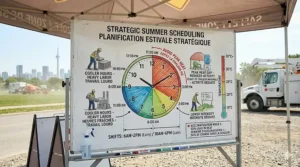
Environmental Awareness: Check the humidex forecast, not just temperature. A 28°C day with high humidity is more dangerous than a 32°C day with low humidity because sweat won’t evaporate effectively. Plan heavier physical tasks for morning hours (before 11 AM) or late afternoon (after 4 PM) when possible. If you must work during peak heat (11 AM – 3 PM), increase break frequency by 50% and reduce work intensity by 20-30%.
Real-World Scenarios: Matching Cooling Solutions to Canadian Work Environments
Scenario 1: Construction Worker – Toronto Summer Marcus works residential framing in the GTA, typically 7 AM to 4 PM through July and August when temperatures regularly hit 30-32°C with 70% humidity. His optimal setup: YLNEWWAYS ice pack vest worn under his safety vest during peak heat hours (11 AM – 2 PM), FROGG TOGGS cooling towel around his neck during morning and late afternoon, Home Prefer sun hat throughout the day, and CamelBak hydration pack with Liquid I.V. electrolytes. Total investment: around $200 CAD. The ice pack vest requires a cooler in his truck with ice packs rotated at lunch break, but the aggressive cooling during peak heat hours prevents the accumulated heat stress that often hits by 2-3 PM. For Marcus, the vest isn’t luxury—it’s the difference between finishing his day strong versus struggling through the last two hours.
Scenario 2: Landscaper – Calgary Environment Priya runs a landscaping crew working across Calgary suburbs, where summer days can swing from 25°C mornings to 35°C+ afternoons, but with characteristically low humidity (30-40%). Her crew uses FROGG TOGGS cooling towels extensively—in Calgary’s dry air, evaporative cooling works exceptionally well, often providing 2+ hours of effective cooling per soaking. Each crew member has a Home Prefer sun hat and carries a 1-litre water bottle with Liquid I.V. powder. The JISULIFE neck fans get deployed during the most physically demanding tasks (sod laying, heavy digging) but aren’t worn continuously to conserve battery. Total per-person cost: around $100 CAD. In Priya’s experience, the dry Alberta climate means they don’t need the aggressive cooling of ice vests—smart use of shade, frequent water breaks, and evaporative cooling handles most situations effectively.
Scenario 3: Warehouse Worker – Non-Climate-Controlled Facility, Southern Ontario James works in a large distribution warehouse outside Hamilton that isn’t air-conditioned. Summer indoor temperatures reach 32-35°C with poor ventilation. His solution centers on the JISULIFE neck fan, which he wears throughout his shift with a spare battery for extended days. He combines this with the Ergodyne cooling bandana worn around his head, and keeps a FROGG TOGGS towel in his locker for break room cooling (soaked in cold water from the break room sink). He uses a 750ml insulated water bottle refilled every 90 minutes with Liquid I.V. The neck fan is crucial—warehouse work involves constant movement but often with obstacles that make vests impractical. Total cost: around $75 CAD. The key insight: James doesn’t try to eliminate heat (impossible in his environment) but manages it continuously through sustained moderate cooling rather than aggressive short-term interventions.
Understanding Heat Illness: Canadian Worker’s Guide to Warning Signs
Heat illness progresses through distinct stages, and recognizing early symptoms can prevent serious medical emergencies. Heat cramps are usually the first warning—muscle spasms in legs, arms, or abdomen during or after work. These signal electrolyte imbalance, typically from sweating heavily while only replacing fluids with plain water. The solution: stop work immediately, move to shade, and drink electrolyte solution (sports drinks or Liquid I.V.). Don’t massage cramping muscles; let them relax naturally while rehydrating.
Heat exhaustion is the second stage and significantly more serious. Symptoms include heavy sweating, pale or flushed skin, rapid weak pulse, nausea, dizziness, and headache. Core body temperature rises to 38-39°C (100-102°F). Many Canadian workers mistake this for “just being tired” and push through—don’t. Heat exhaustion requires immediate action: stop all work, move to the coolest available location, remove excess clothing and equipment, drink water with electrolytes, and apply cool wet cloths to neck, armpits, and groin. Recovery takes 30-60 minutes minimum. Returning to work too quickly often leads to heat stroke.
Heat stroke is a medical emergency requiring immediate professional help. Symptoms include confusion or altered consciousness, hot dry skin (sweating may have stopped), rapid strong pulse, and core temperature above 40°C (104°F). The person may seem drunk, aggressive, or unresponsive. Call 911 immediately, move the person to shade or air conditioning, remove outer clothing, and cool them with whatever means available—wet towels, fans, or even a cold water hose if necessary. Heat stroke can cause permanent organ damage or death within minutes to hours if untreated.
Canadian occupational health regulations require employers to have emergency response plans for heat illness, but as a worker, you need to know these symptoms and act on them immediately. The “tough it out” mentality that might be acceptable for muscle soreness has no place in heat illness—the progression from heat exhaustion to heat stroke can happen in under an hour, and once you’re at the heat stroke stage, you may not be able to recognize your own symptoms or call for help.
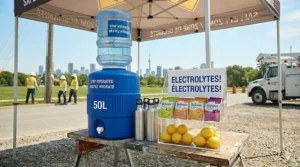
Workplace Rights and Employer Obligations Under Canadian Law
Under the Occupational Health and Safety Act (OHSA) applicable across Canadian provinces with minor variations, employers must take “every reasonable precaution” to protect workers from heat stress. This isn’t optional—it’s law. Reasonable precautions include providing access to cool drinking water, allowing unscheduled breaks when workers feel overheated, providing shade or cooling areas for breaks, and training workers to recognize heat illness symptoms.
Canadian workers have the legal right to refuse unsafe work under Section 43 of the Canada Labour Code (federal workers) or equivalent provincial legislation. If you believe working conditions present an imminent danger due to extreme heat, you can exercise your right to refuse—but you must follow proper procedures: notify your supervisor immediately, explain your concern specifically (referencing temperature, humidity, lack of breaks, or other factors), and remain available while the situation is assessed. Your employer cannot punish you for exercising this right in good faith.
The Canadian Centre for Occupational Health and Safety (CCOHS) recommends that employers implement formal heat stress programs when work environments regularly exceed certain thresholds. While exact temperatures vary by jurisdiction, generally any outdoor work when temperatures exceed 30°C (86°F) or indoor work above 26°C (79°F) should trigger enhanced protection measures. These should include scheduling heavy work during cooler hours, mandatory rest breaks, acclimatization protocols for new workers, and provision of cooling equipment.
As a worker, document heat-related concerns: note dates, temperatures, symptoms experienced, and any cooling measures provided or lacking. If your employer isn’t taking reasonable precautions, you can contact your provincial labour department or occupational health and safety authority anonymously. Resources include CCOHS (1-800-668-4284), provincial MOL offices, or online reporting systems. Remember, reporting safety violations protects you and your coworkers—heat illness incidents are almost always preventable with proper protocols.
Common Mistakes Canadian Outdoor Workers Make in Summer Heat
Mistake #1: Relying Solely on Water Without Electrolytes This is perhaps the most dangerous error. When you’re sweating heavily, you lose sodium, potassium, and other electrolytes faster than water alone can replace them. Drinking 4-5 litres of plain water during a hot work shift can actually dilute your blood sodium to dangerous levels (hyponatremia), causing symptoms identical to heat exhaustion: nausea, confusion, weakness. The fix: alternate plain water with electrolyte drinks. A practical ratio is 2:1—two bottles of water for every one bottle with electrolytes. Products like Liquid I.V., Nuun, or even homemade solutions (1L water + ¼ tsp salt + 2 tbsp sugar + squeeze of lemon) keep your electrolyte balance safe.
Mistake #2: Saving Cooling Measures for “When It Gets Really Bad” Heat stress is cumulative—your body temperature rises gradually through the day, and once you’re overheated, it’s significantly harder to cool down than to prevent overheating in the first place. Workers who skip their cooling vest in the morning “because it’s only 25°C” often find themselves dangerously overheated by 2 PM when it’s 32°C and they’re already carrying hours of accumulated heat stress. Start your cooling measures at the beginning of your shift, not when you already feel hot. Think of it like sunscreen—you apply it before burning, not after.
Mistake #3: Ignoring Acclimatization Requirements Your body adapts to heat stress through physiological changes that take 7-14 days to develop: increased sweat production, earlier onset of sweating, more dilute sweat (conserving electrolytes), and expanded blood volume. Workers who jump into full outdoor work intensity in the first heat wave of summer without gradual acclimatization suffer heat illness at much higher rates. This is especially crucial for Canadian workers—our bodies spend 6-8 months adapted to cold conditions, and we can’t immediately handle summer heat. Start summer work at reduced intensity and build up over 1-2 weeks, or if you’ve been on vacation, ease back in gradually.
Mistake #4: Wearing Cotton When Synthetic Fabrics Are Available Cotton feels comfortable initially, but it absorbs sweat and stays wet against your skin, which prevents further evaporative cooling and can actually make you hotter once saturated. Synthetic moisture-wicking fabrics (polyester, nylon blends) pull sweat away from skin to the fabric surface where it evaporates quickly, maintaining cooling effectiveness throughout your shift. For Canadian outdoor workers, this isn’t about expensive athletic gear—even basic synthetic t-shirts from department stores outperform cotton for heat management. Light-coloured synthetics are ideal, reflecting sunlight while wicking moisture.
Mistake #5: Skipping Breaks to “Get More Done” This backfires dramatically. Heat stress reduces cognitive function, coordination, and work speed. Studies show that workers who skip breaks in hot conditions work 15-30% slower by afternoon and make significantly more mistakes. Taking scheduled 10-minute breaks every hour in shade or air conditioning actually increases overall productivity while drastically reducing injury risk. Canadian construction data shows most heat-related incidents occur in the 2-4 PM period when workers are most fatigued and overheated from skipping earlier breaks. Schedule breaks, enforce them, and use them to actively cool down—not just sit in the sun drinking water.
FAQ: Canadian Workers’ Heat Safety Questions
❓ Can I claim cooling equipment as a work expense on my Canadian taxes?
❓ Do employers in Canada have to provide cooling equipment or can I be required to buy my own?
❓ How much water should I drink per hour when working outdoors in Canadian summer heat?
❓ Are cooling vests safe to use in winter storage, or should I empty the ice packs?
❓ Can I use my cooling equipment while wearing required safety gear like hard hats and safety vests?
Conclusion: Building Your Complete Canadian Summer Work Strategy
Staying cool while working outside in Canadian summers isn’t about finding one magic solution—it’s about layering multiple evidence-based strategies that work together. The temperature might only hit 30°C (which sounds modest compared to tropical regions), but when you add Canadian humidity levels, direct sun exposure, and physically demanding work, the heat stress risk is genuine and serious. Invest in proper cooling equipment, establish structured hydration and break protocols, understand the warning signs of heat illness, and know your workplace rights under Canadian law.
For most outdoor workers, a practical starting kit includes: one quality cooling towel ($20-$30 CAD), a wide-brim UPF sun hat ($25-$45 CAD), a 30-pack of electrolyte powder ($35-$50 CAD), and an insulated water bottle. That’s roughly $100 CAD—less than one day’s lost wages from a heat-related incident. As budget allows, add a cooling vest or neck fan for peak heat conditions. Remember that the Canadian climate offers natural cooling advantages (cooler mornings and evenings, lower baseline humidity in many regions) that you can exploit through smart work scheduling and break timing.
Most importantly, communicate with your employer and coworkers about heat safety. Worker reluctance to take breaks, fear of appearing weak, or pressure to maintain productivity causes more heat illness than lack of knowledge. Create a culture where using cooling equipment and taking heat breaks is normal and expected. Your health and safety are worth infinitely more than any single day’s productivity targets. Summer heat is predictable, heat illness is preventable, and with the right knowledge and equipment, Canadian outdoor workers can stay safe, healthy, and productive all season long.
Recommended for You
- Cooling Vest vs Ice Vest Which is Better: 7 Best Canada 2026
- Best Cooling Gear for Hiking Canada 2026: 7 Must-Have Items
- 7 Best Farmer Cooling Vests Canada 2026: Beat Heat Stress
Disclaimer: This article contains affiliate links. As an Amazon Associate, I earn from qualifying purchases. If you purchase products through these links, we may earn a small commission at no additional cost to you.
✨ Found this helpful? Share it with your friends! 💬🤗
