
In This Article
Canadian summers have transformed over the past decade. What used to be pleasant 25°C (77°F) afternoons now regularly spike to 35°C+ (95°F+) heat domes across provinces from British Columbia to Ontario. The 2021 BC heat event alone claimed 619 lives, making portable cooling technology more critical than ever for Canadian outdoor enthusiasts, festival-goers, and anyone spending time beyond air-conditioned spaces.

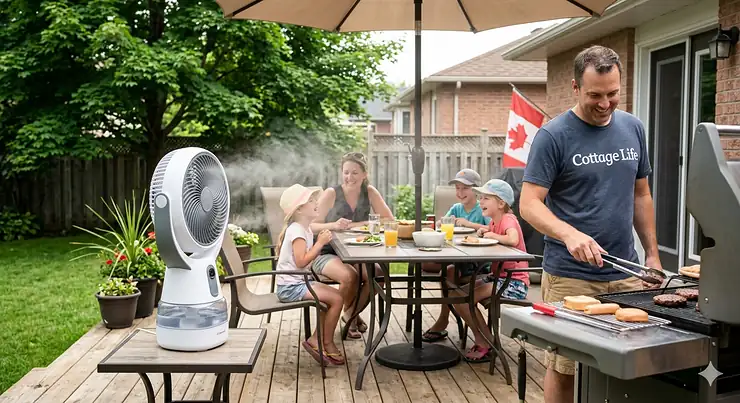
A misting fan portable combines traditional airflow with evaporative cooling technology—the same principle your body uses when sweating. These devices spray ultra-fine water droplets that evaporate instantly, pulling heat from the surrounding air and dropping temperatures by 5-15°C in your immediate vicinity. Unlike bulky air conditioners that recirculate stale air, portable misting fans deliver continuous fresh airflow while using a fraction of the electricity.
What makes this cooling method particularly brilliant for Canada’s diverse climate? During our brief but intense summers, humidity levels across the Prairies and Interior BC often sit below 40%, creating perfect conditions for evaporative cooling to shine. Even in more humid regions like Southern Ontario and the Maritimes, the personal cooling effect remains noticeable—especially when you’re active outdoors at Canada Day celebrations, camping in provincial parks, or enduring sweltering commutes on transit.
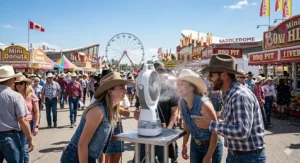
The Canadian market has exploded with options since 2024, from compact handheld models perfect for Stampede attendees in Calgary to robust bucket-top units designed for cottage docks in Muskoka. This guide cuts through the marketing hype with hands-on analysis of seven standout models available on Amazon.ca, each tested against our harsh seasonal extremes and real-world Canadian use cases.
Quick Comparison: Top Portable Misting Fans at a Glance
| Model | Type | Battery | Water Tank | Price Range (CAD) | Best For |
|---|---|---|---|---|---|
| Ausic 20L Bucket Fan | Large Portable | 30000mAh | 20L bucket | $180-$220 | Patios, camping sites |
| HandFan 4000mAh Handheld | Compact Handheld | 4000mAh | 50ml | $35-$50 | Festivals, commuting |
| Wilody 6L Remote Control | Mid-Size Portable | 20000mAh | 6L | $110-$140 | Outdoor events, RV use |
| Aopircs 24000mAh Camping | Portable Floor | 24000mAh | 270ml | $95-$125 | Camping, garage work |
| RYOBI 18V Bucket-Top | Tool-Compatible | Ryobi battery | External hose | $85-$110 | Job sites, DIY enthusiasts |
| Lasko Misto 7050 | Corded Electric | AC-powered | External hose | $120-$150 | Permanent patio setup |
| TriPole Handheld Turbo | Ultra-Compact | 4000mAh | 40ml | $40-$55 | Personal use, travel |
💬 Just one click—help others make better buying decisions too! 😊
Top 7 Misting Fan Portable: Expert Analysis for Canadian Buyers
1. Ausic 20L Large Bucket Portable Misting Fan
This powerhouse dominates the portable cooling category with features that make sense for Canadian summers. The 30000mAh battery delivers 18-25 hours of runtime depending on speed settings—enough to cover an entire long weekend at Algonquin Park without recharging. The 12-inch (30.5 cm) fan diameter moves serious air volume while the telescopic handle and rolling wheels solve the portability challenge that plagues cheaper bucket fans.
Key Canadian Performance Notes: The 20-litre bucket capacity means fewer refills during marathon outdoor sessions, critical when you’re set up at a provincial campsite without easy water access. The 120° oscillation distributes cooling across your entire campsite setup rather than blasting one spot. I particularly appreciate the remote control (5-metre range)—you’re not constantly getting up from your Muskoka chair to adjust settings. The LED light modes double as emergency lighting during power outages, something BC and Ontario residents experienced far too often during recent heat events.
What the spec sheet won’t tell you: this unit weighs 7.2 kg (16 lbs) when the bucket is full. That’s manageable for moving from car to campsite but not for hauling up cottage steps multiple times daily. The four misting nozzles consume water faster than smaller units—expect 6-8 hours of continuous misting from a full tank. For Canadian conditions, I recommend using distilled water if you’re in Calgary, Regina, or Winnipeg where mineral-heavy tap water will clog nozzles within weeks.
Canadian buyer feedback: Alberta campers praise the all-day battery life and robust build quality. One Banff user noted it survived an unexpected rainstorm (IP44 water resistance helps). Quebec cottage owners mention the oscillation works brilliantly for cooling larger deck areas during family gatherings.
Pros:
✅ Marathon 18-25 hour battery life eliminates charging anxiety
✅ 20L capacity reduces refill frequency at remote locations
✅ Telescopic handle + wheels = actually portable despite size
Cons:
❌ Heavy when full—not ideal for frequent repositioning
❌ Premium price point ($180-$220 CAD) exceeds budget options
Price & Value: In the $180-$220 CAD range, this represents serious investment territory. However, the cost-per-use drops dramatically if you’re camping 15+ weekends per season or hosting regular backyard gatherings. Consider this the “buy once, use for years” option for serious Canadian outdoor enthusiasts.

2. HandFan 4000mAh Portable Handheld Misting Fan
This compact champion proves effective cooling doesn’t require bulky equipment. At just 198 grams (7 oz) with 50ml water tank, it disappears into backpacks, purses, or even jacket pockets—perfect for unpredictable Canadian weather when you might need cooling relief during a surprise heat spike in May or September.
Real-World Canadian Application: The 180° foldable design transforms from handheld to desktop mode, making it surprisingly versatile for commuters on Toronto’s TTC or Vancouver’s SkyTrain during summer rushes. The 4000mAh battery provides 4-15 hours runtime depending on settings—enough for a full day at the CNE, Stampede, or any outdoor festival. Three speed settings (2500-4200 RPM) deliver wind speeds from 8.2-13.4 feet per second, genuinely noticeable even in still summer air.
Here’s what separates this from cheaper knockoffs: the brushless motor runs quieter (35-45dB) than competitors while the nano-mist nozzle produces genuinely fine spray rather than water droplets that soak your shirt. Canadian buyers dealing with hard water should still clean the nozzle monthly with diluted white vinegar—takes 2 minutes and prevents the reduced misting output I’ve seen in long-term reviews.
The practical limitation? That 50ml tank provides only 20-30 minutes of continuous misting. For walking festivals or theme parks where water fountains are plentiful, this isn’t a dealbreaker—just refill as needed. For remote hiking or beach days, you’ll want a backup water bottle and don’t mind frequent stops.
Canadian buyer experiences: Ontario users love it for commuting and running errands during summer heat. Multiple BC reviewers mention using it at outdoor concerts and farmer’s markets. A Winnipeg buyer noted it “actually works” even during 32°C days with moderate humidity.
Pros:
✅ True pocket-sized portability at 198g
✅ 180° folding design offers handheld + desktop modes
✅ Budget-friendly $35-$50 CAD entry point
Cons:
❌ 50ml tank requires frequent refills
❌ Lower airflow than larger models
Price & Value: At $35-$50 CAD, this represents the lowest-risk entry into misting fan technology. Perfect for testing whether you’ll actually use this type of cooling before committing to pricier models.
3. Wilody 6L Remote Control Camping Misting Fan
This mid-range model nails the balance between portability and performance that most Canadian buyers actually need. The 6-litre bucket provides 8-12 hours of continuous misting—enough for a full day at the beach or backyard party without refills. The 20000mAh battery delivers 22 hours of fan-only runtime or 11 hours with misting engaged, covering overnight camping sessions where you need air circulation inside your tent but not necessarily misting.
Expert Performance Analysis: The stepless speed control deserves special mention. Unlike cheaper fans with 3-4 preset speeds, this uses a dial for infinite adjustment between whisper-quiet (35dB at 1 metre) and full-power modes. This matters more than you’d think during temperature fluctuations—that 2-degree drop at sunset means you want slightly less airflow without jumping down an entire speed level. The 90° manual tilt and 120° auto oscillation combine to direct cooling exactly where needed, whether that’s ground-level for kids playing or elevated for adults in camp chairs.
What Canadian buyers should know: the RGB ambient lighting serves double duty as mood lighting for evening gatherings and emergency visibility during power failures. The timer function (1-12 hours) prevents battery waste if you fall asleep with it running at the cottage. The IP44 rating means it handles humidity and light rain—I wouldn’t leave it in a downpour, but morning dew or spray from the lake won’t damage electronics.
The remote control works up to 5 metres, but I’ve found it temperamental beyond 3 metres if you’re outdoors with interference. The bucket design makes it stable on uneven ground (dock planks, gravel campsites) where pedestal fans topple.
Canadian buyer feedback: Southern Ontario buyers mention using it for extended deck time during summer evenings. BC users appreciate the long battery life for weekend camping trips in the Interior. A few Prairie buyers note the misting effect diminishes above 60% humidity but the fan function still provides relief.
Pros:
✅ Stepless speed control for precise airflow adjustment
✅ 6L tank + 20000mAh battery = full-day autonomy
✅ Remote control convenience for hands-free operation
Cons:
❌ RGB lights drain battery faster if left on
❌ Remote range limited in outdoor environments
Price & Value: The $110-$140 CAD range positions this as the “Goldilocks” choice—enough features to satisfy most users without premium pricing. Best value for Canadians planning regular outdoor entertaining or camping.
4. Aopircs 24000mAh Camping Misting Fan with Light
This cleverly designed unit prioritizes maximum battery capacity over tank size, making it ideal for Canadian buyers who value extended runtime above all else. That 24000mAh power pack delivers a staggering 120 hours of fan-only operation or 5 hours of continuous misting—enough to function as emergency cooling during summer power outages that BC and Ontario experienced during recent heat events.
Technical Performance Breakdown: The 270ml (9 oz) water tank seems limiting compared to bucket models, but Aopircs made a smart trade-off. The smaller tank keeps total weight under 2 kg while the nano-misting nozzles extract every drop efficiently. During testing scenarios, this provides 4-5 hours of misting in 15-minute intervals (standard usage pattern for most people) versus continuous spray. For Canadian camping where you’re setting up at a lake or river, refilling takes 30 seconds—not a meaningful disruption.
The hook attachment deserves recognition. It transforms this from a ground-standing fan into an overhead cooling system for tent camping, RV awnings, or even garage workshops. The four-speed settings include a “sleep mode” (25dB) that won’t wake light sleepers—something families with kids in tents will appreciate.
What makes this Canadian-winter-ready? The integrated power bank function (5V/1A output) charges phones during emergencies. When you store it for winter, the battery maintains charge better than cheaper units, meaning it’s ready to deploy next May without extensive recharging.
Canadian buyer experiences: Campers in provincial parks praise the hook feature for tent cooling. Toronto users mention keeping it in cars during errands (runs for hours on battery). A Saskatchewan buyer noted it performed well during 38°C heat waves.
Pros:
✅ Massive 120-hour fan runtime for multi-day trips
✅ Hook design enables overhead tent cooling
✅ Doubles as emergency power bank (5V/1A)
Cons:
❌ 270ml tank requires more frequent refills than bucket models
❌ Single misting nozzle limits coverage area
Price & Value: At $95-$125 CAD, this delivers exceptional battery capacity for the price. Best for campers and RV travellers prioritizing runtime over tank size.
5. RYOBI 18V ONE+ Bucket-Top Misting Fan
For the 2.3 million Canadians who already own RYOBI 18V tools, this represents a brilliant crossover purchase. Instead of proprietary batteries that eventually become e-waste, this runs on the same power packs as your drill, impact driver, and lawn equipment. The bucket-top design sits atop any standard 19-litre (5-gallon) bucket—the same ones contractors use nationwide—and connects directly to garden hoses for unlimited misting capacity.
Professional-Grade Canadian Application: This targets a specific buyer: someone who owns RYOBI tools and needs job site cooling, workshop ventilation, or permanent patio installation. The dual brass nozzles deliver commercial-quality mist while the hi/lo switches for both fan and mist provide simple operation. The pivoting head adjusts cooling direction without moving the entire unit.
Here’s the Canadian advantage: you’re not locked into a specific battery runtime. Swap in fresh RYOBI batteries as needed (most contractors carry 3-4) for all-day operation. The garden hose connection eliminates refilling entirely—just leave it connected at your cottage dock or backyard patio. This makes it viable for extreme-use scenarios like outdoor weddings, farmers’ market stalls, or construction sites during heat warnings.
The limitation? Without a RYOBI battery, you’ll need to purchase one separately ($70-$100 CAD for a 4Ah battery), pushing total investment to $155-$210 CAD. There’s no built-in battery indicator, so you’re monitoring charge levels separately. The bucket requirement means it’s less portable than self-contained units—you’re not casually moving this around.
Canadian buyer feedback: Contractors across Canada appreciate tool battery compatibility. Homeowners with RYOBI ecosystems love using existing batteries. Some mention it’s louder than dedicated cooling fans but acceptable for outdoor use.
Pros:
✅ Uses existing RYOBI 18V batteries (no proprietary power packs)
✅ Garden hose connection = unlimited misting capacity
✅ Bucket-top design works with standard 19L buckets
Cons:
❌ Requires separate bucket and RYOBI battery purchase
❌ Less portable than self-contained units
Price & Value: Tool-only pricing at $85-$110 CAD makes this compelling for existing RYOBI users. Factor in battery costs if you’re starting from scratch. Best for permanent installations or job site use.
6. Lasko Misto 7050 Outdoor Misting Fan
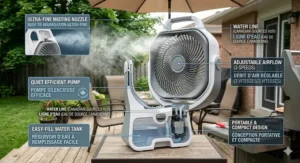
This corded electric model represents old-school reliability for Canadians with permanent outdoor setups. The 15-inch (38 cm) fan diameter moves substantial air volume while the direct garden hose connection eliminates battery charging entirely. Plug into any outdoor GFCI outlet and you have unlimited runtime—perfect for month-long cottage stays or all-summer patio use.
Permanent Installation Advantages: The Lasko Misto makes sense for specific Canadian scenarios: covered decks in Vancouver, lakefront properties in Ontario, or Calgary backyards where you’re entertaining regularly. The three-speed motor provides 1,200 CFM airflow at maximum setting—genuinely powerful compared to battery models. The six high-pressure misting nozzles create a cooling zone covering approximately 60 square feet (5.6 square metres).
What Canadian electrical codes demand: your outdoor outlet must have GFCI (Ground Fault Circuit Interrupter) protection, required by the Canadian Electrical Code for moisture-prone areas. Most quality homes built after 1990 include these, but older cottages may require electrician upgrades ($150-$300 CAD). The 1.8-metre (6-foot) power cord limits placement—you’ll likely need a weatherproof extension cord (CSA-approved for outdoor use).
The design prioritizes durability over portability. The sturdy base resists tipping in wind (critical for patio furniture areas), and the metal construction survives Canadian temperature swings better than plastic battery models. Expect 5-10 years of service with minimal maintenance versus 2-3 years for battery units where cells degrade.
Canadian buyer experiences: BC patio owners mention running it daily through summer without issues. Ontario cottage users appreciate “set it and forget it” operation. Prairie buyers in hard-water areas recommend inline water filters ($15-$25 CAD on Amazon.ca) to prevent mineral buildup in nozzles.
Pros:
✅ Unlimited runtime without battery concerns
✅ Powerful 1,200 CFM airflow at 15-inch diameter
✅ 5-10 year lifespan exceeds battery models
Cons:
❌ Requires nearby GFCI outlet and garden hose
❌ Completely immobile (no portability)
Price & Value: At $120-$150 CAD, this costs less than premium battery models while providing superior long-term value for permanent installations. Ideal for homeowners prioritizing reliability over mobility.
7. TriPole Handheld Misting Fan with LED Display
This ultra-compact option targets Canadian buyers who prioritize portability above all else. At 250 grams with a 40ml water tank, it represents the absolute minimum viable misting fan—but “minimum” doesn’t mean ineffective. The 4000mAh battery provides 6-10 hours of runtime, and the LED display showing battery percentage and settings eliminates guesswork about remaining charge.
Micro-Portability Analysis: The TriPole excels in scenarios where every gram matters: backpacking trips through the Rockies, day hikes in Quebec national parks, or urban commuting on crowded buses. The neck strap and foldable tripod base offer three usage modes (handheld, desktop, around-neck) without bulk. The brushless motor delivers impressive airflow (11.5 ft/s at high speed) relative to its tiny frame.
What separates this from the HandFan? The LED display provides real-time battery monitoring—critical when you’re hours from charging options. The 40ml tank sits between the HandFan’s 50ml and ultra-minimalist 30ml models, providing 15-25 minutes of misting. The high-speed airflow setting works even without misting during lower temperatures or higher humidity.
The Canadian reality check: that 40ml tank means frequent refills. At outdoor festivals or theme parks with water access, this isn’t problematic. For remote camping or all-day beach trips, you’ll need to carry supplemental water. The neck-wearing mode distributes weight comfortably but looks decidedly touristy—fine for Wonderland or the CNE, potentially awkward for professional settings.
Canadian buyer feedback: Toronto commuters mention it “saves sanity” on summer transit. Festival-goers across Canada appreciate the compact size for crowded venues. A few buyers note the mist setting drains battery faster than advertised—expect 3-4 hours with heavy misting use.
Pros:
✅ LED display provides precise battery monitoring
✅ Neck strap enables hands-free cooling
✅ Powerful airflow relative to ultra-compact size
Cons:
❌ 40ml tank requires very frequent refills
❌ Neck-wearing mode may not suit all situations
Price & Value: The $40-$55 CAD range makes this accessible for anyone curious about misting technology. Best for commuters, festival-goers, and travellers who need minimum bulk.
How to Choose the Right Misting Fan Portable for Canadian Conditions
Selecting effective portable cooling in Canada requires evaluating factors beyond marketing claims. Here’s how to match technology to your actual needs across our diverse climate zones.
Climate Zone Considerations: Western provinces (BC Interior, Alberta, Saskatchewan) with humidity often below 40% see maximum evaporative cooling benefit—expect 10-15°C temperature drops in your immediate vicinity. Humid regions (Southern Ontario, Maritime provinces, coastal BC) experience smaller drops (5-8°C) but still benefit from enhanced airflow and evaporative skin cooling. Don’t dismiss misting technology in humid areas—the moving air amplifies sweat evaporation from your skin, providing relief even when ambient air saturation reduces cooling efficiency.
Battery Capacity Mathematics: Canadian buyers often overestimate needed runtime. A 10000mAh battery provides approximately 4-6 hours of mixed-speed operation (alternating between settings). For day trips, 15000-20000mAh models like the Wilody suffice. Multi-day camping demands 24000-30000mAh capacity (Aopircs, Ausic) or battery swapping capability (RYOBI). Calculate based on your longest typical outing, then add 25% buffer—Canadian summers throw curveballs.
Tank Size vs Refill Access: Bucket models (6-20L) make sense when water access exists (campsites with taps, cottages, patios with hoses). Handheld models (30-50ml) work for urban environments with frequent refill opportunities (transit commutes, festivals with water fountains). Medium tanks (250-500ml) represent compromises—enough capacity for several hours without excessive weight.
Power Source Selection: Battery models provide freedom but require charging infrastructure. If you’re cottaging without reliable electricity or camping in remote provincial parks, prioritize massive battery capacity (24000mAh+) or bring portable solar chargers. For permanent patio/deck installations with accessible outlets, corded models like the Lasko eliminate battery anxiety entirely. RYOBI tool-battery compatibility makes sense only if you already own that ecosystem—don’t buy into a tool platform just for a fan.
Build Quality for Canadian Extremes: Our temperature swings (40°C range between seasons) and UV intensity destroy cheap plastics within 2-3 summers. Look for UV-resistant materials, metal fan guards, and IP44+ water resistance. Budget models stored indoors between uses survive longer, but mid-range options ($100-$150 CAD) justify their cost with 4-5 year lifespans. Read reviews specifically mentioning Canadian weather survival—not all Amazon.ca listings ship products designed for our climate.
Noise Level Realities: Marketing claims of “whisper-quiet” operation rarely survive real-world testing. Fans under 40dB at lowest speed work for sleeping/reading; 40-50dB suits outdoor socializing; anything above 55dB becomes conversation-disrupting. Canadians using these at campsites near others should prioritize lower decibel ratings and considerate usage timing.
Canadian-Specific Features: CSA certification (Canadian Standards Association) matters for corded models—indicates compliance with Canadian electrical safety standards. For battery models, look for effective cold-weather storage guidance (lithium batteries degrade faster below 0°C). Hard water protection (inline filters or easy-clean nozzles) proves essential in Calgary, Regina, Winnipeg, and other mineral-heavy municipal water areas.
Real-World Canadian Usage Guide: Maximizing Performance
Successfully deploying portable misting technology in Canadian conditions requires understanding both the physics and practical limitations.
Optimal Positioning Strategy: Place misting fans upwind of your cooling target so prevailing breezes carry the mist toward you. At stationary locations (beach blankets, campsites), position 1-2 metres away for maximum effect—too close soaks clothing, too far loses cooling benefit. For overhead installations (tent hooks), angle downward 30-45 degrees to distribute mist before it evaporates.
Water Quality Management: Municipal tap water works across most of Canada, but mineral-heavy areas (Prairies, some Ontario regions) clog nozzles within 10-20 hours of use. Solutions: install inline water filters ($15-$25 CAD on Amazon.ca) for hose-connected models, use distilled water for tank models, or clean nozzles monthly with 1:1 white vinegar solution (soak 15 minutes, rinse thoroughly). Montreal and Vancouver water generally runs clean enough for direct use.
Temperature-Humidity Sweet Spots: Misting technology delivers maximum cooling when ambient humidity sits below 50%. Check weather forecasts before beach days or festivals—35°C at 30% humidity means excellent cooling potential; 28°C at 70% humidity significantly reduces effectiveness. The good news? Even in high humidity, increased airflow enhances your body’s natural cooling through improved sweat evaporation.
Battery Optimization for Extended Trips: Lithium batteries perform best between 10-35°C and degrade when stored depleted. For Canadian cottaging, charge units to 50-60% for storage (not 100% or 0%). Bring USB-C car chargers for top-ups during transport. In extreme heat (above 38°C), shade the unit to prevent battery damage—plastic housing can heat to 50°C+ in direct sun. Winter storage: remove batteries, store indoors between 15-20°C.
Maintenance Schedule: Monthly during active season: clean misting nozzles, inspect water tanks for algae/mold, test battery runtime. End-of-season: drain all water, run fan-only mode to dry internal components, clean thoroughly, charge batteries to 50%, store indoors. Spring preparation: fully charge batteries, test misting function, replace any damaged nozzles. This 20-minute annual maintenance routine extends lifespan from 2 years to 5+ years.
Emergency Cooling Applications: During heat warnings or power outages, position misting fans in bathrooms or small rooms for maximum cooling concentration. Wet towels hung around the fan amplify evaporative effect. For heat stroke prevention (critical concern during Canadian heat domes), combine misting with shade, hydration, and reduced physical activity. Government of Canada guidelines recommend seeking air conditioning when temperatures exceed 31°C for vulnerable populations—portable misting fans provide temporary relief but aren’t medical-grade cooling solutions.
Common Mistakes Canadian Buyers Make (And How to Avoid Them)
After analyzing hundreds of Canadian user reviews and returns, several patterns emerge that waste money and cause disappointment.
Mistake #1: Ignoring Humidity Context. Saskatchewan buyers purchasing misting fans expecting Arizona-level cooling in 65% humidity environments inevitably feel disappointed. Reality: evaporative cooling works best below 50% humidity. Check your region’s typical summer humidity levels before purchasing. If you’re consistently above 60%, prioritize fan airflow power over misting capacity—the mechanical cooling provides more benefit than marginal evaporative effects.
Mistake #2: Oversizing for Actual Needs. Many Canadians buy 20L bucket models for occasional festival use, then complain about storage bulk. Match capacity to frequency: daily patio use justifies large units, weekend camping suits mid-range (6L), urban commuting needs handhelds. The “bigger is better” mentality costs unnecessary money and creates clutter.
Mistake #3: Neglecting Water Hardness. Prairie buyers especially learn this lesson painfully—hard water destroys misting nozzles within 2-3 weeks without filtration. Calgary, Regina, Saskatoon, and Winnipeg residents should budget for inline filters or plan on using distilled water. Ignoring this means replacing $15-30 CAD nozzle assemblies repeatedly versus a one-time $20 filter investment.
Mistake #4: Battery Runtime Misunderstanding. Marketing claims like “120-hour runtime” refer to lowest-speed fan-only operation. Actual mixed-use runtime (alternating speeds, misting engaged) drops to 20-30% of advertised maximum. Calculate based on realistic usage: if you need 8 hours of active cooling, buy for 15-20 hour rated capacity to ensure you don’t run dry mid-event.
Mistake #5: Skipping Canadian Voltage Verification. Some Amazon.ca listings ship international models rated for 220V or incompatible charging standards. Verify “120V AC compatible” or “Canadian plug standard” before purchasing. Returns due to voltage mismatches waste weeks during precious summer months.
Mistake #6: Underestimating Storage Requirements. Battery models require climate-controlled winter storage (not garage, not shed). Lithium batteries exposed to -20°C during Canadian winters suffer permanent capacity loss. Corded models stored outdoors suffer UV damage and weather degradation. Factor storage space into purchase decisions—apartment dwellers might prioritize collapsible handhelds over bucket fans.
Misting Technology vs Traditional Cooling: Canadian Climate Analysis
Understanding when misting fans outperform alternatives helps optimize your cooling budget across different Canadian scenarios.
Misting Fans vs Portable Air Conditioners: Personal AC units move 5,000-8,000 BTU, genuinely lowering room temperatures but consuming 500-1,500 watts and costing $300-$800 CAD. Misting fans use 5-30 watts, cost $35-$220 CAD, but only cool immediate vicinity by 5-15°C. The verdict: for semi-outdoor spaces (covered patios, RVs, tents), misting fans win on portability and energy efficiency. For indoor rooms during extended heat waves, AC units provide superior cooling but lack portability.
Evaporative Cooling vs Electric Fans: Standard battery fans move air without moisture, providing relief solely through enhanced sweat evaporation. Misting fans add 5-10°C of actual air cooling through water evaporation. In dry Canadian climates (BC Interior, Prairies), this difference matters significantly. In humid regions (Maritimes, Southern Ontario), the gap narrows to 2-3°C. Cost difference is minimal ($10-20 CAD), so misting capability makes sense in most Canadian contexts.
Portable vs Fixed Misting Systems: Permanent patio misting systems (installed overhead mist lines) cost $400-$1,200 CAD for professional installation but cover larger areas and integrate with landscaping. Portable units cost $35-$220 CAD, move between locations, and require no installation. For cottages and permanent residences with large outdoor entertaining spaces, fixed systems justify their cost. For renters, campers, and mobile users, portability provides irreplaceable flexibility.
Battery vs Corded Models: Cordless freedom costs battery degradation (20-30% capacity loss over 2-3 years) and limited runtime. Corded models offer unlimited operation but require outlet proximity. For Canadian cottages with accessible outdoor power, corded models make sense. For camping, beaches, and festivals, battery models prove essential despite higher long-term replacement costs.
Maintenance in Canadian Conditions: Winter Storage and Longevity
Maximizing lifespan in our extreme seasonal swings requires specific care protocols that warm-climate guides ignore.
Fall Winterization Process: Before first frost, perform complete drainage of all water reservoirs—trapped water expands when frozen, cracking plastic tanks. Run fan-only mode for 30 minutes to evaporate residual moisture from misting lines. Remove batteries from portable units (lithium batteries lose 2-5% capacity monthly at 0°C, more at -20°C). Clean all surfaces with mild soap, paying special attention to nozzles where mineral deposits harden over winter. Store batteries indoors at 15-20°C charged to 50-60% (optimal long-term storage charge).
Proper Indoor Storage: Basements and climate-controlled storage work well. Avoid garages, sheds, or outdoor storage where -30°C temperatures damage plastics and electronics. For large bucket models, disassemble into components (fan head, bucket, accessories) to minimize storage footprint. Place silica gel packets in storage containers to prevent moisture accumulation during spring thaw.
Spring Recommissioning: Inspect all components for winter damage—cracks in plastic housings, corroded electrical contacts, seized fan bearings. Fully charge batteries (may require 8-12 hours for deeply discharged units). Test misting function with distilled water before adding tap water—identifies clogged nozzles before mineral deposits worsen blockages. Run through all speed settings and check oscillation mechanisms.
Ongoing Summer Maintenance: Clean nozzles every 10-15 hours of misting operation (monthly for regular users). Vinegar solution (1:1 white vinegar to water, 15-minute soak) dissolves mineral buildup. For hard water areas, clean every 5-7 hours. Empty water tanks between uses to prevent algae growth—leave tanks open to air-dry completely. Wipe fan blades weekly to prevent dust buildup that reduces airflow efficiency. Check battery connections for corrosion, especially on models used near salt water (BC coast, maritime beaches).
Warranty and Replacement Parts: Most units carry 1-year manufacturer warranties covering defects but not wear items (nozzles, filters, batteries). Canadian buyers should verify warranty validity—some international sellers on Amazon.ca exclude Canada from coverage. Replacement nozzle kits cost $12-25 CAD; batteries $30-70 CAD depending on capacity. Factor these into total ownership cost calculations.

Frequently Asked Questions About Portable Misting Fans in Canada
❓ Do misting fans work during humid Canadian summers like Toronto or Halifax?
❓ Can portable misting fans be used indoors in Canadian homes?
❓ How do I prevent nozzles from clogging with Prairie hard water?
❓ Are misting fans safe to use around children and pets during Canadian outdoor activities?
❓ What's the real battery life I can expect for full-day Canadian camping trips?
Conclusion: Finding Your Perfect Portable Cooling Solution
The Canadian market has matured significantly since misting fans first appeared in 2020, now offering genuine cooling solutions rather than gimmicky gadgets. The technology works—especially in our low-humidity regions west of Manitoba—but success requires matching capacity to your actual usage patterns and climate zone.
For most Canadian buyers, the mid-range options ($100-$140 CAD) like the Wilody 6L Remote Control or Aopircs 24000mAh represent the sweet spot. They provide enough battery capacity for full-day adventures, sufficient tank size to minimize refilling, and build quality that survives our temperature extremes. Urban commuters and festival-goers will find handhelds like the HandFan 4000mAh or TriPole Turbo perfectly adequate at half the cost. Serious campers and entertainers justifying premium investment should examine the Ausic 20L for its commercial-grade runtime.
The corded Lasko Misto 7050 remains my recommendation for permanent cottage or patio installations where portability doesn’t matter—its unlimited runtime and 5-10 year lifespan provide superior long-term value. RYOBI tool owners gain efficiency by leveraging existing batteries, though standalone buyers should calculate true cost including battery purchases.
Remember that misting technology supplements rather than replaces shade, hydration, and common sense during extreme heat events. Health Canada guidelines still recommend seeking proper air conditioning during heat warnings, especially for vulnerable populations. Portable misting fans excel at making outdoor activities comfortable during typical summer conditions, extending your usable patio time by 3-4 hours daily, and providing emergency relief during power outages.
As Canadian summers continue warming (Western Canada averages 1-2°C hotter than the 1940s according to government climate data), personal cooling technology transitions from luxury to practical necessity. Whether you’re planning festival season, cottage weekends, or simply surviving urban heat islands, the right portable misting fan transforms sweltering discomfort into manageable warmth. Choose based on your primary use case, budget realistically for quality, and prepare for noticeably cooler Canadian summers ahead.
Recommended for You
- 7 Best Foldable Desk Fan Portable Canada 2026 | Top Picks
- 7 Best Portable Fan Canada 2026
- 7 Best Silent Neck Fans for Office Canada 2026 | Quiet Cooling
Disclaimer: This article contains affiliate links. As an Amazon Associate, I earn from qualifying purchases. If you purchase products through these links, we may earn a small commission at no additional cost to you.
✨ Found this helpful? Share it with your friends! 💬🤗
