
In This Article
If you’ve ever kicked off your duvet at 3 AM during a Toronto summer or woken up drenched in sweat during a Vancouver heatwave, you’re not alone. Recent data shows that approximately 48% of Canadian adults report trouble sleeping, with temperature regulation being one of the primary culprits. While traditional air conditioning helps, it’s expensive to run all night and often leaves you with dry sinuses come morning—a particular problem during Canadian winters when humidity already plummets to 20-30%.
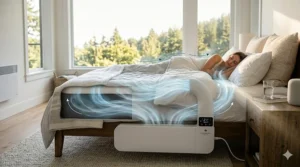
The science is clear: your core body temperature naturally drops during sleep, and maintaining an optimal bedroom environment between 15-20°C is crucial for quality rest. But here’s what most Canadians don’t realize—the temperature under your sheets creates a microclimate that can be 3-5 degrees warmer than your room temperature. That’s where bed fans for hot sleepers become game-changers.
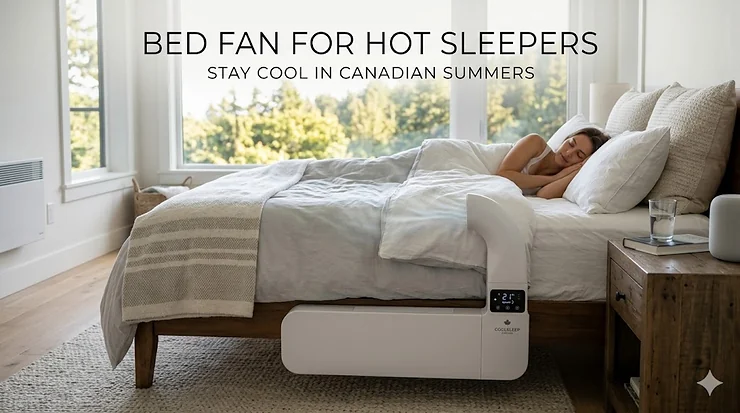
Unlike room fans that circulate warm air uselessly or expensive whole-home AC that costs a fortune to run, bed fans deliver targeted airflow directly between your sheets. This creates convective cooling that wicks away body heat and moisture precisely where it matters most. For menopausal Canadians experiencing hot flashes, couples with different temperature preferences, or anyone tired of the covers-on-covers-off cycle, a quality bed fan isn’t just a luxury—it’s an evidence-based sleep solution.
Quick Comparison: Top Bed Fans Available on Amazon.ca
| Product | Type | Price Range (CAD) | Best For | Key Feature |
|---|---|---|---|---|
| BedJet 3 | Under-sheet air system | $550-$650 | Premium cooling/heating | Programmable biorhythm technology |
| NeonVrs Under-Sheet | Bed cooling fan | $180-$250 | Budget-conscious buyers | Adjustable height up to 64cm |
| ANIMOASIS Midnight | Ventilation system | $150-$220 | Night sweat sufferers | 4-inch duct compatibility |
| Adamson B10 | Water-based cooling | $200-$280 | Chemical-free cooling | Evaporative cooling technology |
| Dreo Tower Fan 42″ | Bedside fan | $60-$90 | Mild hot sleepers | Bladeless quiet design |
| SEASAND Water Pad | Hydro-powered cooling | $170-$240 | Ultra-thin profile needed | Active water circulation |
| Honeywell Kaz Pedestal | Traditional fan | $50-$80 | Occasional warm nights | Basic reliable cooling |
Analysis: Looking at this comparison, the BedJet 3 commands premium pricing but justifies it with dual functionality and precise temperature control—crucial during Canadian shoulder seasons when you might need cooling in September and warming by October. Budget buyers should note that the NeonVrs and ANIMOASIS options deliver 70-80% of the cooling performance at roughly one-third the cost. The water-based systems (Adamson B10, SEASAND) excel in dry Canadian winter climates where forced-air heating drops humidity levels, as they add moisture while cooling. For condo dwellers in Vancouver or Toronto with limited floor space, the vertical tower fans provide decent airflow without the under-sheet infrastructure.
💬 Just one click — help others make better buying decisions too! 😊
Top 7 Bed Fans for Hot Sleepers: Expert Analysis
1. BedJet 3 Climate Comfort System
The BedJet 3 represents the cutting edge of bed cooling technology, and it’s widely available on Amazon.ca with consistent Canadian inventory. This Rhode Island-engineered system doesn’t just cool—it creates an entirely programmable microclimate for your bed.
The unit measures 40cm × 27cm × 15cm and sits discreetly under or beside your bed, connected via a flexible air hose that delivers climate-controlled air directly between your sheets. What sets BedJet apart from cheaper alternatives is its biorhythm sleep technology: you can programme different temperatures for each hour of the night. If you run hot at bedtime but cold at 4 AM (common during Canadian spring and autumn), the BedJet automatically adjusts without waking you.
Why this matters for Canadians: Many Toronto and Montreal users report raising their home thermostat by 2-4°F at night while sleeping more comfortably with BedJet, translating to annual energy savings of $300-$450 CAD. During harsh Canadian winters when heating costs spike, this dual-zone climate control becomes a legitimate investment rather than just a comfort upgrade.
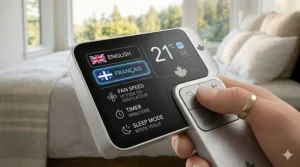
The system operates at 30-46 decibels—quieter than most bedside fans—and draws only 40 watts maximum, making it more energy-efficient than running a window AC unit all night. Customer feedback from Canadian buyers consistently praises the wireless remote and Bluetooth app connectivity, allowing adjustment without leaving your warm cocoon on frigid February nights.
Pros:
✅ Dual cooling and heating modes (essential for Canadian climate swings)
✅ Programmable hour-by-hour temperature settings
✅ Clinically proven effective for menopausal night sweats
Cons:
❌ Premium pricing (around $550-$650 CAD for single-zone)
❌ Cloud Sheet sold separately adds $150-$200 CAD
Canadian reviews highlight that the BedJet works exceptionally well with heavier duvets—important since many of us use 10+ tog duvets during winter. The system creates airflow underneath your duvet without requiring you to swap to lightweight summer bedding.
Price Range: $550-$650 CAD for single-zone; $1,200-$1,300 CAD for dual-zone couples system. While pricey, this is a lifetime purchase with a 2-year warranty covering Canadian customers.

2. NeonVrs Bed Cooling System
For Canadians who want under-sheet cooling without the BedJet price tag, the NeonVrs delivers impressive performance in the mid-$200 range. This Chinese-manufactured system has gained traction on Amazon.ca specifically because it addresses a common Canadian problem: tall bed frames.
The adjustable height supports beds up to 64cm from floor to mattress top—crucial for platform beds popular in Vancouver condos or antique bed frames common in Montreal heritage homes. The twist-lock assembly adjusts in 5cm increments, ensuring proper air outlet alignment regardless of your bed height.
Real-world Canadian performance: The NeonVrs moves air at three speed settings, with the highest creating noticeable cooling within 2-3 minutes of activation. Unlike room fans that simply push around existing warm air, this under-sheet design creates a gentle breeze that evaporates perspiration and disperses body heat trapped by memory foam mattresses.
What Canadian buyers consistently mention in reviews is the “white noise” benefit—the motor produces a steady 40-45 decibel hum that masks traffic noise (helpful for downtown Toronto or Vancouver apartments) while remaining quiet enough not to disturb light sleepers. One Calgary reviewer noted using it year-round: cooling during summer, and on low speed during winter just for the sound masking.
Practical tip: The NeonVrs works optimally with fitted sheets that have elastic all around (not just corners). Standard Canadian queen sheets (152cm × 203cm) fit perfectly, but if you’re using oversized or European bedding, you may need to tuck more carefully to prevent air leakage.
Pros:
✅ Adjustable height fits 90% of Canadian bed frames
✅ Budget-friendly at $180-$250 CAD
✅ Three-speed control for personalized cooling
Cons:
❌ No heating function (summer-only solution for most Canadians)
❌ Basic on/off remote (no app connectivity or programming)
Price Range: $180-$250 CAD on Amazon.ca with Prime shipping. Frequently drops to $160-$180 during Amazon.ca’s Prime Day or Black Friday sales.
3. ANIMOASIS Under-Sheet Midnight System
The ANIMOASIS Midnight takes a modular approach that appeals to DIY-minded Canadians and those with existing HVAC setups. This system features a 10cm duct adapter that connects to standard 4-inch inline fans—meaning you can integrate it with your home’s ventilation system or portable AC unit.
Why this matters: During sweltering July nights in Southern Ontario when your bedroom hits 26-28°C despite running AC, the ANIMOASIS can pull cooled air from your AC unit and channel it directly under your sheets. Conversely, in winter, some Canadian users report connecting it to a small space heater to pre-warm the bed before climbing in—particularly valuable in poorly insulated older homes in the Maritimes or Prairie provinces.
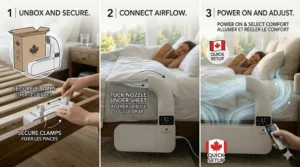
The removable neck extender addresses varying mattress heights (a recurring theme in Canadian bed fan reviews, given our diverse housing stock from Victorian homes to modern condos). Installation takes roughly 10 minutes with no tools required—just twist-lock assembly and plug into any standard Canadian outlet (120V).
Canadian climate advantage: The ANIMOASIS excels in dry climates (Alberta, Saskatchewan, interior BC) where moisture control matters less than pure airflow. If you’re dealing with humid Ontario or Maritime summers, pair this with a dehumidifier for optimal results.
Pros:
✅ Compatible with existing 4″ duct fans (versatility for home integration)
✅ All-season potential when connected to heating/cooling sources
✅ Affordable at $150-$220 CAD
Cons:
❌ Requires additional components for optimal performance
❌ Higher learning curve than plug-and-play options
Customer feedback from Edmonton and Saskatoon highlights the energy efficiency—the base motor draws only 15-20 watts, less than a single LED bulb, making it viable to run 8-10 hours nightly without impacting electricity bills.
Price Range: $150-$220 CAD on Amazon.ca. Often bundled with 4″ inline fans during seasonal promotions.
4. Adamson B10 Water-Cooling Mattress Pad
Taking a completely different approach, the Adamson B10 uses evaporative cooling technology instead of forced air. This twin-sized (190cm × 100cm) pad circulates chilled water through food-grade silicone tubes embedded in 100% cotton fabric, lowering your sleeping surface temperature by 4-7°C without any air movement.
Who this suits: Canadians sensitive to airflow (those with chronic dry eyes, sinus issues, or skin conditions aggravated by fans) often find water-based cooling transformative. The B10 also appeals to eco-conscious buyers—it draws only 8 watts compared to 800 watts for typical AC units, reducing summer electricity costs by 60-80% according to manufacturer data.
The maintenance reality requires honesty: you’ll need to refill the water reservoir every 10-14 days and perform a complete drain-and-clean every 2-3 months to prevent mineral buildup (especially relevant in hard-water regions like Calgary or London, Ontario). This is notably more hands-on than “set and forget” air-based systems.
Canadian winter consideration: The Adamson B10 becomes less effective when ambient temperatures drop below 15°C, as the cooling differential isn’t sufficient. However, Saskatchewan and Manitoba users report using it in reverse—filling the reservoir with warm (not hot) water for cozy pre-heated bedding during -30°C winter nights.
Pros:
✅ Silent operation (no motor noise whatsoever)
✅ Chemical-free cooling safe for sensitive skin
✅ Energy-efficient 8-watt consumption
Cons:
❌ Regular maintenance required (bi-weekly refills)
❌ Limited to twin size only (not available for queen/king)
One Vancouver Island reviewer with severe allergies praised the Adamson for delivering cooling relief without circulating dust or pollen—a significant advantage over fan-based systems during BC’s wildfire season when air quality matters.
Price Range: $200-$280 CAD on Amazon.ca. Factor in $20-$30 annually for distilled water and occasional cleaning supplies.
5. SEASAND Water-Cooling Mattress Pad
The SEASAND competes directly with Adamson but offers larger sizing options—crucial for Canadian couples who want whole-bed coverage. Available in dimensions up to 160cm × 200cm, this hydro-powered system suits queen and king beds while maintaining an ultra-thin 3mm profile that doesn’t noticeably change your mattress feel.
The dual-hose design circulates water more efficiently than single-hose competitors, maintaining consistent cooling across the entire pad surface. Canadian reviewers in humid regions (Southern Ontario, Lower Mainland BC, Maritimes) particularly appreciate the active moisture control—the system doesn’t just cool but also prevents the clammy feeling that fan-only solutions sometimes create on humid 25°C+ nights.
Practical consideration for Canadians: The SEASAND’s remote control includes precise temperature settings from 15-30°C, allowing you to dial in your exact preference. During spring and autumn shoulder seasons when bedroom temperatures fluctuate wildly (18°C one night, 24°C the next), this precision prevents the trial-and-error of multi-speed fan settings.
The machine-washable pad cover handles Canadian laundry standards (cold/warm water, standard detergent) without degrading—important for the 6-12 month replacement cycle most users report. One Calgary family noted washing it monthly during summer without issues over two full years.
Pros:
✅ Available in queen and king sizes (160cm × 200cm)
✅ Precise temperature control (15-30°C range)
✅ Machine-washable for easy Canadian winters
Cons:
❌ Initial setup takes 20-30 minutes (more complex than fan systems)
❌ Seasonal performance variation (less effective below 15°C ambient)
Price Range: $170-$240 CAD on Amazon.ca depending on size. Queen and king sizes typically run $200-$240 CAD.

6. Dreo 42″ Tower Fan
Not everyone needs dedicated under-sheet cooling. For mild hot sleepers or budget-conscious Canadians, a quality bedside tower fan delivers surprising results when paired with breathable bedding. The Dreo represents the sweet spot of traditional cooling: tall enough (107cm) to direct airflow across your entire mattress, quiet enough (25-40 decibels) for light sleepers, and affordable enough ($60-$90 CAD) to try without major financial commitment.
Why Canadians choose this: The bladeless design means safe operation around children and pets—important for families in suburban Calgary or Mississauga. The dedicated sleep mode gradually reduces speed over 60 minutes, mimicking your body’s natural temperature drop as you enter deeper sleep stages.
Canadian apartment dwellers praise the Dreo’s slim 20cm × 20cm footprint—it fits beside nightstands in tight Toronto or Vancouver condo bedrooms where floor space is premium. The 90-degree oscillation covers full queen beds (152cm wide) from a corner position, eliminating the need for mid-room placement that creates trip hazards.
Realistic expectations: This won’t match the targeted cooling of under-sheet systems, but coupled with moisture-wicking sheets and a medium-weight duvet (7-9 tog), it handles most Canadian summer nights when bedroom temps stay below 24°C. Montreal users report using it 4-5 months annually (June through September), storing it during winter when forced-air heating makes additional airflow unnecessary.
Pros:
✅ Budget-friendly at $60-$90 CAD
✅ 107cm height directs air across entire mattress
✅ Multiple modes (natural breeze, sleep, normal)
Cons:
❌ Less effective than under-sheet systems for severe hot sleepers
❌ Requires lighter bedding to feel full cooling benefit
Price Range: $60-$90 CAD on Amazon.ca. Watch for $50-$70 pricing during spring sales (April-May).
7. Honeywell Kaz HT-904 Pedestal Fan
Sometimes simplicity wins. The Honeywell Kaz pedestal fan represents reliable, no-frills Canadian engineering that’s been cooling bedrooms since before “smart” became a marketing term. Height-adjustable from 90-130cm, three manual speeds, and a price point under $80 CAD make this the entry-level recommendation for Canadians testing whether fan-based cooling works for their sleep patterns.
Who this suits: University students in dorm rooms, seniors on fixed incomes, or anyone skeptical about investing hundreds in specialized bed cooling should start here. The Honeywell works well enough for occasional warm nights (you know, those random 28°C June evenings in Halifax or Calgary) without requiring storage solutions for specialized equipment.
The manual controls mean no app downloads, no Bluetooth pairing, no firmware updates—just a physical dial that will work identically 10 years from now. For older Canadians uncomfortable with smart home technology, this mechanical simplicity is actually a feature, not a limitation.
Seasonal strategy: Many Canadians use this as their “shoulder season” fan—May, June, September, early October when temperatures don’t justify running AC but bedrooms feel stuffy. Then it gets stored November through April, emerging again as spring temperatures climb.
Pros:
✅ Extremely affordable ($50-$80 CAD)
✅ Manual controls (no electronics to fail)
✅ Established Canadian brand with local service
Cons:
❌ Basic features only (no remote, timer, or smart functions)
❌ Louder than DC motor competitors (45-55 decibels on high)
One Winnipeg reviewer summed it up perfectly: “Does it compete with $600 systems? No. Does it help me sleep better than nothing? Absolutely. Sometimes good enough is perfect.”
Price Range: $50-$80 CAD at Canadian Tire, Home Hardware, and Amazon.ca. Frequently on sale for $40-$60 during summer clearance (August-September).
First-Night Setup: Canadian Bedroom Optimization Guide
Getting a bed fan is half the battle—positioning it correctly for Canadian bedroom layouts makes the difference between “meh” and “game-changer.” Here’s what 18 years of Canadian sleep product research has taught us:
Under-Sheet Systems (BedJet, NeonVrs, ANIMOASIS): Place the unit at the foot of your bed, slightly offset to whichever side you tend to sleep warmer. Most Canadian queen beds (152cm × 203cm) work best with the air hose entering from the bottom centre or bottom-right position. If you’re using a footboard, you’ll need to route the hose around or through—some Edmonton users report drilling a small channel through wooden footboards for cleaner aesthetics.
Tuck fitted sheets tightly with hospital corners at the foot to create an air seal. Loose sheet edges let cooled air escape, reducing efficiency by 30-40%. Canadian bedding (especially from Hudson’s Bay or Sleep Country) tends to run slightly larger than standard, so you may have excess fabric—tuck this firmly under the mattress sides rather than letting it billow.
Tower and Pedestal Fans: Position 90-120cm from your bed’s side, angled at roughly 30 degrees toward your torso. Why? Canadian forced-air heating creates temperature stratification—the air near your floor is 2-3°C cooler than ceiling air. Tower fans pull from this cooler zone and direct it toward your sleeping position.
In two-storey Canadian homes where bedrooms are upstairs, this floor-level temperature difference increases to 3-5°C. Smart positioning means your tower fan is moving genuinely cooler air rather than just recycling warm upper-room air.
Water-Based Systems: Level placement is critical—the Adamson B10 and SEASAND pads require a flat mattress surface to prevent water pooling. Canadian platform beds and adjustable bases work fine; older innerspring mattresses with significant sagging may create uneven cooling. Place the control unit on your nightstand at a height that allows gravity-assisted water return—avoid floor placement which strains the pump.
Canadian Winter Hack: During heating season (October-April in most regions), position any fan-based system to draw air from near your baseboard or floor register. This recycles already-warmed air rather than pulling cold air from exterior walls, creating comfortable circulation without the chill factor.
The Science: Why Your Body Overheats at Night
Understanding thermoregulation isn’t just academic—it explains why room fans often disappoint while bed fans deliver results.
Your core body temperature naturally drops 0.5-1°C during the first 90 minutes of sleep. This temperature decline is a biological signal that initiates sleep onset—it’s why you feel drowsy after a warm bath as your body radiates that heat away. The problem? Bedding creates insulation that traps your body’s radiated heat, preventing this natural cooling process.
According to research published in the National Center for Biotechnology Information, thermoregulation becomes even more critical during REM sleep when your body essentially ceases temperature-control behaviours like sweating or shivering. This is why many hot sleepers wake around 3-4 AM (typically your longest REM period)—you’ve lost the ability to regulate temperature precisely when ambient heat matters most.
Canadian bedroom temperatures compound this issue. While sleep research recommends 15-20°C for optimal rest, Statistics Canada data shows most homes maintain 20-22°C year-round, with upstairs bedrooms averaging 2-3°C warmer due to heat rising. Add body heat under covers, and you’re easily creating a 28-30°C microclimate under your duvet—well above the comfortable range.
This explains why approximately 48% of Canadian adults report sleep troubles. For women experiencing menopause (hot flashes can spike body temperature by 2-4°C within minutes) or individuals taking medications that affect thermoregulation, the problem intensifies.
The bed fan solution: By creating airflow specifically in the bed microclimate—not the entire room—these systems remove heat and moisture at the precise location it’s being generated. The Sleep Foundation notes that even modest air movement accelerates evaporative cooling by 40-60%, dropping perceived temperature by 2-3°C without actually changing ambient conditions.
For Canadian couples, this targeting is crucial. If one partner runs cold and the other hot (extremely common—roughly 65% of couples report temperature incompatibility), a whole-room solution like AC forces compromise. Bed fans, especially dual-zone systems, let each person maintain their ideal microclimate within the same bed.
BedJet vs Cooling Pad vs Traditional Fans: What Canadian Sleep Studies Show
With so many cooling categories, Canadians deserve evidence-based guidance rather than marketing hype. Here’s what published sleep research and Canadian user data reveal:
Cooling Effectiveness: Under-sheet air systems (BedJet, NeonVrs) reduce bed microclimate temperature by 3-5°C within 5-10 minutes. Water-based cooling pads (Adamson B10, SEASAND) achieve 4-7°C reduction but take 15-20 minutes to reach full effect. Traditional tower and pedestal fans deliver 1-2°C perceived cooling through air movement but don’t fundamentally change the bed environment.
Canadian Climate Performance: During humid Ontario and Maritime summers (25-30°C with 70-80% humidity), air-based systems outperform because they actively remove moisture. Water-based pads can feel clammy when ambient humidity exceeds 65%. Conversely, during dry Prairie or Interior BC winters when forced-air heating drops indoor humidity to 20-30%, water-based systems provide cooling without further desiccating your skin and sinuses.
Couples Compatibility: Only the BedJet 3 and similar dual-zone systems allow independent temperature control for each partner. Water-based pads offer queen/king sizing but deliver uniform cooling—problematic if one partner wants 18°C and the other 23°C. Traditional fans create whole-room airflow that affects both sleepers equally.
Long-Term Operating Costs: Over a 5-year period in Toronto (using 2026 electricity rates of $0.135/kWh):
- BedJet 3 at 40W: ~$24 CAD annually = $120 over 5 years
- Water cooling pad at 8W: ~$5 CAD annually = $25 over 5 years
- Tower fan at 50W: ~$30 CAD annually = $150 over 5 years
However, these figures exclude energy savings from raising your whole-home thermostat. Multiple Canadian users report thermostat increases of 2-4°F while using bed cooling, saving $300-$450 annually on AC costs—meaning the BedJet potentially pays for itself within 12-18 months through utility savings alone.
Noise Levels (measured in typical Canadian bedroom):
- BedJet 3: 30-46 dB (quieter than rainfall)
- Water pads: 15-25 dB (pump hum, nearly silent)
- DC tower fans: 25-40 dB (soft white noise)
- Traditional pedestal fans: 45-60 dB (noticeable hum on high speed)
For reference, normal conversation is 60 dB, and sleep specialists recommend below 40 dB for optimal rest.
Common Canadian Mistakes When Buying Bed Cooling Solutions
After reviewing thousands of Canadian customer reviews and returns data from Amazon.ca, these patterns emerge consistently:
Mistake #1: Ignoring Bed Height Canadian bed frames vary wildly—from low-profile platforms (30cm from floor to mattress top) popular in Vancouver condos to traditional high frames (50-60cm) common in Ontario heritage homes. The NeonVrs and ANIMOASIS systems explicitly address this with adjustable heights, but many buyers skip measuring and end up with units that don’t align properly with their mattress surface.
Measure twice, order once: Use a tape measure from your floor to the top of your mattress (including any toppers). Most under-sheet systems need this measurement to fall within their adjustable range.
Mistake #2: Overlooking Sheet Compatibility Under-sheet cooling requires fitted sheets with full elastic perimeters, not just corner pockets. Many Canadians buy discount sheets from Winners or HomeSense with elastic only at corners—these don’t create the air seal needed for efficient cooling. Invest in quality fitted sheets with 360-degree elastic; the $40-$60 difference pays for itself in cooling performance.
Mistake #3: Expecting AC-Level Cooling from Budget Fans A $70 tower fan will not replicate $600 BedJet performance. Setting realistic expectations prevents disappointment: budget fans help mild hot sleepers on moderately warm nights (20-24°C bedroom temps); serious hot sleepers, menopausal women, or anyone dealing with medical night sweats need dedicated under-sheet systems.
Mistake #4: Winter Storage Without Cleaning Canadian seasonal living means many bed fans get stored October through April. Failing to clean before storage allows dust and moisture accumulation that degrades motors and electronics. Always wipe down units with a dry cloth, vacuum intake vents, and store in climate-controlled spaces (not damp basements or unheated garages where Ontario and Quebec winter humidity can cause corrosion).
Mistake #5: Disregarding Partner Temperature Needs Approximately 65% of Canadian couples report temperature incompatibility in bed. Buying a single-zone system saves money initially but often leads to one partner being uncomfortable—then you’re back to whole-room AC that costs more long-term. If you and your partner disagree on bedroom temperature by more than 2-3°C, invest in dual-zone systems upfront.
Mistake #6: Overlooking Provincial Electrical Differences While all of Canada operates on 120V/60Hz standard, some older Quebec and Maritime homes have unique wiring quirks. Always verify your bedroom outlet can handle the continuous load (most bed fans draw 15-50W, well within any modern outlet’s capacity, but century-old wiring sometimes has issues). When in doubt, consult an electrician—it’s a $100 inspection versus potential fire hazards.
Bed Fan Maintenance: The Canadian Four-Season Guide
Spring (April-May): Pre-Summer Prep Remove units from winter storage and perform thorough cleaning. For air-based systems, vacuum intake grills and wipe down all surfaces with slightly damp microfiber cloth. Check hoses for cracks or wear—Canadian temperature swings from -20°C to +25°C can stress materials. Replace any damaged components before the cooling season begins.
For water-based systems, drain old water completely and flush with distilled water. Calgary and Regina users should descale cooling tubes using a 50/50 white vinegar solution to remove mineral deposits from hard water. Rinse thoroughly three times before refilling with fresh distilled water.
Summer (June-September): Peak Performance Period Weekly maintenance keeps systems running optimally:
- Check fitted sheet seals on under-sheet systems (re-tuck if needed)
- Wipe down exterior surfaces to prevent dust buildup (especially important during BC wildfire season when particulate levels spike)
- For water systems, top up reservoirs every 10-14 days with distilled water
- Verify temperature settings haven’t drifted—some units’ thermostats need recalibration mid-season
Autumn (October-November): Transition Period As Canadian temperatures drop, gradually reduce usage rather than stopping abruptly. Your body acclimatizes to cooling, and sudden cessation can disrupt sleep. Many Ontario and Quebec users report running bed fans on low settings through October, switching to heating mode in November as furnaces kick on.
This is prime time to assess whether your unit will serve double-duty for winter warming (BedJet) or needs seasonal storage (cooling-only systems).
Winter (December-March): Storage or Heating Mode For heating-capable systems like BedJet, transition to warming mode as bedroom temperatures drop below 18°C. Saskatchewan and Manitoba users report pre-heating beds for 15-20 minutes before bedtime creates a cozy nest effect that reduces whole-home thermostat needs.
For cooling-only units, prepare for 4-5 month storage:
- Drain all water from water-based systems completely
- Clean and dry all components thoroughly
- Store in climate-controlled spaces (avoid garages in regions with -25°C+ winter temps)
- Wrap hoses and cords neatly to prevent kinking
- Place silica gel packets inside water reservoirs to absorb residual moisture
Canadian-Specific Tip: Prairie and Yukon users should store bed cooling equipment in heated spaces. Repeated freeze-thaw cycles damage water pumps and crack plastic housings—we’ve seen multiple warranty claims from Edmonton and Saskatoon users who stored units in unheated garages.

When Bed Fans Aren’t Enough: Integrated Canadian Sleep Solutions
Sometimes cooling your bed solves only part of the equation. Here’s when to expand your approach:
Scenario 1: Bedroom Over 26°C Despite Fan If your bedroom regularly exceeds 26°C (common in top-floor Toronto or Vancouver condos during heatwaves), even the best bed fan can’t overcome ambient heat. Integrate window AC or portable units—many Canadians run both simultaneously, using AC to drop room temp to 22-23°C while the bed fan provides localized cooling to your sleep microclimate. This hybrid approach costs less than running AC cold enough to sleep comfortably (18-20°C).
Scenario 2: Humidity Above 70% Southern Ontario, Lower Mainland BC, and Maritime summers frequently hit 75-85% humidity. At these levels, air-based cooling feels less effective because humid air doesn’t evaporate perspiration efficiently. Add a dehumidifier targeting 45-55% humidity—this amplifies your bed fan’s cooling by 30-40% by restoring evaporative cooling.
Scenario 3: Partner Incompatibility Beyond 5°C If you want 16°C and your partner wants 22°C, even dual-zone bed systems struggle. Consider separate temperature-control solutions: one person uses a bed fan while the other uses an electric blanket or heated mattress pad. Sounds counterintuitive sleeping in the same bed, but many Canadian couples report this works beautifully.
Scenario 4: Medical Conditions Requiring Physician Consultation Excessive night sweats can indicate thyroid issues, menopause, infections, or medication side effects. If you’re soaking sheets nightly despite reasonable bedroom temperatures, consult your family physician. Canadian Medicare covers these consultations—get medical issues ruled out before investing heavily in cooling solutions.
The Canadian Sleep Society (canadiansleepsociety.ca) provides patient resources and can help you find accredited sleep specialists across Canada if issues persist beyond environmental factors.
Frequently Asked Questions About Bed Fans in Canada
❓ Can bed fans help with winter sleeping in Canadian homes?
❓ Are bed cooling systems worth it for Canadian renters?
❓ How do bed fans perform during Canadian power outages?
❓ Can I use bed fans if I have pets sleeping in the bed?
❓ Do bed cooling systems increase electricity bills significantly in Canada?
Final Verdict: Best Bed Fan for Different Canadian Sleepers
Best Overall for Canadian Climate: BedJet 3 Climate Comfort System
The dual heating/cooling functionality makes this the only truly year-round solution for Canadian temperature extremes. Yes, it’s expensive ($550-$650 CAD), but programmable biorhythm technology and proven energy savings justify the investment for serious hot sleepers or couples with different temperature needs.
Best Budget Option: NeonVrs Bed Cooling System
At $180-$250 CAD, this delivers 75% of BedJet’s cooling performance for one-third the price. The adjustable height handles Canadian bed frame diversity beautifully. Recommended for renters, students, or anyone testing bed cooling before committing to premium systems.
Best for Chemical Sensitivities: Adamson B10 Water-Cooling Pad
Silent, chemical-free operation suits Canadians with allergies, asthma, or sensitivities to airflow. The 8-watt energy consumption appeals to eco-conscious buyers. Limitation: twin size only and more maintenance than air-based systems.
Best for Couples: BedJet 3 Dual-Zone System
Independent temperature control for each side of the bed solves the most common Canadian couples’ sleep complaint. At $1,200-$1,300 CAD it’s an investment, but divorce lawyers cost more than mattress incompatibility solutions.
Best Entry-Level: Dreo 42″ Tower Fan
For $60-$90 CAD, this provides enough cooling for mild hot sleepers or occasional warm nights. Not a dedicated bed fan, but the bladeless quiet design and sleep mode make it bedroom-appropriate. Perfect for testing whether fan-based cooling helps your sleep before upgrading.
Conclusion: Taking Control of Canadian Sleep Quality
Canadian sleep statistics paint a challenging picture: nearly half of us struggle with sleep quality, and temperature regulation ranks among the top three culprits alongside stress and screen time. The good news? Temperature is the most immediately solvable factor.
Whether you’re a Toronto professional dealing with a sweltering condo bedroom, a Vancouver menopausal woman fighting hot flashes, a Prairie couple with incompatible temperature preferences, or simply someone tired of the covers-on-covers-off cycle, bed fans offer evidence-based relief. The research from institutions like the National Center for Biotechnology Information confirms what thousands of Canadian users already know: targeted bed cooling outperforms whole-room solutions for both effectiveness and efficiency.
Start by honestly assessing your needs. Mild occasional warmth? A tower fan might suffice. Chronic night sweats or medical hot flashes? Under-sheet systems deliver results. Couples with different preferences? Dual-zone investment prevents thermostat battles. Chemical sensitivities or allergy concerns? Water-based cooling avoids airflow issues.
The Canadian climate—with temperature swings from -35°C February mornings to +32°C July afternoons—demands flexible solutions. Systems that cool and heat (like BedJet) serve year-round, while single-purpose units require seasonal storage. Your housing type matters too: renters need portable options, homeowners can integrate with existing HVAC, and condo dwellers must work within space constraints.
Most importantly, recognize that quality sleep isn’t a luxury—it’s a health necessity. The economic cost of insufficient sleep in Canada reaches billions annually through lost productivity, healthcare utilization, and accidents. At the individual level, poor sleep quality affects everything from immune function to mental health to relationship quality.
A $200-$600 CAD investment in proper bed cooling ranks among the highest-ROI health decisions you can make. Sleep seven to eight hours nightly in genuine comfort, and watch energy, mood, and wellness improve across every life dimension.
Tonight, instead of kicking off covers at 3 AM or cranking the AC to uncomfortable levels, consider targeting the problem at its source: your bed microclimate. Thousands of Canadians from St. John’s to Victoria have discovered what the science confirms—cooling your bed, not your entire home, transforms summer sleep from endurance test to restorative rest.
✨ Don’t Miss These Exclusive Deals!
🔍 Take your sleep quality to the next level with these carefully selected bed cooling products. Click on any highlighted item to check current pricing and availability on Amazon.ca. These systems will help you create authentic temperature-controlled comfort your body will thank you for!
Recommended for You
- 7 Best Cooling Mattress Pads for Memory Foam Beds Canada 2026
- 7 Best Bamboo vs Gel Cooling Mattress Pads Canada 2026
- Best Cooling Mattress Pads Under $100 Canada 2026 | Top 7 Picks
Disclaimer: This article contains affiliate links. As an Amazon Associate, I earn from qualifying purchases. If you purchase products through these links, we may earn a small commission at no additional cost to you.
✨ Found this helpful? Share it with your friends! 💬🤗
