
In This Article
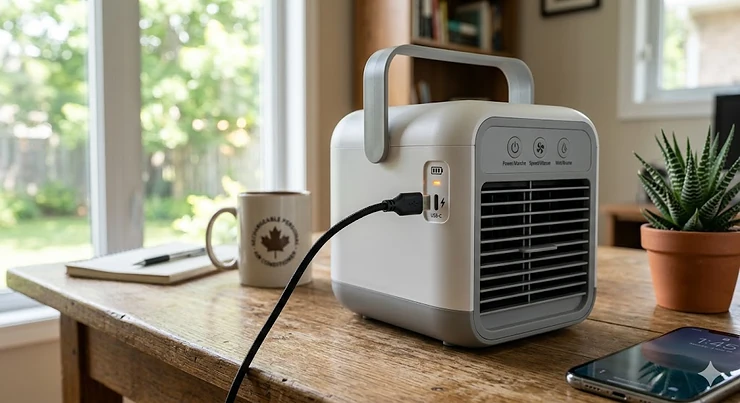
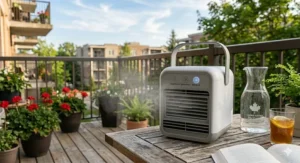
A rechargeable personal air conditioner is a small, battery-powered cooling device — usually an evaporative (water-based) cooler or a clip-on/wearable fan — that blows cool air directly at you without needing to be plugged into a wall. Environment and Climate Change Canada is forecasting 2026 to be among the hottest years on record, and cities from Vancouver to Toronto have already issued early-season heat warnings. That’s exactly the kind of summer where a desk fan that “doubles as an air conditioner” starts looking tempting.
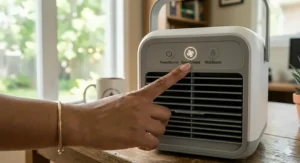
Before you buy one, it helps to know what these gadgets actually are. None of them are air conditioners in the technical sense — there’s no compressor or refrigerant inside. They’re personal evaporative coolers, and a few of them are just rechargeable fans with a cold metal plate. That’s not a knock against them; for cooling your face, neck, or desk space on a hot day, they genuinely help. It’s just worth knowing the limits going in, especially since Health Canada specifically notes that fans become ineffective at cooling the body once temperatures climb past 35°C — at that point, you need real air conditioning or a cooling centre, not a gadget.
This guide covers 7 real rechargeable personal air conditioner and cooler models you can actually find on Amazon.ca, what they’re good (and not good) for, and how to avoid the generic, low-quality knockoffs that flood this category.
Quick Comparison Table
| Product | Type | Runtime per Charge | Best For | Price Range (CAD) |
|---|---|---|---|---|
| Arctic Air Pure Chill Rechargeable | Desktop evaporative cooler | Up to ~10 hrs per fill | Bedside/desk cooling | $40–$70 |
| Arctic Air Pocket (Pocket Chill) | Pocket-sized evaporative cooler | Up to ~12 hrs | Purse/pocket carry | $20–$35 |
| Arctic Air Grip Go | Clamp-on evaporative cooler | Up to ~5 hrs | Treadmill, desk, patio table | $25–$40 |
| Arctic Air Freedom | Wearable neck fan | Several hours, varies by speed | Hands-free outdoor cooling | $35–$55 |
| Arctic Air Freedom Touch | Wearable neck fan + cold plate | Up to ~6 hrs | Hot flashes, outdoor events | $45–$65 |
| Arctic Air Breeze Jet | Clip-on wearable fan | Several hours, varies by speed | Waist/collar clip, travel | $30–$50 |
| Generic rechargeable misting mini-coolers (various sellers) | Desktop evaporative fan | 4–10 hrs, varies widely | Budget desk cooling | $20–$45 |
A few things jump out here. The named Arctic Air products are the most consistent performers because they’re a recognized brand with stable specs across retailers, while the generic listings vary enormously in build quality from one seller to the next, even when the product photos look identical. Runtime claims across the board should be read as best-case — speed setting, ambient humidity, and how much you’re asking the unit to do all eat into that number. If portability is your top priority, the pocket and wearable options edge out the desktop units, but they also have the smallest water reservoirs and need refilling more often during heavy use.
💬 Just one click — help others make better buying decisions too!😊
✨ Don’t miss these deals!
Click through to check current pricing and availability on Amazon.ca before you buy — prices and stock change daily.
Top 7 Rechargeable Personal Air Conditioners — Expert Analysis
1. Arctic Air Pure Chill Rechargeable
This is the cordless version of Ontel’s well-known Pure Chill desktop cooler, with a 550 mL top-fill water tank and several fan speeds. What the spec sheet won’t tell you: the cooling effect comes entirely from water evaporating through a filter pad, so it works best in low-humidity conditions — which describes most of inland Canada on a hot, dry afternoon, but is less effective in the humid stretches of southern Ontario or coastal B.C. in late summer. Several editorial reviewers of the corded sibling model have noted the cooling is strongest in the first hour after adding ice, then tapers off as the filter warms — worth knowing if you’re hoping for all-night cooling rather than a few hours of real relief.
Pros: No cord needed once charged; large-ish tank for its size; simple top-fill design.
Cons: Evaporative cooling weakens in humid weather; filter needs periodic replacement.
Price runs roughly $40–$70 CAD depending on bundle. It’s a reasonable mid-tier pick if you want a cordless desk cooler and don’t need it to double as a fashion accessory.
2. Arctic Air Pocket (Pocket Chill)
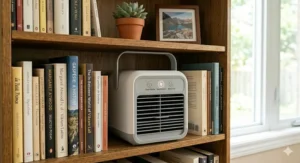
About the size of a smartphone, this one is built for carrying in a bag or back pocket, with a small misting reservoir and roughly 12-hour rated runtime on low. It’s genuinely one of the more useful “grab and go” options if you want a quick blast of cool, misted air at a festival, on transit, or walking the dog on a humid Halifax evening. Owners commonly note the water compartment is on the small side, so don’t expect it to run on mist mode for the full 12 hours — that number assumes lighter settings.
Pros: Truly pocketable; long rated battery life; inexpensive.
Cons: Small water tank limits continuous misting; charging is via USB cable, not fast-charge.
Typical price sits around $20–$35 CAD, making it one of the cheaper entries on this list and a sensible stocking-stuffer-style gift.
3. Arctic Air Grip Go
This one clamps onto a desk edge, treadmill, stroller, or patio table with a 2.5-inch universal clamp and swivels 360 degrees. The battery is rated around 5 hours per charge, shorter than the pocket and wearable models, which makes sense given it’s also running a more powerful fan motor. The clamp itself has been called out by reviewers as notably sturdy compared to similar clip-fans, which matters if you’re mounting it somewhere with vibration, like a treadmill rail.
Pros: Sturdy clamp fits a wide range of surfaces; swivelling head; rechargeable via USB.
Cons: Shortest runtime on this list; no carrying case for travel.
Price typically lands around $25–$40 CAD — solid value if a clip-on fan suits your setup better than a desktop unit.
4. Arctic Air Freedom
The wearable option here is a hands-free neck cooler shaped a bit like an open-back headphone, with vents along the top edge that direct air at your neck and face. It runs on a rechargeable lithium-ion battery, and runtime depends heavily on speed setting. One practical Canadian-specific note: lithium-ion batteries like this one aren’t allowed in checked luggage and have carry-on restrictions on some routes, so if you’re flying with it, check current Transport Canada and airline rules rather than assuming it travels freely.
Pros: Hands-free design; lightweight; rechargeable.
Cons: No water/evaporative cooling — it’s airflow only, so the “cooling” is really just moving air past your skin; can look unusual in public, which some buyers love and others don’t.
Expect to pay around $35–$55 CAD. Best suited to commuters, hikers, or anyone doing yard work who wants both hands free.
5. Arctic Air Freedom Touch
A step up from the basic Freedom, this version adds a thermoelectric cooling plate that rests against the back of your neck alongside the fan vents, rated for roughly 6 hours per charge. Multiple retailer reviews single out the cold plate as the standout feature — it’s a genuinely different sensation from airflow alone, closer to holding a cold pack against your neck. A few reviewers found the band runs small for larger neck sizes, so it’s worth checking the sizing notes on the listing before buying as a gift.
Pros: Cooling plate adds real, airflow-independent cooling; useful for hot flashes or outdoor events, not just hot weather; rechargeable.
Cons: Pricier than the basic Freedom; fit can run small for some users.
Price is typically around $45–$65 CAD, making it the most expensive item on this list but arguably the one with the most genuinely novel cooling tech.
6. Arctic Air Breeze Jet
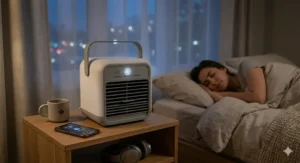
A clip-on wearable that attaches to a collar, waistband, or stroller strap rather than wrapping around the neck. It’s positioned as a lighter, more travel-friendly alternative to the full neck-fan style, rechargeable and rated for several hours of use depending on speed.
Pros: Lightweight and unobtrusive; clips onto clothing rather than wrapping around the body; good for kids or anyone who dislikes neck-worn devices.
Cons: Less direct airflow than a neck fan since it’s not positioned right against the skin; battery specs are less standardized across retailer listings, so double-check the exact runtime on the listing you’re buying from.
Price generally runs $30–$50 CAD.
7. Generic Rechargeable Misting Mini-Coolers
This isn’t one product — it’s the enormous category of near-identical desktop misting fans from marketplace sellers, usually advertised with 4,000–5,200 mAh batteries, 3 speed settings, and water tanks between 500 mL and 1,200 mL. They’re the cheapest entries on Amazon.ca for this search term, and that’s both their appeal and their risk: build quality, real battery life, and customer support vary wildly between sellers even when the listing photos are nearly identical, because many of these are rebranded from the same overseas factories. If you go this route, lean toward listings with a longer review history and a real number of verified ratings rather than a brand-new listing with suspiciously perfect reviews.
Pros: Lowest price point on this list; widely available; decent feature set on paper (multiple speeds, LED lights, USB charging).
Cons: Inconsistent quality control between sellers; vague or inflated battery claims are common; harder to get warranty support if something fails.
Price ranges from about $20–$45 CAD, with no consistent “going rate” since it depends entirely on the seller.
What to Expect: Real-World Performance in Canadian Conditions
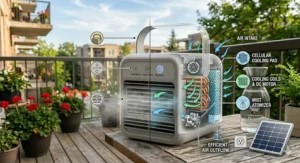
Evaporative cooling works by pulling warm air through a water-soaked filter; as the water evaporates, it absorbs heat from the air passing through, which is the same basic principle behind a swamp cooler. That mechanism is genuinely most effective in hot, dry air — it cools less in humid conditions because the air is already closer to saturated and can’t absorb much more moisture. Practically, that means these devices tend to perform better on a dry 28°C day on the Prairies than on a sticky 28°C day with high humidex in southwestern Ontario or the Maritimes.
It’s also worth being clear-eyed about scale: these units cool the air immediately around your face or desk, not a room. If you’re trying to bring down the temperature of an entire bedroom, you want a real portable or window air conditioner with a BTU rating suited to the room’s square footage, not a personal cooler. And on genuinely dangerous heat days, Health Canada is explicit that fans — including cooling gadgets that rely mainly on airflow — stop being effective at cooling the body once temperatures pass roughly 35°C, and recommends moving to an air-conditioned space instead. A personal cooler is a comfort upgrade for an ordinary hot day, not a safety device for a heat warning.
Real-World Scenario: Matching the Product to Your Life
The Calgary condo office worker: stuck at a desk with central air that never feels quite cool enough. A desktop evaporative cooler like the Pure Chill Rechargeable, refilled each morning, is a low-effort way to add a few degrees of relief without annoying anyone with a space heater-sized appliance.
The Ottawa commuter cycling or walking to work: wants hands-free cooling that doesn’t involve carrying a water bottle to refill mid-commute. The Arctic Air Freedom or Freedom Touch fits this better than anything evaporative, since it doesn’t depend on a water tank running dry partway through the ride.
The family heading to outdoor festivals or kids’ sports games all summer: wants something cheap, portable, and replaceable if a kid drops it in the grass. The Pocket Chill or a budget generic misting fan makes more sense here than a $60 wearable — the cost of loss or breakage matters more than top-tier cooling power.
Common Mistakes When Buying a Rechargeable Personal Air Conditioner in Canada
- Assuming “air conditioner” means refrigerant-based cooling. Almost everything sold under this search term is an evaporative cooler or a plain fan. If you need to cool a sealed room with no airflow, you need a real portable AC unit, not a personal one.
- Ignoring humidity. A device that performs beautifully in a dry climate may feel underwhelming during a humid Toronto or Halifax summer, since evaporative cooling depends on dry air to work.
- Trusting battery and runtime claims at face value. Manufacturer numbers are almost always measured on the lowest speed setting in ideal conditions; real-world use on higher speeds will be shorter.
- Buying the cheapest unbranded listing without checking the seller’s review history. A brand-new storefront with only five-star reviews and no negative feedback is a common pattern for low-quality dropship listings — look for sellers with hundreds of reviews accumulated over time.
- Forgetting about filter and tank maintenance. Evaporative coolers need their filter pads replaced periodically and their tanks emptied between uses to avoid mould and mineral buildup — skipping this is the single biggest reason people end up disappointed after a few weeks.
Rechargeable Cooler vs. Plug-In Fan vs. Real Air Conditioner
It’s worth being honest about where this category sits relative to its two neighbours. A rechargeable personal cooler trades cooling power for portability — you can take it anywhere, but it won’t touch the temperature of a room. A plug-in box fan or tower fan moves more air for less money and never needs charging, but it’s stuck near an outlet and, like all fans, becomes less useful once the air itself is hot rather than just still. A true portable or window air conditioner — something rated in BTUs with an actual compressor — is the only category here that lowers the air temperature of a space rather than just moving or evaporating moisture into it, and it’s the only one that matters once a heat warning is in effect. Think of rechargeable personal coolers as a complement to a real AC unit for spot-cooling, travel, and outdoor use — not a replacement for one in your bedroom on a 35°C night.
How to Spot a Fake or Misleading Review on Amazon.ca
Because this product category is so saturated with near-identical listings, reviews can be one of the least reliable signals if you don’t know what to look for. A few honest tells: a wall of five-star reviews posted within the same short window, reviews that read like marketing copy rather than personal experience, and “verified purchase” badges on accounts with no other review history. Canada’s Competition Bureau, which enforces rules against misleading advertising and deceptive marketing practices, notes that genuine testimonials are supposed to reflect real, current experience with a product — which is exactly what a flood of generic, near-identical reviews usually doesn’t. When in doubt, sort by “most recent” rather than “top reviews” and read a handful from the last few weeks rather than trusting an aggregate star rating alone.
Practical Usage and Maintenance Guide
Getting decent performance and lifespan out of any evaporative personal cooler comes down to a few habits:
- Use cold or iced water, not room-temperature tap water. The colder the water going in, the colder the air coming out, especially in the first hour of use.
- Empty the tank between uses rather than letting water sit. Standing water in a warm room is exactly the kind of environment mould likes, and a mouldy filter will make the airflow smell worse, not cooler.
- Replace the filter pad on schedule. Most evaporative units recommend swapping the cooling filter every one to three months with regular use — skipping this is a common reason people feel the unit “stopped working” when really the filter is just saturated with mineral deposits.
- Charge fully before first use, and avoid letting lithium-ion batteries sit fully drained for long periods, which can shorten battery lifespan over time on any rechargeable device.
- Store with an empty, dry tank over winter. Leaving water in a plastic reservoir for months is a reliable way to end up with a mildew smell by the time next summer rolls around.
Long-Term Cost in Canada
These devices are inexpensive enough that “total cost of ownership” mostly comes down to two things: replacement filters (a few dollars every couple of months for evaporative models, if the manufacturer sells them separately) and battery longevity, since none of these have user-replaceable batteries — once the lithium-ion cell degrades, the device is generally replaced rather than repaired. At $20–$70 CAD per unit, even a unit that lasts only two or three summers is a low-stakes purchase compared to a real portable air conditioner, which can run several hundred dollars but actually lowers room temperature and is built to last many seasons with proper care.
Frequently Asked Questions
❓ Does a rechargeable personal air conditioner actually cool a room in Canada?
❓ Are these rechargeable air coolers available at Canadian Tire as well as Amazon.ca?
❓ How long does the battery last on a rechargeable personal cooler?
❓ Do these personal coolers work in Canadian winters or only summer?
❓ Is a rechargeable evaporative cooler less effective in humid weather?
Conclusion
A rechargeable personal air conditioner won’t replace a real AC unit, and it’s not meant to — but for spot-cooling your desk, commute, or weekend outdoors, the better-known Arctic Air models on this list offer a reasonably consistent experience for a modest price, while the sea of generic listings is a gamble that pays off more often at the lower end of the price range than the higher end. If you remember one thing from this guide, let it be this: check the humidity forecast as much as the temperature, and on genuinely dangerous heat days, head for real air conditioning rather than relying on any personal cooling gadget.
✨ Stay Cool This Summer
Check current pricing, availability, and reviews on Amazon.ca before you decide — and if you found this guide useful, sharing it helps other Canadian shoppers avoid the low-quality knockoffs in this category too.
Recommended for You
- 7 Best Dog Cooling Towels in Canada 2026 (Tested Picks)
- Best Cooling Collar for Dogs Hot Weather in Canada 2026 (Top 7)
- 7 Best Orthopedic Cooling Dog Beds for Senior Dogs in Canada (2026)
Disclaimer: This article contains affiliate links. As an Amazon Associate, I earn from qualifying purchases. If you purchase products through these links, we may earn a small commission at no additional cost to you.
Found this helpful? Share it with your friends! 🤗
