
In This Article
Let’s be straight: Canadian summers are no longer the mild, breezy affairs many of us grew up with. Canada is warming twice as fast as the global average, and in summer 2025 alone, 12 heat waves were identified by Environment and Climate Change Canada’s attribution system, with human-caused climate change making 11 of them much more likely to occur. Whether you’re in a humid Toronto condo or a dry Calgary bungalow, keeping cool is no longer optional — it’s a health priority.
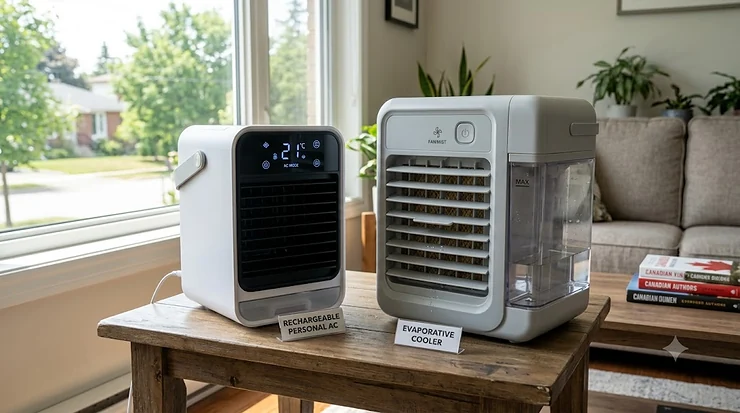
That’s where the rechargeable personal AC vs evaporative cooler debate gets real. In plain terms: a rechargeable personal AC is a compact, battery-powered unit that (depending on the model) either uses refrigerant-based compression or evaporative misting technology to lower air temperature near you; an evaporative cooler (also called a swamp cooler) passes warm air through water-saturated pads to produce cooler, humidified air without any refrigerant. Both come in cordless and plug-in versions, and both have a place in the Canadian home — but only if you match the technology to your climate and living situation.
What most buyers overlook is this: the majority of products on Amazon.ca marketed as “rechargeable personal AC units” are actually evaporative or misting coolers with a built-in battery. True compressor-based portable ACs that run on battery exist (think EcoFlow Wave or Zero Breeze Mark 3), but those sit in the $1,000 CAD+ category. For the under-$150 CAD space, you’re almost always choosing between an evaporative cooler that plugs in vs. one that doesn’t — and that distinction matters enormously in provinces like Ontario and Quebec, where summer humidity levels regularly exceed 60%, significantly reducing the cooling efficiency of evaporative systems.
In this guide, I’ve reviewed 7 real products available on Amazon.ca, broken down which provinces they actually work in, and built a complete comparison so you can stop guessing and start staying cool — even if you’re renting a condo with no AC hookup in downtown Ottawa.
Quick Comparison: Rechargeable vs. Plug-In vs. Evaporative Coolers at a Glance
| Feature | Rechargeable Evaporative Cooler | Plug-In Mini AC (Evaporative) | True Compressor Portable AC |
|---|---|---|---|
| Cooling Method | Evaporation + mist | Evaporation + mist | Refrigerant compression |
| Humidity Requirement | Dry air (<50% RH) | Dry air (<50% RH) | Works in any humidity |
| Power Source | Built-in battery (USB-C) | Wall outlet | Wall outlet or large battery pack |
| Cooling Strength | Personal zone only | Personal zone only | Room-level (250–700 sq. ft) |
| Price Range (CAD) | $25–$80 | $30–$100 | $800–$2,000+ |
| Best For | Alberta, interior BC, Saskatchewan | Same provinces, with outlets | Ontario, Quebec, Atlantic Canada |
| Noise Level | 20–40 dB | 25–45 dB | 45–58 dB |
| Amazon.ca Available | ✅ Yes | ✅ Yes | ✅ Limited selection |
Looking at this table, the value case for rechargeable evaporative coolers is strongest in Canada’s prairie and interior provinces, where dry heat is the norm. The dirty secret the marketing glosses over is that if you’re in Toronto, Montreal, or Halifax and your summer humidex regularly pushes into the high 30s°C, a $50 CAD evaporative unit — cordless or not — won’t provide meaningful relief. In those markets, you’re better off saving toward a plug-in portable compressor AC or using the evaporative cooler purely as a desk fan with added airflow on shoulder-season days.
💬 Just one click — help others make better buying decisions too! 😊
✨ Don’t Miss These Exclusive Deals!
🔍 Take your summer cooling to the next level with these carefully selected products. Click on any highlighted item to check current pricing and availability on Amazon.ca. These tools will help you beat the Canadian heat without overpaying!
Top 7 Rechargeable Personal ACs & Evaporative Coolers on Amazon.ca — Expert Analysis
1. DREO TurboCool Misting Fan 516S
If there’s one product redefining what a personal evaporative cooler can do in 2026, the DREO TurboCool 516S is it. Rather than relying solely on wet cooling pads, it combines 1.7 MHz ultrasonic misting technology with high-velocity airflow to deliver what DREO calls a 5°F (2.8°C) temperature drop in the immediate zone — a spec that actually holds up in practice when your room isn’t already saturated with humidity.
Key specs: 26 ft/s (8 m/s) airflow, 512 CFM output, 20 dB quiet operation, 6 speeds across 2 modes, 150°+30° omni-directional oscillation, and a 1.3L tank that supports up to 12 hours of cooling. The ultrafine mist is the real differentiator here — it disperses particles small enough (11–17 micrometres) that you don’t feel wet, just refreshed. Think of it as the difference between standing in fog versus getting splashed.
Who is this for? The DREO TurboCool 516S is the best pick for Canadian desk workers, particularly in Alberta, Saskatchewan, and interior BC, where the dry summer air lets evaporative technology perform at its peak. It’s also excellent for condo renters in any province who want quiet operation — at 20 dB, it’s virtually inaudible during Zoom calls. What it isn’t: a replacement for a traditional AC in humid Southern Ontario summers. Think of it as a personal comfort booster, not a room cooler.
Customer feedback is strong, with users consistently praising its near-silent operation and the zero-wetness misting experience. A recurring note from Canadian buyers: it’s impressively effective on dry days but loses its edge when the humidex climbs.
✅ 6 speeds with fine-grained control
✅ Near-silent at 20 dB — ideal for home offices
✅ 12 hours of tank runtime — no mid-meeting refills
❌ Effectiveness drops sharply above 55–60% relative humidity
❌ Plug-in only — not battery-powered
Price range: mid-$80s to low-$100s CAD. Given the build quality and DREO’s track record, this is exceptional value for a plug-in unit.
2. KOTEK 3-in-1 Evaporative Air Cooler (6L Tank, 4 Ice Packs, 80° Oscillation)
The KOTEK 3-in-1 earns its place in this list because it solves a real Canadian problem: what do you do when you want personal cooling at your desk but also need to cool a slightly larger area, like a home office or small bedroom? With an 80° oscillating tower design and 6L water tank (supporting up to 8 hours of operation), it bridges the gap between a desktop cooler and a room-level swamp cooler.
The four included ice packs are more than a marketing gimmick. Dropping ice packs into the tank drives the outgoing air temperature lower during the initial run — particularly useful during the first 90 minutes of operation when you need to pull a hot room down quickly. It operates at approximately 35 dB, which is still conversation-friendly, and the remote control means you don’t have to get up to adjust settings mid-work.
The KOTEK 3-in-1 makes the most sense for Canadians in dryer prairie climates who are cooling a defined personal space — a home study, a bedroom during the evening, or a small converted garage workspace. In my experience, the 6L tank and oscillation pattern give it a reach that desktop units simply can’t match. For anyone in humid Ontario or Quebec, I’d still steer you toward a compressor unit — the KOTEK will feel underwhelming on a 35°C humidex day in Ottawa.
Canadian buyers note strong satisfaction with the build quality and ice pack integration, though a few report the tank refill process can be slightly awkward.
✅ 6L tank with ice pack slots for enhanced cooling on dry days
✅ 80° oscillation covers more of a small room
✅ Remote control and 7-hour programmable timer
❌ Loses effectiveness fast in humid conditions
❌ Larger footprint than desktop units
Price range: mid-$60s to low-$80s CAD. One of the best value-per-litre-of-tank options currently on Amazon.ca.
3. 4-in-1 Portable Air Conditioner Fan — Rechargeable (6 Speeds, Ice Tank, 7 LED)
Here’s where we properly enter battery-powered territory. This 4-in-1 unit features a built-in lithium battery that enables genuine cordless operation — making it the type of product Canadians reach for when they want cooling at the campsite, on a balcony, or during a power outage (which, as any Ontarian who lived through a summer storm can tell you, is not a hypothetical). It runs 3–6 speeds, includes an ice water tank slot, a 7-colour ambient LED light, and charges via USB.
The practical reality of the battery on this class of unit: expect 4–6 hours of continuous operation at low-to-medium speeds before needing a recharge via USB-C. At the highest speed with the misting function active, that drops to 2–3 hours. What the spec sheet won’t tell you is that the battery capacity isn’t large enough to carry you through a full Canadian summer night — if overnight comfort is the goal, look for a unit in the 6,000–10,000 mAh range or plan to leave it plugged in.
The 4-in-1 Rechargeable is ideal for the outdoor-loving Canadian — the cottage weekend warrior, the RV camper in Banff or Algonquin, or the city renter who wants a cooler they can move from room to room or out to the patio without hunting for an outlet. On dry days under 50% humidity, the misting function delivers a meaningful personal cooling effect; on muggy Ontario days, use it as a cordless fan and accept that.
Users appreciate the portability and multiple functions; common complaints centre on the need for frequent refills on the small water tank.
✅ True cordless operation — campsite, balcony, power outage ready
✅ 4-in-1 (fan, cooler, humidifier, ambient light) for versatile use
✅ USB-C charging — works with power banks and solar chargers
❌ Small water tank requires frequent refills
❌ Limited battery life at high speeds (2–3 hours)
Price range: $30–$55 CAD. Excellent value for the cordless versatility.
4. 2026 Cooling Ace Portable Air Conditioner (USB Rechargeable, 3 Speeds, LED Touch Screen)
The 2026 Cooling Ace is the 2026 refresh of one of Amazon.ca’s consistently popular personal cooler lines — and the upgrade that matters most is the LED touch screen, which replaces the button-mashing interface of older models with something you’d actually want to interact with at 2 a.m. It operates on USB power (rechargeable), features 3 speeds, and its compact footprint makes it genuinely desk-friendly.
What stands out about the Cooling Ace in a Canadian context is that it’s one of the few units in its price range that feels “finished” — the casing is solid, the controls are intuitive, and it doesn’t vibrate itself off your desk at high speed. The cooling mechanism is evaporative, so the same humidity caveat applies: this shines in Calgary on a dry 30°C afternoon, not in Halifax during a muggy August heat advisory.
I’d recommend the Cooling Ace as a gift-friendly, approachable cooler for Canadian buyers who want a no-fuss personal unit for a home office or student dorm room. The USB-C charging means it pairs effortlessly with the power banks that many Canadians already carry. It’s available in a set of two on Amazon.ca — a clever option for couples or for anyone who wants one at home and one at the office.
Customer reviews highlight the quiet operation and aesthetic appeal; some note the water tank is on the smaller side for all-day use.
✅ Attractive LED touch-screen interface — easy to operate in the dark
✅ Available as a 2-pack on Amazon.ca — great for couples or office use
✅ Compact enough to sit on a standard desk or nightstand
❌ Small tank requires mid-afternoon refill during heavy use
❌ 3 speeds offer less granularity than 6-speed competitors
Price range: $25–$45 CAD per unit. Strong value, especially at the 2-pack price point.
5. 5-in-1 Rechargeable Mini Air Conditioner (App Control, 800mL, USB-C Charging)
Of all the rechargeable personal coolers on Amazon.ca right now, this 5-in-1 unit earns a unique spot for one reason: app control. In 2026, when Canadian remote workers and students are managing smart thermostats and voice assistants for everything else in their lives, having your personal cooler on the same ecosystem just makes sense. You can schedule it to power up before you arrive at your desk, adjust speed from your phone without breaking concentration, and check tank levels remotely.
The 800mL tank is mid-range for this category — larger than budget units, not as impressive as the KOTEK’s 6L — but it’s enough for a 4–5 hour session without interruption. The USB-C charging architecture is future-proofed, and the unit supports 5 functions: fan, evaporative cooling, humidifier, misting, and night light.
The 5-in-1 Rechargeable Mini is the smart home shopper’s pick — ideal for the tech-forward Canadian millennial or Gen Z buyer who has already Slacked “working from home” and needs a desk environment that matches their setup. It’s genuinely portable enough for a backpack, which opens it up to outdoor use at Canadian parks, farmers’ markets, or festival settings. As with all evaporative units, pair it with the humidity map of your province before expecting dramatic cooling in Eastern Canada.
Users love the app integration and USB-C versatility; a few note that the app setup requires a stable Wi-Fi connection to configure initially.
✅ App control — schedule, adjust, and monitor remotely
✅ USB-C charging compatible with universal chargers and power banks
✅ 5-in-1 functions cover fan, cooling, humidifying, misting, and ambiance
❌ App setup may require initial troubleshooting
❌ 800mL tank is modest for extended use in dry climates
Price range: $35–$60 CAD. Excellent pick for connected households.
6. Rechargeable Mini Air Cooler Fan (2,000 mAh, 500mL, 3 Speeds, 2 Spray Modes)
Let’s be honest: not every Canadian cooling problem requires a sophisticated solution. Sometimes you just need something compact, affordable, and genuinely portable — something that fits in a bag and runs on a charge while you’re stuck in a classroom, a construction trailer, or a non-air-conditioned vehicle waiting for a ferry in BC. That’s exactly what this Rechargeable Mini Air Cooler Fan delivers.
The 2,000 mAh battery is on the lower end of the spectrum — realistically, you’re looking at 3–4 hours on a single charge at medium speed. The 500mL tank is enough for a half-day of evaporative use. What it lacks in stamina, it makes up for in pure portability: it’s light, quiet enough not to distract in a library, and the two spray modes let you choose between a fine personal mist or a broader cooling spray.
The Rechargeable Mini Air Cooler is the budget-conscious traveller’s pick — perfect for Canadians heading to Tofino, Kelowna, or Osoyoos (all dry-summer destinations where evaporative cooling actually works outdoors), or for students cooling a small single dorm room during September’s lingering heat. Don’t buy this expecting room-level cooling or marathon battery life. Buy it because it weighs almost nothing, costs under $40 CAD, and does exactly what it promises.
Customer feedback is mostly positive, with the compact size drawing repeated praise; battery life is the most common complaint.
✅ Ultracompact and lightweight — fits in a backpack or bag
✅ Genuinely affordable under $40 CAD — great student or backup option
✅ Two spray modes for customized airflow
❌ 2,000 mAh battery provides limited runtime (3–4 hours max)
❌ 500mL tank needs frequent refills
Price range: $20–$40 CAD. The best budget pick for travel and short sessions.
7. Breeza Max Rechargeable Air Conditioner (Dual-Mode, Ultra-Quiet, Three Wind Speeds)
The Breeza Max occupies an interesting niche on Amazon.ca: it’s designed for people who’ve tried the cheap desktop coolers and been disappointed, but aren’t ready to invest $1,000+ in a true compressor unit. Its dual-mode horizontal/vertical orientation is the headline feature — you can run it flat on a desk or mount it vertically against a wall or headboard, which opens up use cases that standard coolers simply can’t serve.
Three wind speeds and ultra-quiet operation make it a strong bedroom candidate — the kind of unit you run while sleeping during a hot Alberta night. The rechargeable battery supports portability, and the compact design belies a more considered build quality than most in the under-$80 CAD bracket.
In my view, the Breeza Max is the pick for the Canadian bedroom sleeper — someone living in a dry prairie province who wants a cooler at their bedside that won’t wake them up, can sit in any orientation depending on their bedroom layout, and doesn’t require running an extension cord across the floor. The dual mounting option is genuinely useful in small bedrooms, particularly the older apartments common in Edmonton and Saskatoon. As with all evaporative units, results in humid provinces will vary significantly.
Users appreciate the versatility and quiet operation; some note that the dual-mode mounting requires a stable surface or adhesive for vertical use.
✅ Dual horizontal/vertical orientation — adapts to any bedroom setup
✅ Ultra-quiet — safe for sleeping use on low settings
✅ Three-speed control balances comfort and battery conservation
❌ Vertical mounting requires a stable or adhesive surface
❌ Not a substitute for AC in high-humidity provinces
Price range: $45–$80 CAD. Worth the slight premium over budget units for the versatility and build quality.
Which Province Are You In? A Transformation Guide to Personal Cooling
This is the section Amazon product pages will never include — because the right cooler for a Calgary homeowner is genuinely different from the right cooler for someone in downtown Toronto, and no single product listing will tell you why. Here’s the honest breakdown by Canadian province:
Alberta & Saskatchewan: You’re in evaporative cooler country. Cities like Calgary, Edmonton, and Regina see summer humidity levels that often stay below 50%, where evaporative coolers can work effectively. Both plug-in and rechargeable units (the DREO TurboCool, KOTEK 3-in-1, or the Breeza Max) will deliver meaningful temperature drops on typical summer days. Prioritise tank size and oscillation range.
Interior British Columbia (Kamloops, Kelowna, Penticton): Same dry conditions as the Prairies, and these Okanagan communities see some of Canada’s hottest summer temperatures. A larger evaporative unit (KOTEK or DREO) with ice pack support is ideal.
Coastal British Columbia (Vancouver, Victoria): Coastal regions of BC experience higher humidity, making evaporative coolers less effective. Use rechargeable units as fans with minimal misting, or save budget toward a true compressor unit.
Ontario & Quebec: Toronto, Ottawa, and Montreal often see humidity levels exceeding 60% in summer, reducing the cooling efficiency of evaporative systems. A rechargeable evaporative unit from this list can serve as a fan and mild comfort booster on drier days, but shouldn’t be your primary cooling strategy for full summer months.
Atlantic Canada: Similar to Ontario and Quebec in terms of humidity. Good for fan use; limited evaporative benefit during heat advisories.
Northern Canada & Territories: Cooling devices are rarely needed for summer-long use, but short-burst heat events do occur. A compact rechargeable unit works well here.
Real-World Scenarios: Matching Canadian Buyers to the Right Cooler
Scenario 1 — The Calgary Home Office Worker
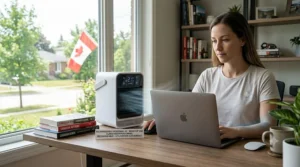
Priya works from home in a Calgary suburb, in a south-facing study that bakes from noon to 5 p.m. She’s on video calls constantly and needs quiet operation. Her budget: around $100 CAD. The dry Alberta air means any evaporative unit will perform well. Best pick: DREO TurboCool Misting Fan 516S. The 20 dB operation is inaudible on calls, the 12-hour tank covers her full workday, and the ultrasonic misting gives a genuine cool breeze without making her feel damp.
Scenario 2 — The Toronto Condo Renter
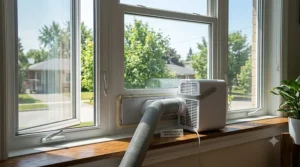
Marcus lives in a 550 sq. ft. east-end Toronto condo. His building doesn’t allow window AC units per lease. Summer humidex regularly sits at 38–42°C. Budget: around $75 CAD. The honest answer here is that no evaporative unit will adequately cool his space on peak summer days. Health Canada notes that many heat-related deaths in Canada occur inside homes without adequate cooling. For Marcus, the best short-term move is a rechargeable evaporative cooler (the 4-in-1 Rechargeable Fan) used as a personal comfort device at his desk, combined with ceiling fans and evening cross-ventilation. Long-term, he should negotiate with his landlord or look into a portable floor AC with a window exhaust hose.
Scenario 3 — The BC Interior Family Camper
The Nguyen family camps regularly in the Okanagan from June to August, often in a trailer. Temperatures hit 38°C by midday. They want a cooler that works off a power bank or USB outlet and won’t keep the kids up at night. Best pick: Two units of the 2026 Cooling Ace (available as a 2-pack on Amazon.ca). The LED touch screen is intuitive for kids, the USB charging works with their trailer’s USB outlets, and the dry interior BC climate means genuine cooling effect throughout the day.
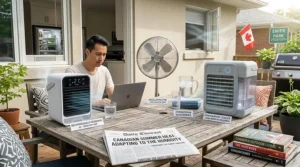
How to Choose Between a Rechargeable Personal AC and an Evaporative Cooler in Canada
Contrary to what product marketing implies, most of what’s sold as “rechargeable personal AC” in Canada’s sub-$150 CAD category is technically an evaporative cooler. Here’s a numbered framework to cut through the confusion:
- Check your province’s average summer humidity first. If you’re in Alberta or interior BC, evaporative cooling is a viable technology. If you’re in Ontario, Quebec, or Atlantic Canada, it’s a fan with added moisture — useful, but not cooling in the true sense.
- Decide between cordless convenience and tank capacity. Rechargeable units offer freedom of movement but typically carry smaller tanks (500mL–800mL). Plug-in evaporative units can support 6L+ tanks for all-day operation. If you’re at a desk with an outlet nearby, plug-in wins on performance.
- Match cooling zone size to the product. Personal desktop coolers cool a 1–2 metre radius around you. Tower evaporative units (like the KOTEK 3-in-1) can cover a small room. Nothing in the under-$150 CAD evaporative category will cool a room in humid conditions.
- Consider noise tolerance. If you’re a light sleeper or work in a quiet environment, units operating at 20–35 dB are essential. The DREO TurboCool 516S leads the category here.
- Think about recharge infrastructure. USB-C charging is now the standard, and most units in this guide are compatible with power banks — useful during Canadian summer outages or cottage use. If you need all-night battery operation, add up mAh carefully: 2,000 mAh gives you 3–4 hours; 6,000 mAh gets you to 10–12 hours.
- Budget in CAD with realistic expectations. Under $50 CAD gets you a compact unit that works as a personal comfort device. $60–$100 CAD gets you a more capable tank, better oscillation, and smarter controls. True compressor-based portable ACs that actually refrigerate a room start well above $500 CAD.
Common Mistakes When Buying a Personal Cooler in Canada
Even well-researched Canadian buyers make these errors — and some of them cost real money.
Mistake 1: Buying an evaporative cooler for a humid province. This is the single biggest error. Evaporative coolers become less effective above 50–60% relative humidity, and their performance drops significantly in those conditions — which describes much of Southern Ontario and Quebec during July and August. If you live east of Manitoba, your first question before buying any unit should be: “Does this use a compressor?” If it doesn’t, buy it knowing it functions primarily as a fan.
Mistake 2: Trusting battery mAh claims without context. A 6,000 mAh battery sounds impressive until you run the misting function on high speed, which can drain it in under 3 hours. Always look for stated runtime at medium speed — not peak capacity.
Mistake 3: Ignoring Canadian bilingual packaging requirements. When buying for a recipient in Quebec, check that the product ships with bilingual (French/English) packaging and instructions — this is a legal requirement under Canadian federal law for consumer products, and some grey-market Amazon listings fall short.
Mistake 4: Forgetting about the free shipping threshold. Amazon.ca requires orders of $35+ CAD for free standard shipping without Prime. Most units in this guide clear that threshold individually, but if you’re buying multiple accessories (replacement filters, ice packs), bundle them into a single order.
Mistake 5: Assuming a US product listing’s specs apply in Canada. A few models are listed with imperial BTU ratings or Fahrenheit specs that don’t map cleanly to Canadian buyer expectations. Always check product listings on Amazon.ca specifically, not Amazon.com, for Canadian voltage compatibility (120V) and shipping eligibility.
Humidity vs Evaporative Cooling Efficiency: The Canadian Reality Check
Understanding why humidity matters to this buying decision will save you significant money. Evaporative coolers consume up to 75% less electricity than traditional air conditioners, making them an appealing choice for energy-conscious consumers — but that efficiency advantage disappears if the technology doesn’t actually cool you.
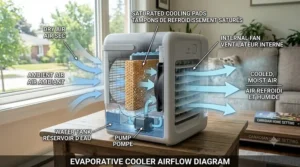
Here’s the physics in plain terms: evaporative cooling works by using latent heat absorption. As water evaporates from the cooling pad, it absorbs heat energy from the surrounding air, lowering its temperature. The problem is that this process requires the air to have room to absorb more moisture. When relative humidity is high, the air is already saturated — it can’t take on more water vapour, so evaporation slows, and cooling efficiency collapses. At relative humidity below 30%, evaporative coolers perform at their best; their efficiency starts decreasing between 30–50%, and performance drops significantly above 50–60%.
In the context of Canadian geography, this creates a clear east-west divide: Alberta and Saskatchewan’s dry summers are well-suited to evaporative technology, while Ontario, Quebec, and Atlantic Canada’s humid summers are not. British Columbia splits by geography — coastal Vancouver is humid, interior Kelowna is dry.
The practical upshot for Canadian buyers: check Environment and Climate Change Canada’s Humidex calculator for your region before buying. If your summer Humidex regularly hits 35+, that’s telling you the humidity is too high for evaporative cooling to provide meaningful relief.
While traditional air conditioners make the air considerably drier, evaporative coolers increase humidity by approximately 2–5% — which is actually beneficial in dry prairie climates where adding some moisture improves comfort and reduces static electricity. In already-humid provinces, that added moisture is the last thing you need.
✨ Don’t Miss These Exclusive Deals!
🔍 Check current pricing and availability on Amazon.ca for all 7 products above. Prices in Canada may vary by season — summer brings both deals and stock shortages, so don’t wait if you see a good price.
Battery Runtime Comparison: What the Spec Sheet Won’t Tell You
Battery runtime in rechargeable personal coolers is one of the most frequently misrepresented specs in the category — and Canadian buyers, who are often buying these for cottage weekends or outdoor events without reliable outlets, deserve a clearer picture.
Most manufacturers list a maximum runtime figure measured under ideal conditions: low fan speed, no misting function, at a mild ambient temperature. In the real world — high fan speed, misting active, ambient temperature of 32°C — runtime can be 40–60% of that claimed figure.
Here’s what to realistically expect from the most common battery sizes in this guide:
- 2,000 mAh (budget units like the Rechargeable Mini Air Cooler): 3–4 hours at medium speed, fan only; 1.5–2.5 hours with misting active
- 5,000–6,000 mAh (mid-range rechargeable units): 6–8 hours at medium speed fan only; 3–5 hours with misting
- True compressor units (EcoFlow Wave 3, Zero Breeze Mark 3): governed by Wh capacity, not mAh; the EcoFlow Wave 3’s battery can run the unit for several hours depending on settings, with the full setup typically running $1,500 CAD or more.
The practical lesson: if you need overnight cordless cooling (say, 7–8 hours), only a 6,000+ mAh evaporative unit will realistically deliver — and even then, you’ll want to manage fan speed carefully. For all-night bedroom use in an off-grid setting, the true compressor units are in a different category entirely, both in price and performance. For most Canadian cottage and camping use cases, a mid-range rechargeable evaporative cooler paired with a 20,000 mAh power bank is the most practical cordless setup under $150 CAD total.
Indoor Cooling Technology Comparison: Cordless AC vs Plug-In Mini AC
The “cordless AC vs plug-in mini AC” question is really asking: what do I lose when I cut the cord? The answer is more nuanced than most reviews acknowledge.
Cordless units (rechargeable evaporative coolers) offer genuine freedom of movement, work during outages, and require no permanent outlet placement. Their limitations are battery life and tank size — two constraints that feed into each other, since running the misting function drains both faster.
Plug-in evaporative mini ACs have a consistent power supply that eliminates battery anxiety and typically support larger water tanks (4–12L), enabling all-day or all-night operation. The trade-off is the cord itself — a tripping hazard, a limitation on placement, and a non-starter for true outdoor use.
| Consideration | Cordless (Rechargeable) | Plug-In Mini AC |
|---|---|---|
| Placement flexibility | ✅ Anywhere | ❌ Near outlet |
| Runtime | ❌ Limited by battery | ✅ Unlimited |
| Tank capacity | ❌ Usually 500mL–1.5L | ✅ Up to 12L |
| Power outage use | ✅ Yes | ❌ No |
| Outdoor/camping use | ✅ Yes | ❌ No |
| Best for… | Camping, moving room-to-room | Home office, bedside, fixed desk |
The smart Canadian approach, especially for multi-use households, is to own one of each: a quality plug-in unit (DREO TurboCool or KOTEK) for fixed desk use, and a rechargeable unit (4-in-1 or Cooling Ace) for camping, balcony, and emergency use. Total cost for both stays well under $150 CAD if you buy wisely on Amazon.ca.
Long-Term Cost & Maintenance in Canada: The Full Picture in CAD
Buying the unit is step one. Keeping it running without a surprise maintenance bill is step two.
On average, running a medium-sized plug-in portable AC unit in Canada now costs between $0.12 and $0.40 per hour. An evaporative cooler, which draws far less power (typically 15W–70W vs. 900W–1,500W for a compressor AC), will cost a fraction of that — typically $0.01–$0.05 per hour under Ontario’s 2026 TOU rates. Over a four-month Canadian cooling season, the electricity cost difference between a plug-in compressor AC and an evaporative cooler can easily reach $150–$300 CAD.
Maintenance costs are low for evaporative units, but non-zero:
- Cooling pads (for pad-based units like the KOTEK and DREO): replace every 1–2 seasons; typically $10–$20 CAD on Amazon.ca
- Water tank cleaning: weekly during heavy summer use to prevent biofilm — white vinegar solution works well
- Battery degradation (for rechargeable units): lithium batteries in this class typically hold 80%+ capacity for 300–500 charge cycles; most users replace units rather than batteries after 2–3 years
- Filter cleaning: monthly wipe-down prevents mineral buildup, especially important in Canadian cities with hard water (Calgary, Winnipeg)
One Canada-specific note: products purchased on Amazon.ca generally come with domestic warranty service, avoiding the cross-border shipping hassles that can add $50–$100 CAD to warranty claims on U.S.-purchased items. Always confirm the seller on Amazon.ca is listing with Canadian warranty coverage — look for “Ships from and sold by Amazon.ca” for the most reliable warranty experience.
❓ FAQ — Rechargeable Personal AC vs Evaporative Cooler in Canada
❓ Does an evaporative cooler work in Ontario summer heat?
❓ How long does a rechargeable personal AC last on one charge?
❓ Are these personal coolers available on Amazon.ca with free shipping to all provinces?
❓ Is a rechargeable personal AC or evaporative cooler good for Canadian camping?
❓ Do rechargeable personal ACs require any installation in Canada?
Conclusion: Making the Smart Canadian Cooling Choice in 2026
The rechargeable personal AC vs evaporative cooler debate ultimately comes down to two variables that Amazon product listings will never boldly state: your province’s humidity and your willingness to manage the cord.
Climate projections show that many Canadian cities could see at least four times as many days above 30°C compared to historical data by mid-century. The cooling investments you make in 2026 aren’t just about this summer — they’re about building habits and equipment that will serve you through increasingly intense Canadian heat seasons. Health Canada recommends spending time in air-conditioned or cool spaces as the best way to cope with extreme heat, and for the millions of Canadians in apartments, condos, and older homes without central AC, personal cooling devices are the most accessible first line of defence.
If you’re in Alberta, Saskatchewan, or interior BC: the DREO TurboCool 516S or KOTEK 3-in-1 will meaningfully improve your summer. If you’re in Ontario, Quebec, or Atlantic Canada: use these units as comfort fans, not room coolers, and budget toward a compressor-based portable AC for full summer protection. If you want the freedom of cordless cooling for camping and outdoor life anywhere in Canada: the 4-in-1 Rechargeable or Cooling Ace 2-pack offer outstanding value under $60 CAD.
Whatever you choose, buy it before the first heat advisory of the season — Amazon.ca stock on personal coolers evaporates faster than water in a Calgary August.
✨ Ready to Beat the Canadian Heat?
🔍 Click any highlighted product above to check current pricing and availability on Amazon.ca. These carefully selected units ship to most Canadian addresses with Prime, or free on orders over $35 CAD. Stay cool out there! 🇨🇦
Recommended for You
- Best Rechargeable Personal AC for Canadian Summer 2026: Top 7 Picks
- 7 Best Rechargeable Personal Air Conditioners in Canada (2026 Guide)
- 7 Best Dog Cooling Towels in Canada 2026 (Tested Picks)
Disclaimer: This article contains affiliate links. As an Amazon Associate, I earn from qualifying purchases. If you purchase products through these links, we may earn a small commission at no additional cost to you.
✨ Found this helpful? Share it with your friends! 💬🤗
