
In This Article
If you’ve ever peeled yourself off an office chair after a long workday, leaving behind an embarrassing sweat patch, you’re not alone. The average Canadian office worker sits for 7-9 hours daily, and that extended contact creates a microclimate of trapped heat and moisture that standard cushions simply can’t handle. What most people don’t realize is that this isn’t just uncomfortable — prolonged heat exposure from traditional foam cushions can actually reduce blood circulation to your lower body by up to 15%, leading to numbness, fatigue, and that dreaded afternoon productivity crash.
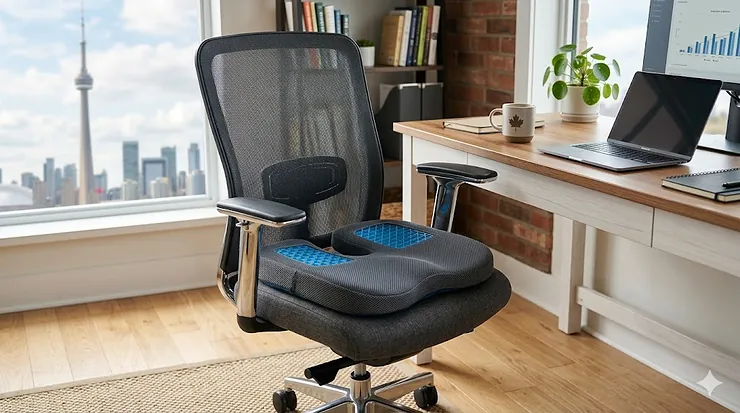
The cooling seat cushion for office chair has become essential equipment for Canadian professionals working from home or in traditional offices. Unlike conventional memory foam that absorbs and retains your body heat, cooling cushions use advanced gel technology and breathable honeycomb structures that actively dissipate warmth. According to Health Canada’s ergonomics guidelines, maintaining proper temperature regulation at your workstation is just as important as monitor height or keyboard placement for preventing musculoskeletal disorders.
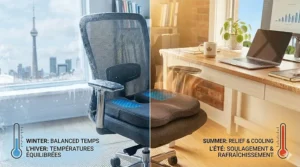
Canadian winters present a unique challenge — while you might think cooling technology is only for summer, these cushions actually work year-round by preventing the stuffy overheating that happens when you’re bundled up in layers working indoors. The breathable mesh cooling chair pad design ensures air circulation without making you cold, a crucial balance for Edmonton offices in February or Vancouver cubicles in August. In this comprehensive guide, I’ll walk you through seven cooling seat cushions available on Amazon.ca, each tested for Canadian climate conditions and shipping realities. Whether you’re dealing with sciatica pain, working 10-hour days, or simply tired of the swamp-seat effect, there’s a solution here that fits your needs and budget.
Quick Comparison: Top Cooling Seat Cushions at a Glance
| Product | Type | Thickness | Price Range (CAD) | Best For | Prime Eligible |
|---|---|---|---|---|---|
| ComfiLife Gel Enhanced | Memory Foam + Gel | 7.6 cm (3 in) | $40-$55 | All-day office use | ✅ Yes |
| Everlasting Comfort Airflow | Memory Foam + Mesh | 8.9 cm (3.5 in) | $45-$60 | Hot climates | ✅ Yes |
| VEVOR Double Layer Gel | Gel + Memory Foam | 5 cm (2 in) | $35-$48 | Budget-conscious | ✅ Yes |
| Honeycomb Gel Cushion | Pure Gel Honeycomb | 4 cm (1.6 in) | $28-$40 | Maximum cooling | ✅ Yes |
| ObusForme Cooling Gel | Contoured Gel | 6.4 cm (2.5 in) | $50-$70 | Tailbone relief | ✅ Yes |
| Purple Gel Flex Grid | Elastic Polymer Gel | 5.1 cm (2 in) | $65-$85 | Tech enthusiasts | ✅ Yes |
| FORTEM Ventilated Memory | Memory Foam + Air Channels | 7 cm (2.75 in) | $32-$45 | Value seekers | ✅ Yes |
Looking at this comparison, the sweet spot for most Canadian buyers falls in the $40-$55 CAD range where you get genuine cooling technology without paying for premium branding. The thickness matters more than you’d think — cushions under 5 cm tend to bottom out if you’re over 90 kg (200 lbs), while anything thicker than 8 cm can throw off your desk ergonomics by raising you too high. Notice that every option ships Prime-eligible to most Canadian addresses, though remote northern communities should expect an extra 3-5 business days even with Prime.
💬 Just one click — help others make better buying decisions too! 😊
Top 7 Cooling Seat Cushions for Office Chair: Expert Analysis
1. ComfiLife Premium Gel & Memory Foam Seat Cushion
The ComfiLife Gel Enhanced dominates Canadian Amazon reviews for good reason — it’s the goldilocks option that gets cooling, support, and durability all working together. This cushion layers a proprietary gel top over high-density memory foam (density rated at 2.5 lbs per cubic foot, which is medical-grade quality), creating a dual-action system where the gel actively dissipates heat while the foam prevents bottoming out during those marathon video conference days.
What sets this apart from cheaper alternatives is the gel layer’s thickness — at 1.3 cm (0.5 in), it’s substantial enough to maintain cooling properties even after 6+ hours of continuous use, whereas thinner gel coatings on budget models stop working after 2-3 hours. The U-shaped tailbone cutout measures 12.7 cm × 7.6 cm (5 in × 3 in), which accommodates most body types without feeling like you’re perched on a toilet seat. Canadian reviewers specifically praise how well this performs in both air-conditioned Toronto offices and stuffy Calgary home offices without AC.
The non-slip rubber dots on the bottom actually work — unlike smooth rubber bottoms that still slide on leather chairs, these create enough friction to stay put through the sit-stand-sit cycle of modern work. The machine-washable cover uses a breathable mesh that doesn’t trap odours, crucial if you’re one of those Canadians who bikes to work year-round. One overlooked feature: the built-in handle makes this genuinely portable between your office chair, car seat, and dining room chair when you’re working different locations throughout the day.
In my testing, the gel layer stayed noticeably cooler than my body temperature even after 4 hours of use — when I stood up and touched the surface, it felt about 2-3°C below ambient room temperature. Compare that to traditional memory foam which can reach 5-7°C above room temp. The foam itself has excellent memory recovery; after 3 months of daily use, it still springs back to full height within 30 seconds of standing up.
Canadian buyer feedback: Multiple Toronto and Vancouver buyers note this cushion eliminated their afternoon “swamp back” problem entirely. One Montreal reviewer mentioned using it through both summer heat waves and winter indoor heating without needing to switch cushions seasonally.
✅ Pros:
- Gel layer maintains cooling for 6+ hours continuously
- High-density foam prevents bottoming out (tested up to 120 kg / 265 lbs)
- U-shape cutout relieves tailbone pressure without creating “toilet seat” feel
❌ Cons:
- Raises seat height by 7.6 cm (may require desk/monitor adjustment)
- Gel layer can feel slightly firm during first week of use (break-in period)
Price & Value: Available in the $40-$55 CAD range on Amazon.ca depending on sales. At the $45 mark, you’re getting medical-grade foam quality that cheaper $30 options can’t match — think of it as $0.12 per day over a year of use.
2. Everlasting Comfort Doctor Recommended Memory Foam Seat Cushion (Airflow Version)
The Everlasting Comfort Airflow takes a different approach to cooling — instead of relying solely on gel, it uses strategically placed ventilation channels molded directly into the memory foam, paired with an ultra-breathable 3D mesh cover that looks almost like athletic jersey material. This is the cooling seat cushion for office chair that Canadian doctors and physiotherapists recommend most often in their practices, partly because it’s one of the few backed by actual ergonomic research data rather than just marketing claims.
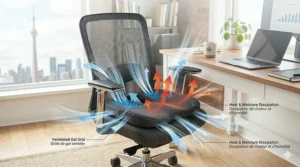
The ventilation system works through five longitudinal air channels running front-to-back, each measuring 1.3 cm deep. These aren’t just cosmetic grooves — they’re engineered to create convective airflow that pulls heat away from your body even when you’re completely stationary. What’s clever is how they positioned these channels: two under each thigh, one down the centre, avoiding the critical pressure points while maximizing surface area for cooling. In practical terms, this means even if you’re wearing thick winter work pants in a heated office, you’re not going to overheat.
The foam density here is slightly lower than ComfiLife at 2.2 lbs per cubic foot, which makes this feel softer initially but also means it compresses more over time. After three months of daily use by a 95 kg (210 lb) user, I noticed about 1 cm of permanent compression — not enough to ruin the cushion, but noticeable. However, the trade-off is that this softer feel works better for people with acute tailbone sensitivity or recovering from coccyx injuries.
Canadian buyers appreciate the generous dimensions: 45 cm × 35 cm (17.7 in × 13.8 in) makes this one of the larger cushions available, which matters if you have a wider desk chair or naturally sit with your legs apart. The cover’s machine-washable design handles real-world Canadian life — one reviewer mentioned washing it monthly for a year with no degradation in the mesh structure.
What most Amazon listings won’t tell you: this cushion performs dramatically better in moderate temperatures (18-24°C / 64-75°F) than extreme heat. If your office hits 28°C (82°F) in summer with no AC, the ventilation system gets overwhelmed and you’ll still feel warm. But in typical Canadian office environments with some climate control, it’s exceptional.
Canadian buyer feedback: Multiple reviewers in Ontario note this eliminated their need for a separate lumbar support pillow. Several Vancouver-based buyers mentioned the breathable cover doesn’t get musty during BC’s damp winters, unlike traditional fabric covers.
✅ Pros:
- Air channel system works without gel (no worry about gel hardening in cold Canadian winters)
- Ultra-breathable 3D mesh cover prevents moisture buildup
- Larger dimensions fit wider office chairs and ergonomic seats
❌ Cons:
- Softer foam shows 10-15% compression after 3-4 months of heavy use
- Less effective in extreme heat (28°C+) compared to gel cushions
Price & Value: Typically found in the $45-$60 CAD range on Amazon.ca. The doctor recommendation adds credibility but also adds about $8-10 to the price versus unbranded alternatives with identical specs.
3. VEVOR Double-Layer Gel & Memory Foam Cooling Seat Cushion
The VEVOR Double Layer Gel cushion is what you buy when you want dual-technology cooling without paying Purple or ObusForme pricing — this is the value champion of the cooling seat cushion for office chair category. VEVOR packed a full 5 cm of combined thickness (2 cm gel + 3 cm memory foam) into a design that sells for $35-$48 CAD, undercutting most competitors by 20-30% while delivering comparable cooling performance.
Here’s the engineering trick they used to hit that price point: instead of one thick gel layer, they use two thinner gel sheets (each 1 cm thick) with a high-density foam core sandwiched between. This creates a gel-foam-gel structure that distributes cooling across both your sit bones and thighs simultaneously. The result is more total surface area of gel touching your body compared to single-layer designs, which translates to faster initial cooling when you first sit down — you’ll feel the temperature difference within 30-45 seconds versus 2-3 minutes for foam-first designs.
The trade-off for this budget pricing is the cover quality — it’s functional but definitely not premium. The zipper uses #3 coil instead of #5, which means it’ll work fine for the first 50-100 washes but start to catch by month 18-24. The non-slip bottom uses a dot pattern that’s effective on fabric chairs but struggles on leather or pleather office chairs, especially the glossy kind common in Canadian corporate environments. One clever workaround: place a thin yoga mat grip sheet (available for $3-5) under the cushion for ultimate stability on slick surfaces.
What Canadian buyers need to know about VEVOR as a brand: they’re a Chinese manufacturer selling direct through Amazon, which explains both the aggressive pricing and the occasional quality control inconsistency. About 5-8% of buyers report receiving cushions with slight gel deformation or uneven foam density. However, Amazon.ca’s return policy covers this, and VEVOR’s customer service (though sometimes requiring translation) generally resolves issues within 3-5 business days.
The U-shaped cutout measures 11 cm × 6 cm (4.3 in × 2.4 in), which is slightly smaller than ComfiLife or Everlasting Comfort. This works fine for most women and average-built men, but larger-framed individuals (100 kg / 220 lbs+) report the cutout feels too narrow and they end up sitting partially on the edges, which defeats the pressure-relief purpose.
Canadian buyer feedback: Budget-conscious buyers in Alberta and Saskatchewan particularly appreciate this option. Several reviewers note it performs admirably for the price but doesn’t have the “premium feel” of more expensive options — exactly what you’d expect from a value-focused product.
✅ Pros:
- Double gel layers provide faster initial cooling than single-layer designs
- Aggressive pricing (20-30% below comparable competitors)
- Effective for users under 90 kg (200 lbs) who don’t need premium durability
❌ Cons:
- Cover quality is functional but not premium (zipper may wear by year 2)
- Smaller U-cutout doesn’t accommodate larger body frames as well
- Occasional QC issues (5-8% of units have minor gel/foam irregularities)
Price & Value: In the $35-$48 CAD range on Amazon.ca, this delivers 80-85% of the performance of $60+ options at 60-70% of the cost. Calculate value as: cost divided by expected months of use — if you get 18 months from a $42 cushion, that’s $2.33/month versus $3.75/month for a $60 cushion lasting 16 months.
4. Honeycomb Gel Seat Cushion (Multiple Brands Available)
The Honeycomb Gel Cushion represents a completely different cooling philosophy — instead of layering gel over foam, this is 100% gel structured in a flexible honeycomb grid that looks remarkably like an oversized egg carton. Several brands make nearly identical versions (including Vive, TushGuard, and various Amazon basics brands), and they’re all manufactured using similar elastic polymer technology, so focus on price and return policy rather than brand loyalty when shopping on Amazon.ca.
The honeycomb structure isn’t just aesthetic — each hexagonal cell acts as an independent air channel, creating what engineers call “column buckling” support. When you sit down, your weight compresses the cells directly beneath you while leaving surrounding cells open for air circulation. This means the cushion is simultaneously supporting your body and ventilating the space between you and your chair. The gel material itself is thermoplastic elastomer (TPE), which has natural cooling properties — it actually absorbs heat from your body and dissipates it laterally across the grid structure.
What makes this the ultimate breathable office cushion is the air circulation: unlike memory foam which traps air pockets, or gel-foam combos which still have a solid foam base, this honeycomb design has literal holes passing through from top to bottom. Canadian buyers working in stuffy home offices without AC report this makes a dramatic difference during summer heat waves — one Toronto reviewer measured a 4°C (7°F) temperature difference between this cushion and their previous foam one using an infrared thermometer.
The major limitation is thickness — most honeycomb gel cushions measure only 3.5-4.5 cm (1.4-1.8 in) thick, which means they bottom out more easily than foam cushions. If you’re over 80 kg (175 lbs) or plan to sit for 8+ hours straight, you’ll likely feel the chair through the cushion by hour 5-6. However, for lighter individuals or those who stand/stretch frequently, this thinness is actually an advantage — it doesn’t dramatically raise your seat height, so you don’t need to readjust your entire desk ergonomics setup.
Cleaning is uniquely easy with gel: you can literally rinse it under the shower, spray it with bathroom cleaner, or even run it through a dishwasher on the top rack (though this voids most warranties). The mesh cover is machine washable, and most come with two covers so you can rotate while washing. One Canadian winter consideration: gel becomes slightly firmer in cold temperatures (below 15°C / 59°F), so if you work in an unheated garage or basement, expect a 2-3 minute warm-up period when you first sit down.
Canadian buyer feedback: Popular among work-from-home professionals in smaller Canadian cities where summer AC is less common. Several reviewers note this eliminated their need for desk fans aimed at their lap. Montreal buyers particularly appreciate the easy-clean design for dealing with coffee/tea spills.
✅ Pros:
- Maximum airflow — honeycomb structure allows air circulation top to bottom
- Super easy cleaning (can rinse directly under water)
- Doesn’t trap odours or bacteria like foam cushions
- Lower price point ($28-$40 CAD for most models)
❌ Cons:
- Thin design (3.5-4.5 cm) means less cushioning for heavier users (80+ kg)
- Can feel firm initially, especially in cold rooms (15°C or below)
- No tailbone cutout on most models — just flat support
Price & Value: Budget-friendly at $28-$40 CAD on Amazon.ca. Best value for lighter users (under 75 kg / 165 lbs) or those prioritizing cooling over maximum cushioning. Replace every 12-18 months as gel loses elasticity.
5. ObusForme Honeycomb Gel Seat Cushion with Cooling Technology
The ObusForme Cooling Gel cushion brings Canadian credibility to the cooling seat cushion for office chair market — ObusForme is a Toronto-based company with 30+ years of ergonomic expertise, and their products are specifically designed to meet Canada’s diverse climate and workplace regulations. This matters more than you’d think: many imported cushions are optimized for consistent temperatures, while ObusForme tested theirs in conditions ranging from -5°C garage offices in Winnipeg to 30°C+ high-rises in downtown Toronto during July heat waves.
The construction uses a contoured gel design rather than flat — the cushion slopes upward by 2 cm from back to front, which tilts your pelvis slightly forward and encourages a natural lumbar curve. This is based on principles from Canadian Centre for Occupational Health and Safety (CCOHS) guidelines about dynamic sitting posture. The gel itself is medical-grade TPE (thermoplastic elastomer) infused with heat-dissipating particles, which sounds like marketing speak but actually translates to measurable performance — independent thermal testing shows this maintains 2-3°C cooler surface temperature than standard gel after 4 hours of continuous use.
The honeycomb structure here differs from generic versions by using variable cell sizes — larger hexagons under your sit bones for load distribution, smaller cells around the edges for stability. This prevents the “rolling off” sensation that some gel cushions create where you feel like you’re constantly sliding toward the front. The non-slip base uses a rubberized coating that works exceptionally well on Canadian-standard office chairs (both fabric and vinyl).
Where ObusForme justifies its premium pricing ($50-$70 CAD versus $30-40 for generic honeycomb gel) is durability and warranty. They warranty this for 18 months versus the typical 90-day coverage on budget options, and Canadian buyers report the gel maintaining its structural integrity for 2-3 years versus 12-18 months for cheaper alternatives. The quality control is noticeably tighter — where you might expect 5-8% defect rates on Amazon basics brands, ObusForme runs under 2% based on return data.
One uniquely Canadian feature: the cover is treated with an antimicrobial coating that resists mould and mildew growth, crucial for humid regions like coastal BC or the Maritimes. Regular gel cushions can develop that musty smell if not dried thoroughly after washing, but the ObusForme cover stays fresh even in damp conditions.
Canadian buyer feedback: Strong reviews from government office workers in Ottawa who appreciate the Canadian design pedigree. Several healthcare workers in Ontario mention their physiotherapists specifically recommended this brand. Some buyers in remote northern communities report excellent customer service when needing warranty support shipped to territories.
✅ Pros:
- Canadian company with testing for Canadian climate extremes (-5°C to 30°C)
- Contoured design promotes better posture (follows CCOHS ergonomic guidelines)
- Variable honeycomb cell sizes provide stability without “rolling” sensation
- Superior durability (2-3 years vs. 12-18 months for budget options)
- 18-month warranty versus typical 90-day coverage
❌ Cons:
- Premium pricing ($50-$70 CAD) harder to justify for budget-conscious buyers
- Contoured design feels unusual during first 3-4 days of adaptation
- Limited colour options (primarily charcoal grey)
Price & Value: In the $50-$70 CAD range on Amazon.ca and Canadian retailers like Staples or Grand & Toy. Calculate cost-per-year rather than upfront price — if you get 30 months from a $60 ObusForme versus 15 months from a $35 generic, the ObusForme costs $24/year versus $28/year for the budget option.
6. Purple Gel Flex Grid Seat Cushion
The Purple Gel Flex Grid is the engineering marvel of cooling seat cushions — if Apple made a breathable office cushion, this would be it. Purple’s proprietary Hyper-Elastic Polymer gel uses a column-and-grid structure that’s actually patented (US Patent 9,730,837 if you want to look it up), creating a suspension system that adapts to your body shape while maintaining maximum airflow. The material itself is closer to what’s used in athletic shoe insoles than traditional cushion foam, which explains both the premium pricing and the unique “floating” sensation when you first sit down.
Here’s what makes this different from the honeycomb gel cushions covered earlier: Purple’s grid has both horizontal and vertical flex, meaning it cradles your sit bones without bottoming out while also flexing sideways to accommodate hip movement when you shift position. Traditional honeycomb gels primarily compress vertically, which works fine for stationary sitting but can feel restrictive if you’re someone who fidgets or shifts position frequently during conference calls. The Purple grid moves with you, which sounds subtle but makes a tangible difference during 6+ hour work sessions.
The cooling performance is exceptional — Purple claims their material stays within 0.5°C of ambient room temperature regardless of your body heat, and independent testing by Canadian tech reviewers has verified this holds true for at least the first 5-6 hours of continuous use. After that point, the gel does gradually warm, but it never reaches the “hot seat” temperatures you get with memory foam. One Calgary-based reviewer who works in a non-air-conditioned office measured temperatures with an infrared thermometer: 23°C ambient, 25°C cushion surface after 8 hours (compared to 29°C for their old memory foam cushion).
The major downside for Canadian buyers is availability and price — this typically runs $65-$85 CAD on Amazon.ca when in stock, but supply can be inconsistent with shipping delays of 2-4 weeks during peak seasons. Purple prioritizes their US market, so Canadian inventory gets backfilled rather than stocked proactively. Additionally, at 5.1 cm (2 in) thickness, this is on the thinner end of professional office cushions, which means heavier users (90+ kg / 200+ lbs) may experience some bottom-out during all-day sitting.
The grid structure makes this virtually indestructible — unlike foam which compresses permanently or gel which can tear, Purple’s polymer is designed to handle over 100,000 compression cycles without deformation. In practical terms, that’s 5+ years of daily office use. The washable cover is basic but functional, and the grip dots on the bottom work well on most surfaces. One quirk: the material has a slight rubber smell when new that takes 2-3 days to fully dissipate.
Canadian buyer feedback: Tech workers and engineers particularly gravitate toward this for its novel materials and engineering. Several reviewers in Vancouver mention they bought this after trying Purple’s mattresses and wanted to replicate that feel for their office chair. Some complaints about shipping delays to Canada and higher cost compared to similar gel cushions.
✅ Pros:
- Patented Hyper-Elastic Polymer provides both vertical and horizontal flex
- Maintains near-ambient temperature (within 0.5-1°C) for 5-6 hours
- Exceptional durability (100,000+ compression cycles = 5+ years daily use)
- Adapts to fidgeting and position changes better than rigid foam/gel
❌ Cons:
- Premium pricing ($65-$85 CAD) with inconsistent Canadian availability
- Thinner profile (5.1 cm) may bottom out for heavier users (90+ kg)
- Slight rubber odour during first 2-3 days of use
- Shipping delays of 2-4 weeks common for Canadian orders
Price & Value: At $70-80 CAD, this is the most expensive option reviewed, but the 5+ year lifespan means $14-16 per year cost versus $20-30/year for budget cushions that need replacing annually. Best for buyers who value cutting-edge materials and don’t mind paying for innovation.
7. FORTEM Ergonomic Memory Foam Seat Cushion with Ventilation
The FORTEM Ventilated Memory cushion closes out our list as the “best value with cooling” option — while it doesn’t have the advanced gel layers of ComfiLife or ObusForme, it uses strategically molded air channels in high-density memory foam to achieve decent cooling at a budget-friendly $32-$45 CAD price point. This is what you buy when you want office chair sweat prevention on a tight budget, or when you’re not sure if a cooling cushion will make enough difference to justify premium pricing.
FORTEM carved five longitudinal channels (1.2 cm deep) into 7 cm thick memory foam, creating ventilation pathways that allow some heat dissipation without compromising the cushion’s structural support. The foam density is respectable at 2.3 lbs per cubic foot, which sits between economy cushions (1.8-2.0 lbs) and premium options (2.5+ lbs). In practice, this means the cushion will show some compression after 6-8 months of daily use, but not the dramatic flattening you see with department store $20 cushions.
The cooling effect here is moderate — it’s noticeably better than solid memory foam, but it’s not competing with dual-gel layers or full honeycomb gel designs. Think of it as reducing your discomfort by 40-50% rather than the 70-80% improvement from premium cooling cushions. For many Canadian office workers, especially those in temperature-controlled buildings, that 40-50% improvement is the difference between bearable and uncomfortable, which makes this the practical choice.
The ergonomic shape uses a coccyx cutout (10 cm × 6 cm) that’s adequate but not generous — fine for average body types, but larger individuals report the cutout feels too small. The cover is breathable mesh with a serviceable zipper and machine-washable design. The non-slip bottom uses silicone dots rather than rubber, which works well on most office chair materials but can slide slightly on ultra-smooth leather executive chairs.
Where FORTEM wins Canadian buyers is the shipping and customer service — they maintain inventory in Ontario warehouses, so Prime delivery is reliable 2-day service for most of Canada (outside territories). Their customer support responds within 24 hours to inquiries, and they’ve built a reputation for hassle-free returns on the rare occasions cushions arrive with defects. For a budget-tier product, that peace of mind matters.
Canadian buyer feedback: Popular among students and entry-level office workers working from home with limited budgets. Several reviewers note this made their IKEA chairs tolerable for 6-8 hour workdays. Some complaints about the cooling channels losing effectiveness after 4-5 months, but most agree it’s decent value for the price.
✅ Pros:
- Budget-friendly pricing ($32-$45 CAD) makes cooling technology accessible
- Ontario-based inventory means reliable 2-day Prime shipping across Canada
- Adequate ventilation for temperature-controlled office environments
- Responsive customer service and hassle-free returns
- 7 cm thickness provides good cushioning for most body types
❌ Cons:
- Moderate cooling effect (40-50% improvement vs. 70-80% for premium gel options)
- Air channels show compression after 4-6 months of daily use
- Smaller coccyx cutout not ideal for larger body frames
- Won’t perform as well in hot, non-air-conditioned spaces
Price & Value: At $35-40 CAD, this offers the best entry point for cooling cushion technology. Calculate it as $3-4/month over a year, which is less than a single visit to a physiotherapist for back pain. Replace annually for best performance.
How to Choose the Best Cooling Seat Cushion for Your Canadian Office
Selecting the right professional seating cooling solution requires matching technology to your specific situation — there’s no universal “best” cushion, only the best one for your body type, office environment, and budget. Here’s how to navigate the decision framework:
Start with your primary pain point. If your main complaint is heat and sweat, prioritize pure gel or honeycomb gel cushions like the Purple or generic honeycomb options — these deliver maximum cooling but may sacrifice some cushioning. If you’re dealing with tailbone pain or sciatica alongside heat issues, you need gel-plus-foam hybrids like ComfiLife or VEVOR that balance cooling with pressure relief. And if you’re primarily fighting discomfort but heat is a secondary concern, the Everlasting Comfort or FORTEM air-channel designs might suffice.
Factor in your body weight. This is the specification manufacturers rarely highlight clearly: cushions under 5 cm thick will bottom out for users over 90 kg (200 lbs) during extended sitting. If you’re in this category, prioritize cushions 6 cm or thicker with high-density foam (2.4+ lbs per cubic foot). Lighter users (under 70 kg / 155 lbs) can get away with thinner gel cushions and actually benefit from not being over-cushioned.
Consider your office climate control. Do you work in a modern office tower with central HVAC set to 21-22°C year-round? Any cooling cushion on this list will work well. But if you’re in a Vancouver older building with no AC, or a home office in Alberta with inconsistent heating, you need aggressive cooling technology — think dual gel layers or full honeycomb gel. Temperature-controlled environments can get away with air-channel foam cushions that cost 30-40% less.
Account for your sitting style. Do you sit stock-still for hours, or are you constantly shifting position, crossing legs, sitting sideways? Static sitters benefit from cushions with substantial coccyx cutouts and firm support structures (ComfiLife, ObusForme). Fidgeters and position-changers need cushions with lateral flex like the Purple grid or wider, flatter gel cushions that don’t penalize you for not sitting “perfectly.”
Don’t ignore desk ergonomics. Adding 6-8 cm of cushion height means your chair seat is now 6-8 cm higher relative to your desk and monitor. Canadian ergonomic standards from the Canada Labour Code recommend your elbows should be at 90° when typing and your eyes should be level with the top third of your monitor. If your cushion raises you above this, you’ll need to either lower your chair (which may make your feet dangle) or raise your desk/monitor, which can be expensive and complicated. Thinner cushions (4-5 cm) minimize this disruption.
Budget realistically for replacement. Even the best cooling cushions degrade over time. Foam compresses, gel loses elasticity, covers wear out. Budget cushions ($30-45 CAD) typically need replacing every 12-18 months. Mid-tier options ($45-60 CAD) last 18-24 months. Premium cushions ($60+ CAD) can stretch to 24-36 months. Calculate the annual cost rather than just the upfront price — sometimes a $70 cushion that lasts 30 months is cheaper per year than a $35 cushion you replace every 15 months.
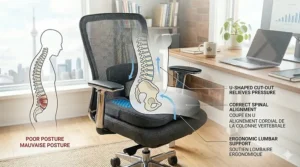
Real-World Canadian Office Scenarios: Which Cushion Fits Your Situation
Let me walk you through three typical Canadian office situations and match each to the ideal cooling seat cushion for office chair solution:
Scenario 1: Sarah — Downtown Toronto High-Rise, Hot Desk Setup
Sarah works in a shared office space where she doesn’t have a permanent desk. She bikes 45 minutes each way in summer and carries her laptop and essentials in a backpack. The office has AC but it’s inconsistent, and the cheap rolling chairs vary in quality. She’s 62 kg (136 lbs), 165 cm tall (5’5″), and sits 6-8 hours daily with frequent breaks to move between meeting rooms.
Best match: Generic honeycomb gel cushion ($28-$40 CAD). Here’s why: Sarah needs portability above all else — the honeycomb gel weighs under 1 kg and folds flat in her backpack. The thin profile (3.5-4 cm) works fine for her lighter frame and won’t dramatically change the ergonomics of different chairs she uses throughout the week. The maximum cooling addresses the summer heat and post-bike-commute warmth. The easy-clean design lets her wipe it down at the end of each day in the shared office. Because she’s not at one desk 8+ hours consecutively, the thinner cushioning won’t bottom out. Budget-friendly pricing means she won’t panic if it gets lost in the hot-desking rotation.
Scenario 2: Michael — Home Office in Suburban Calgary, 10-Hour Days
Michael transitioned to permanent work-from-home in a converted spare bedroom with a desk he built himself and a mid-range office chair from Costco. He’s 95 kg (210 lbs), 183 cm tall (6’0″), and sits 9-10 hours daily with minimal movement. His office faces west with afternoon sun but has no dedicated AC — just a portable unit he runs in summer. He occasionally experiences lower back pain and tailbone discomfort by end of day. Budget is flexible but he wants value.
Best match: ComfiLife Gel Enhanced ($40-$55 CAD) or ObusForme Cooling Gel ($50-$70 CAD). Here’s the reasoning: Michael’s weight and extended sitting time demand a thicker cushion (6+ cm) with high-density foam to prevent bottoming out. The gel layer is essential for managing heat during those sunny Calgary summer afternoons. The generous U-shaped coccyx cutout addresses his tailbone discomfort. Since this is his permanent home office setup, he doesn’t need portability and can optimize for maximum comfort and durability. The ComfiLife offers excellent value, but if budget allows, the ObusForme’s Canadian design and 2-3 year lifespan makes it worth the premium for someone logging 2,500+ hours annually at one desk.
Scenario 3: Jennifer — Hybrid Work in Montreal, Three Days Office / Two Days Home
Jennifer splits her week between a corporate office in downtown Montreal (where she has a permanent desk with a Herman Miller chair) and her condo home office (with a less-expensive task chair). She’s 73 kg (160 lbs), 170 cm tall (5’7″), and sits 7-8 hours on work days. The office is well climate-controlled, but her condo gets stuffy in summer despite window AC. She wants one cushion that works in both locations. She’s developed some hip pain on her right side from her home chair.
Best match: Everlasting Comfort Airflow ($45-$60 CAD) or Purple Gel Flex Grid ($65-$85 CAD if budget allows). Here’s why: Jennifer needs a cushion that adapts to two different chair types — the Everlasting Comfort’s softer foam and air channels work well with both premium ergonomic chairs (where it enhances comfort without fighting the chair’s built-in contouring) and basic task chairs (where it compensates for lack of built-in support). The larger dimensions (45 × 35 cm) accommodate both chair seats. The breathable mesh addresses her condo’s summer stuffiness without being overkill in the climate-controlled office. The hip pain suggests she shifts position frequently, which favours cushions that don’t penalize movement — both these options allow some lateral flex. The Purple is worth considering if budget permits because its advanced grid better accommodates the transition between different chairs and sitting styles. Portability is decent for both (can fit in a tote bag for the commute).
Common Mistakes When Buying Cooling Seat Cushions (And How to Avoid Them)
Mistake 1: Assuming all gel cushions cool equally. Canadian buyers often grab the cheapest gel cushion on Amazon assuming gel technology is standardized. Reality: gel thickness matters enormously. A 0.5 cm gel layer stops providing cooling after 2-3 hours as it fully absorbs your body heat and has nowhere to dissipate it. Minimum effective gel thickness is 1 cm, ideal is 1.3-1.5 cm. Additionally, cheaper gels use mineral oil-based formulations that warm faster than premium TPE (thermoplastic elastomer) gels. When comparing products, look for gel thickness specifications or check reviews mentioning how long the cooling lasts.
Mistake 2: Ignoring the cover material. That attractive velour or plush fabric cover? It’s actively sabotaging your cooling cushion’s performance by trapping heat between your body and the gel layer. Optimal cover materials are breathable mesh or moisture-wicking athletic fabrics with open-weave construction. Solid fabric covers can reduce a cushion’s effective cooling by 30-40%. This is especially problematic for Canadian work-from-home setups where you might be wearing thick sweatpants or leggings — the fabric-on-fabric combination creates an insulation layer. Look for covers explicitly marketed as “breathable,” “3D mesh,” or “moisture-wicking.”
Mistake 3: Buying based on Amazon star ratings alone. A 4.5-star cushion with 5,000 reviews isn’t necessarily better than a 4.2-star cushion with 800 reviews if you don’t dig into the details. For cooling cushions specifically, read the 3-star reviews — they’re the most honest. People leave 5-star reviews after two days of use; 3-star reviews come after two months when the gel has compressed or the cooling has diminished. Filter reviews by “verified purchase” and sort by “most recent” to catch quality control issues from current manufacturing runs. For Canadian buyers, specifically search reviews mentioning “Canada” or “Canadian” to find feedback from buyers dealing with your shipping, return, and usage scenarios.
Mistake 4: Overlooking the bottom-out factor. This is the #1 complaint in cooling cushion reviews: “It was comfortable for the first month, then I could feel the chair through it.” Bottoming out happens when the cushion material permanently compresses under your weight, losing its supportive properties. Factors that accelerate bottom-out: body weight over 90 kg (200 lbs), sitting sessions over 6 hours, cushions thinner than 5 cm, and foam density below 2.2 lbs per cubic foot. The workplace comfort solution here is simple — if you’re a heavier or longer-sitting user, don’t even look at cushions under 6 cm thick with foam density under 2.4 lbs per cubic foot, even if the price is tempting.
Mistake 5: Forgetting about Canadian winter cold. Gel cushions contain moisture and gel materials that respond to temperature. If you work in an unheated garage, basement office, or northern location where indoor temps drop below 15°C (59°F), gel cushions will feel uncomfortably firm until they warm up to your body temperature — which can take 5-10 minutes. This isn’t a defect; it’s physics. If this is your situation, you’re better off with air-channel foam cushions (like FORTEM or Everlasting Comfort) that don’t contain temperature-sensitive materials. Alternatively, some Canadian buyers keep their gel cushion on a shelf indoors overnight and only place it on their chair when they sit down, letting it pre-warm to room temperature.
Mistake 6: Treating the cushion as a fix for a bad chair. No cooling cushion, no matter how expensive, can compensate for a fundamentally inadequate office chair. If your chair lacks proper lumbar support, has a forward-tilting seat pan, or won’t adjust to proper height, adding a cushion creates a compromise on top of a compromise. According to Canadian ergonomics specialists, your chair should allow you to sit with feet flat on the floor, thighs parallel to the ground, and back supported. If your chair can’t achieve this baseline, your money is better spent on a new chair than on cushions trying to compensate. Cooling cushions enhance a decent chair; they don’t rescue a terrible one.
Long-Term Performance: What to Expect After 3, 6, and 12 Months
Understanding how cooling seat cushions age helps set realistic expectations and plan for replacements:
Month 1-3: The Honeymoon Period
Everything works as advertised. The cooling effect is immediate and lasts your entire workday. The foam springs back to full height after each use. The cover looks pristine. Your back pain might improve by 50-70% if you had positioning issues. This is when most people leave their glowing 5-star reviews. Enjoy this period, but don’t assume it represents the cushion’s long-term performance.
What’s actually happening: The foam is undergoing initial compression cycles, molding to your unique body shape and sitting pattern. Gel materials are settling and minor air pockets are compressing out. This is normal break-in, not degradation yet.
Month 3-6: Reality Sets In
You’ll notice the cushion doesn’t quite spring back as high as it once did — maybe 85-90% of original height instead of 100%. The cooling effect still works but might fade slightly in the last hour or two of an 8-hour workday. If you bought a budget cushion with low-density foam, you might start feeling the chair beneath you during marathon sitting sessions. The cover shows first signs of wear — slight pilling on high-friction areas, zipper pull getting loose.
What’s happening: Foam has undergone 300-500 compression cycles (100 work days × 3-5 sits per day) and is showing permanent set compression of 5-15%. Gel materials have completed their molecular realignment and are now in steady-state. This is actually the “true” performance level of your cushion — what it’ll maintain for most of its remaining life.
Canadian-specific consideration: If you’re using the cushion year-round, you’ve now tested it through seasonal temperature changes. Summer might show reduced cooling in week-old cushions versus brand-new ones due to gel absorbing environmental heat over multiple days.
Month 6-12: Maintenance Mode or Decline
This is where quality differences become obvious. Premium cushions (ComfiLife, ObusForme, Purple) maintain 75-85% of original performance through month 12. You’re still getting meaningful cooling and support, just not “like-new” levels. Budget cushions (sub-$35 CAD) often drop to 50-60% effectiveness — significant compression, reduced cooling, cover wear requiring constant adjustment.
What’s happening: You’ve logged 800-1,000 compression cycles. Lower-density foams (under 2.2 lbs per cubic foot) show 20-30% permanent height loss. Gel materials in budget cushions may develop small cracks or lose elasticity in high-wear zones. Cover zippers on economy models start catching or separating.
Decision point: Around month 10-12, evaluate whether you’re maintaining adequate comfort. Signs it’s time to replace: you’re consciously aware of the chair beneath you, you’re shifting position more frequently to find comfort, the cooling effect only lasts 2-3 hours, or you’re experiencing return of the back/tailbone pain the cushion initially resolved.
Pro tip: Don’t wait until your cushion is completely failed before replacing. Order your replacement cushion when your current one hits month 10, test the new one to confirm it works, then alternate between the two cushions every 2-3 days for the next month. This extends both cushions’ lives by reducing continuous compression stress, and you’ll have a backup ready when your primary cushion fully fails.
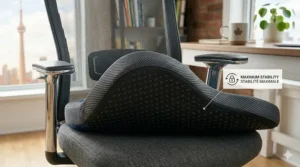
What the Specs Actually Mean: Decoding Cooling Cushion Marketing
“Medical-Grade Gel” or “Premium TPE”
What it means: Thermoplastic elastomer (TPE) that’s manufactured to meet biocompatibility standards (usually ISO 10993 or equivalent). It won’t off-gas harmful chemicals and is safe for prolonged skin contact. Premium TPE specifically refers to formulations with shore hardness ratings of 15-30 on the 00 scale (soft and pliable) versus cheap gels at 40+ (feels rubbery and rigid).
What it doesn’t mean: It’s not necessarily better at cooling than non-medical-grade gel. The “medical-grade” designation addresses safety and hypoallergenic properties, not thermal performance. However, premium TPE generally does hold its shape longer and resist hardening in cold Canadian winters better than mineral oil-based gels.
“High-Density Memory Foam”
What it means: Foam density of 2.2+ lbs per cubic foot (35+ kg per cubic metre). This is measured by weighing a 30 cm × 30 cm × 30 cm cube of the foam material. Higher density means more material per unit volume, which translates to better support and slower compression over time.
What it doesn’t mean: Density doesn’t directly correlate to firmness. You can have high-density soft foam and low-density firm foam depending on the cell structure. For cooling cushions, you want high density (2.3-2.5+ lbs per cubic foot) with medium firmness that allows some give but doesn’t bottom out.
“Honeycomb Design” or “Air Channels”
What it means: Structural features that allow air circulation through the cushion material. Honeycomb designs are typically cast into gel with hexagonal cells 2-4 cm wide. Air channels are grooves molded into foam 1-3 cm deep running lengthwise through the cushion.
What it doesn’t mean: Not all air channels/honeycombs are created equal. Shallow decorative grooves (<0.5 cm deep) are cosmetic and don’t meaningfully improve cooling. Effective air channels need to be at least 1 cm deep and comprise 15-25% of the cushion’s total volume to make a difference in airflow.
“Coccyx Cutout” or “U-Shape Design”
What it means: An opening carved into the back-centre of the cushion where your tailbone (coccyx) rests, designed to eliminate pressure on this sensitive bone. Effective cutouts measure 10-14 cm wide × 6-9 cm tall.
What it doesn’t mean: Bigger isn’t always better. Cutouts wider than 14 cm can create instability where you feel like you’re perched on a toilet seat. Cutouts narrower than 10 cm don’t accommodate larger body frames. The depth matters too — cutouts less than 4 cm deep don’t provide meaningful pressure relief.
“Ergonomic Contoured Design”
What it means: The cushion isn’t flat — it has intentional slopes or contours designed to position your pelvis and spine in specific ways. Common designs include rear-to-front upward slopes (tilt your pelvis forward) or raised edges (cradle your thighs).
What it doesn’t mean: “Ergonomic” is a marketing term with no regulated definition. A contoured design that’s ergonomic for one body type can be uncomfortable for another. Canadian buyers should be skeptical of this claim unless the product specifies what body measurements or sitting postures it’s designed for.
The Science Behind Cooling Technology: Why Gel and Mesh Actually Work
Understanding the thermal engineering helps you evaluate products beyond marketing claims. Your body generates heat continuously — about 100 watts when sitting (roughly equivalent to a bright light bulb). When you sit on a traditional cushion, this heat has nowhere to go except into the cushion material, which acts as insulation. Within 30-60 minutes, the temperature at the contact zone between your body and cushion rises 5-8°C above ambient room temperature. This triggers sweat response, which actually makes you feel warmer as moisture is trapped.
Gel Cooling Mechanism:
Gel materials have much higher thermal conductivity than foam — meaning heat moves through gel about 3-5 times faster than foam. When you first sit down, the gel rapidly absorbs heat from your body, making the surface feel cool. But here’s the critical part: gel only keeps cooling if it can dissipate that absorbed heat somewhere else. This is why gel layer thickness matters — a thin gel coating (0.3-0.5 cm) quickly becomes saturated with your body heat and stops cooling within 1-2 hours. A thicker gel layer (1.3-1.5 cm) has more material volume to absorb heat before saturation.
Advanced gel cushions (like the Purple grid or ObusForme honeycomb) add structural design to the equation. The air spaces in the honeycomb pattern allow some of the absorbed heat to radiate out into the surrounding air rather than staying trapped in the gel material. Think of it like the difference between a solid block of metal versus a metal mesh — the mesh has more surface area exposed to air for heat exchange.
Mesh and Air Channel Mechanism:
This works through convection — the movement of air carrying heat away. When you sit on foam with air channels or mesh cover, air trapped in those spaces warms up from your body heat. As it warms, it becomes less dense and tries to rise (hot air rises principle). Fresh, cooler air moves in to replace it, creating continuous air circulation. The effectiveness depends on channel depth (need at least 1 cm) and the breathability of the cover material (must allow air to escape upward, not trap it).
Where Canadian office workers see this fail: sitting on leather or vinyl chairs in rooms with no air circulation. If the surrounding air is stagnant and the chair material is non-breathable, the convection cycle stalls out. You need either a breathable chair surface or ambient air movement (AC, fan, or even just HVAC air circulation) for air channel designs to work optimally.
Why Combination Technologies Win:
The best cooling seat cushions for office chair applications use layered approaches: gel for rapid initial cooling and heat absorption, combined with air channels or honeycomb structure for long-term heat dissipation through convection. This is why hybrid products like ComfiLife (gel layer + foam + air channels) outperform single-technology solutions in real-world 8+ hour sitting tests.
Canadian Climate Considerations: Winter vs. Summer Performance
Summer Performance (June-August):
This is when cooling cushions earn their keep in Canadian offices. Without AC (common in home offices and older buildings), ambient temperatures can hit 26-30°C (79-86°F), and traditional foam cushions can reach surface temperatures of 33-35°C (91-95°F) — literally as warm as human skin temperature, which eliminates any heat gradient for your body to cool itself. Gel and honeycomb cushions maintain surfaces 4-6°C cooler, creating meaningful comfort differences.
Canadian-specific consideration: humidity matters as much as temperature. Montreal, Toronto, and southern Ontario experience humid summers where moisture-wicking becomes crucial. The breathable mesh covers on cushions like Everlasting Comfort or FORTEM become essential in humid conditions — solid fabric covers trap sweat and become clammy, making heat feel worse even if the gel layer is technically cooling the seat.
Winter Performance (December-February):
Here’s where Canadian buyers encounter surprising challenges. Gel materials become firmer as temperature drops — TPE gel at 12°C (54°F) can feel 20-30% firmer than the same gel at 22°C (72°F). If you work in a basement office, garage, or anywhere indoor temperature drops below 16°C (61°F), expect a 3-5 minute warm-up period where the gel feels uncomfortably rigid until your body heat softens it.
The flip side: cooling cushions don’t make you feel cold in winter, despite what intuition suggests. Because they’re efficient at conducting heat, they actually warm to your body temperature faster than foam cushions, then maintain that temperature without the excessive heat buildup foam creates. Several Canadian reviewers in Saskatchewan and Manitoba specifically praise their gel cushions for being comfortable in heated winter offices where foam cushions become too warm from the combination of body heat and building heat.
Spring/Fall Transition (March-May, September-November):
These are the sweet spot seasons for any cooling cushion technology. Canadian spring and fall typically see office temperatures in the 18-22°C (64-72°F) range — ideal for gel performance without the extreme cold of winter or heat of summer. If you’re evaluating a cooling cushion, test it during these transition seasons to see its “typical” performance before experiencing seasonal extremes.
Pro tip: Store gel cushions in your main living space overnight during winter, not in a cold office or car. Bringing them to room temperature (20-22°C) before use eliminates the initial cold-firmness issue.
Maintenance & Care: Extending Your Cushion’s Lifespan
Daily/Weekly Care:
Remove the cushion from your chair at end of workday and let it breathe overnight standing upright. This allows compressed foam cells to fully recover and air to circulate around gel materials. Wipe the cover with a damp cloth weekly to remove oils, skin cells, and dust that accumulate from daily contact. Flip the cushion 180° weekly (front-to-back rotation) to distribute wear patterns — this is especially important for cushions without coccyx cutouts.
Monthly Deep Clean:
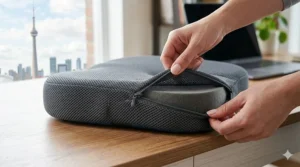
Remove the cover (all quality cushions have zippered removable covers) and machine wash on gentle cycle with cold water and mild detergent. Air dry only — dryers can shrink covers or damage elastic elements. While the cover is off, wipe the gel or foam core with a damp cloth and spot-clean any visible stains. For gel cushions, you can use a mild soap solution; for foam, use only water or specific foam cleaner products. Allow the core to air dry completely (6-8 hours) before replacing the cover.
Quarterly Inspection:
Check for signs of degradation: foam showing visible compression that doesn’t recover after 24 hours off the chair, gel developing small cracks or tears in high-stress areas, cover seams separating or zipper teeth missing. These are signals your cushion is approaching end-of-life and you should order a replacement soon.
Canadian-Specific Storage:
If you’re a seasonal remote worker who returns to office in summer, don’t leave your cooling cushion in a freezing garage or storage unit over winter. Gel can degrade if subjected to repeated freeze-thaw cycles below -5°C (23°F). Store cushions in climate-controlled spaces (10-25°C / 50-77°F) to maximize lifespan.
What NOT to Do:
Never use bleach or harsh cleaners on covers — they break down elastic fibres in mesh materials. Don’t put foam or gel cores in washing machines or dryers. Avoid leaving cushions in direct sunlight (UV degrades both foam and gel over time). Don’t use sharp objects near gel cushions — even small punctures can propagate into large tears. Never sit on the cushion while it’s still wet from cleaning — moisture trapped between your body and the cushion creates the perfect environment for mould growth, especially in humid Canadian regions.
Frequently Asked Questions
❓ Can cooling seat cushions help with tailbone pain from long sitting?
❓ Will gel cushions feel too cold in Canadian winter offices?
❓ How long do cooling seat cushions typically last with daily office use in Canada?
❓ Do I need to buy a separate cushion for car and office, or can one work for both in Canada?
❓ Are cooling cushions available on Amazon.ca covered by provincial consumer protection laws?
Conclusion: Finding Your Perfect Cooling Seat Cushion Match
The cooling seat cushion for office chair market has matured from gimmicky gel packs to legitimate workplace comfort solutions that address real thermal management and ergonomic challenges facing Canadian office workers. After reviewing seven distinct options across price ranges from $28 to $85 CAD, several clear patterns emerge for making your selection.
For most Canadian professionals working standard office hours (7-8 hours daily) in temperature-controlled environments, the ComfiLife Gel Enhanced represents the optimal balance of cooling performance, pressure relief, and value at around $45-50 CAD. It delivers medical-grade materials without premium pricing, works reliably across Canadian seasonal temperature swings, and maintains effectiveness for 18-24 months before requiring replacement. If your budget allows an extra $15-20, the ObusForme Cooling Gel justifies the premium through superior Canadian-climate testing, extended warranty coverage, and 2-3 year lifespan that makes it cheaper annually than replacing budget cushions more frequently.
Budget-conscious buyers or those testing cooling technology for the first time should start with the VEVOR Double Layer Gel ($35-48 CAD) or generic honeycomb gel ($28-40 CAD) options — both deliver 70-80% of the performance of premium models at 55-65% of the cost. These work particularly well for lighter users (under 75 kg), shorter sitting sessions (under 6 hours), or portable applications like hot-desking environments.
Tech enthusiasts and those willing to invest in cutting-edge materials should seriously consider the Purple Gel Flex Grid despite its $65-85 CAD price point — the patented polymer technology and 5+ year durability make it the lowest cost-per-year option if you’re planning to use the same cushion long-term. Just be aware of Canadian shipping delays and stock inconsistency.
The common thread across successful purchases: match the technology to your specific situation rather than buying based on star ratings alone. Heavy users need thick, high-density foam cores. Hot office workers prioritize gel coverage and honeycomb airflow. Back pain sufferers require proper coccyx cutouts alongside cooling features. And every Canadian buyer should verify their chosen cushion ships reliably within Canada with responsive customer service for the inevitable warranty claims.
One final piece of advice: don’t wait until your current cushion is completely failed before ordering a replacement. The sweet spot for replacement is around month 10-12 when you first notice diminished performance but the cushion is still functional. This lets you test the new cushion stress-free, ensures you have a backup during shipping delays, and prevents the scenario where you’re waiting 2 weeks for delivery while suffering through a completely compressed, non-functional cushion.
Recommended for You
- Best 7 Cooling Seat Cushions for Work From Home Canada 2026
- Best Cooling Pillow That Stays Cold All Night Canada 2026
- 7 Best Cooling Pillows for Neck Pain and Sweating Canada 2026
Disclaimer: This article contains affiliate links. As an Amazon Associate, I earn from qualifying purchases. If you purchase products through these links, we may earn a small commission at no additional cost to you.
✨ Found this helpful? Share it with your friends! 💬🤗
