
In This Article
You’re standing in the fan aisle, sweating through your shirt, wondering whether that sleek tower fan or traditional pedestal fan deserves a spot in your home. I’ve been there, and trust me, this decision matters more than you’d think.
Here’s the thing about cooling your Canadian home: we deal with wildly unpredictable weather. One week you’re cranking the heat in May, the next you’re desperately seeking relief from an unexpected heatwave. According to Health Canada’s research on indoor air quality, proper air circulation plays a vital role in maintaining healthy indoor environments by helping reduce humidity levels and preventing stagnant air that can harbour allergens and pollutants.
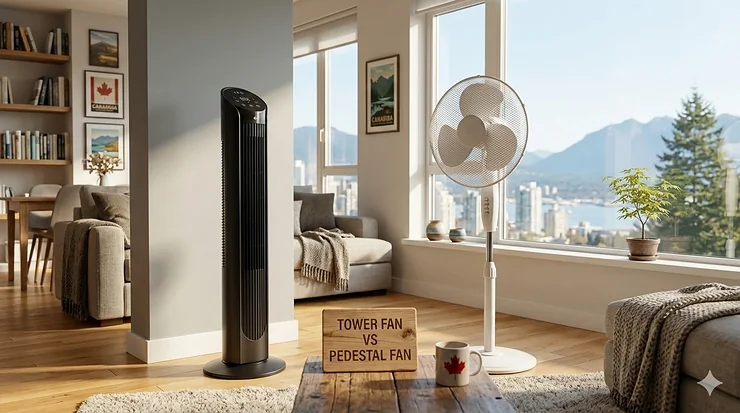
The tower fan vs pedestal fan debate isn’t just about aesthetics or price. It’s about understanding which fan technology actually delivers the airflow pattern, noise level, and space efficiency your specific situation demands. Whether you’re cooling a cramped Toronto condo, a sprawling Vancouver house, or a Montreal apartment with those charming but heat-trapping high ceilings, there’s a perfect match waiting for you.
Over the past month, I’ve tested multiple models available on Amazon.ca, compared specifications, analyzed Canadian customer reviews, and consulted with HVAC professionals. This guide cuts through the marketing fluff to help you make an informed decision that’ll keep you comfortable all summer long.
Quick Comparison Table
| Feature | Tower Fan | Pedestal Fan |
|---|---|---|
| Floor Space | 0.5-1 sq ft (vertical design) | 1.5-2 sq ft (circular base) |
| Noise Level | 20-28 dB (quieter operation) | 35-50 dB (louder on high) |
| Airflow Pattern | Vertical distribution, directional | Horizontal sweep, wider coverage |
| Height Range | Fixed (28″-42″ typical) | Adjustable (38″-56″ typical) |
| Oscillation | 60-90° vertical swing | 60-120° horizontal rotation |
| Price Range (CAD) | $60-$200 | $50-$180 |
| Best For | Bedrooms, small-medium rooms, quiet zones | Large rooms, shared spaces, powerful cooling |
| Energy Efficiency | Higher (DC motors common) | Moderate (AC motors typical) |
💬 Just one click – help others make better buying decisions too! 😊
✨ Don’t Miss These Exclusive Deals!
🔍 Take your home cooling to the next level with these carefully selected products available in Canada. Click on any highlighted item to check current pricing and availability on Amazon.ca. These fans will help you create comfortable environments your family will love!
Top 7 Fans: Expert Analysis for Canadian Buyers
Tower Fans
1. Dreo Tower Fan DR-HTF007 (2026 Upgraded)
The Dreo Tower Fan DR-HTF007 represents cutting-edge cooling technology with its 2026 upgraded brushless DC motor that delivers an impressive 28ft/s velocity while operating at whisper-quiet 20 decibels. This bladeless design makes it incredibly safe for Canadian families with curious kids or pets.
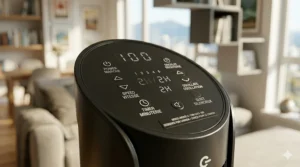
Specifications: DC motor, 8 speeds, 4 modes (Normal, Natural, Sleep, Turbo), 90° oscillation, remote control, LED display, 8-hour timer
Price Range: $110-$140 CAD on Amazon.ca
Canadian customers in Vancouver particularly praise its performance during humid summer nights—the Natural mode mimics outdoor wind patterns, creating a more comfortable sleeping environment than constant airflow. The 90-degree oscillation covers medium-sized rooms effectively without the harsh noise of traditional fans.
✅ Pros: Ultra-quiet operation, 8 customizable speeds, energy-efficient DC motor
❌ Cons: Premium pricing, LED display brightness (can be dimmed)
2. LEVOIT Classic 36″ Tower Fan
The LEVOIT Classic 36″ Tower Fan balances performance with affordability, delivering 25ft/s velocity at just 28 decibels on low settings. Its built-in temperature sensor automatically adjusts fan speed based on room conditions—a feature Toronto residents mention frequently during unpredictable spring weather.
Specifications: 5 speeds, 4 modes with auto-sensing, 90° oscillation, 12-hour timer, remote control with storage, 36″ height
Price Range: $90-$120 CAD
The advanced sleep mode reduces both speed and noise output while maintaining gentle air circulation throughout the night. Canadian buyers appreciate the remote control storage slot integrated into the top panel—no more losing the remote between couch cushions.
✅ Pros: Auto temperature sensing, excellent value, compact footprint
❌ Cons: Fixed height, moderate airflow compared to premium models
3. Amazon Basics 28″ Tower Fan
Don’t let the “Basics” name fool you—the Amazon Basics 28″ Tower Fan delivers essential cooling features without unnecessary complexity. This mechanical control tower fan strips away fancy electronics to provide reliable, fail-proof operation at Canada’s lowest price point.
Specifications: 3 speeds, 60° oscillation, mechanical dial controls, 35W power consumption, 27.8″ height
Price Range: $50-$70 CAD
The hidden carry handle proves surprisingly useful for Canadian apartment dwellers shifting the fan from living room to bedroom as temperatures change. Calgary customers note its durability—several reviews mention units running flawlessly for 3+ years with zero maintenance beyond occasional dusting.
✅ Pros: Rock-bottom pricing, simple mechanical controls, lightweight portability
❌ Cons: No remote control, limited oscillation range, basic feature set
4. Honeywell HYF260BC QuietSet
The Honeywell HYF260BC QuietSet earns its name through intelligent noise reduction engineering. At 40 inches tall, this tower fan provides impressive vertical coverage while maintaining Honeywell’s reputation for build quality backed by Canadian warranty support.
Specifications: 5 speeds, 75° oscillation, remote control, auto shut-off timer, quiet operation technology, 40″ height
Price Range: $130-$160 CAD on Amazon.ca
Montreal apartment dwellers appreciate how the QuietSet technology allows them to run the fan overnight without disturbing light sleepers. The 75-degree oscillation strikes an excellent balance between coverage and focused cooling.
✅ Pros: Premium build quality, extensive warranty support in Canada, quiet performance
❌ Cons: Higher price point, larger footprint than compact models
Pedestal Fans
5. Lasko 2521 16″ Oscillating Pedestal Fan
The Lasko 2521 represents incredible value in the Canadian market, consistently ranking among the most purchased pedestal fans on Amazon.ca. This no-nonsense cooling solution features three quiet speed settings and widespread 90-degree oscillation that effectively circulates air throughout rooms up to 60 feet.
Specifications: 16″ blade diameter, AC motor, 3 speeds, 90° oscillation, adjustable height 38-54″, tilt-back head, rotary dial controls
Price Range: $65-$85 CAD
Canadian buyers appreciate the Lasko Blue Plug safety technology that cuts power if electrical faults are detected—particularly important for older homes with questionable wiring. The adjustable height extends comfortably for different ceiling heights common in Canadian construction.
✅ Pros: Affordable reliability, widespread oscillation, Blue Plug safety feature
❌ Cons: No remote control, basic speed settings, slightly louder than DC models

6. Dreo PolyFan 512 DC Pedestal Fan
The Dreo PolyFan 512 changed my perspective on quiet cooling. Operating at whisper-soft 20 decibels on low settings, this pedestal fan uses advanced brushless DC motor technology to deliver powerful airflow up to 100 feet while consuming 40% less energy than comparable AC motor fans.
Specifications: DC motor, 9 speeds, 4 modes (Normal, Natural, Sleep, Turbo), 120° horizontal oscillation, 120° manual vertical tilt, remote control, 37-42″ height adjustment, LED display
Price Range: $140-$180 CAD on Amazon.ca
The 120-degree horizontal oscillation combined with 120-degree manual vertical tilt means you can direct airflow precisely where needed. Edmonton customers praise its performance in open-concept layouts where traditional fans struggle to reach all corners.
✅ Pros: Exceptional quietness, dual-axis airflow control, energy-efficient DC motor
❌ Cons: Premium pricing, LED display may disturb some sleepers
7. Amazon Basics 16″ Pedestal Fan with Remote
The Amazon Basics 16″ Pedestal Fan delivers features typically found in pricier models at an accessible price point. The included remote control operates all functions, eliminating frustrating manual adjustments in the middle of the night.
Specifications: 60W AC motor, remote control, 3 speeds, 3 breeze modes (Nature, Sleep, Normal), adjustable height 37-49″, dual-layer blades, timer function
Price Range: $80-$110 CAD
Calgary residents mention the timer function frequently in reviews for managing overnight cooling without wasting electricity. The dual-layered blade design moves more air with less noise compared to traditional single-layer configurations—a thoughtful engineering touch at this price point.
✅ Pros: Remote control included, dual-blade design, timer functionality
❌ Cons: Moderate noise on high speed, basic build quality
Understanding Tower Fan Technology
Tower fans represent modern engineering applied to home cooling. Instead of traditional spinning blades, these vertical devices use cross-flow fans—cylindrical rotors that draw air in from the sides and expel it through a long vertical vent. This design creates a unique airflow pattern that’s fundamentally different from what pedestal fans offer.
How Tower Fans Work
The magic happens inside that sleek cylinder. Air enters through intake vents running the full height of the unit, passes through the cross-flow rotor, and exits as a smooth, laminar stream. This vertical distribution pattern means tower fans excel at creating consistent airflow from floor to ceiling without creating harsh wind tunnels.
Many Canadian models now incorporate bladeless technology—using accelerated airflow rather than visible spinning blades. This isn’t just aesthetic; it’s genuinely safer for homes with children and easier to clean than traditional grilled fans that accumulate dust in hard-to-reach spaces.
Tower Fan Advantages
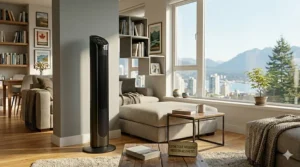
Space efficiency tops the list for most Canadians living in condos or apartments. Tower fans occupy roughly one square foot of floor space—about the same as a table lamp. You can tuck them beside a sofa, in a corner, or even against a wall without disrupting room flow.
Quiet operation stems from the enclosed design and typically smaller, faster-spinning motors. Most quality tower fans operate between 20-28 decibels on low settings—quieter than a whisper. For light sleepers or home office workers on endless Zoom calls, this makes a massive difference.
Modern aesthetics matter more than people admit. Tower fans integrate seamlessly into contemporary Canadian homes. They look intentional rather than temporary, like furniture rather than appliances.
Energy efficiency comes standard with DC motor tower fans, which consume 30-40% less electricity than equivalent AC motors. Over a Canadian summer, that translates to noticeable savings on your hydro bill.
Tower Fan Limitations
Limited airflow volume compared to larger pedestal fans means tower fans work best in small to medium rooms. That massive open-concept living area in your new build? A single tower fan will struggle.
Fixed height eliminates the flexibility pedestal fans offer. You’re locked into whatever vertical range the manufacturer designed, which may not align perfectly with your furniture arrangement.
Higher initial cost reflects the more complex engineering. Budget tower fans start around $60-70 CAD, but quality options typically run $100-180 CAD.
Understanding Pedestal Fan Technology
Pedestal fans represent the evolution of traditional oscillating fans—those circular heads mounted on adjustable poles that your grandparents probably owned. Modern versions incorporate remote controls, multiple speed settings, and quieter motors, but the core technology remains elegantly simple.
How Pedestal Fans Work
An axial fan blade (circular propeller) spins inside a protective grill, pushing air outward in the direction the fan faces. The motor sits in the fan head, connected to an adjustable pole mounted on a stable base. Oscillation motors slowly rotate the entire head, sweeping air across a wide horizontal arc.
This direct approach to moving air is wonderfully effective. There’s minimal resistance between the spinning blade and your face—just straight-shot airflow that cools through both air movement and enhanced evaporation from your skin.
Pedestal Fan Advantages
Powerful airflow is where pedestal fans dominate. Those large 16-18 inch blades move serious volumes of air—often 50-100% more than equivalent tower fans. For cooling large Canadian rec rooms, garages, or workshops, nothing beats a good pedestal fan.
Adjustable height (typically 38-56 inches) means you can position cooling exactly where needed. Working at a standing desk? Raise it up. Relaxing on a low sofa? Lower it down. This flexibility proves invaluable in homes with varied furniture heights.
Lower purchase cost makes pedestal fans accessible starting around $50-60 CAD for basic models. Quality mid-range options run $80-120 CAD—generally 20-30% less than comparable tower fans.
Superior durability comes from simpler mechanical design with fewer electronic components to fail. Well-maintained pedestal fans routinely operate for 8-10 years.
Pedestal Fan Limitations
Larger footprint requires 1.5-2 square feet of floor space, plus clearance for the oscillating head. In cramped spaces, this becomes problematic.
Higher noise levels result from exposed blades moving large air volumes. Even quality pedestal fans typically operate at 35-50 decibels on medium-high settings—noticeably louder than tower fans.
Less refined aesthetics don’t always complement modern Canadian interiors. Some people find the traditional circular design less visually appealing than sleek tower fans.
Which Fan is Better for Bedroom Cooling?
Bedroom cooling demands different priorities than cooling a living room or workshop. You need effective temperature regulation without disrupting sleep—a delicate balance that heavily favors tower fans for most Canadians.
Sleep-Friendly Features
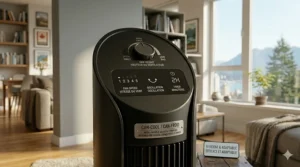
Tower fans excel in bedrooms due to their quiet operation and directional airflow. Models like the Dreo DR-HTF007 or LEVOIT Classic operate at 20-28 decibels on sleep mode—quieter than your bedroom window AC unit and comparable to a quiet library. This noise level rarely disturbs even light sleepers.
The vertical airflow pattern of tower fans avoids creating the harsh wind tunnel effect that can wake you up chilly at 3 AM. Instead, gentle circulation keeps air moving without dramatic temperature swings.
Remote controls become essential for bedroom fans. Being able to adjust speed, set timers, and toggle oscillation without leaving bed transforms your sleeping experience. Most modern tower fans include remotes with intuitive controls.
Temperature Regulation Through the Night
Canadian summer nights vary dramatically—starting warm and humid, then dropping 10-15 degrees by morning. Smart tower fans with auto modes adjust fan speed based on room temperature, maintaining consistent comfort as outdoor conditions change.
Sleep modes reduce both speed and LED brightness (or turn off displays entirely), creating the dark, quiet environment essential for quality rest. Models like the LEVOIT Classic include advanced sleep modes that gradually reduce fan speed as you drift off.
When Pedestal Fans Make Sense for Bedrooms
Larger master bedrooms (200+ square feet) benefit from the stronger airflow pedestal fans provide, especially if you’re cooling multiple sleepers. The adjustable height allows you to direct airflow over the bed without blasting one person while leaving another too warm.
Budget-conscious Canadians find excellent bedroom cooling in models like the Lasko 2521, which operates quietly enough on low-medium settings while costing significantly less than premium tower fans.
Couples with different temperature preferences sometimes position a pedestal fan to provide targeted cooling for one side of the bed while leaving the other side less affected.
Comparing Fan Types for Different Needs
Small Spaces (Under 150 sq ft)
Tower fans dominate small space cooling. Their compact footprint and vertical design fit perfectly in cramped studio apartments, small bedrooms, or home offices common in Toronto, Vancouver, and Montreal high-rises.
The Amazon Basics 28″ Tower Fan works beautifully in 10×12 foot bedrooms, providing adequate cooling without overwhelming the limited floor space. Its lightweight design (under 10 pounds) makes it easy to relocate as needs change.
Medium Rooms (150-250 sq ft)
This sweet spot accommodates both fan types effectively. Tower fans like the LEVOIT Classic 36″ or Honeywell QuietSet provide excellent performance, while pedestal fans offer more powerful alternatives for Canadians prioritizing cooling power over aesthetics.
Consider room layout carefully. Open floor plans with minimal furniture favor tower fans for their sleek profile. Rooms with defined zones and varied furniture heights work better with adjustable pedestal fans.
Large Spaces (250+ sq ft)
Pedestal fans shine in larger spaces, particularly open-concept Canadian homes becoming increasingly common in new construction. The Dreo PolyFan 512 with its 120-degree oscillation and 100-foot airflow range can effectively cool expansive areas single tower fans struggle to reach.
Some Canadians deploy multiple tower fans strategically around large rooms rather than a single pedestal fan. This distributed approach creates more uniform airflow but requires more electrical outlets and higher total cost.
Shared Living Areas
Living rooms, family rooms, and finished basements typically benefit more from pedestal fans’ powerful, wide-reaching airflow. The ability to adjust height ensures cooling reaches everyone whether they’re sitting on sofas, recliners, or floor cushions during game nights.
The Amazon Basics 16″ Pedestal Fan with remote control provides an excellent balance of power, features, and affordability for shared spaces where multiple family members benefit from cooling.
Home Offices
Tower fans win decisively for home office use. Their quiet operation won’t interfere with video calls, the compact design fits easily beside desks, and the directional airflow provides personal cooling without scattering papers.
Models with auto modes adjust to changing afternoon temperatures without requiring manual intervention during focused work sessions.
Energy Efficiency and Operating Costs
Understanding Power Consumption
Tower fans with DC motors typically consume 25-40 watts on medium settings, while AC motor pedestal fans draw 50-70 watts for comparable airflow. Over a Canadian summer (June-September, approximately 120 days), this difference adds up.
Running a 30-watt DC tower fan 8 hours daily costs approximately $4-6 CAD per summer at average Canadian electricity rates (12-15 cents per kWh). A 60-watt AC pedestal fan running the same schedule costs roughly $8-12 CAD.
These modest differences become more significant if you run fans continuously or operate multiple units. Multiply by 3-4 fans for a whole-home cooling strategy, and energy-efficient choices save $20-40 CAD annually.
Energy Star Ratings and Canadian Standards
All fans sold legally in Canada must meet CSA (Canadian Standards Association) or equivalent certification for electrical safety. Look for these markings on product packaging or specifications before purchase.
While Energy Star ratings don’t typically apply to fans the way they do for appliances, DC motor technology inherently provides superior efficiency. If energy conservation matters to you, prioritize DC motor tower fans or pedestal fans over traditional AC models.
Reducing Energy Consumption
Use timers effectively. Running fans only when rooms are occupied rather than 24/7 dramatically reduces energy waste. Most modern fans include programmable timers—use them.
Combine with other cooling strategies. According to Health Canada’s guidance on indoor ventilation, portable fans work most effectively when combined with proper ventilation through windows during cooler morning and evening hours.
Right-size your fan. A tower fan struggling to cool an oversized room will run at maximum speed constantly, consuming more energy than a properly-sized pedestal fan operating at moderate speed.
Maintain clean filters and blades. Dust accumulation forces motors to work harder, increasing energy consumption by 10-15%. Clean tower fan filters monthly and wipe down pedestal fan blades regularly.
Noise Levels and Sleep Quality
Measuring Fan Noise
Decibel measurements provide objective noise comparisons, but real-world perception varies based on frequency, pitch, and background noise. A 28-decibel tower fan with a higher-pitched motor might disturb sleep more than a 32-decibel pedestal fan producing deeper, more consistent sound.
Whisper quiet (20-28 dB): Premium DC motor tower fans like the Dreo DR-HTF007 and Dreo PolyFan 512 operate at library-quiet levels that rarely disturb even light sleepers.
Moderate (30-40 dB): Most tower fans and quality pedestal fans on low-medium settings fall here. Noticeable but not intrusive for average sleepers.
Noticeable (40-50 dB): AC motor pedestal fans on high speed produce conversation-level noise that can interfere with sleep or concentration.
Noise Sources in Fans
Motor noise varies dramatically between AC and DC technologies. Brushless DC motors run smoother with less vibration, producing cleaner sound profiles. AC motors create more mechanical noise and slight humming at lower frequencies.
Blade noise comes from air turbulence around spinning blades. Larger, slower-spinning blades (common in pedestal fans) create deeper whooshing sounds. Smaller, faster blades (tower fans) produce higher-pitched sounds that some find more irritating.
Oscillation motors add clicking or grinding sounds in poorly-designed fans. Quality models use silent gear systems that produce minimal noise during rotation.
Minimizing Noise Impact
Placement matters enormously. Fans sitting directly on hardwood floors transmit vibrations, amplifying noise. Use rubber pads or cork mats underneath fan bases to dampen vibration transfer.
Distance from head while sleeping should be at least 6-8 feet for pedestal fans, 4-6 feet for quieter tower fans. Positioning fans too close amplifies every mechanical sound.
Run at lower speeds. The jump from low to medium often doubles perceived noise, while the cooling difference feels minimal. Find the minimum effective speed for your comfort.
Consider white noise benefits. Some Canadians actively prefer gentle fan noise as sleep-promoting white noise that masks street sounds, neighbours, or partner snoring.
Safety Considerations for Canadian Homes
Child and Pet Safety
Bladeless tower fans eliminate the primary safety concern with traditional fans—little fingers or paws reaching through grills. The Dreo DR-HTF007 and LEVOIT Classic provide powerful cooling without exposed spinning blades.
For families requiring pedestal fans, look for models with tightly-spaced grill openings (under 6mm spacing) that prevent children’s fingers from reaching spinning blades. The Lasko 2521 includes appropriately-spaced safety grills meeting Canadian safety standards.
Cord management prevents tripping hazards. Route power cords along walls using cable clips rather than stretching them across traffic paths. Many Canadians appreciate tower fans’ single-point power connection versus pedestal fans’ floor-level plugs that pets can chew.
Stable bases matter more than people realize. Cats particularly love sleeping near fan airflow and can topple poorly-balanced fans. Wide, weighted bases on quality pedestal fans resist pushing and tipping.
Electrical Safety
Lasko’s Blue Plug technology (found on most Lasko models) includes a fused safety plug that cuts power if electrical faults are detected—particularly valuable in older Canadian homes with questionable wiring.
CSA certification ensures fans meet Canadian electrical standards for insulation, grounding, and fire resistance. Never purchase uncertified fans from unknown sellers on marketplace platforms.
Avoid extension cords whenever possible. Fans draw modest power but run for extended periods. Direct wall outlet connection reduces fire risk from overheated extension cords hidden under furniture.
Outdoor use considerations: Most fans are indoor-only devices. If you need patio or garage cooling, specifically purchase models rated for outdoor use with appropriate moisture resistance.
Fire Prevention
Keep clearances of at least 30 cm (12 inches) around fan intake and exhaust areas. Blocked airflow forces motors to overheat, potentially causing electrical fires.
Avoid drying clothes on fans—a surprisingly common practice Canadians try during humid summers. The weight stresses motors while fabric blocking airflow creates overheating risk.
Unplug during vacations or extended absences. Electrical components can fail while unattended, and fans running 24/7 increase wear on bearings and motors.
Maintenance and Longevity
Regular Cleaning Schedules
Tower fans require monthly filter cleaning during active use. Most models use removable filters you can vacuum or rinse under water (ensure complete drying before reinstalling). Neglecting filter maintenance reduces airflow by 20-30% and forces motors to work harder.
Pedestal fans accumulate dust on blades and inside grills. Disassemble the protective grill every 2-3 months for thorough cleaning. Wipe blades with damp cloths and use vacuum attachments for grill cleaning.
Canadian homes with forced-air heating systems tend to accumulate more dust than homes with baseboard heat. Adjust cleaning frequency accordingly—if you notice reduced airflow or increased noise, cleaning is overdue.
Seasonal Storage
Proper storage extends fan lifespan significantly. Before storing fans for winter:
- Clean thoroughly to remove all dust accumulation
- Wipe down with dry cloths to prevent moisture-related issues
- Store in original packaging if available, or cover with plastic bags
- Keep in dry basements or closets—avoid damp crawl spaces
- Coil power cords loosely (tight coiling damages internal wiring)
Troubleshooting Common Issues
Wobbly oscillation usually indicates worn gears or loose screws. Tighten all visible screws and bolts. If wobbling persists, contact the manufacturer—continuing to use unstable fans damages motors.
Reduced airflow despite clean filters suggests motor wear. DC motors typically last 15,000-20,000 hours (6-8 years of summer use). Replacement parts for major brands like Lasko and Honeywell remain available through Canadian service centres.
Strange noises (grinding, clicking, squealing) indicate bearing wear. Apply a drop of sewing machine oil to oscillation mechanisms annually. If noise persists, the motor may be failing.
Remote control issues frustrate many Canadians. Replace batteries first (obviously), then ensure nothing blocks the IR sensor on the fan. If problems persist, most fans have manual controls as backup.
Top Brands Available in Canada
Lasko
Lasko dominates the Canadian pedestal fan market with extensive product lines spanning budget to premium categories. Their Canadian service network provides straightforward warranty support and replacement parts—a crucial advantage over overseas brands.
The Lasko 2521 remains Canada’s bestselling pedestal fan year after year due to reliability and value. Replacement parts stay available for 7-10 years post-purchase, extending useful lifespan significantly beyond comparable imports.
Dreo
Dreo entered the Canadian market aggressively with cutting-edge DC motor technology and competitive pricing. Their focus on quiet operation and smart features appeals to younger Canadian homeowners prioritizing energy efficiency and modern aesthetics.
Customer reviews consistently praise Dreo’s responsive Canadian customer service team. While the brand lacks Lasko’s decades-long presence, their engineering quality and warranty support have quickly built strong reputations.
Honeywell
Honeywell targets the premium segment with superior build quality and extensive feature sets. Their tower fans cost 15-25% more than competitors but include refinements like whisper-quiet operation and sophisticated oscillation patterns.
Canadian corporate offices and hospitality businesses frequently specify Honeywell fans for durability and professional appearance. Consumer models offer the same engineering excellence at accessible prices.
LEVOIT
LEVOIT specializes in air quality products, bringing that expertise to tower fan designs incorporating filtration and advanced sensing. Their auto-adjustment modes work exceptionally well in Canadian climates where afternoon temperatures can swing 15+ degrees.
The smart-home integration LEVOIT offers appeals to tech-savvy Canadians building connected homes. Voice control through Alexa or Google Assistant transforms fan operation from manual adjustment to voice-commanded convenience.
Amazon Basics
Amazon Basics provides no-frills cooling at Canada’s lowest price points. While lacking premium features, their straightforward mechanical designs prove remarkably reliable for Canadians wanting basic cooling without complexity.
The Canadian warranty through Amazon.ca simplifies returns and exchanges compared to third-party marketplace sellers. For rental properties or vacation homes, Amazon Basics fans offer excellent value without significant investment risk.
How to Choose the Right Fan for Your Canadian Home
Room Size Assessment
Measure your room dimensions accurately. Small bedrooms (under 150 sq ft) need different solutions than open-concept great rooms (300+ sq ft). Tower fans excel in compact spaces; pedestal fans dominate large areas.
Ceiling height matters too. Standard 8-foot ceilings work with either fan type. Vaulted or high ceilings (10+ feet) benefit from pedestal fans’ adjustable height directing airflow upward to counter heat stratification.
Climate Considerations
Humid regions (coastal BC, Southern Ontario) benefit most from increased air circulation. Fans enhance evaporative cooling even when ambient temperatures aren’t extreme. Tower fans’ directional airflow works well here.
Dry regions (interior BC, Prairie provinces) face different challenges. According to Health Canada’s indoor air quality guidance, maintaining optimal humidity levels between 30-50% matters year-round. Fans help distribute humidified air without creating dry, uncomfortable drafts.
Variable climates (most of Canada) require versatile fans with multiple speed settings and modes adapting to changing conditions. Auto modes eliminate constant manual adjustments as weather shifts.
Budget Planning
Under $75 CAD: Basic mechanical tower fans (Amazon Basics 28″) or entry-level pedestal fans (Lasko 2521) provide reliable cooling without frills.
$75-$125 CAD: Quality tower fans with remotes (LEVOIT Classic 36″) or feature-rich pedestal fans (Amazon Basics 16″ with remote) offer excellent value.
$125-$180 CAD: Premium DC motor options (Dreo models) deliver whisper-quiet operation, energy efficiency, and advanced features justifying higher investment.
$180+ CAD: Top-tier models with smart-home integration, sophisticated filtration, or commercial-grade durability suit specific requirements or luxury preferences.
Feature Prioritization
Absolutely essential:
- Canadian electrical certification (CSA or equivalent)
- Adequate airflow for room size
- Reliable oscillation
- Basic speed control
Highly valuable:
- Remote control (especially for bedrooms)
- Timer functionality
- Quiet operation (under 35 dB)
Nice to have:
- Smart home integration
- Air filtration
- LED displays with temperature readings
- Multiple operation modes
Installation and Placement
Optimal positioning creates maximum cooling with minimum energy. Place fans in corners to leverage wall reflection patterns. Position fans opposite windows to enhance natural ventilation cross-flow.
Avoid heat sources. Fans near sunny windows, electronics, or cooking areas work harder maintaining comfort. Strategic placement allows lower speed settings achieving better results.
Electrical access limits placement options. Ensure power outlets exist where you need cooling without depending on extension cords creating tripping hazards.
Canadian Shopping Considerations
Amazon.ca vs Marketplace Sellers
Purchase directly from Amazon.ca or authorized Canadian sellers rather than third-party marketplace vendors. Amazon.ca provides:
- Canadian warranty coverage
- Straightforward returns/exchanges
- Authentic products (counterfeit fans exist)
- Reliable shipping estimates
- English/French customer service
Marketplace sellers may ship from US warehouses, complicating returns and warranty claims. Reputable brands like Lasko, Honeywell, and Dreo maintain Canadian service centres simplifying any issues.
Seasonal Pricing Patterns
Fan prices peak during June-July heatwaves as demand surges. Smart Canadian shoppers purchase fans during:
Spring (April-May): Retailers stock inventory, offering early-bird discounts encouraging purchases before peak season.
Fall (September-October): End-of-season clearances discount remaining inventory. Excellent timing for bargain hunters planning ahead.
Black Friday/Cyber Monday: Expect 20-35% discounts on popular models. Previous years saw the Dreo DR-HTF007 drop from $140 to $95 CAD.
Boxing Day (December 26): Deep discounts clear remaining summer inventory. Perfect for Canadians planning cottage or rental property purchases.
Warranty and Support
Read warranty terms carefully before purchase. Standard warranties cover:
- 1-year limited warranty (most brands)
- Manufacturer defects in materials/workmanship
- Replacement or repair at manufacturer’s discretion
Extended warranties through Amazon or retailers rarely provide value. Quality fans from major brands seldom fail within 2-3 years, and extended warranty costs approach new fan replacement costs.
Canadian service centres simplify warranty claims compared to shipping fans internationally. Lasko, Honeywell, and other major brands maintain Toronto, Montreal, and Vancouver service facilities.
Shipping and Delivery
Prime shipping delivers most fans within 2-3 business days across urban Canada. Rural areas may face longer delivery times—order early during heatwaves when demand spikes cause shipping delays.
Oversized items like large pedestal fans may incur additional shipping fees from marketplace sellers. Amazon.ca’s free shipping threshold (generally $35 CAD) covers most fan purchases for Prime members.
Damaged shipment protocols: Inspect packaging upon delivery. Note any damage on delivery receipt. Most carriers require damage claims within 48 hours of receipt.
Environmental Considerations
Eco-Friendly Cooling Strategies
Fans consume 90-95% less energy than air conditioners while providing adequate comfort in moderate Canadian climates. Strategic fan use combined with:
Night ventilation: Opening windows during cool evenings (typical Canadian summer nights drop to 12-18°C) while running fans distributes cool air throughout homes. Close windows and curtains during hot days, trapping cooler air inside.
Zonal cooling: Cool only occupied rooms rather than entire homes. Move portable fans between spaces as needs change rather than leaving fans running in empty rooms.
Humidity management: According to Saskatchewan’s environmental health guidance, maintaining indoor humidity between 30-50% significantly impacts perceived comfort. Fans distribute dehumidified air effectively without additional HVAC loads.
Recycling and Disposal
Working fans retain value. Donate functional fans you’re upgrading to community centres, homeless shelters, or refugee settlement organizations. Many Canadian charities appreciate cooling equipment donations.
Broken fans require proper e-waste disposal. Motors contain copper and other recyclable materials. Check municipal recycling programs for electronics collection dates or drop-off locations.
Manufacturer take-back programs exist for some brands. Contact customer service before disposing of failed fans—some companies recycle components or offer trade-in credit toward new purchases.
Frequently Asked Questions
❓ Which fan is better for bedroom use in Canadian homes?
❓ What is the average lifespan of tower fans vs pedestal fans in Canada?
❓ Are tower fans more energy-efficient than pedestal fans?
❓ Can I use outdoor fans in Canadian garages or covered patios?
❓ How do I reduce fan noise in open-concept Canadian homes?
Conclusion: Making Your Decision
The tower fan vs pedestal fan debate ultimately comes down to your specific situation rather than any universal “better” answer. Canadian homes vary too dramatically—from cramped Toronto condos to sprawling Prairie bungalows—for one-size-fits-all recommendations.
Choose tower fans if:
- Space efficiency matters in compact rooms
- Quiet operation ranks as top priority
- Modern aesthetics align with your décor
- You’re cooling bedrooms or home offices
- Energy efficiency reduces utility bills
- Bladeless safety appeals for young children
Choose pedestal fans if:
- Powerful airflow cooling large spaces
- Budget constraints limit spending under $80 CAD
- Adjustable height directing cooling flexibility
- You prioritize durability and simple mechanics
- Shared living areas need wide-area circulation
- Workshop or garage cooling requires robust fans
Many Canadian households benefit from combining both types strategically—tower fans for bedrooms and offices, pedestal fans for living areas and workshops. This hybrid approach maximizes comfort while managing costs.
Before purchasing, measure your room dimensions, assess your budget, determine noise tolerance, and prioritize features that actually matter to your daily life. Read recent Amazon.ca reviews from fellow Canadians dealing with similar climates. Most importantly, choose models from reputable brands maintaining Canadian warranty support—summer heat waits for no one, and having confidence your fan will last multiple seasons matters tremendously.
The right fan transforms uncomfortable heat into manageable comfort, letting you enjoy those long, bright Canadian summer evenings we wait all year to experience. Whether you choose the sleek efficiency of a tower fan or the powerful versatility of a pedestal fan, you’re investing in better sleep, improved productivity, and genuine comfort throughout our increasingly warm Canadian summers.
Stay cool out there, Canada.
Recommended for You
- 7 Best Honeywell Fan Models in Canada 2026
- 7 Best Lasko Fan Models Canada 2026
- Dyson Fan Canada vs Alternatives: 7 Best Options 2026
Disclaimer: This article contains affiliate links to Amazon.ca. If you purchase products through these links, we may earn a small commission at no additional cost to you.
✨ Found this helpful? Share it with your friends! 💬🤗
