
In This Article
Picture this: it’s a sweltering July evening in Toronto, and your air conditioner is running full blast, driving up your electricity bill while barely making a dent in the stifling heat. Now imagine opening a couple of windows, flipping a switch, and within minutes, your entire home is flooded with cool, fresh air — all while using just a fraction of the energy. That’s the magic of a whole house fan, and more Canadian homeowners are discovering this game-changing cooling solution every summer.
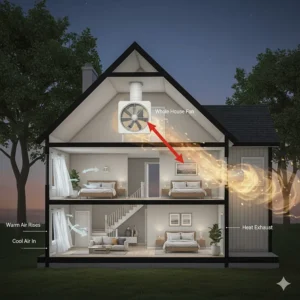
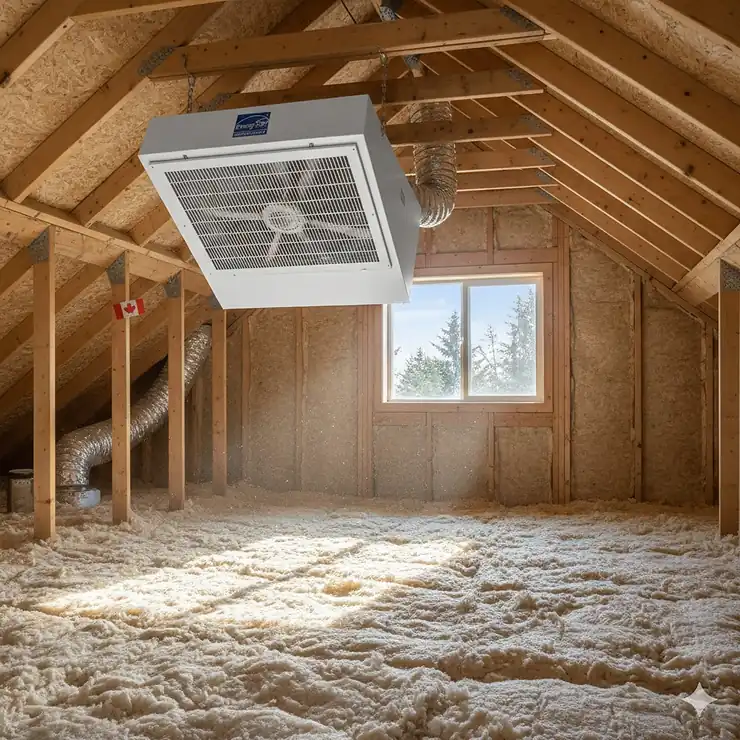
A whole house fan is an attic-mounted ventilation system that pulls cool outdoor air through open windows and pushes hot, stale air out through your attic vents. Unlike traditional air conditioning that recirculates the same indoor air, these powerful fans create a refreshing breeze throughout your entire home. According to the U.S. Department of Energy, whole house fans can be an energy-efficient alternative to air conditioning in many climates, and Canadian homes are perfectly positioned to take advantage of this technology during our cool evenings and moderate summer temperatures.
The numbers tell a compelling story. While a typical central air conditioner consumes between 3,000 and 5,000 watts per hour, a whole house fan uses only 200 to 700 watts — that’s about 90% less energy consumption. For Canadian families facing rising energy costs, this translates to savings of $800 or more per cooling season. Whether you’re in Vancouver’s mild climate or dealing with Edmonton’s temperature swings, a properly sized whole house fan can transform your home comfort while keeping your wallet happy. In this comprehensive guide, we’ll explore the top seven whole house fans available on Amazon.ca, helping you choose the perfect solution for your Canadian home.
Quick Comparison Table: Top Whole House Fans in Canada
| Product | CFM Rating | Coverage Area | Price (CAD) | Best For | Rating |
|---|---|---|---|---|---|
| QuietCool CL-6000 RF | 5,665 CFM | Up to 2,833 sq ft | $850-$950 | Large homes | 4.5/5 |
| AC Infinity CLOUDWAY S12 | 1,600 CFM | Medium homes | $300-$400 | Smart control | 4.3/5 |
| QA-Deluxe 6500 | 6,500 CFM | Up to 4,400 sq ft | $700-$800 | Two-story homes | 4.2/5 |
| QuietCool CL-3100 RF | 3,126 CFM | Up to 1,610 sq ft | $699-$769 | Small to medium homes | 4.2/5 |
| AC Infinity CLOUDWAY T10 | 1,200 CFM | Small homes | $250-$350 | Budget-conscious | 4.0/5 |
| QA-Deluxe 5500 | 5,500 CFM | Up to 3,400 sq ft | $650-$750 | Mid-range performance | 4.1/5 |
| HV1000 with R38 Insulation | 1,000 CFM | Compact spaces | $500-$600 | Cold climates | 3.8/5 |
💬 Just one click – help others make better buying decisions too!😊
✨ Don’t Miss These Exclusive Deals!
🔍 Take your home cooling to the next level with these carefully selected products available in Canada. Click on any highlighted item to check current pricing and availability on Amazon.ca. These tools will help you create authentic comfort your family will love!
Top 7 Whole House Fans: Expert Analysis for Canadian Homes
1. QuietCool CL-6000 RF – The Premium Powerhouse
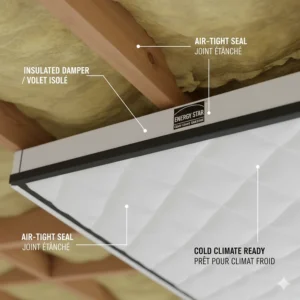
The QuietCool CL-6000 RF stands as the gold standard in whole house cooling for Canadian homeowners who refuse to compromise on performance. This ducted inline system delivers an impressive 5,665 cubic feet per minute of airflow, capable of completely exchanging the air in a 2,833 square foot home every 3-4 minutes. What sets this model apart is QuietCool’s patented acoustical ducting system combined with R5 insulated damper doors — critical for Canadian climates where you need to seal out cold attic air during winter months.
Canadian buyers on Amazon.ca consistently praise the wireless RF control kit, which lets you operate the fan from anywhere in your home with a range up to 100 feet. The two-speed PSC motor runs at 769 watts on high and 560 watts on low, using a fraction of the energy consumed by central air conditioning. Installation typically takes 1-2 hours with no joist cutting required, fitting standard 16 or 24-inch on-centre framing common in Canadian construction.
Price Range: $850-$950 CAD on Amazon.ca
Coverage: Up to 2,833 sq ft
Key Specs: 5,665 CFM, two-speed, wireless control, R5 damper
✅ Pros:
- Exceptional airflow for large Canadian homes
- Whisper-quiet operation despite powerful motor
- 10-year motor warranty with 3-year parts coverage
❌ Cons:
- Higher initial investment than competitors
- Requires adequate attic ventilation (minimum 7.6 sq ft)
Customer Feedback (Canada): “Installed this in our two-story home in Calgary and it’s been incredible. Even on the hottest days, we can cool the entire house in under 20 minutes. The wireless control is fantastic, and the insulated damper keeps our heating bills down in winter.”
2. AC Infinity CLOUDWAY S12 – Smart Home Integration Winner
The AC Infinity CLOUDWAY S12 brings cutting-edge technology to whole house cooling with its PWM-controlled EC motor and 10-speed wireless controller. Delivering 1,600 CFM of airflow, this ceiling-mounted attic fan excels at cooling medium-sized Canadian homes while consuming up to 95% less power than traditional AC units. The standout feature is the intelligent EC motor technology — these electronically commutated motors run 40% more efficiently than AC motors and maintain consistent performance across all speed settings.
What Canadian homeowners appreciate most is the fan’s dual-ball bearing design rated for 50,000 hours of continuous operation, plus IP-44 protection against dust and moisture — essential for our varying climates. The included 4-layer aluminum ducting, stainless steel clamps, and 2-door gravity-fed shutter system come pre-configured for easy installation. The shutters automatically close when the fan stops, preventing heat loss during cooler months.
Price Range: $300-$400 CAD on Amazon.ca
Coverage: Medium homes (1,200-1,600 sq ft)
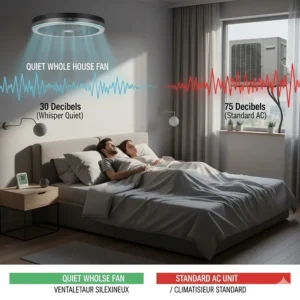
Key Specs: 1,600 CFM, 10-speed control, EC motor, 62 dBA noise level
✅ Pros:
- Energy-efficient EC motor technology
- 10 speed settings for precise control
- Complete installation kit included
❌ Cons:
- Lower CFM rating limits use to smaller homes
- May require additional attic vents for optimal performance
Customer Feedback (Canada): “Perfect for our bungalow in Ontario. The 10-speed control is brilliant — we run it on low overnight and ramp it up during evening cool-down. Installation was straightforward, and the energy savings are noticeable on our hydro bill.”
3. QA-Deluxe 6500 – Maximum Coverage Champion
For owners of larger two-story Canadian homes, the QA-Deluxe 6500 delivers unmatched cooling capacity with its powerful 6,500 CFM airflow rating. This beast handles homes up to 4,400 square feet on two levels or 3,000 square feet single-story, making it ideal for growing Canadian families or open-concept floor plans. The precision spun aluminum fan housing with rigid mounting brackets features rubber bushings to minimize vibration and noise — you’ll feel the cooling power without the disruptive racket.
The plug-and-play design includes a 2-speed wall switch with timer functionality, eliminating the need for complex hardwiring. Canadian builders appreciate that it fits between standard 16 to 24-inch on-centre joists without any framing modifications. The R-5 insulated damper box is crucial for Canadian winters, preventing cold attic air from seeping into living spaces when the fan is dormant. With dimensions of 28.5″ D x 14″ W x 14″ H and requiring 5.5 square feet of attic ventilation, proper planning ensures optimal performance.
Price Range: $700-$800 CAD on Amazon.ca
Coverage: Up to 4,400 sq ft (2-story), 3,000 sq ft (1-story)
Key Specs: 6,500 CFM, R-5 damper, 2-speed operation, low voltage
✅ Pros:
- Highest CFM rating for maximum coverage
- No framing required for installation
- 10-year motor warranty, 3-year parts warranty
❌ Cons:
- Requires substantial attic ventilation
- Heavier unit may need additional support
Customer Feedback (Canada): “We have a 3,200 sq ft two-story in Mississauga and this fan cools our entire house in about 15 minutes. The insulated damper is essential for our cold winters. Best investment we’ve made for home comfort.”
4. QuietCool CL-3100 RF – Perfect Balance for Small Homes
The QuietCool CL-3100 RF strikes the sweet spot between performance and affordability for small to medium Canadian homes. Moving 3,126 CFM on high speed and 2,847 CFM on low, this advanced whole house fan efficiently cools spaces up to 1,610 square feet. The two-speed PSC motor consumes just 299 watts on high and 256 watts on low — comparable to running three standard light bulbs — while delivering rapid whole-house air exchanges every 3-4 minutes.
Canadian buyers value the included wireless RF control kit featuring a sleek glass touch switch with up to 12-hour countdown timer. The small 14″ x 22″ ceiling cutout minimizes installation impact, perfect for homes where aesthetic considerations matter. The acoustical duct connects to an R5 damper box that maintains thermal efficiency during Canada’s extended heating season. QuietCool’s reputation for whisper-quiet operation holds true — you’ll notice the fresh air before you hear the motor.
Price Range: $699-$769 CAD on Amazon.ca
Coverage: Up to 1,610 sq ft
Key Specs: 3,126 CFM high / 2,847 CFM low, wireless control, R5 damper
✅ Pros:
- Ideal sizing for typical Canadian bungalows
- Energy-efficient dual-speed operation
- Premium wireless control with timer
❌ Cons:
- May struggle with larger open-concept layouts
- Control must be purchased separately from some retailers
Customer Feedback (Canada): “Installed in our 1,400 sq ft rancher in BC and it’s perfect. The two speeds give us flexibility — low for overnight cooling, high for quick evening cool-down. Shipping to Canada was fast through Amazon.ca.”
5. AC Infinity CLOUDWAY T10 – Budget-Friendly Smart Choice
The AC Infinity CLOUDWAY T10 proves that advanced whole house cooling doesn’t require breaking the bank. This 1,200 CFM system brings professional-grade EC motor technology to budget-conscious Canadian homeowners, with WiFi-integrated app control that lets you monitor and adjust your home’s cooling from anywhere. The temperature and humidity controller automatically adjusts fan speeds based on real-time conditions, optimizing energy consumption without manual intervention.
What makes this model particularly attractive for Canadian homes is the comprehensive automation capabilities. Set minimum fan speeds for continuous gentle circulation, program schedules around your daily routine, or enable cycle modes for periodic ventilation. The mobile app provides historical climate charts and CSV data export — useful for tracking energy savings over time. The 10-inch duct size and compact 9.8″ x 15.1″ x 11.3″ dimensions make it suitable for homes with limited attic space.
Price Range: $250-$350 CAD on Amazon.ca
Coverage: Small homes (800-1,200 sq ft)
Key Specs: 1,200 CFM, WiFi control, temperature/humidity sensing, 48 dBA
✅ Pros:
- Affordable entry point for whole house cooling
- Smart automation reduces energy waste
- Near-silent operation at 48 dBA
❌ Cons:
- Lower airflow limits effectiveness in larger spaces
- WiFi dependency may frustrate some users
Customer Feedback (Canada): “Great value for our small home in Nova Scotia. The app control is convenient and the automated temperature response means we don’t have to think about it. Uses barely any electricity compared to our old window AC.”

6. QA-Deluxe 5500 – Mid-Range Performance Leader
The QA-Deluxe 5500 occupies the middle ground between budget options and premium powerhouses, delivering 5,500 CFM of cooling performance for Canadian homes up to 3,400 square feet on two levels or 2,400 square feet single-story. This model features QA-Deluxe’s signature engineering advances: precision spun aluminum housing, acoustical ducting, and mounting brackets with rubber bushings for vibration-free operation. The wireless 1-speed timer control offers simplicity for homeowners who prefer straightforward operation.
Canadian contractors appreciate that this unit ships mostly pre-assembled, reducing installation time to approximately one hour for experienced DIYers. The R5 insulated damper box with heavy-duty support brackets keeps the damper off drywall, preventing heat transfer during winter. At 28.5″ D x 14″ W x 14″ H, it fits standard Canadian construction, and the required 4.5 square feet of attic ventilation is easily achievable in most homes. The 10-year motor warranty and 3-year parts coverage provide peace of mind for long-term investment.
Price Range: $650-$750 CAD on Amazon.ca
Coverage: Up to 3,400 sq ft (2-story), 2,400 sq ft (1-story)
Key Specs: 5,500 CFM, wireless control, R5 damper, single-speed
✅ Pros:
- Excellent price-to-performance ratio
- Simple wireless operation
- Made in USA with quality components
❌ Cons:
- Single-speed limits flexibility
- Requires proper attic venting for peak performance
Customer Feedback (Canada): “Solid performer for our 2,800 sq ft home in Saskatchewan. No-frills operation but gets the job done efficiently. The insulated damper box is essential for our harsh winters. Would buy again.”
7. HV1000 with R38 Insulation – Cold Climate Specialist
The HV1000 with R38 Insulation specifically targets Canadian homeowners in colder provinces who need superior thermal protection during extended winter seasons. While its 1,000 CFM rating makes it the lowest-powered option on our list, the exceptional R38 insulation value sets it apart for climates where winter heating costs dwarf summer cooling expenses. This unit excels in Prairie provinces and northern regions where preventing heat loss takes priority.
The integrated backdraft damper prevents air leakage when the unit is off, contributing to year-round energy conservation. Canadian buyers appreciate that despite the compact 1,000 CFM capacity, strategic use during cool mornings and evenings effectively pre-cools the home’s thermal mass, maintaining comfortable temperatures throughout the day. The simple installation process suits homes with basic ventilation needs, and the robust R38 insulation far exceeds standard whole house fan offerings.
Price Range: $500-$600 CAD on Amazon.ca
Coverage: Compact spaces (600-1,000 sq ft)
Key Specs: 1,000 CFM, R38 insulation, backdraft damper
✅ Pros:
- Exceptional R38 insulation for cold climates
- Integrated backdraft damper prevents drafts
- Lower price point with specialized features
❌ Cons:
- Limited cooling capacity for larger homes
- May require supplemental cooling in extreme heat
Customer Feedback (Canada): “Perfect for our cottage in Northern Ontario. The R38 insulation keeps heating costs down in winter, and in summer it provides just enough cooling for our 900 sq ft space. Great for seasonal properties.”
Understanding Whole House Fan Technology for Canadian Climates
How Whole House Fans Work
A whole house fan operates on beautifully simple principles that align perfectly with Canadian climate patterns. Installed in your attic between ceiling joists, these powerful ventilation systems create negative pressure inside your home when activated. You open windows on opposite sides of your house — ideally in cooler, shadier areas — and switch on the fan. Within seconds, the fan draws cool outdoor air through the windows while simultaneously pushing hot, stale indoor air up into the attic and out through existing roof vents or gable vents.
The cooling effect comes from two mechanisms. First, the rapid air exchange physically replaces warm indoor air with cooler outdoor air. According to Natural Resources Canada, proper ventilation is crucial for maintaining energy-efficient homes, and whole house fans excel at providing fresh air circulation. Second, the breeze created by moving air makes occupants feel 5 to 10 degrees cooler through evaporative cooling on skin — similar to wind chill in reverse.
Canadian Climate Advantages
Canadian homeowners enjoy unique advantages when using whole house fans thanks to our climate characteristics. Most regions experience cool evenings even during summer heat waves, with temperatures dropping 10-15 degrees Celsius after sunset. This natural temperature differential creates ideal conditions for whole house fan operation. In Vancouver’s mild summers, you might run your fan 4-5 months annually. In Toronto or Montreal, evening temperatures regularly dip into comfortable ranges throughout July and August. Even Prairie cities with hot days cool down rapidly once the sun sets.
The key is timing your fan usage strategically. Run your whole house fan during cool mornings between 6-9 AM to flush out overnight heat accumulation, or during evenings from 7 PM onwards when outdoor temperatures drop below indoor levels. This pre-cooling strategy cools your home’s thermal mass — the structural materials, furniture, and contents — which then radiates coolness throughout the following day, reducing or eliminating air conditioning needs.
Energy Efficiency Comparison
The energy savings potential of whole house fans versus traditional air conditioning is staggering for Canadian households. A typical 3-ton central air conditioning system consumes approximately 3,500 watts per hour of operation. Running this system for eight hours daily during a three-month summer season costs roughly $250-$300 depending on provincial electricity rates. In contrast, even a powerful 700-watt whole house fan running the same duration costs just $50-$75 for the entire season.
Natural Resources Canada emphasizes the importance of energy-efficient cooling solutions, and whole house fans align perfectly with government initiatives to reduce residential energy consumption. The energy efficiency extends beyond direct operational costs. By reducing air conditioning usage by 50-90%, you also extend your HVAC system’s lifespan, decrease maintenance requirements, and lower your carbon footprint. Many Canadian provinces offer energy efficiency rebates and incentives — check with your local utility company about potential savings on whole house fan installations.
Sizing Your Whole House Fan for Canadian Homes
CFM Requirements by Climate Zone
Choosing the correct CFM (cubic feet per minute) rating is crucial for effective whole house cooling in Canadian climates. The general sizing rule recommends 2-3 CFM per square foot of living space, but Canadian climate zones require nuanced approaches. Coastal regions like Vancouver and Victoria with moderate temperatures can use the lower 2 CFM per square foot ratio. For a 1,500 square foot home, this means a 3,000 CFM fan provides adequate cooling.
Central Canadian cities — Toronto, Ottawa, Montreal — experience hotter, more humid summers requiring 2.5 CFM per square foot. That same 1,500 square foot home needs approximately 3,750 CFM capacity for comfortable cooling. Prairie provinces and interior BC endure the hottest summer temperatures and benefit from 3 CFM per square foot. Edmonton or Calgary homeowners with 1,500 square feet should target 4,500 CFM for optimal performance.
Attic Ventilation Requirements
Proper attic ventilation is non-negotiable for whole house fan effectiveness and safety. Your attic requires sufficient vent area to exhaust the massive airflow these fans create — typically 1 square foot of net free attic venting per 750 CFM of fan capacity. A 4,500 CFM fan needs approximately 6 square feet of attic venting distributed between soffit vents, ridge vents, or gable vents.
Insufficient venting creates dangerous positive pressure in your attic, potentially forcing hot air back into living spaces through ceiling penetrations. Before purchasing a whole house fan, inspect your existing attic ventilation. Most Canadian homes built to code have adequate venting, but older homes or those with finished attics may require upgrades. Professional installers can calculate your net free area and recommend additional venting if needed.
Ceiling Height and Open Floor Plans
Modern Canadian homes often feature vaulted ceilings, open-concept layouts, and two-story great rooms that impact whole house fan sizing. Higher ceilings increase your home’s cubic footage significantly. A 1,500 square foot home with 8-foot ceilings contains 12,000 cubic feet of air, while 10-foot ceilings raise this to 15,000 cubic feet — a 25% increase requiring proportionally higher CFM ratings.
Open floor plans improve whole house fan effectiveness by allowing unrestricted airflow throughout living areas. However, homes with many closed rooms, hallways, or multiple levels may need supplemental circulation fans to distribute cooling evenly. Consider your home’s layout when selecting fan capacity, and remember that oversizing by 10-20% ensures powerful, rapid cooling even on the hottest evenings.
Installation Considerations for Canadian Homes
DIY vs Professional Installation
Whole house fan installation falls within reach of handy Canadian homeowners with basic electrical and carpentry skills, though professional installation offers advantages. DIY installation typically takes 4-6 hours for first-timers, saving $300-$600 in labour costs. You’ll need basic tools: drill, jigsaw, wire strippers, voltage tester, and ladder. Most manufacturers design units to fit standard 16 or 24-inch on-centre joists common in Canadian construction, eliminating framing work.
Professional installation by licensed contractors ensures proper electrical connections meeting Canadian Electrical Code requirements, correct attic ventilation calculations, and warranty compliance. Many manufacturers require professional installation for warranty validation. HVAC contractors across Canada charge $400-$800 for whole house fan installation depending on complexity. If your electrical panel is distant from the installation site or you need additional attic venting, professional expertise prevents costly mistakes.
Electrical Requirements and Safety
Canadian whole house fans require dedicated 15 or 20-amp electrical circuits connected to your home’s service panel. The National Electrical Code of Canada mandates proper grounding, wire sizing appropriate for amp draw, and junction box placement accessible for future maintenance. Most fans operate on standard 120-volt household current, simplifying electrical work compared to 240-volt appliances.
Safety considerations include ensuring the fan’s backdraft damper or winter cover seals completely when not in use. Carbon monoxide hazards exist if you operate the fan while gas appliances or fireplaces are running — the negative pressure can cause backdrafting of combustion gases. Install carbon monoxide detectors throughout your home and never operate the fan simultaneously with fuel-burning appliances. The insulated damper boxes included with quality units prevent this issue while maintaining thermal efficiency.
Attic Access and Structural Modifications
Canadian homes require adequate attic access for whole house fan installation and ongoing maintenance. Standard attic hatches measure 22″ x 30″ — sufficient for maneuvering compact fans but challenging for larger units. Some installers create temporary enlarged openings during installation, then restore original dimensions afterward. Two-story homes with truss roof systems occasionally lack sufficient clearance between ceiling joists and roof decking, necessitating creative mounting solutions.
Structural modifications beyond cutting the ceiling opening are rare with modern whole house fans. Units designed for 16 or 24-inch on-centre joists install without framing alterations, though you may need to add blocking between joists for secure mounting. Heritage homes with plaster ceilings require extra care to prevent cracking — consider hiring specialists experienced in older construction. Always verify your home’s structural integrity before installation, and consult professionals if you encounter complications.
Maximizing Efficiency: Operation Tips for Canadian Homeowners
Optimal Running Times and Schedules
Strategic operation timing transforms whole house fans from simple cooling devices into money-saving climate control systems. Canadian homeowners achieve maximum efficiency by aligning fan usage with natural temperature patterns. Start your day by running the fan for 15-30 minutes between 6-8 AM when outdoor temperatures are coolest, flushing out accumulated overnight heat and pre-cooling your home’s thermal mass.
Evening operation provides the greatest comfort benefits. Once outdoor temperatures drop below indoor levels — typically 7-9 PM depending on your region — open windows on opposite sides of your home to create cross-ventilation. Run the fan on high speed for 10-20 minutes to rapidly exchange all indoor air, then switch to low speed for gentle overnight circulation. This pattern can cool a typical Canadian home to comfortable sleeping temperatures within 30 minutes while consuming less electricity than a single incandescent light bulb.
Window Positioning Strategy
Window selection and positioning dramatically impact whole house fan effectiveness. Open windows on the lower floor in shaded areas — north-facing or tree-sheltered locations that remain cooler throughout the day. Position opened windows on opposite sides of your home to create cross-ventilation paths that channel cool air throughout living spaces. A general rule: open windows equivalent to twice the ceiling opening’s square footage.
Security concerns understandably worry Canadian homeowners about leaving windows open overnight or while away. Install window stops that limit opening to 4-6 inches — sufficient for airflow while preventing intrusion. Window sensors connected to home security systems allow monitored ventilation. Basement windows provide excellent cool air intake but require window well covers to prevent rain infiltration. Experiment with different window combinations to find what works best for your home’s layout and comfort preferences.
Integration with Existing HVAC Systems
Whole house fans and air conditioning systems can work harmoniously in Canadian homes when used strategically. Never operate both simultaneously — this wastes energy and forces your AC to compete against outdoor air infiltration. Instead, use your whole house fan as primary cooling during moderate weather and cooler hours, reserving air conditioning for extreme heat or humid conditions.
The optimal integration strategy employs whole house fans for evening and overnight cooling, then seals the home during hot afternoon hours. If daytime temperatures become uncomfortable, run minimal air conditioning to maintain comfort, but your pre-cooled home requires far less AC runtime. Many Canadian families report reducing air conditioning usage by 70-90% after installing whole house fans, with payback periods under two years considering average cooling season costs.
Benefits Beyond Cooling: Whole House Fan Advantages
Improved Indoor Air Quality
Whole house fans dramatically enhance indoor air quality by completely exchanging your home’s air volume every 3-4 minutes. Canadian homes sealed tightly for energy efficiency trap indoor pollutants: cooking odours, pet dander, volatile organic compounds from furniture and cleaning products, excess humidity, and carbon dioxide from occupant respiration. Natural Resources Canada research emphasizes that proper ventilation is essential for healthy indoor environments, and whole house fans provide continuous fresh air circulation traditional HVAC systems cannot match.
The rapid air exchange flushes out accumulated allergens, reducing respiratory irritation for sensitive family members. Unlike recirculating air conditioning that filters but doesn’t replace indoor air, whole house fans provide constant outdoor air refreshment. Parents appreciate how quickly cooking smells, pet odours, and bathroom humidity dissipate. The continuous airflow also prevents moisture accumulation that leads to mold growth — particularly important in humid Canadian regions like coastal BC or Maritime provinces.
Reduced Attic Temperature
Whole house fans simultaneously cool living spaces and attic areas, delivering dual energy-saving benefits. Canadian attics routinely reach 60-70°C (140-160°F) on sunny summer days, radiating heat downward through ceiling insulation and increasing air conditioning loads. Operating a whole house fan dramatically reduces attic temperatures by exhausting superheated air and drawing in cooler outdoor air.
Lower attic temperatures extend roof shingle lifespan by reducing thermal cycling and UV degradation. Canadian roofing materials face extreme temperature swings between summer heat and winter cold — moderating peak temperatures prevents premature aging. Additionally, cooler attics reduce strain on upper-floor air conditioning ducts and reduce the temperature differential your ceiling insulation must resist. Some Canadian homeowners report attic temperature reductions of 15-20°C when operating whole house fans regularly.
Environmental Impact and Sustainability
Choosing whole house fans aligns with Canada’s climate action commitments and reduces household carbon footprints. The average Canadian home emits approximately 2.5 tonnes of CO2 annually from cooling-related electricity consumption. Replacing air conditioning with whole house fan cooling for 50-70% of the cooling season cuts emissions by 1.25-1.75 tonnes annually — equivalent to removing a vehicle from the road for several months.
Energy conservation extends beyond individual savings to benefit provincial electrical grids. Peak electricity demand occurs during hot summer afternoons when air conditioning loads stress generation capacity. By shifting cooling to evening hours using whole house fans, Canadian households reduce peak demand pressure and the need for expensive peaker plants. Natural Resources Canada initiatives promoting energy-efficient home cooling recognize whole house fans as sustainable solutions supporting national climate goals.

Common Questions: FAQ About Whole House Fans in Canada
❓ How much does it cost to run a whole house fan in Canada?
❓ Can whole house fans work in humid Canadian climates?
❓ What size whole house fan do I need for a 2,000 sq ft Canadian home?
❓ Are whole house fans noisy compared to air conditioning?
❓ Can I install a whole house fan myself or do I need a professional in Canada?
Conclusion: Choosing Your Perfect Whole House Fan
Selecting the right whole house fan transforms your Canadian home’s comfort while delivering substantial energy savings season after season. Whether you choose the powerhouse QuietCool CL-6000 RF for large two-story homes, the smart AC Infinity CLOUDWAY series for tech-savvy homeowners, or the budget-friendly AC Infinity T10 for compact spaces, each option on our list provides proven performance backed by satisfied Canadian customers.
Remember that successful whole house fan operation depends on three key factors: proper sizing for your home’s square footage and climate zone, adequate attic ventilation to exhaust airflow safely, and strategic operation during cool morning and evening hours. Canadian homeowners are perfectly positioned to maximize these systems thanks to our naturally cooling evenings, moderate summer temperatures in most regions, and commitment to energy efficiency.
The investment pays for itself remarkably quickly. With potential savings of $200-$300 annually on cooling costs, most whole house fans recoup their purchase price within 2-3 years. Add the benefits of improved indoor air quality, reduced attic temperatures, extended roof lifespan, and decreased carbon emissions, and the decision becomes obvious. Visit the highlighted products on Amazon.ca to check current pricing, read additional Canadian customer reviews, and take the first step toward cooler, more comfortable summers without the crushing electricity bills.
✨ Don’t Miss These Exclusive Deals!
🔍 Transform your home cooling strategy with these carefully selected whole house fans available in Canada. Click on any highlighted item to check current pricing and availability on Amazon.ca. These energy-efficient systems will help you create authentic comfort your family will love while protecting your wallet and the environment!
Recommended for You
- 7 Best Industrial Fans Canada 2026: Heavy Duty Workshop & Warehouse Cooling
- 7 Best Outdoor Misting Fans Canada 2026 – Beat the Heat!
- Top 7 Box Fan Canada 2026 | Best Cooling Solutions Review
Disclaimer: This article contains affiliate links to Amazon.ca. If you purchase products through these links, we may earn a small commission at no additional cost to you.
✨ Found this helpful? Share it with your friends! 💬🤗
