
In This Article
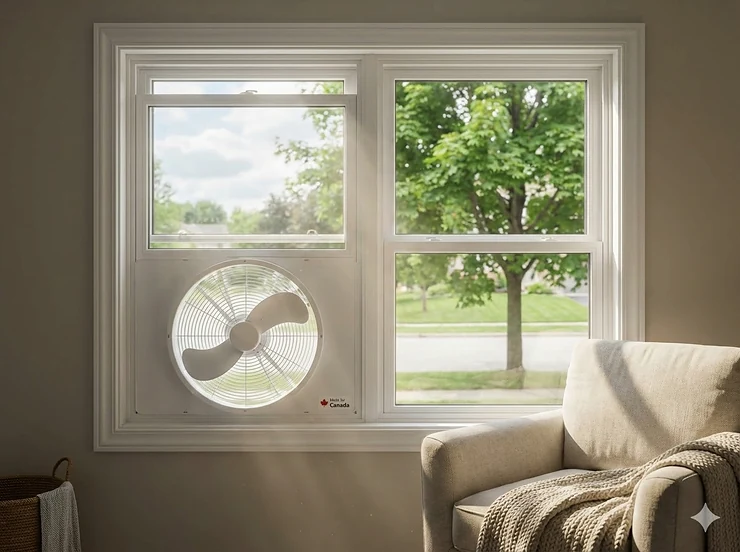
When summer heat hits Canadian cities from Vancouver to Toronto, you might think air conditioning is your only option. Think again! Window fans have quietly become one of the most cost-effective cooling solutions for Canadian homeowners, operating at just a fraction of the cost of traditional AC units while providing exceptional ventilation and temperature control.
A window fan Canada setup can maintain comfortable temperatures and ventilation in your home while running at a tiny fraction of the cost of central air conditioning. These versatile devices aren’t just about cooling—they’re about creating a healthier indoor environment by constantly exchanging stale indoor air with fresh outdoor breezes.
Canadian homeowners face unique challenges. Our diverse climate zones mean some regions experience intense summer heat while others deal with humid coastal conditions. Window fans address these challenges brilliantly by offering reversible airflow options, allowing you to pull in cool evening air or exhaust hot, stuffy air accumulated during the day. Whether you’re in a high-rise condo in Montreal or a bungalow in Calgary, there’s a window fan solution perfectly suited to your needs.
Quick Comparison Table: Top Window Fans Available in Canada
| Product | Fan Type | Key Features | Price Range (CAD) | Best For |
|---|---|---|---|---|
| Vornado TRANSOM | Single Chamber | 4 speeds, remote, electronically reversible | $130-$155 | Premium performance |
| Comfort Zone CZ310R | Twin 9″ | 3 speeds, reversible, manual control | $40-$45 | Budget-friendly |
| Holmes Dual Blade | Twin Digital | Programmable thermostat, 2 speeds | $60-$85 | Smart automation |
| shinic Window Fan | Twin 9″ | Remote control, 3 modes, expandable | $100-$110 | Mid-range versatility |
| Air King 9166 | Single 20″ | Storm Guard, 3 speeds, powerful motor | $145-$165 | Whole-house cooling |
| Bionaire BW2300-N | Twin 8.5″ | Remote, reversible, thermostat | $95-$120 | Quiet operation |
| Comfort Zone 9-Inch | Twin | WiFi enabled, app control, 3 speeds | $95-$105 | Smart home integration |
💬 Just one click – help others make better buying decisions too! 😊
Top 7 Window Fan Canada Options: Expert Analysis
1. Vornado TRANSOM Window Fan – Premium Low-Profile Design
The Vornado TRANSOM represents a complete reimagining of what a window fan for cooling should deliver. Unlike traditional models, this electronically reversible window fan maintains a sleek, low-profile design at just 7.16″ tall while delivering powerful whole-room airflow.
Key Specifications:
- 4 speed settings with auto temperature control
- Fits windows 26″-40″ wide (66-102 cm)
- Weather-resistant case for Canadian climates
- 8-foot power cord for installation flexibility
Price: $130-$155 CAD on Amazon.ca
Canadian Customer Feedback: Canadian buyers consistently praise the TRANSOM’s quiet operation and premium build quality. One Toronto reviewer noted it “transformed our bedroom from a sauna into a comfortable sleeping space without the AC bill shock.”
✅ Pros:
- Exceptionally quiet operation (perfect for bedrooms)
- Electronically reversible—switch intake/exhaust with one button
- Low-profile preserves window view
- Weather-resistant for variable Canadian conditions
❌ Cons:
- Higher price point than basic models
- Requires specific window dimensions (horizontal only)
2. Comfort Zone CZ310R Twin Window Fan – Best Budget Option
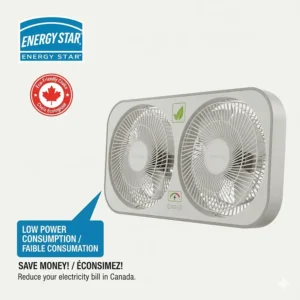
For Canadians seeking affordable yet effective ventilation, the Comfort Zone CZ310R delivers remarkable value. This reversible twin window fan twin design brings professional-grade features to an entry-level price point.
Key Specifications:
- Dual 9″ blade configuration
- 3-speed manual control
- Removable screen and cover included
- Expandable panels for custom window fit
Price: $40-$45 CAD on Amazon.ca
Canadian Customer Feedback: With over 48 verified Canadian purchases last month, buyers appreciate the straightforward operation and energy savings. A Vancouver customer reported, “Cut our summer electricity bill by nearly 40% compared to running AC.”
✅ Pros:
- Exceptional value for money
- Simple, reliable manual controls
- Removable screen prevents bugs and debris
- Covers included for when fan isn’t in use
❌ Cons:
- No remote control or automation
- Basic thermostat functionality
3. Holmes Dual Blade Digital Window Fan – Smart Thermostat Control
The Holmes Dual Blade brings intelligent automation to window cooling with its programmable digital thermostat. This exhaust intake window fan twin setup automatically maintains your desired temperature.
Key Specifications:
- Programmable thermostat with LED display
- Dual 3-blade fans for enhanced airflow
- 2 speed settings (optimized for efficiency)
- Water-resistant motors for rainy conditions
Price: $60-$85 CAD on Amazon.ca
Canadian Customer Feedback: Canadian reviewers love the set-and-forget convenience. An Edmonton homeowner shared, “The thermostat feature is brilliant—it kicks on when needed and shuts off automatically. Perfect for our unpredictable prairie weather.”
✅ Pros:
- Automatic temperature maintenance
- Water-resistant motors (ideal for coastal regions)
- Additional extender panels for larger windows
- Easy-to-read LED screen
❌ Cons:
- Only 2 speed options
- Digital display may be too bright for some bedrooms
4. shinic Window Fan with Remote Control – Versatile Mid-Range Choice
The shinic Window Fan offers an impressive balance of features and affordability. This window fan with remote control provides three distinct ventilation patterns to suit any Canadian home’s needs.
Key Specifications:
- Twin 9″ blades with full remote operation
- 3 modes: Cool, Exhaust, Circulate
- Adjustable width (23.5″-37″ / 60-94 cm)
- ETL certified for Canadian safety standards
Price: $100-$110 CAD on Amazon.ca
Canadian Customer Feedback: The versatility impresses Canadian buyers across climate zones. A Halifax resident noted, “The three modes are genuinely useful—cool mode for hot afternoons, exhaust for cooking odours, and circulate for fall evenings.”
✅ Pros:
- Full remote control convenience
- Three distinct operational modes
- Wide adjustability fits most Canadian windows
- Quiet operation on low speed
❌ Cons:
- Mid-range price without premium features
- Remote requires line-of-sight
5. Air King 9166 20-Inch Whole House Window Fan – Maximum Power
For serious whole-house ventilation, the Air King 9166 delivers industrial-grade performance in a residential package. This energy efficient window fan moves massive air volumes while maintaining reasonable power consumption.
Key Specifications:
- Powerful 20-inch (51 cm) blade
- Storm Guard feature for inclement weather
- 3-speed permanent split capacitor motor
- Impact-resistant plastic housing
Price: $145-$165 CAD on Amazon.ca
Canadian Customer Feedback: The Storm Guard feature enables the window to be closed behind the fan during inclement weather, or when securing the home—a feature Canadian buyers particularly value during sudden summer storms.
✅ Pros:
- Exceptional airflow for whole-house cooling
- Storm Guard protection (uniquely valuable in Canada)
- Durable construction
- OSHA and ETL compliant
❌ Cons:
- Larger footprint requires bigger windows
- Higher noise level at maximum speed
6. Bionaire BW2300-N Twin Reversible – Premium Quiet Operation
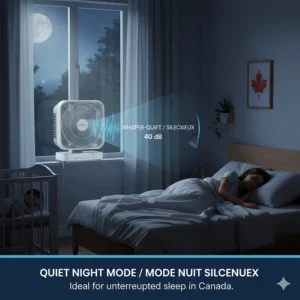
The Bionaire BW2300-N focuses on whisper-quiet performance without sacrificing cooling power. This window fan for ventilation excels in bedrooms and home offices where noise control matters.
Key Specifications:
- Twin 8.5″ reversible blades
- 3-speed settings with remote control
- Thermostat with memory function
- Fits windows 24.25″-36″ (62-91 cm)
Price: $95-$120 CAD on Amazon.ca
Canadian Customer Feedback: Canadian customers consistently rate this model highly for bedroom use. A Winnipeg buyer mentioned, “So quiet on low speed, we forget it’s running. Perfect for our master bedroom during those muggy July nights.”
✅ Pros:
- Exceptionally quiet low-speed operation
- Thermostat remembers previous settings
- Remote control for bedside convenience
- Compact 13″ overall height
❌ Cons:
- Thermostat resets if unplugged
- Smaller blade size than some competitors
7. Comfort Zone 9-Inch WiFi Window Fan – Smart Home Ready
The Comfort Zone 9-Inch WiFi model brings your window fan into the smart home era. Control this reversible window fan twin setup from anywhere using the Comfort Zone app or voice assistants.
Key Specifications:
- WiFi connectivity with app control
- Compatible with Alexa and Google Assistant
- 3 modes: Cool, Exhaust, Circulate
- Auto-locking expanders for secure fit
Price: $95-$105 CAD on Amazon.ca
Canadian Customer Feedback: Tech-savvy Canadians appreciate the convenience. A Toronto condo owner shared, “I can turn it on from work when I see hot weather coming. The apartment is cool by the time I get home.”
✅ Pros:
- Complete smart home integration
- Remote operation from anywhere via app
- Voice control capability
- Removable fabric cover and bug screen
❌ Cons:
- Requires stable WiFi connection
- Initial app setup can be finicky
✨ Don’t Miss These Exclusive Deals!
🔍 Take your home cooling to the next level with these carefully selected window fans available in Canada. Click on any highlighted item to check current pricing and availability on Amazon.ca. These energy-efficient solutions will help you create comfortable, fresh indoor environments your family will love!
Understanding Window Fan Technology: How They Work
Window fans are designed to fit into open windows, and often have expandable side panels to cover the entire window opening. The magic lies in their ability to create powerful air exchange between your indoor and outdoor spaces.
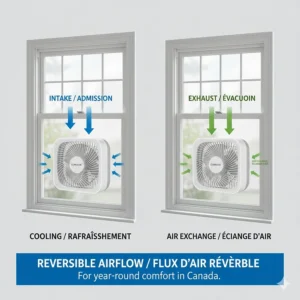
Modern window fans operate on a simple yet effective principle: they either draw fresh outdoor air inside (intake mode) or push stale indoor air outside (exhaust mode). The most advanced models, like the reversible window fan twin configurations, can do both simultaneously—one blade pulling fresh air in while the other exhausts hot air out.
The Science of Airflow Direction
Here’s where strategic thinking comes in. During hot Canadian summer afternoons when outdoor temperatures peak, you want your fan facing outward to exhaust the accumulated heat. Window fans are most effective at exhausting hot air from your home, so in general, the best time to use them is when the air indoors is hotter or less comfortable than the air outside.
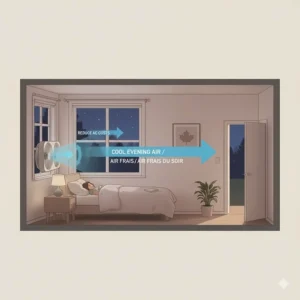
However, once the sun sets and evening temperatures drop—which happens reliably across most Canadian regions—flip your fan to intake mode. This strategy pulls in that beautiful cool evening air that makes our northern summers so pleasant.
Energy Efficiency Considerations
An ENERGY STAR certified ventilating fan uses 70% less energy, on average, than a standard model. While window fans aren’t always ENERGY STAR rated (as they fall into a different regulatory category in Canada), the principle holds: choosing an energy efficient window fan with optimized blade design and high-performance motors dramatically reduces your cooling costs.
According to Natural Resources Canada’s Office of Energy Efficiency, setting your thermostat two degrees higher and using ceiling fans to circulate cool air can reduce your air conditioning costs by 14 percent. Window fans amplify this effect by completely replacing AC for much of the summer season.
Types of Window Fans Available in Canada
Twin Blade vs. Single Chamber Designs
Twin Blade Fans like the Comfort Zone CZ310R and shinic models feature two independent fans mounted side-by-side. Each can operate in different modes simultaneously—genius for creating cross-ventilation. One Canadian homeowner in Ottawa uses one blade for intake on the shaded north side while the other exhausts hot air from the sunny south exposure.
Single Chamber Fans like the Vornado TRANSOM use one unified air chamber with reversible capability. They’re typically more powerful per square inch and maintain a lower profile, preserving your window view.
Manual vs. Electronically Reversible Models
Manual reversible fans require you to physically turn the unit around to switch between intake and exhaust. They’re simple, reliable, and budget-friendly.
Electronically reversible models like the Holmes Dual Blade switch modes at the touch of a button. This convenience proves invaluable during those transitional spring and fall months when you might switch modes multiple times daily.
With vs. Without Remote Control
A window fan with remote control transforms your cooling strategy. Imagine adjusting fan speed from bed without getting up, or switching modes while cooking dinner. Models like the Bionaire BW2300-N and shinic window fan include remotes, while the Comfort Zone WiFi model takes it further with smartphone app control.
For tech enthusiasts, the WiFi-enabled options integrate seamlessly with Canadian smart home ecosystems, letting you create automated schedules based on temperature thresholds.

How to Choose the Right Window Fan for Canadian Homes
1. Measure Your Window Openings Carefully
Canadian windows vary significantly. Older homes might have unique dimensions, while newer condos often feature standardized sizes. Measure both width and height:
- Width: Most fans adjust from 24″-40″ (61-102 cm)
- Minimum Height: Typically 8″-13″ (20-33 cm)
- Window Type: Double-hung, slider, or casement
The Air King 9166 requires a larger opening but delivers unmatched power. Smaller spaces work perfectly with compact models like the Comfort Zone CZ310R.
2. Consider Your Climate Zone
Prairie Provinces (AB, SK, MB): You need fans that handle dramatic temperature swings. Look for models with programmable thermostats like the Holmes Dual Blade that automatically adjust to changing conditions.
Coastal Regions (BC, NS, NB): Humidity control matters here. The Air King and Vornado TRANSOM with their weather-resistant construction excel in moisture-prone environments.
Central Canada (ON, QC): You’ll face both scenarios. Versatile models with multiple modes like the shinic window fan provide year-round utility.
Northern Regions: Energy efficiency takes priority. Focus on fans with optimized motors and multiple speed settings to minimize power consumption during long summer days.
3. Noise Level Considerations
Bedroom installations demand whisper-quiet operation. The Bionaire BW2300-N and Vornado TRANSOM consistently receive top marks for quiet performance. Living spaces can tolerate moderate noise levels, making the powerful Air King 9166 acceptable despite higher decibel output.
4. Budget Planning
Budget-Friendly ($40-$60 CAD): The Comfort Zone CZ310R delivers exceptional value with core features.
Mid-Range ($85-$120 CAD): Models like the Holmes Dual Blade and shinic window fan add automation and convenience.
Premium ($130-$165 CAD): The Vornado TRANSOM and Air King 9166 justify higher prices with superior performance and durability.
5. Feature Prioritization
Must-Have Features:
- Reversible airflow (intake and exhaust capability)
- Multiple speed settings
- Expandable panels for secure window fit
- Bug screen inclusion
Nice-to-Have Features:
- Remote control operation
- Programmable thermostat
- WiFi connectivity and app control
- Weather-resistant construction
- LED display with dimmer
Installation Tips for Canadian Homeowners
Installing a window fan properly ensures optimal performance and energy efficiency. Here’s how to do it right:
Pre-Installation Checklist
✅ Clean window tracks and frames thoroughly
✅ Ensure window opens and closes smoothly
✅ Check electrical outlet proximity (most fans have 6-8 foot cords)
✅ Remove existing window screens if necessary
✅ Verify window dimensions match fan specifications
Step-by-Step Installation
Step 1: Position the fan in the window opening. Most models rest on the window sill.
Step 2: Extend the expandable side panels until they reach the window frame edges. The shinic and Comfort Zone models feature accordion-style extenders that adjust from 24″-37″ (61-94 cm).
Step 3: Lower the window sash onto the top of the fan unit, creating a secure seal. Close the window holding the fan as tightly as possible to prevent local circulation.
Step 4: Use any included slider-safe extender panels for vertical slider windows. These provide additional stability and prevent gaps.
Step 5: Plug in and test all functions before finalizing installation.
Canadian-Specific Considerations
Security: Window fans create a potential security vulnerability. Consider installing auxiliary locks on windows with fans, especially ground-floor installations.
Seasonal Storage: Canadian winters mean storing your fan for months. Keep original packaging for dust-free storage, or use large plastic bags. Store in a dry location to prevent motor corrosion.
Multi-Level Homes: Install exhaust fans on upper floors where hot air naturally accumulates, and intake fans on lower, cooler levels for optimal whole-house circulation.
Energy Savings: The True Cost of Window Fans in Canada
Let’s talk numbers that matter to Canadian household budgets.
Operating Costs Comparison
Window Fan:
- Average power consumption: 50-100 watts
- Running 8 hours/day for 90 summer days
- At $0.12/kWh (average Canadian rate): $4.32-$8.64 per summer
Portable Air Conditioner:
- Average power consumption: 1,000-1,500 watts
- Same 720 hours of operation
- At $0.12/kWh: $86.40-$129.60 per summer
Central Air Conditioning:
- Average power consumption: 3,000-5,000 watts
- Same usage pattern
- At $0.12/kWh: $259.20-$432.00 per summer
The math is compelling. A window fan for cooling costs roughly 95% less to operate than portable AC and 98% less than central air conditioning.
GST/HST Considerations
Remember to factor in Canadian sales tax when budgeting for your purchase. Rates vary by province:
- Most provinces: 13-15% HST
- Alberta: 5% GST only
- Saskatchewan, Manitoba: 5% GST + 6-7% PST
A $100 window fan might cost $105 in Alberta but $113-$115 in Ontario or Nova Scotia.
Long-Term Value
Quality window fans like the Vornado TRANSOM or Air King 9166 typically last 5-10 years with proper maintenance. Even at premium prices, they pay for themselves in a single summer compared to AC costs.
Maintenance and Care Tips for Canadian Climate
Canadian temperature extremes demand proper fan maintenance for longevity.
Monthly Cleaning (During Use Season)
Blade Cleaning: Unplug the fan first. Use a damp cloth to wipe dust from blades. For stubborn buildup, use a soft brush attachment on your vacuum.
Screen Maintenance: Remove and rinse bug screens monthly. Let dry completely before reinstalling.
Frame Inspection: Check expandable panels for cracks or damage, especially after windstorms.
Seasonal Deep Cleaning (Spring/Fall)
Before storing or deploying your fan, perform a thorough cleaning:
- Remove all panels and screens
- Vacuum internal components carefully
- Wipe housing with mild soap solution
- Dry completely (crucial in Canadian humidity)
- Apply silicone spray to moving parts sparingly
Weather Precautions
Don’t operate window fans in heavy rains or poor weather. If your window fan gets wet, allow it to dry completely before plugging it back in again.
Canadian prairie thunderstorms can appear suddenly. Consider fans with weather-resistant construction like the Vornado TRANSOM or models with built-in covers for unexpected rain.
Winter Storage Protocol
Step 1: Clean thoroughly and ensure complete dryness
Step 2: Wrap in original packaging or plastic bags
Step 3: Store in temperature-controlled space (avoid unheated garages in prairie provinces where -40°C temperatures can damage plastic components)
Step 4: Keep remote controls with batteries removed to prevent corrosion
Troubleshooting Common Issues
Fan Won’t Turn On
Check: Power outlet functionality using another device
Check: Circuit breaker hasn’t tripped
Check: Fan is fully plugged in (vibration can loosen connections)
Solution: Reset any built-in thermostats that may have shut off the fan
Excessive Noise or Vibration
Cause: Improper installation or loose window fit
Solution: Tighten window sash, adjust expandable panels, ensure fan sits level
Cause: Blade obstruction or damage
Solution: Inspect blades for debris, cracks, or warping
Weak Airflow
Cause: Dirty or clogged blades and screens
Solution: Clean thoroughly following maintenance guidelines
Cause: Operating at low speed
Solution: Increase speed setting (obvious but commonly overlooked!)
Thermostat Not Working
Cause: Incorrect temperature setting
Solution: Review manual for proper programming on models like
Holmes Dual Blade Cause: Sensor obstruction
Solution: Ensure nothing blocks the temperature sensor
Remote Control Issues
Cause: Dead batteries (replace annually)
Cause: Line-of-sight obstruction
Solution: Point remote directly at receiver, remove curtains or blinds blocking signal
Comparing Window Fans vs. Other Cooling Options
| Feature | Window Fan | Portable AC | Central AC |
|---|---|---|---|
| Initial Cost | $40-$165 CAD | $300-$800 CAD | $3,000-$8,000+ CAD |
| Operating Cost (Summer) | $5-$10 CAD | $85-$130 CAD | $260-$430 CAD |
| Installation | 5 minutes | 15 minutes | Professional required |
| Effectiveness | Excellent (when outdoor temps lower) | Very good | Excellent |
| Noise Level | Low-moderate | Moderate-high | Low (indoor unit) |
| Energy Efficiency | Exceptional | Moderate | Good (modern units) |
| Portability | High | Moderate | None |
| Humidity Control | Increases ventilation | Reduces humidity | Reduces humidity |
| Best For | Moderate climates, budget-conscious | Specific room cooling | Whole-home climate control |
Best Practices for Maximizing Cooling Efficiency
Strategic Fan Placement
Upper-Level Homes: Place exhaust fans on upper floors where hot air collects. Install intake fans on ground level to draw in cooler air.
Single-Level Homes: Position exhaust fans on the warm side (typically south or west-facing windows), intake fans on shaded sides (north or east).
Apartment Living: Use one fan in the living room and one in the bedroom. Alternate intake/exhaust based on time of day.
Time-of-Day Operation
Morning (6 AM – 10 AM): Switch to intake mode to capture cool morning air before temperatures rise.
Afternoon (10 AM – 6 PM): Close windows and shades. Run fans on exhaust to remove accumulated heat. Consider turning fans off during peak heat if outdoor temperatures exceed indoor temps.
Evening (6 PM – Midnight): Full intake mode. This is when window fans shine brightest in Canada—pulling in that glorious cool evening air.
Overnight: Reduce speed for quieter operation while maintaining gentle air circulation.
Cross-Ventilation Techniques
Create an airflow path through your home. If you have two window fans, place one on exhaust mode and the other on intake mode on opposite sides of your living space. This creates a powerful air exchange that can cool your entire home in minutes.
Combining with Other Strategies
Pair your window fan for ventilation with these complementary tactics:
✅ Close blinds and curtains during peak sun exposure
✅ Use ceiling fans to distribute cool air throughout rooms
✅ Cook outdoors or use smaller appliances to reduce heat generation
✅ Plant trees or install awnings for natural shading (long-term strategy)
Safety Considerations for Canadian Use
Electrical Safety
Canadian homes use 110-120V electrical systems. All fans listed here meet Canadian electrical standards. However:
Never use extension cords with window fans—they draw consistent power and extension cords can overheat.
Keep cords away from water sources especially important in humid coastal regions.
Unplug during electrical storms to prevent power surge damage.
Child and Pet Safety
Blade Guards: All modern window fans include safety grilles preventing finger access. Ensure these remain securely attached.
Cord Management: Keep power cords out of reach. Consider cord clips or ties to prevent tripping hazards.
Stability: Properly installed fans shouldn’t wobble, but children should still be taught not to touch operating fans.
Fire Safety
While window fans themselves don’t pose fire risks, their placement matters:
Maintain clearance from curtains, blinds, and other flammable materials Don’t cover operating fans with clothing or towels Monitor older fans for unusual smells indicating motor issues
Security Considerations
Ground-floor window installations create potential entry points:
Use auxiliary window locks that allow the window to remain partially open but prevent full opening Consider fan models with rigid extender panels that provide additional security Remove fans when away for extended periods (vacations)

Environmental Impact: The Sustainable Choice
Choosing a window fan aligns with Canada’s climate commitments and environmental goals.
Carbon Footprint Reduction
In 2021, the building sector accounted for over 17% of national GHG emissions according to data from Natural Resources Canada’s Comprehensive Energy Use Database. Reducing AC use through window fan adoption directly addresses this challenge.
Per-Summer CO2 Reduction:
- Replacing 720 hours of AC with window fan operation saves approximately 250-400 kg of CO2 emissions annually (based on Canadian electricity grid averages)
- Over a 10-year fan lifespan: 2,500-4,000 kg CO2 saved
Resource Conservation
Window fans use minimal materials compared to AC units:
- No refrigerants (AC systems contain potent greenhouse gases)
- Simpler motors mean less rare earth metal consumption
- Plastic components increasingly sourced from recycled materials
- Longer lifespan with proper maintenance reduces landfill waste
Supporting Canadian Energy Goals
All ENERGY STAR certified products are tested to strict efficiency standards and are certified by an independent third party. While window fans aren’t typically ENERGY STAR rated, choosing energy efficient window fan models supports broader efficiency initiatives.
Regional Buying Guide: Where to Purchase in Canada
Amazon.ca – Best Overall Selection
All fans reviewed here are available on Amazon.ca with competitive pricing and reliable shipping across all provinces and territories. Prime members enjoy free shipping, typically within 2-5 business days to major urban centres.
Advantages:
- Comprehensive customer reviews from Canadian buyers
- Easy returns and warranty support
- Regular sales and Prime Day discounts
- CAD pricing (no currency conversion surprises)
Canadian Tire
For hands-on examination before purchase, Canadian Tire locations nationwide stock popular models like the Comfort Zone and Holmes fans seasonally (May-August).
Home Depot Canada & Lowe’s Canada
Both chains offer competitive pricing and knowledgeable staff who can discuss installation requirements specific to Canadian building codes.
Best Buy Canada
Focuses on premium models like the Vornado TRANSOM with in-store pickup options across Canada.
Warranty and Return Policies in Canada
Understanding your rights as a Canadian consumer ensures peace of mind with your purchase.
Standard Manufacturer Warranties
Most window fans include 1-year limited warranties covering manufacturing defects:
Vornado: Industry-leading warranty with responsive Canadian customer service Holmes/Bionaire: 1-year warranty, replacement rather than repair for defective units Comfort Zone: Standard 1-year coverage with straightforward claim process
Amazon.ca Return Policy
30-day return window for most items. Fans must be in original packaging with all components. Defective units qualify for free return shipping.
Extended Warranty Options
Consider extended protection for premium purchases:
- Best Buy offers extended warranty plans
- Credit card purchase protection (check your card benefits)
- Square Trade warranties available through Amazon.ca
Consumer Protection in Canada
Federal consumer protection laws ensure:
- Products must match descriptions
- Defects within reasonable timeframe qualify for remedy
- Provincial variations (Quebec has enhanced consumer protections)
❓ How do I know which direction my window fan should face in Canada?
❓ What is the average cost of running a window fan in Canada during summer?
❓ Can I use a window fan during rain in Canadian weather?
❓ Are window fans effective in humid climates like coastal British Columbia?
❓ Do window fans work with all types of Canadian window designs?
Conclusion: Finding Your Perfect Window Fan Canada Solution
Choosing the right window fan transforms your Canadian home’s comfort level while dramatically reducing energy costs. Whether you prioritize the budget-friendly simplicity of the Comfort Zone CZ310R, the smart automation of the Holmes Dual Blade, or the premium performance of the Vornado TRANSOM, there’s a perfect option for your specific needs.
Remember these key takeaways:
🍁 Climate Matters: Canadian regions require different features—coast dwellers need weather resistance, prairie residents benefit from thermostatic control
💰 ROI is Real: Window fans pay for themselves in a single summer compared to AC costs
🌟 Quality Counts: Investing in proven brands like Vornado, Holmes, and Air King ensures years of reliable service
🔄 Versatility Wins: Reversible window fan twin models offer maximum flexibility for changing conditions
The best time to invest in a window fan Canada solution is right now—before summer heat arrives and inventory tightens. Take advantage of early-season pricing on Amazon.ca, and prepare your home for comfortable, cost-effective cooling.
Your indoor environment deserves better than expensive, energy-hungry air conditioning. Make the switch to intelligent window fan cooling and join thousands of Canadian homeowners enjoying fresh air, lower bills, and sustainable comfort.
Recommended for You
- 7 Best Neck Fans Canada 2026: Ultimate Cooling Guide
- 7 Best Handheld Fan Canada 2026: Stay Cool Anywhere
- 7 Best Clip On Fan Canada 2026
Disclaimer: This article contains affiliate links to Amazon.ca. If you purchase products through these links, we may earn a small commission at no additional cost to you.
✨ Found this helpful? Share it with your friends! 💬🤗
